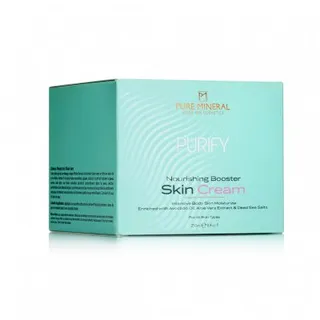
Pure Mineral Nourishing Booster Aloe Vera and Avocado Skin Cream

Pure Mineral Nourishing Booster Aloe Vera and Avocado Skin Cream

Efficacy75/100IrritancyHigh

Works for

Moisturizing
Panthenol, Isopropyl myristate + 16 more
Works well
What the product description says
“Nourishing Booster Aloe Vera and Avocado Skin Cream”
From product name

This product can help improve hydration of the skin with the two types of ingredients.

The first type is called “humectants”:
these ingredients help attract water. When humectants are on the surface of the skin, they “pull in” the moisture from the outside environment, or from within deeper layers of the skin. The following ingredients in this product do the job: panthenol, honey.

This product also contains ingredients called “occlusives”. They help reduce the speed with which our skin loses moisture to the outside environment. These ingredients also help soften the upper layer of the skin, so it feels less tight and nicer to the touch. The following ingredients in this product do the job: cocos nucifera oil, dimethicone.

The following ingredients in this product are especially good for supporting the skin barrier and helping with the hydration level: panthenol

PanthenolHeroEffect: HighHelps attract water to the upper layer of the skin and can help improve skin barrier function~0.2–0.4%
Isopropyl myristateKey activeEffect: HighAn emollient that helps soften the skin. Could be comedogenic~4.1–5%
Glyceryl stearate seKey activeEffect: MediumUsed to stabilize the product formulations and works as an emollient~2.8–3.4%
Cetearyl alcoholKey activeEffect: MediumA non-drying alcohol. Works as an emollient. Helps water and oil mix together and creates a nice product texture~2.3–2.8%
Cetyl alcoholKey activeEffect: MediumA non-drying alcohol that works to soften the skin and stabilize product formulations helping oil and water mix together~1.5–1.8%
DimethiconeKey activeEffect: HighA silicone that helps to reduce water loss from the surface of the skin. Can temporarily "fill in" lines and wrinkles, absorb oil, and create a nice product finish~1–1.3%
Prunus amygdalus dulcis oilKey activeEffect: MediumAn emollient that softens the skin~0.45–0.7%
Cocos nucifera oilKey activeEffect: HighAn emollient. Found to be as effective as a moisturizer for dry skin as mineral oil. Could be comedogenic~0.3–0.6%
HoneyKey activeEffect: MediumHelps attract water to the skin and might have some anti-bacterial properties. Can be an allergen~0.25–0.4%
Olea europaea fruit oilKey activeEffect: MediumAn emollient that helps soften the skin but is not effective for restoring its barrier function. Might be helpful to calm down inflammation~0.25–0.45%
Borago officinalis seed oilKey activeEffect: HighA plant oil that is effective in reducing irritation in skin, restore the barrier function and support its hydration~0.2–0.35%
Hippophae rhamnoides oilKey activeEffect: HighA good emollient. Contains various ingredients including vitamins and fatty acids that could work in the skin to neutralize free radicals and minimize moisture loss - if enough of these compounds is able to penetrate the skin in an active form.~0.2–0.4%
Aloe barbadensis leaf juiceEffect: Low, below effective doseTraditionally used to treat sunburns, dermatitis and inflammation, but evidence for its effectiveness is lacking. The extract can contain humectants that help attract water into the skin~0.25–0.45%
Camellia sinensis leaf extractEffect: Low, below effective doseCan contain potent anti-oxidant compounds (abbreviated ECG, GCG, EGC, and EGCG) that might help protect the skin from free radicals. Can help calm down inflammation and has some anti-bacterial properties. Unfortunately, these antioxidants are unstable and lose their effectiveness very quickly in products. The concentration of the antioxidant compounds in the extract also tends to be low to be effective in topical formulation~0.2–0.35%
Persea gratissima oilUnder-dosedAn emollient that helps soften the skin and could be helpful in repairing its barrier function~0.45–0.7%
Simmondsia chinensis seed oilUnder-dosedSoftens the upper layer of skin and helps restore the healthy skin barrier. Has shown to help calm down inflammation in skin. It is a stable oil, meaning that it retains its properties even when exposed to air.~0.4–0.6%
Argania spinosa kernel oilUnder-dosedAn emollient that helps soften the upper layer of the skin. Might have some weak anti-oxidant properties~0.3–0.6%
Butyrospermum parkii butterUnder-dosedA great moisturising ingredient that softens the skin and reduces water loss from its upper layer. It also can be helpful in protecting skin from free radicals~0.3–0.5%
Anti-aging
Prunus amygdalus dulcis oil, Butyrospermum parkii butter + 4 more
Not delivered
What the product description says
“The natural oils penetrate deep into dry, parched skin where wrinkles start.”
Source: Feelunique

This product does not contain ingredients that are able to reduce fine lines and wrinkles or help with skin elasticity, but it can improve the look of the skin temporarily through moisturization. Well-moisturized skin might also be able to repair the sun damage better.

This ingredient punica granatum extract might be able to help neutralize free radicals in skin and help it fight off some of the sun damage.

Prunus amygdalus dulcis oilEffect: LowAn emollient that softens the skin~0.45–0.7%
Butyrospermum parkii butterEffect: Low, below effective doseA great moisturising ingredient that softens the skin and reduces water loss from its upper layer. It also can be helpful in protecting skin from free radicals~0.3–0.5%
Aloe barbadensis leaf juiceEffect: Low, below effective doseTraditionally used to treat sunburns, dermatitis and inflammation, but evidence for its effectiveness is lacking. The extract can contain humectants that help attract water into the skin~0.25–0.45%
Camellia sinensis leaf extractEffect: Low, below effective doseCan contain potent anti-oxidant compounds (abbreviated ECG, GCG, EGC, and EGCG) that might help protect the skin from free radicals. Can help calm down inflammation and has some anti-bacterial properties. Unfortunately, these antioxidants are unstable and lose their effectiveness very quickly in products. The concentration of the antioxidant compounds in the extract also tends to be low to be effective in topical formulation~0.2–0.35%
Ascorbic acidUnder-dosedThe most well-researched antioxidant that works in skin. Helps neutralize free radicals supporting collagen production, helping to even out the skin tone and preventing early signs of aging~0.2–0.4%
Retinyl palmitateUnder-dosedThree steps removed from the active form of vitamin A - retinoic acid. To have an effect in the skin, it first needs to be converted twice to become the retinoic acid. This means it is less potent than retinol, but could also be less irritating. Once converted to the retinoic acid in the skin, it helps against all signs of aging, improves skin cell turnover and helps fight blemishes and clogged pores. However, in many cosmetic formulations, it is used in a concentration that is too low to have the full effect~0.2–0.4%
Anti-oxidation
Not advertised by the brand · Punica granatum extract, Prunus amygdalus dulcis oil + 9 more
May help

This product contains antioxidants (punica granatum extract) that might be able to help neutralize free radicals in skin to lessen the damage it gets from the UV light (sun). There is not enough evidence to confirm their effectiveness in skin though.

Punica granatum extractKey activeEffect: MediumA plant extract that can help neutralize free radicals in skin and even out the skin tone, but is typically used in products in a concentration that is too low to be effective~0.2–0.35%
Prunus amygdalus dulcis oilEffect: LowAn emollient that softens the skin~0.45–0.7%
Daucus carota sativa seed oilEffect: LowA plant oil that might help neutralize free radicals and have an anti-bacterial effect~0.25–0.5%
Borago officinalis seed oilEffect: LowA plant oil that is effective in reducing irritation in skin, restore the barrier function and support its hydration~0.2–0.35%
Hippophae rhamnoides oilEffect: LowA good emollient. Contains various ingredients including vitamins and fatty acids that could work in the skin to neutralize free radicals and minimize moisture loss - if enough of these compounds is able to penetrate the skin in an active form.~0.2–0.4%
Calendula officinalis flower oilEffect: LowA plant oil that might have an antibacterial and some antioxidant effect. Is a common allergen and irritant~0.1–0.2%
Tocopheryl acetateEffect: Low, below effective doseA more stable but less bio-available form of vitamin E compared to Tocopherol. Might help moisturize and protect the skin from free radicals, but mostly used in low concentrations to stabilize other ingredients.~0.3–0.55%
Butyrospermum parkii butterEffect: Low, below effective doseA great moisturising ingredient that softens the skin and reduces water loss from its upper layer. It also can be helpful in protecting skin from free radicals~0.3–0.5%
Argania spinosa kernel oilEffect: Low, below effective doseAn emollient that helps soften the upper layer of the skin. Might have some weak anti-oxidant properties~0.3–0.6%
Ascorbic acidUnder-dosedThe most well-researched antioxidant that works in skin. Helps neutralize free radicals supporting collagen production, helping to even out the skin tone and preventing early signs of aging~0.2–0.4%
Camellia sinensis leaf extractUnder-dosedCan contain potent anti-oxidant compounds (abbreviated ECG, GCG, EGC, and EGCG) that might help protect the skin from free radicals. Can help calm down inflammation and has some anti-bacterial properties. Unfortunately, these antioxidants are unstable and lose their effectiveness very quickly in products. The concentration of the antioxidant compounds in the extract also tends to be low to be effective in topical formulation~0.2–0.35%

Can it cause trouble?

Irritancy
6 strong irritants: Parfum, Melaleuca alternifolia leaf oil + 4 more — patch-test recommended
High risk
We flagged 22 ingredients with irritancy potential. Severity depends on your sensitivity threshold; the table lists the worst offenders first.
IngredientFunctionIrritationEst. amount
Propylene glycolHelps oil and water mix together and can enhance the penetration of other ingredients into the skin. It can be irritatingHigh~3.9–4.8%est.
Sodium lauryl sulfateA cleansing agent (SLS). It can be irritatingHigh~2.2–2.7%est.
ParfumAn aromatic blend of unspecified and possibly irritating ingredientsHigh~0.5–0.75%est.
Anthemis nobilis flower extractA plant extract that one one hand, can contain compounds that can help calm down skin irritation, but, on the other hand, its other compounds (especially fragrant ones) can themselves be irritatingHigh~0.25–0.45%est.
Melaleuca alternifolia leaf oilAn essential oil that can be irritating. Has some anti-bacterial propertiesHigh~0.25–0.4%est.
Retinyl palmitateThree steps removed from the active form of vitamin A - retinoic acid. To have an effect in the skin, it first needs to be converted twice to become the retinoic acid. This means it is less potent than retinol, but could also be less irritating. Once converted to the retinoic acid in the skin, it helps against all signs of aging, improves skin cell turnover and helps fight blemishes and clogged pores. However, in many cosmetic formulations, it is used in a concentration that is too low to have the full effectHigh~0.2–0.4%est.
Ascorbic acidThe most well-researched antioxidant that works in skin. Helps neutralize free radicals supporting collagen production, helping to even out the skin tone and preventing early signs of agingHigh~0.2–0.4%est.
Hippophae rhamnoides oilA good emollient. Contains various ingredients including vitamins and fatty acids that could work in the skin to neutralize free radicals and minimize moisture loss - if enough of these compounds is able to penetrate the skin in an active form.High~0.2–0.4%est.
Calendula officinalis flower oilA plant oil that might have an antibacterial and some antioxidant effect. Is a common allergen and irritantHigh~0.1–0.2%est.
Lavandula angustifolia oilAn essential oil. Potential allergen and can be irritating. It has some anti-bacterial propertiesHigh~0.15–0.25%est.
Pogostemon cablin leaf oilUsed as a fragranceHigh~0.1–0.2%est.
Sodium cetearyl sulfateHelps water and oil mix together and works as a cleansing agentMedium~1.6–2%est.
EthylhexylglycerinA preservativeMedium~0.55–0.85%est.
Sorbitan tristearateHelps oil and water mix togetherMedium~0.45–0.65%est.
Persea gratissima oilAn emollient that helps soften the skin and could be helpful in repairing its barrier functionMedium~0.45–0.7%est.
Simmondsia chinensis seed oilSoftens the upper layer of skin and helps restore the healthy skin barrier. Has shown to help calm down inflammation in skin. It is a stable oil, meaning that it retains its properties even when exposed to air.Medium~0.4–0.6%est.
Argania spinosa kernel oilAn emollient that helps soften the upper layer of the skin. Might have some weak anti-oxidant propertiesMedium~0.3–0.6%est.
Tocopheryl acetateA more stable but less bio-available form of vitamin E compared to Tocopherol. Might help moisturize and protect the skin from free radicals, but mostly used in low concentrations to stabilize other ingredients.Medium~0.3–0.55%est.
Olea europaea fruit oilAn emollient that helps soften the skin but is not effective for restoring its barrier function. Might be helpful to calm down inflammationMedium~0.25–0.45%est.
Aloe barbadensis leaf juiceTraditionally used to treat sunburns, dermatitis and inflammation, but evidence for its effectiveness is lacking. The extract can contain humectants that help attract water into the skinMedium~0.25–0.45%est.
Potassium sorbateA preservativeMedium~0.2–0.4%est.
Punica granatum extractA plant extract that can help neutralize free radicals in skin and even out the skin tone, but is typically used in products in a concentration that is too low to be effectiveMedium~0.2–0.35%est.
Comedogenic
6 ingredients rated 2 or more on the 0–5 pore-clogging scale
6 flagged
These ingredients have a comedogenic rating of 2 or more on a 0–5 scale; the table shows each one's rating. In leave-on products they can clog pores in acne-prone skin.
IngredientFunctionRatingEst. amount
Isopropyl myristateAn emollient that helps soften the skin. Could be comedogenic3/5~4.1–5%est.
Sodium lauryl sulfateA cleansing agent (SLS). It can be irritating3/5~2.2–2.7%est.
Cocos nucifera oilAn emollient. Found to be as effective as a moisturizer for dry skin as mineral oil. Could be comedogenic3/5~0.3–0.6%est.
Butyrospermum parkii butterA great moisturising ingredient that softens the skin and reduces water loss from its upper layer. It also can be helpful in protecting skin from free radicals3/5~0.3–0.5%est.
Glyceryl stearate seUsed to stabilize the product formulations and works as an emollient2/5~2.8–3.4%est.
Cetearyl alcoholA non-drying alcohol. Works as an emollient. Helps water and oil mix together and creates a nice product texture2/5~2.3–2.8%est.

User reviews

Would you recommend?
No community reviews yet.

Be the first — your take helps the next person decide.

Ingredients

Filter by role to see what each ingredient is doing.

Water~45–55%
Formula
Irritation risk
Low

Plain old water

More about Water
Isopropyl myristate~4.1–5%
Key activeComedogenic 3/5
Irritation risk
Low
Comedogenicity
3/5
Works for
Moisturizing

An emollient that helps soften the skin. Could be comedogenic

More about Isopropyl myristate
Propylene glycol~3.9–4.8%
Irritant · high
Irritation risk
High
Works for
Moisturizing

Helps oil and water mix together and can enhance the penetration of other ingredients into the skin. It can be irritating

More about Propylene glycol
Glyceryl stearate se~2.8–3.4%
Key activeComedogenic 2/5
Irritation risk
Low
Comedogenicity
2/5
Works for
CleansingMoisturizing

Used to stabilize the product formulations and works as an emollient

More about Glyceryl stearate se
Cetearyl alcohol~2.3–2.8%
Key activeComedogenic 2/5
Irritation risk
Low
Comedogenicity
2/5
Works for
CleansingMoisturizing

A non-drying alcohol. Works as an emollient. Helps water and oil mix together and creates a nice product texture

More about Cetearyl alcohol
Sodium lauryl sulfate~2.2–2.7%
Comedogenic 3/5Irritant · high
Irritation risk
High
Comedogenicity
3/5
Works for
Cleansing

A cleansing agent (SLS). It can be irritating

More about Sodium lauryl sulfate
Sodium cetearyl sulfate~1.6–2%
Irritant · medium
Irritation risk
Medium
Works for
Cleansing

Helps water and oil mix together and works as a cleansing agent

More about Sodium cetearyl sulfate
Cetyl alcohol~1.5–1.8%
Key active
Irritation risk
Low
Works for
CleansingMoisturizing

A non-drying alcohol that works to soften the skin and stabilize product formulations helping oil and water mix together

More about Cetyl alcohol
Stearyl alcohol~1.3–1.5%
Formula
Irritation risk
Low
Works for
Cleansing

An emollient that helps soften the skin

More about Stearyl alcohol
Dimethicone~1–1.3%
Key active
Irritation risk
Low
Works for
MoisturizingMattifying

A silicone that helps to reduce water loss from the surface of the skin. Can temporarily "fill in" lines and wrinkles, absorb oil, and create a nice product finish

More about Dimethicone
Phenoxyethanol~0.65–1%
Formula
Irritation risk
Low

A preservative. It helps prevent bacterial growth in cosmetic products

More about Phenoxyethanol
Ethylhexylglycerin~0.55–0.85%
Irritant · medium
Irritation risk
Medium

A preservative

More about Ethylhexylglycerin
Parfum~0.5–0.75%
Irritant · high
Irritation risk
High

An aromatic blend of unspecified and possibly irritating ingredients

More about Parfum
Peg-40 stearate~0.5–0.75%
Formula
Irritation risk
Low
Works for
Cleansing

Helps oil and water mix together

More about Peg-40 stearate
Sorbitan tristearate~0.45–0.65%
Irritant · medium
Irritation risk
Medium
Works for
Cleansing

Helps oil and water mix together

More about Sorbitan tristearate
Prunus amygdalus dulcis oil~0.45–0.7%
Key active
Irritation risk
Low
Works for
MoisturizingAnti-oxidationAnti-aging

An emollient that softens the skin

More about Prunus amygdalus dulcis oil
Persea gratissima oil~0.45–0.7%
Under-dosedIrritant · medium
Irritation risk
Medium
Works for
Moisturizing

An emollient that helps soften the skin and could be helpful in repairing its barrier function

More about Persea gratissima oil
Cocos nucifera oil~0.3–0.6%
Key activeComedogenic 3/5
Irritation risk
Low
Comedogenicity
3/5
Works for
Moisturizing

An emollient. Found to be as effective as a moisturizer for dry skin as mineral oil. Could be comedogenic

More about Cocos nucifera oil
Simmondsia chinensis seed oil~0.4–0.6%
Under-dosedIrritant · medium
Irritation risk
Medium
Works for
Moisturizing

Softens the upper layer of skin and helps restore the healthy skin barrier. Has shown to help calm down inflammation in skin. It is a stable oil, meaning that it retains its properties even when exposed to air.

More about Simmondsia chinensis seed oil
Argania spinosa kernel oil~0.3–0.6%
Under-dosedIrritant · medium
Irritation risk
Medium
Works for
MoisturizingAnti-oxidation

An emollient that helps soften the upper layer of the skin. Might have some weak anti-oxidant properties

More about Argania spinosa kernel oil
Tocopheryl acetate~0.3–0.55%
Irritant · medium
Irritation risk
Medium
Works for
Anti-oxidation

A more stable but less bio-available form of vitamin E compared to Tocopherol. Might help moisturize and protect the skin from free radicals, but mostly used in low concentrations to stabilize other ingredients.

More about Tocopheryl acetate
Anthemis nobilis flower extract~0.25–0.45%
Irritant · high
Irritation risk
High
Works for
Anti-inflammatoryReduces irritation

A plant extract that one one hand, can contain compounds that can help calm down skin irritation, but, on the other hand, its other compounds (especially fragrant ones) can themselves be irritating

More about Anthemis nobilis flower extract
Melaleuca alternifolia leaf oil~0.25–0.4%
Irritant · high
Irritation risk
High
Works for
Antibacterial

An essential oil that can be irritating. Has some anti-bacterial properties

More about Melaleuca alternifolia leaf oil
Maris
Not recognized
Silt~0.25–0.45%
Formula
Irritation risk
Low
More about Silt
Maris aqua~0.25–0.45%
Formula
Irritation risk
Low

Sea water. Helps dissolve other ingredients in a product

More about Maris aqua
Butyrospermum parkii butter~0.3–0.5%
Under-dosedComedogenic 3/5
Irritation risk
Low
Comedogenicity
3/5
Works for
MoisturizingAnti-agingAnti-oxidation

A great moisturising ingredient that softens the skin and reduces water loss from its upper layer. It also can be helpful in protecting skin from free radicals

More about Butyrospermum parkii butter
Olea europaea fruit oil~0.25–0.45%
Key activeIrritant · medium
Irritation risk
Medium
Works for
Moisturizing

An emollient that helps soften the skin but is not effective for restoring its barrier function. Might be helpful to calm down inflammation

More about Olea europaea fruit oil
Honey~0.25–0.4%
Key active
Irritation risk
Low
Works for
MoisturizingAntibacterial

Helps attract water to the skin and might have some anti-bacterial properties. Can be an allergen

More about Honey
Aloe barbadensis leaf juice~0.25–0.45%
Irritant · medium
Irritation risk
Medium
Works for
MoisturizingAntibacterialReduces irritationAnti-inflammatoryReduces rednessAnti-blemishAnti-aging

Traditionally used to treat sunburns, dermatitis and inflammation, but evidence for its effectiveness is lacking. The extract can contain humectants that help attract water into the skin

More about Aloe barbadensis leaf juice
Daucus carota sativa seed oil~0.25–0.5%
Formula
Irritation risk
Low
Works for
Anti-oxidationAntibacterial

A plant oil that might help neutralize free radicals and have an anti-bacterial effect

More about Daucus carota sativa seed oil
Retinyl palmitate~0.2–0.4%
Under-dosedIrritant · high
Irritation risk
High
Works for
Evens skin toneAnti-blemishAnti-agingExfoliation

Three steps removed from the active form of vitamin A - retinoic acid. To have an effect in the skin, it first needs to be converted twice to become the retinoic acid. This means it is less potent than retinol, but could also be less irritating. Once converted to the retinoic acid in the skin, it helps against all signs of aging, improves skin cell turnover and helps fight blemishes and clogged pores. However, in many cosmetic formulations, it is used in a concentration that is too low to have the full effect

More about Retinyl palmitate
Panthenol~0.2–0.4%
Hero · Moisturizing
Irritation risk
Low
Works for
Reduces rednessMoisturizingReduces irritation

Helps attract water to the upper layer of the skin and can help improve skin barrier function

More about Panthenol
Ascorbic acid~0.2–0.4%
Under-dosedIrritant · high
Irritation risk
High
Works for
Evens skin toneAnti-agingAnti-oxidation

The most well-researched antioxidant that works in skin. Helps neutralize free radicals supporting collagen production, helping to even out the skin tone and preventing early signs of aging

More about Ascorbic acid
Potassium sorbate~0.2–0.4%
Irritant · medium
Irritation risk
Medium

A preservative

More about Potassium sorbate
Punica granatum extract~0.2–0.35%
Key activeIrritant · medium
Irritation risk
Medium
Works for
Anti-oxidationEvens skin tone

A plant extract that can help neutralize free radicals in skin and even out the skin tone, but is typically used in products in a concentration that is too low to be effective

More about Punica granatum extract
Hippophae rhamnoides oil~0.2–0.4%
Key activeIrritant · high
Irritation risk
High
Works for
MoisturizingAnti-oxidation

A good emollient. Contains various ingredients including vitamins and fatty acids that could work in the skin to neutralize free radicals and minimize moisture loss - if enough of these compounds is able to penetrate the skin in an active form.

More about Hippophae rhamnoides oil
Camellia sinensis leaf extract~0.2–0.35%
Under-dosed
Irritation risk
Low
Works for
Anti-oxidationAntibacterialAnti-agingMoisturizingAnti-blemishEvens skin tone

Can contain potent anti-oxidant compounds (abbreviated ECG, GCG, EGC, and EGCG) that might help protect the skin from free radicals. Can help calm down inflammation and has some anti-bacterial properties. Unfortunately, these antioxidants are unstable and lose their effectiveness very quickly in products. The concentration of the antioxidant compounds in the extract also tends to be low to be effective in topical formulation

More about Camellia sinensis leaf extract
Dunaliella bardawil extract~0.15–0.3%
Formula
Calendula officinalis flower oil~0.1–0.2%
Irritant · high
Irritation risk
High
Works for
Anti-oxidationAnti-inflammatory

A plant oil that might have an antibacterial and some antioxidant effect. Is a common allergen and irritant

More about Calendula officinalis flower oil
Borago officinalis seed oil~0.2–0.35%
Key active
Irritation risk
Low
Works for
Anti-inflammatoryMoisturizingReduces irritationAnti-oxidation

A plant oil that is effective in reducing irritation in skin, restore the barrier function and support its hydration

More about Borago officinalis seed oil
Lavandula angustifolia oil~0.15–0.25%
Irritant · high
Irritation risk
High

An essential oil. Potential allergen and can be irritating. It has some anti-bacterial properties

More about Lavandula angustifolia oil
Pogostemon cablin leaf oil~0.1–0.2%
Irritant · high
Irritation risk
High

Used as a fragrance

More about Pogostemon cablin leaf oil
Ingredient list view

Water, Isopropyl myristate, Propylene glycol, Glyceryl stearate se, Cetearyl alcohol, Sodium lauryl sulfate, Sodium cetearyl sulfate, Cetyl alcohol, Stearyl alcohol, Dimethicone, Phenoxyethanol, Ethylhexylglycerin, Parfum, Peg-40 stearate, Sorbitan tristearate, Prunus amygdalus dulcis oil, Persea gratissima oil, Cocos nucifera oil, Simmondsia chinensis seed oil, Argania spinosa kernel oil, Tocopheryl acetate, Anthemis nobilis flower extract, Melaleuca alternifolia leaf oil, Unknown, Silt, Maris aqua, Butyrospermum parkii butter, Olea europaea fruit oil, Honey, Aloe barbadensis leaf juice, Daucus carota sativa seed oil, Retinyl palmitate, Panthenol, Ascorbic acid, Potassium sorbate, Punica granatum extract, Hippophae rhamnoides oil, Camellia sinensis leaf extract, Dunaliella bardawil extract, Calendula officinalis flower oil, Borago officinalis seed oil, Lavandula angustifolia oil, Pogostemon cablin leaf oil

Compare prices

Retailers ranked by price — lowest first.

No pricing data available yet for this product.

Worth comparing, line by line.

Match % combines shared ingredients, the first five ingredients, shared actives and hero ingredients, irritancy (lower counts in the alternative's favour), texture and body area. Only products in the same routine step are compared.

Side-by-side comparison of this product against its closest alternatives
Pure MineralNourishing Booster Aloe Vera and Avocado Skin CreamYOUR PRODUCTNovaclearHydro Night Cream - NovaclearBABORSkinovage Argan CreamDanne Montague-KingDMK Pro Amino Creme
Match—62%58%58%
Price—$21.37—$29.43
Shared key ingredients—6 of 135 of 135 of 13
Key difference—GlycerinNiacinamidePalmitoyl Tetrapeptide-7
Irritancy High Medium Medium Medium
Drying alcohol—— Contains drying alcohol —
View product Shop Shop Shop

More alternatives: Elizabeth Grant Caviar Cellular Recharge Super Day CreamEveline Cosmetics Bio Hyaluron Expert

Cheaper alternatives? Browse formulas in the same category.
We compare ingredient profiles across our catalog — pick the closest match for your budget.
Open dupe finder

Sources cited in this review

Every concentration estimate and effectiveness label is anchored to one of these 18 studies and safety reviews.

  1. 1
  2. 2
    Propylene Glycolpubmed.ncbi.nlm.nih.gov
  3. 3
  4. 4
  5. 5
  6. 6
Pure Mineral Nourishing Booster Aloe Vera and Avocado Skin Cream
Pure MineralNourishing Booster Aloe Vera and Avocado Skin Cream

Affiliate links · As an Amazon Associate, WIMJ earns from qualifying purchases.

As an Amazon Associate, WIMJ earns from qualifying purchases.