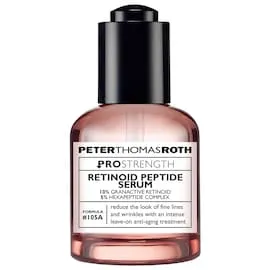
Peter Thomas Roth PRO Strength Retinoid Peptide Serum
Works for
Evens skin toneHydroxypinacolone retinoateWorks well
“Pores, Dryness, and Uneven Skin Tone”
This product can help reduce hypepigmentation and even out the skin tone because it contains the following effective ingredients: hydroxypinacolone retinoate.
Keep in mind that you would need to apply any topical skincare targetted at hypigmentation consistently for a couple of months to get a result. No topical skincare product can help get rid of hyperpigmentation (including post-acne marks and age spots) instantly.
MoisturizingPalmitoyl hexapeptide-14, Ceramide np + 19 moreWorks well
“Squalane, ceramide NP, and a super-lipid complex moisturise and help minimise the potential for irritation and dryness.”
This product can help improve hydration of the skin with the two types of ingredients.
The first type is called “humectants”:
these ingredients help attract water.
When humectants are on the surface of the skin, they “pull in” the moisture from the outside environment, or from
within deeper layers of the skin. The following ingredients in this product do the job:
sodium hyaluronate, sodium pca.
This product also contains ingredients called “occlusives”. They help reduce the speed with which our skin loses moisture to the outside environment. These ingredients also help soften the upper layer of the skin, so it feels less tight and nicer to the touch. The following ingredients in this product do the job: caprylic/capric triglyceride, dimethicone.
The following ingredients in this product are especially good for supporting the skin barrier and helping with the hydration level: ceramide np, palmitoyl hexapeptide-14
Anti-agingHydroxypinacolone retinoate, Palmitoyl hexapeptide-14 + 1 moreWorks well
“This serum works to reduce the look of fine lines and wrinkles.”
This product can help reduce and prevent fine lines and wrinkles, improve skin elasticity and firmness because it contains hydroxypinacolone retinoate.
These ingredients in the product can also be helpful, even though there is less evidence for their effectiveness: palmitoyl hexapeptide-14.
Keep in mind that it typically takes at least 6 weeks to notice any results because the changes that are needed to improve fine lines and elasticity happen in the deeper layers of the skin. No topical anti-aging product can “erase” wrinkles or fully reverse signs of aging.
Anti-blemishHydroxypinacolone retinoate, Linoleic acidWorks well
“Pores, Dryness, and Uneven Skin Tone”
This product can help reduce breakouts and clogged pores because it contains the following ingredient: hydroxypinacolone retinoate. This ingredient is used for treating acne and can have a noticeable effect.
Can it cause trouble?
Irritancy2 strong irritants: Hydroxypinacolone retinoate, Zingiber officinale root extractMedium risk
Comedogenic1 ingredient rated 2 or more on the 0–5 pore-clogging scale1 flagged
User reviews
Be the first — your take helps the next person decide.
Ingredients
Filter by role to see what each ingredient is doing.
C9-12 alkane~23–35%
Dimethicone~6.1–9.2%
- Irritation risk
- Low
A silicone that helps to reduce water loss from the surface of the skin. Can temporarily "fill in" lines and wrinkles, absorb oil, and create a nice product finish
More about DimethiconeIsononyl isononanoate~5.1–7.7%
- Irritation risk
- Low
Forms a protective film on the surface of the skin to prevent moisture loss. Gives a velvety feel to products while reducing tackiness
More about Isononyl isononanoateDimethyl isosorbide~3.7–5.5%
- Irritation risk
- Low
Used to dissolve other ingredients in a product and can enhance their ability to penetrate the skin
More about Dimethyl isosorbideTrisiloxane~2.7–4.1%
Cyclopentasiloxane~2.1–3.2%
- Irritation risk
- Low
A silicone that helps improve the product texture and spreadability. Can absorb oil creating a short-term mattifying effect on the skin
More about CyclopentasiloxanePolysilicone-11~1.7–2.5%
- Irritation risk
- Low
A silicone that forms a light film on the skin surface helping to bind water and temporarily absorb oils creating a matt and powdery feel
More about Polysilicone-11Coco-caprylate/caprate~1.3–2%
- Irritation risk
- Low
Helps to soften the upper layer of the skin without creating a greasy texture
More about Coco-caprylate/caprateCaprylic/capric triglyceride~1.3–1.9%
- Irritation risk
- Medium
A good mix of fatty acids that forms a protective layer on the skin. Improves the shelf life of products. Derived from coconut and glycerin
More about Caprylic/capric triglycerideHydroxypinacolone retinoate~0.2–0.75%
- Irritation risk
- High
A derivative of the most potent form of vitamin A, retinoic acid. The ingredient can be sold under name Granactive Retinoid. Note that if a skincare brand discloses the concentration of Granactive Retinoid in a product, the concentration refers to a diluted form of Hydroxypinacolone Retinoate: 1% of Granactive Retinoid corresponds to 0.1% of Hydroxypinacolone Retinoate. Hydroxypinacolone Retinoate (HPR) is a unique derivative of retinoic acid because it can directly work in the skin and does not require additional conversion steps. According to studies done by the manufacturer on models of human skin (not real people), this derivative is more effective than other cosmetic versions of retinoids (such as retinol, retinaldehyde, and retinyl palmitate), and, at the same time, causes less irritation. It has been also demonstrated to be more stable than retinol which makes formulating with easier and increases the chances that a product with it will maintain its effectiveness after opening. The packaging should still ideally be air-tight. HPR is available over the counter in the EU, UK, Asia, Australia and New Zealand, but is only with a prescription in Canada.
More about Hydroxypinacolone retinoatePalmitoyl hexapeptide-14~0.55–1.25%
Ceramide np~0.5–1.2%
- Irritation risk
- Low
A type of lipid similar to ceramides naturally present in skin. Helps to soften the upper layer of the skin and supports the skin barrier function to keep it hydrated. Can help to prevent inflammation in skin
More about Ceramide npHelianthus annuus seed extract~0.4–0.95%
- Irritation risk
- Low
Hordeum vulgare extract~0.45–1%
- Irritation risk
- Medium
A plant extract that might have some anti-oxidant properties. Avoid if you are sensitive to gluten
More about Hordeum vulgare extractCucumis sativus extract~0.35–0.8%
- Irritation risk
- Medium
Laminaria ochroleuca extract~0.35–0.8%
- Irritation risk
- Low
- Comedogenicity
- 3/5
Helps attract water to the upper layer of the skin
More about Laminaria ochroleuca extractZingiber officinale root extract~0.35–0.75%
- Irritation risk
- High
A plant extract that can contain an irritating essential oil. Might have some anti-oxidant effect, but evidence is lacking
More about Zingiber officinale root extractPhytosteryl canola glycerides~0.3–0.75%
- Irritation risk
- Low
Helps soften the upper layer of the skin
More about Phytosteryl canola glyceridesSodium hyaluronate~0.2–0.75%
- Irritation risk
- Low
One of the best moisturizing ingredients. Attracts water into the upper layer of the skin
More about Sodium hyaluronateSodium pca~0.2–0.7%
- Irritation risk
- Low
Naturally present in skin and helps to attract water to its upper layer
More about Sodium pcaSqualane~0.3–0.75%
- Irritation risk
- Low
An oil naturally present in skin. Works as an emollient to soften the skin and form a protective layer on its surface without a greasy feeling.
More about SqualaneTocopherol~0.2–0.7%
- Irritation risk
- Low
Pure form of vitamin E. Can help moisturise and protect the skin from free radicals. Often used to help stabilise other ingredients or the formula itself
More about TocopherolLecithin~0.3–0.75%
- Irritation risk
- Low
Used mostly for creating emulsions - helping oil and water mix together. Helps soften the upper layer of the skin
More about LecithinLinoleic acid~0.35–0.8%
- Irritation risk
- Low
An excellent emollient. Helps soften the skin, restore its barrier function, and can help to calm down inflammation. It can be helpful to prevent blemishes and clogged pores
More about Linoleic acidOleic acid~0.3–0.75%
- Irritation risk
- Medium
Helps soften the upper layer of the skin. At the same time, it can weaken the skin's barrier enhancing penetration of other ingredients and increasing the risk of skin dryness
More about Oleic acidPalmitic acid~0.3–0.7%
- Irritation risk
- Low
An emollient that is naturally present in skin and helps soften it
More about Palmitic acidStearic acid~0.35–0.85%
- Irritation risk
- Low
Helps oil and water mix together and works as an emollient
More about Stearic acidHydroxystearic acid~0.3–0.75%
Triolein~0.15–0.65%
Bisabolol~0.15–0.55%
- Irritation risk
- Low
An active component of chamomile plant that historically has been used to calm down irritated skin. A recent study shows that bisabolol indeed can have some anti-inflammatory effect on skin, even though conclusive data is lacking. Bisabolol has a sweet floral scent and can be added to products for its aromatic properties
More about BisabololEthylhexyl hydroxystearate~0.2–0.7%
- Irritation risk
- Low
Helps soften the upper layer of the skin and reduce water loss from it
More about Ethylhexyl hydroxystearateEthoxydiglycol~0.1–0.45%
Ethylhexylglycerin~0.1–0.45%
Water~0.1–0.4%
Mica~0.1–0.45%
- Irritation risk
- Low
Creates an illusion of smoother and more radiant skin tone. Adds shimmer to the skin by reflecting light
More about MicaPhenoxyethanol~0.1–0.4%
- Irritation risk
- Low
A preservative. It helps prevent bacterial growth in cosmetic products
More about PhenoxyethanolIngredient list view
C9-12 alkane, Dimethicone, Isononyl isononanoate, Dimethyl isosorbide, Trisiloxane, Cyclopentasiloxane, Polysilicone-11, Coco-caprylate/caprate, Caprylic/capric triglyceride, Hydroxypinacolone retinoate, Palmitoyl hexapeptide-14, Ceramide np, Helianthus annuus seed extract, Hordeum vulgare extract, Cucumis sativus extract, Laminaria ochroleuca extract, Zingiber officinale root extract, Phytosteryl canola glycerides, Sodium hyaluronate, Sodium pca, Squalane, Tocopherol, Lecithin, Linoleic acid, Oleic acid, Palmitic acid, Stearic acid, Hydroxystearic acid, Triolein, Bisabolol, Ethylhexyl hydroxystearate, Ethoxydiglycol, Ethylhexylglycerin, Water, Mica, Phenoxyethanol
Compare prices
Retailers ranked by price — lowest first.
Worth comparing, line by line.
Match % combines shared ingredients, the first five ingredients, shared actives and hero ingredients, irritancy (lower counts in the alternative's favour), texture and body area. Only products in the same routine step are compared.
| Peter Thomas RothPRO Strength Retinoid Peptide SerumYOUR PRODUCT | Beauty PieSuper Retinal Rejuvenating Serum | Dr. DeneseHemp Super Serum | CliniqueSmart Clinical Repair Wrinkle Correcting Serum | |
|---|---|---|---|---|
| Match | — | 72% | 69% | 64% |
| Price | — | $55.00 | — | $57.99 |
| Shared key ingredients | — | 7 of 16 | 8 of 16 | 5 of 16 |
| Key difference | — | Retinal | Tetrahexyldecyl Ascorbate | Ascorbyl Glucoside |
| Irritancy | Medium | Medium | Medium | Medium |
| Drying alcohol | — | — | — | — |
| View product | Shop | Shop | Shop |


More alternatives: Be Minimalist Granactive Retinoid 02%Lancer Skincare Younger Pure Youth Serum with MIMIXYL
Product summary
"Peter Thomas Roth - PRO Strength Retinoid Peptide Serum" is effective for: Evens skin tone, Moisturizing, Anti-aging and Anti-blemish
Ingredient callouts
- this product contains an effective form of Retinoids (vitamin A): hydroxypinacolone retinoate 0.20% - 0.75%. Retinoids are potent multitasking actives. They work to improve and prevent early signs of aging, reduce hyperpigmentation (age spots and post-acne marks), and prevent inflamed blemishes and clogged pores. The downside of Retinoids is that they can be irritating. If you are not already using a Retinoid in your routine, it is best to start slowly and apply the Retinoid product only a few times per week. If your skin tolerates it well, you can gradually increase the frequency to daily.
- Ceramides (ceramide np 0.50% - 1.20%). Ceramides are a type of lipids that our skin produces itself. They are a building block of the skin's barrier. Ceramides used in skincare are synthetic or extracted from plants. They work well for softening the skin surface and "patch holes" in the skin's barrier.
- Peptides (palmitoyl hexapeptide-14 0.55% - 1.25%). Peptides are a very big group of ingredients. They all consist of a different combination of aminoacids. Our skin produces Peptides naturally. Some of them work as natural antibiotics, promote wound-healing and production of collagen. The scientists are still studying how effective the topical application of Peptides is, but it is very likely that theynare helpful. Peptides might be able to support skin barrier restoration and even have an anti-aging benefit. At the very least, they certainly help attract water to the skin and support the hydration in this way.
- We love that there is also Linoleic Acid in this product (0.35% - 0.80%). Linoleic Acid is one of the skin's natural emollients. It supports the skin barrier and can even help reduce clogged pores.
- Humectants (sodium pca 0.20% - 0.70% and sodium hyaluronate 0.20% - 0.75%). These ingredients help attract water to the upper layer of the skin and improve the skin hydration.
Sources cited in this review
Every concentration estimate and effectiveness label is anchored to one of these 21 studies and safety reviews.
- 1
- 2Final Report on the Safety Assessment of Dimethicone Copolyoljournals.sagepub.com
- 3
- 4Safety Assessment of Alkyl Esters as Used in Cosmeticscir-safety.org
- 5
- 6

Affiliate links · As an Amazon Associate, WIMJ earns from qualifying purchases.