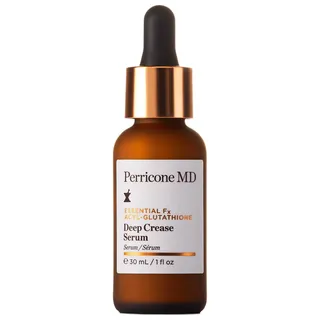
Perricone MD Essential Fx Acyl-Glutathione: Deep Crease Serum

Perricone MD Essential Fx Acyl-Glutathione: Deep Crease Serum

Efficacy87/100IrritancyHigh

Works for

Moisturizing
Acetyl hexapeptide-8, Squalane + 21 more
Works well
What the product description says
“Over time, these engraved imperfections appear shallower and expression lines appear erased, as the vitamin F blend works to replenish skin’s moisture barrier and protect it from environmental aggressors.”
Source: Perricone MD

This product can help improve hydration of the skin with the two types of ingredients.

The first type is called “humectants”:
these ingredients help attract water. When humectants are on the surface of the skin, they “pull in” the moisture from the outside environment, or from within deeper layers of the skin. The following ingredients in this product do the job: anhydroxylitol, glycine.

This product also contains ingredients called “occlusives”. They help reduce the speed with which our skin loses moisture to the outside environment. These ingredients also help soften the upper layer of the skin, so it feels less tight and nicer to the touch. The following ingredients in this product do the job: caprylic/capric triglyceride, dimethicone.

The following ingredients in this product are especially good for supporting the skin barrier and helping with the hydration level: acetyl hexapeptide-8

Acetyl hexapeptide-8Hero· HumectantEffect: HighA type of peptide. Peptides are excellent moisturizers and might be able support collagen production reducing fine lines and wrinkles~0.15–0.3%
SqualaneKey active· Emollient, OcclusiveEffect: HighAn oil naturally present in skin. Works as an emollient to soften the skin and form a protective layer on its surface without a greasy feeling.~4.1–5%
DimethiconeKey active· Emollient, OcclusiveEffect: HighA silicone that helps to reduce water loss from the surface of the skin. Can temporarily "fill in" lines and wrinkles, absorb oil, and create a nice product finish~2–2.5%
Macadamia ternifolia seed oilKey active· EmollientEffect: MediumPlant oil from nuts that helps soften the upper layer of the skin. Contains a high concentration of oleic acid that can weaken skin's barrier function and increase water-loss while enhancing penetration of other ingredients~1.7–2.1%
XylitylglucosideKey active· HumectantEffect: HighHelps attract water to the upper layer of the skin and repair the skin barrier function~1.5–1.8%
Caprylic/capric triglycerideKey active· Emollient, OcclusiveEffect: HighA good mix of fatty acids that forms a protective layer on the skin. Improves the shelf life of products. Derived from coconut and glycerin~1.1–1.3%
AnhydroxylitolKey active· HumectantEffect: HighHelps attract water to the upper layer of the skin and repair the skin barrir function~0.75–1.15%
Hydrolyzed rice proteinKey active· HumectantEffect: MediumHelps attract water to the upper layer of the skin. Might have some anti-oxidant properties~0.4–0.6%
Glycine soja oilKey active· EmollientEffect: HighA good emollient that helps soften the skin and helps repair its barrier function. It can clog pores if used in high concentrations.~0.35–0.6%
Salvia hispanica seed oilKey active· EmollientEffect: HighChia seed oil. Helps to soften the upper layer of the skin and might be helpful in repairing skin barrier~0.35–0.65%
Hydrolyzed sodium hyaluronateKey activeEffect: HighAttracts water into the upper layer of the skin~0.3–0.55%
Sodium hyaluronateKey active· HumectantEffect: HighOne of the best moisturizing ingredients. Attracts water into the upper layer of the skin~0.3–0.5%
GlycineKey active· HumectantEffect: HighHelps to attract water to the upper layer of the skin and can help restore the skin barrier function~0.3–0.6%
Magnesium aspartateKey activeEffect: MediumMight be helpful in restoring skin barrier function and calm down inflammation in skin~0.3–0.6%
ProlineKey activeEffect: Medium~0.3–0.55%
Hydrogenated polyisobutene· Emollient, OcclusiveEffect: LowUsed to improve the product consistency and soften the upper layer of the skin~3.2–3.9%
Caprylyl glycol· Humectant, EmollientEffect: LowHelps preserve products and creates a nice product texture~0.55–0.85%
Linum usitatissimum seed oilEffect: Low~0.3–0.55%
TocopherolEffect: Low, below effective dosePure form of vitamin E. Can help moisturise and protect the skin from free radicals. Often used to help stabilise other ingredients or the formula itself~0.35–0.6%
Lactic acidUnder-dosedAn exfoliating and moisturizing alpha-hydroxy acid (AHA). Typically causes less irritation than other AHAs, for example, glycolic acid. At high concentrations (about 15%), lactic acid can help reduce lines and wrinkles. Recent studies show that lactic acid can support the "good" bacteria living on skin's surface (healthy skin microbiome)~0.55–0.85%
Zinc gluconateUnder-dosedTypically used to stabilize the product formulations. It is a salt of a polyhydroxy acid (PHA) and in larger concentrations, can help shed the dead cells from the skin surface revealing smoother skin. It can help attract water to the upper layer of the skin. Might to be helpful against acne and clogged pores. Could be helpful in neutralizing free radicals, but solid research is missing. Due to the zinc content, might help calm down inflammation in skin~0.3–0.6%
Alaria esculenta extractUnder-dosedWorks as a humectant helping to attract water to the upper layer of the skin and might be effective as an anti-oxidant.~0.3–0.6%
Copper gluconateUnder-dosedTypically used to stabilize the product formulations. It is a salt of polyhydroxy acid (PHA) and in larger concentrations, can help shed the dead cells from the skin surface revealing smoother skin. It can help attract water to the upper layer of the skin. Might to be helpful against acne and clogged pores. Could be helpful in neutralizing free radicals, but solid research is missing~0.25–0.45%
Anti-aging
Acetyl hexapeptide-8, Tocopherol + 5 more
May help
What the product description says
“Softens the look of facial lines from daily repetitive movements.”
Source: Perricone MD

This product contains acetyl hexapeptide-8. This ingredient might be able to help reduce and prevent fine lines and wrinkles, improve skin elasticity and firmness, but there is not enough evidence that it actually works.

Acetyl hexapeptide-8Key activeEffect: MediumA type of peptide. Peptides are excellent moisturizers and might be able support collagen production reducing fine lines and wrinkles~0.15–0.3%
TocopherolEffect: Low, below effective dosePure form of vitamin E. Can help moisturise and protect the skin from free radicals. Often used to help stabilise other ingredients or the formula itself~0.35–0.6%
Zinc gluconateEffect: Low, below effective doseTypically used to stabilize the product formulations. It is a salt of a polyhydroxy acid (PHA) and in larger concentrations, can help shed the dead cells from the skin surface revealing smoother skin. It can help attract water to the upper layer of the skin. Might to be helpful against acne and clogged pores. Could be helpful in neutralizing free radicals, but solid research is missing. Due to the zinc content, might help calm down inflammation in skin~0.3–0.6%
Alaria esculenta extractEffect: Low, below effective doseWorks as a humectant helping to attract water to the upper layer of the skin and might be effective as an anti-oxidant.~0.3–0.6%
Copper gluconateEffect: Low, below effective doseTypically used to stabilize the product formulations. It is a salt of polyhydroxy acid (PHA) and in larger concentrations, can help shed the dead cells from the skin surface revealing smoother skin. It can help attract water to the upper layer of the skin. Might to be helpful against acne and clogged pores. Could be helpful in neutralizing free radicals, but solid research is missing~0.25–0.45%
Tetrahexyldecyl ascorbateUnder-dosedBeing a lipid soluble form of vitamin C, it is more stable than ascorbic acid, but still degrades quickly and needs to be stabilized in a formulation with another ingredient. It is claimed to penetrate skin better than pure vitamin C and have the the similar benefits, but solid studies of its effectiveness are lacking. Is likely to require a higher concentration in a product than pure vitamin C to be effective. It might be able to help reduce pore clogging.~1.2–1.4%
Lactic acidUnder-dosedAn exfoliating and moisturizing alpha-hydroxy acid (AHA). Typically causes less irritation than other AHAs, for example, glycolic acid. At high concentrations (about 15%), lactic acid can help reduce lines and wrinkles. Recent studies show that lactic acid can support the "good" bacteria living on skin's surface (healthy skin microbiome)~0.55–0.85%

Can it cause trouble?

Irritancy
5 strong irritants: Parfum, Citronellol + 3 more — patch-test recommended
High risk
We flagged 18 ingredients with irritancy potential. Severity depends on your sensitivity threshold; the table lists the worst offenders first.
IngredientFunctionIrritationEst. amount
ParfumAn aromatic blend of unspecified and possibly irritating ingredientsHigh~0.35–0.6%est.
Benzyl alcoholA preservative. Can be used to mask unpleasant smell. Can be irritatingHigh~0.25–0.45%est.
CitronellolA fragrance. Can be irritatingHigh~0.15–0.3%est.
HydroxycitronellalA fragrance. A likely allergen and can be irritatingHigh~0.15–0.25%est.
LimoneneA common frangrance that can easily irritate skin, especially if exposed to air, light or heatHigh~0.1–0.15%est.
LinaloolA fragrance. Can be irritatingHigh~0.1–0.15%est.
Macadamia ternifolia seed oilPlant oil from nuts that helps soften the upper layer of the skin. Contains a high concentration of oleic acid that can weaken skin's barrier function and increase water-loss while enhancing penetration of other ingredientsMedium~1.7–2.1%est.
Tetrahexyldecyl ascorbateBeing a lipid soluble form of vitamin C, it is more stable than ascorbic acid, but still degrades quickly and needs to be stabilized in a formulation with another ingredient. It is claimed to penetrate skin better than pure vitamin C and have the the similar benefits, but solid studies of its effectiveness are lacking. Is likely to require a higher concentration in a product than pure vitamin C to be effective. It might be able to help reduce pore clogging.Medium~1.2–1.4%est.
Caprylic/capric triglycerideA good mix of fatty acids that forms a protective layer on the skin. Improves the shelf life of products. Derived from coconut and glycerinMedium~1.1–1.3%est.
Lactic acidAn exfoliating and moisturizing alpha-hydroxy acid (AHA). Typically causes less irritation than other AHAs, for example, glycolic acid. At high concentrations (about 15%), lactic acid can help reduce lines and wrinkles. Recent studies show that lactic acid can support the "good" bacteria living on skin's surface (healthy skin microbiome)Medium~0.55–0.85%est.
Acrylates/c10-30 alkyl acrylate crosspolymerMaintains the texture of skincare products. Allows the product to spread evenly. Helps oil and water mix togetherMedium~0.55–0.85%est.
Caprylyl glycolHelps preserve products and creates a nice product textureMedium~0.55–0.85%est.
Caprylyl/capryl glucosideHelps oil and water mix together. Can be used as a cleansing agentMedium~0.6–0.95%est.
EthylhexylglycerinA preservativeMedium~0.35–0.6%est.
Glycine soja oilA good emollient that helps soften the skin and helps repair its barrier function. It can clog pores if used in high concentrations.Medium~0.35–0.6%est.
Zinc gluconateTypically used to stabilize the product formulations. It is a salt of a polyhydroxy acid (PHA) and in larger concentrations, can help shed the dead cells from the skin surface revealing smoother skin. It can help attract water to the upper layer of the skin. Might to be helpful against acne and clogged pores. Could be helpful in neutralizing free radicals, but solid research is missing. Due to the zinc content, might help calm down inflammation in skinMedium~0.3–0.6%est.
Copper gluconateTypically used to stabilize the product formulations. It is a salt of polyhydroxy acid (PHA) and in larger concentrations, can help shed the dead cells from the skin surface revealing smoother skin. It can help attract water to the upper layer of the skin. Might to be helpful against acne and clogged pores. Could be helpful in neutralizing free radicals, but solid research is missingMedium~0.25–0.45%est.
Potassium sorbateA preservativeMedium~0.2–0.4%est.
Comedogenic
1 ingredient rated 2 or more on the 0–5 pore-clogging scale
1 flagged
These ingredients have a comedogenic rating of 2 or more on a 0–5 scale; the table shows each one's rating. In leave-on products they can clog pores in acne-prone skin.
IngredientFunctionRatingEst. amount
Glycine soja oilA good emollient that helps soften the skin and helps repair its barrier function. It can clog pores if used in high concentrations.2/5~0.35–0.6%est.

User reviews

Would you recommend?
No community reviews yet.

Be the first — your take helps the next person decide.

Ingredients

Filter by role to see what each ingredient is doing.

Water~45–55%
Formula
Irritation risk
Low

Plain old water

More about Water
Propanediol~4.2–5.2%
Formula
Irritation risk
Low

Acts as a solvent for other ingredients. Speeds up the absorption of other ingredients into the skin

More about Propanediol
Squalane~4.1–5%
Key active
Irritation risk
Low
Works for
Moisturizing

An oil naturally present in skin. Works as an emollient to soften the skin and form a protective layer on its surface without a greasy feeling.

More about Squalane
Hydrogenated polyisobutene~3.2–3.9%
Formula
Irritation risk
Low
Works for
Moisturizing

Used to improve the product consistency and soften the upper layer of the skin

More about Hydrogenated polyisobutene
S-palmitoylglutathione~2.3–2.8%
Formula
Dimethicone~2–2.5%
Key active
Irritation risk
Low
Works for
MoisturizingMattifying

A silicone that helps to reduce water loss from the surface of the skin. Can temporarily "fill in" lines and wrinkles, absorb oil, and create a nice product finish

More about Dimethicone
Macadamia ternifolia seed oil~1.7–2.1%
Key activeIrritant · medium
Irritation risk
Medium
Works for
Moisturizing

Plant oil from nuts that helps soften the upper layer of the skin. Contains a high concentration of oleic acid that can weaken skin's barrier function and increase water-loss while enhancing penetration of other ingredients

More about Macadamia ternifolia seed oil
Xylitylglucoside~1.5–1.8%
Key active
Irritation risk
Low
Works for
Moisturizing

Helps attract water to the upper layer of the skin and repair the skin barrier function

More about Xylitylglucoside
Tetrahexyldecyl ascorbate~1.2–1.4%
Under-dosedIrritant · medium
Irritation risk
Medium
Works for
Anti-agingEvens skin toneAnti-oxidation

Being a lipid soluble form of vitamin C, it is more stable than ascorbic acid, but still degrades quickly and needs to be stabilized in a formulation with another ingredient. It is claimed to penetrate skin better than pure vitamin C and have the the similar benefits, but solid studies of its effectiveness are lacking. Is likely to require a higher concentration in a product than pure vitamin C to be effective. It might be able to help reduce pore clogging.

More about Tetrahexyldecyl ascorbate
Caprylic/capric triglyceride~1.1–1.3%
Key activeIrritant · medium
Irritation risk
Medium
Works for
Moisturizing

A good mix of fatty acids that forms a protective layer on the skin. Improves the shelf life of products. Derived from coconut and glycerin

More about Caprylic/capric triglyceride
Anhydroxylitol~0.75–1.15%
Key active
Irritation risk
Low
Works for
Moisturizing

Helps attract water to the upper layer of the skin and repair the skin barrir function

More about Anhydroxylitol
Phenoxyethanol~0.65–1%
Formula
Irritation risk
Low

A preservative. It helps prevent bacterial growth in cosmetic products

More about Phenoxyethanol
Dimethyl mea~0.6–0.9%
Formula
Irritation risk
Low
More about Dimethyl mea
Lactic acid~0.55–0.85%
Under-dosedIrritant · medium
Irritation risk
Medium
Works for
Evens skin toneMoisturizingExfoliationAnti-aging

An exfoliating and moisturizing alpha-hydroxy acid (AHA). Typically causes less irritation than other AHAs, for example, glycolic acid. At high concentrations (about 15%), lactic acid can help reduce lines and wrinkles. Recent studies show that lactic acid can support the "good" bacteria living on skin's surface (healthy skin microbiome)

More about Lactic acid
Xylitol~0.55–0.8%
Formula
Irritation risk
Low

Helps attract water to the upper layer of the skin and repair the skin barrier function

More about Xylitol
Acrylates/c10-30 alkyl acrylate crosspolymer~0.55–0.85%
Irritant · medium
Irritation risk
Medium

Maintains the texture of skincare products. Allows the product to spread evenly. Helps oil and water mix together

More about Acrylates/c10-30 alkyl acrylate crosspolymer
Caprylyl glycol~0.55–0.85%
Irritant · medium
Irritation risk
Medium
Works for
Moisturizing

Helps preserve products and creates a nice product texture

More about Caprylyl glycol
Caprylyl/capryl glucoside~0.6–0.95%
Irritant · medium
Irritation risk
Medium
Works for
Cleansing

Helps oil and water mix together. Can be used as a cleansing agent

More about Caprylyl/capryl glucoside
Xanthan gum~0.45–0.7%
Formula
Irritation risk
Low
Works for
Cleansing

Used to create a thicker product consistency

More about Xanthan gum
Hydrolyzed rice protein~0.4–0.6%
Key active
Irritation risk
Low
Works for
MoisturizingAnti-oxidation

Helps attract water to the upper layer of the skin. Might have some anti-oxidant properties

More about Hydrolyzed rice protein
Parfum~0.35–0.6%
Irritant · high
Irritation risk
High

An aromatic blend of unspecified and possibly irritating ingredients

More about Parfum
Linum usitatissimum seed oil~0.3–0.55%
Formula
Irritation risk
Low
Works for
Moisturizing
More about Linum usitatissimum seed oil
Salvia hispanica seed oil~0.35–0.65%
Key active
Irritation risk
Low
Works for
Moisturizing

Chia seed oil. Helps to soften the upper layer of the skin and might be helpful in repairing skin barrier

More about Salvia hispanica seed oil
Tocopherol~0.35–0.6%
Formula
Irritation risk
Low
Works for
Anti-oxidationAnti-agingAnti-inflammatoryMoisturizing

Pure form of vitamin E. Can help moisturise and protect the skin from free radicals. Often used to help stabilise other ingredients or the formula itself

More about Tocopherol
Hydrolyzed pea protein~0.35–0.65%
Formula
Ethylhexylglycerin~0.35–0.6%
Irritant · medium
Irritation risk
Medium

A preservative

More about Ethylhexylglycerin
Tetrasodium glutamate diacetate~0.3–0.6%
Formula
Irritation risk
Low

Helps stabilize the product formulation

More about Tetrasodium glutamate diacetate
Glycine soja oil~0.35–0.6%
Key activeComedogenic 2/5Irritant · medium
Irritation risk
Medium
Comedogenicity
2/5
Works for
Moisturizing

A good emollient that helps soften the skin and helps repair its barrier function. It can clog pores if used in high concentrations.

More about Glycine soja oil
Magnesium aspartate~0.3–0.6%
Key active
Irritation risk
Low
Works for
Anti-inflammatoryMoisturizing

Might be helpful in restoring skin barrier function and calm down inflammation in skin

More about Magnesium aspartate
Zinc gluconate~0.3–0.6%
Under-dosedIrritant · medium
Irritation risk
Medium
Works for
MoisturizingAnti-blemishExfoliationAnti-agingEvens skin toneAnti-oxidationAnti-inflammatory

Typically used to stabilize the product formulations. It is a salt of a polyhydroxy acid (PHA) and in larger concentrations, can help shed the dead cells from the skin surface revealing smoother skin. It can help attract water to the upper layer of the skin. Might to be helpful against acne and clogged pores. Could be helpful in neutralizing free radicals, but solid research is missing. Due to the zinc content, might help calm down inflammation in skin

More about Zinc gluconate
Alaria esculenta extract~0.3–0.6%
Under-dosed
Irritation risk
Low
Works for
MoisturizingAnti-oxidationAnti-aging

Works as a humectant helping to attract water to the upper layer of the skin and might be effective as an anti-oxidant.

More about Alaria esculenta extract
Glycine~0.3–0.6%
Key active
Irritation risk
Low
Works for
Moisturizing

Helps to attract water to the upper layer of the skin and can help restore the skin barrier function

More about Glycine
Hydrolyzed sodium hyaluronate~0.3–0.55%
Key active
Irritation risk
Low
Works for
Moisturizing

Attracts water into the upper layer of the skin

More about Hydrolyzed sodium hyaluronate
Proline~0.3–0.55%
Key active
Irritation risk
Low
Works for
Moisturizing
More about Proline
Sodium hyaluronate~0.3–0.5%
Key active
Irritation risk
Low
Works for
Moisturizing

One of the best moisturizing ingredients. Attracts water into the upper layer of the skin

More about Sodium hyaluronate
Benzyl alcohol~0.25–0.45%
Irritant · high
Irritation risk
High

A preservative. Can be used to mask unpleasant smell. Can be irritating

More about Benzyl alcohol
Copper gluconate~0.25–0.45%
Under-dosedIrritant · medium
Irritation risk
Medium
Works for
MoisturizingEvens skin toneAnti-blemishExfoliationAnti-oxidationAnti-aging

Typically used to stabilize the product formulations. It is a salt of polyhydroxy acid (PHA) and in larger concentrations, can help shed the dead cells from the skin surface revealing smoother skin. It can help attract water to the upper layer of the skin. Might to be helpful against acne and clogged pores. Could be helpful in neutralizing free radicals, but solid research is missing

More about Copper gluconate
Potassium sorbate~0.2–0.4%
Irritant · medium
Irritation risk
Medium

A preservative

More about Potassium sorbate
Sodium benzoate~0.15–0.3%
Formula
Irritation risk
Low

A preservative

More about Sodium benzoate
Acetic acid~0.15–0.3%
Formula
Irritation risk
Low
More about Acetic acid
Acetyl hexapeptide-8~0.15–0.3%
Hero · Moisturizing
Irritation risk
Low
Works for
MoisturizingAnti-aging

A type of peptide. Peptides are excellent moisturizers and might be able support collagen production reducing fine lines and wrinkles

More about Acetyl hexapeptide-8
Citronellol~0.15–0.3%
Irritant · high
Irritation risk
High

A fragrance. Can be irritating

More about Citronellol
Hydroxycitronellal~0.15–0.25%
Irritant · high
Irritation risk
High

A fragrance. A likely allergen and can be irritating

More about Hydroxycitronellal
Limonene~0.1–0.15%
Irritant · high
Irritation risk
High

A common frangrance that can easily irritate skin, especially if exposed to air, light or heat

More about Limonene
Linalool~0.1–0.15%
Irritant · high
Irritation risk
High

A fragrance. Can be irritating

More about Linalool
Ingredient list view

Water, Propanediol, Squalane, Hydrogenated polyisobutene, S-palmitoylglutathione, Dimethicone, Macadamia ternifolia seed oil, Xylitylglucoside, Tetrahexyldecyl ascorbate, Caprylic/capric triglyceride, Anhydroxylitol, Phenoxyethanol, Dimethyl mea, Lactic acid, Xylitol, Acrylates/c10-30 alkyl acrylate crosspolymer, Caprylyl glycol, Caprylyl/capryl glucoside, Xanthan gum, Hydrolyzed rice protein, Parfum, Linum usitatissimum seed oil, Salvia hispanica seed oil, Tocopherol, Hydrolyzed pea protein, Ethylhexylglycerin, Tetrasodium glutamate diacetate, Glycine soja oil, Magnesium aspartate, Zinc gluconate, Alaria esculenta extract, Glycine, Hydrolyzed sodium hyaluronate, Proline, Sodium hyaluronate, Benzyl alcohol, Copper gluconate, Potassium sorbate, Sodium benzoate, Acetic acid, Acetyl hexapeptide-8, Citronellol, Hydroxycitronellal, Limonene, Linalool

Compare prices

Retailers ranked by price — lowest first.

Perricone MD
$92.00 Out of stock
Check
Amazon US
Price unavailable Out of stock
Check

Affiliate links · As an Amazon Associate, WIMJ earns from qualifying purchases.

Worth comparing, line by line.

Match % combines shared ingredients, the first five ingredients, shared actives and hero ingredients, irritancy (lower counts in the alternative's favour), texture and body area. Only products in the same routine step are compared.

Side-by-side comparison of this product against its closest alternatives
Perricone MDEssential Fx Acyl-Glutathione: Deep Crease SerumYOUR PRODUCTMEDIHEALBaobab Soothing Moisture SerumGenabellePDRN Dual Glow Serum MistObagiSUPER ANTIOXIDANT SERUM
Match—48%47%45%
Price——$21.01—
Shared key ingredients—6 of 178 of 177 of 17
Key difference—Copper Tripeptide-1Copper Tripeptide-1Salicylic Acid
Irritancy High Medium Medium Medium
Drying alcohol————
View product Shop Shop Shop

More alternatives: Elizabeth Grant Professional Institute Eye Serum DuoTula Instant De-Puff Eye Renewal Serum

Cheaper alternatives? See how this stacks up against similar formulas.
We compare ingredient profiles across our catalog — pick the closest match for your budget.
Open dupe finder

Sources cited in this review

Every concentration estimate and effectiveness label is anchored to one of these 23 studies and safety reviews.

  1. 1
  2. 2
  3. 3
  4. 4
  5. 5
  6. 6
Perricone MD Essential Fx Acyl-Glutathione: Deep Crease Serum
Perricone MDEssential Fx Acyl-Glutathione: Deep Crease Serum

Affiliate links · As an Amazon Associate, WIMJ earns from qualifying purchases.

As an Amazon Associate, WIMJ earns from qualifying purchases.