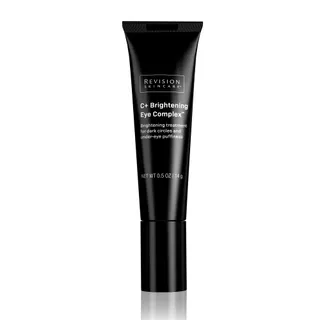
Revision Skincare C+ Brightening Eye Complex

Revision Skincare C+ Brightening Eye Complex

Efficacy100/100IrritancyMedium

Works for

Evens skin tone
Tetrahexyldecyl ascorbate, Chrysin + 4 more
Works well
What the product description says
“Powered by innovative MelaC+™ Technology featuring 10% THD Ascorbate—the most potent and stable form of Vitamin C—this advanced formula targets the underlying causes of under-eye darkness and puffiness, including excess fluid buildup, discoloration, and diminished dermal support.”
Source: Revision Skincare

This product can help reduce hypepigmentation and even out the skin tone because it contains the following effective ingredients: tetrahexyldecyl ascorbate

The following ingredient (ingredients) in this product might be helpful, but there is no evidence to confirm that it actually can help even out the skin tone: chrysin, glycine soja protein.

Keep in mind that you would need to apply any topical skincare targetted at hypigmentation consistently for a couple of months to get a result. No topical skincare product can help get rid of hyperpigmentation (including post-acne marks and age spots) instantly.

Tetrahexyldecyl ascorbateKey activeEffect: HighBeing a lipid soluble form of vitamin C, it is more stable than ascorbic acid, but still degrades quickly and needs to be stabilized in a formulation with another ingredient. It is claimed to penetrate skin better than pure vitamin C and have the the similar benefits, but solid studies of its effectiveness are lacking. Is likely to require a higher concentration in a product than pure vitamin C to be effective. It might be able to help reduce pore clogging.~8.1–9.9%
ChrysinKey activeEffect: MediumMight be helpful in reducing fine lines and wrinkles, as well as lightening the skin, but solid evidence is missing. Could somewhat help in reducing the darkness of the under-eye area. Helps to neutralise free radicals in skin~0.45–0.65%
Glycine soja proteinEffect: LowA plant extract that helps to attract water to the upper layer of the skin and soften it. It might be helpful in neutralizing free radicals. It might be somewhat helpful for evening out the skin tone. It might be able to support elastin production but solid research is lacking~0.45–0.7%
Camellia sinensis leaf extractEffect: LowCan contain potent anti-oxidant compounds (abbreviated ECG, GCG, EGC, and EGCG) that might help protect the skin from free radicals. Can help calm down inflammation and has some anti-bacterial properties. Unfortunately, these antioxidants are unstable and lose their effectiveness very quickly in products. The concentration of the antioxidant compounds in the extract also tends to be low to be effective in topical formulation~0.45–0.7%
N-hydroxysuccinimideEffect: LowIs claimed to be able to brighten skin tone by removing some blood-related pigmented compounds in skin (hemoglobin and related elements) but solid research is missing. Can be irritating~0.4–0.65%
Yeast extractEffect: Low, below effective doseHelps attract water to the upper layer of the skin and might have some anti-oxidant and skin lightening properties. It can help calm down inflammation in skin~0.45–0.65%
Anti-aging
Side benefit the brand mentions · Tetrahexyldecyl ascorbate, Palmitoyl tetrapeptide-7 + 9 more
Works well
What the product description says
“Travel Size Product Locate An Authorized Skincare Professional Near You C+ Brightening Eye Complex TM delivers a comprehensive new solution for brighter eyes that helps reduce dark circles and under-eye puffiness.”
Source: Revision Skincare

This product can help reduce and prevent fine lines and wrinkles, improve skin elasticity and firmness because it contains tetrahexyldecyl ascorbate.

These ingredients in the product can also be helpful, even though there is less evidence for their effectiveness: acetyl hexapeptide-8, palmitoyl tetrapeptide-7, palmitoyl tripeptide-1, palmitoyl tripeptide-5.

Keep in mind that it typically takes at least 6 weeks to notice any results because the changes that are needed to improve fine lines and elasticity happen in the deeper layers of the skin. No topical anti-aging product can “erase” wrinkles or fully reverse signs of aging.

Tetrahexyldecyl ascorbateKey activeEffect: HighBeing a lipid soluble form of vitamin C, it is more stable than ascorbic acid, but still degrades quickly and needs to be stabilized in a formulation with another ingredient. It is claimed to penetrate skin better than pure vitamin C and have the the similar benefits, but solid studies of its effectiveness are lacking. Is likely to require a higher concentration in a product than pure vitamin C to be effective. It might be able to help reduce pore clogging.~8.1–9.9%
Palmitoyl tetrapeptide-7Key activeEffect: MediumA type of peptide. Peptides are excellent moisturizers and might be able support collagen production reducing fine lines and wrinkles~0.5–0.75%
Palmitoyl tripeptide-1Key activeEffect: MediumA type of peptide. Peptides are excellent moisturizers and might be able support collagen production reducing fine lines and wrinkles~0.5–0.7%
Acetyl hexapeptide-8Key activeEffect: MediumA type of peptide. Peptides are excellent moisturizers and might be able support collagen production reducing fine lines and wrinkles~0.45–0.7%
Palmitoyl tripeptide-5Key activeEffect: MediumA type of peptide. Peptides are excellent moisturizers and might be able support collagen production reducing fine lines and wrinkles~0.45–0.65%
UbiquinoneEffect: LowCoenzyme Q10. It helps neutralize free radicals in skin, improves skin hydration and might be helpful agains fine lines and wrinkles. It can be an allergen~0.45–0.65%
Camellia sinensis leaf extractEffect: LowCan contain potent anti-oxidant compounds (abbreviated ECG, GCG, EGC, and EGCG) that might help protect the skin from free radicals. Can help calm down inflammation and has some anti-bacterial properties. Unfortunately, these antioxidants are unstable and lose their effectiveness very quickly in products. The concentration of the antioxidant compounds in the extract also tends to be low to be effective in topical formulation~0.45–0.7%
ChrysinEffect: LowMight be helpful in reducing fine lines and wrinkles, as well as lightening the skin, but solid evidence is missing. Could somewhat help in reducing the darkness of the under-eye area. Helps to neutralise free radicals in skin~0.45–0.65%
Glycine soja proteinEffect: LowA plant extract that helps to attract water to the upper layer of the skin and soften it. It might be helpful in neutralizing free radicals. It might be somewhat helpful for evening out the skin tone. It might be able to support elastin production but solid research is lacking~0.45–0.7%
Aloe barbadensis leaf juiceEffect: Low, below effective doseTraditionally used to treat sunburns, dermatitis and inflammation, but evidence for its effectiveness is lacking. The extract can contain humectants that help attract water into the skin~0.6–0.85%
TocopherolEffect: Low, below effective dosePure form of vitamin E. Can help moisturise and protect the skin from free radicals. Often used to help stabilise other ingredients or the formula itself~0.45–0.65%
Anti-oxidation
Side benefit · Tetrahexyldecyl ascorbate, Ubiquinone + 13 more
Works well

This product contains antioxidants (superoxide dismutase, tetrahexyldecyl ascorbate, ubiquinone) that can help neutralize free radicals in skin. By doing so, they can lessen the damage the skin gets from the UV light (sun).

The following ingredients - camellia sinensis leaf extract, chrysin also can have an antioxidant effect, but there is less evidence to confirm their effectiveness in skin.

Tetrahexyldecyl ascorbateKey activeEffect: HighBeing a lipid soluble form of vitamin C, it is more stable than ascorbic acid, but still degrades quickly and needs to be stabilized in a formulation with another ingredient. It is claimed to penetrate skin better than pure vitamin C and have the the similar benefits, but solid studies of its effectiveness are lacking. Is likely to require a higher concentration in a product than pure vitamin C to be effective. It might be able to help reduce pore clogging.~8.1–9.9%
UbiquinoneKey activeEffect: HighCoenzyme Q10. It helps neutralize free radicals in skin, improves skin hydration and might be helpful agains fine lines and wrinkles. It can be an allergen~0.45–0.65%
Superoxide dismutaseKey activeEffect: HighAn antioxidant enzyme that is naturally present in skin. It can help support skin barrier function and reduce inflammation in skin. It is used in topical medications for inflammatory skin conditions including atopic dermatitis (eczema) and psoriasis. There are three types of natural Superoxide Dismutase in human skin. The compound used in topical treatments and cosmetics are mimics of typically one of these natural variants~0.45–0.65%
Camellia sinensis leaf extractKey activeEffect: MediumCan contain potent anti-oxidant compounds (abbreviated ECG, GCG, EGC, and EGCG) that might help protect the skin from free radicals. Can help calm down inflammation and has some anti-bacterial properties. Unfortunately, these antioxidants are unstable and lose their effectiveness very quickly in products. The concentration of the antioxidant compounds in the extract also tends to be low to be effective in topical formulation~0.45–0.7%
ChrysinKey activeEffect: MediumMight be helpful in reducing fine lines and wrinkles, as well as lightening the skin, but solid evidence is missing. Could somewhat help in reducing the darkness of the under-eye area. Helps to neutralise free radicals in skin~0.45–0.65%
Vitis vinifera seed oilEffect: LowA great emollient that can also have anti-oxidant properties~2.8–3.5%
Aesculus hippocastanum seed extractEffect: LowPlant extract. Might have some anti-oxidant properties. Can be irritating~0.45–0.65%
Glycine soja proteinEffect: LowA plant extract that helps to attract water to the upper layer of the skin and soften it. It might be helpful in neutralizing free radicals. It might be somewhat helpful for evening out the skin tone. It might be able to support elastin production but solid research is lacking~0.45–0.7%
Oenothera biennis seed extractEffect: LowA plant extract that might have some anti-oxidant properties but evidence is lacking~0.45–0.65%
CaffeineEffect: LowMight be helpful in neutralizing free radicals. Can have a dehydration effect that might somewhat decrease the look of puffy eyes~0.4–0.65%
Hydrolyzed rice proteinEffect: LowHelps attract water to the upper layer of the skin. Might have some anti-oxidant properties~0.4–0.65%
Tocopheryl acetateEffect: Low, below effective doseA more stable but less bio-available form of vitamin E compared to Tocopherol. Might help moisturize and protect the skin from free radicals, but mostly used in low concentrations to stabilize other ingredients.~0.45–0.7%
Pyrus malus fruit extractEffect: Low, below effective doseCan have some moisturizing properties due to its sugar content~0.4–0.65%
TocopherolUnder-dosedPure form of vitamin E. Can help moisturise and protect the skin from free radicals. Often used to help stabilise other ingredients or the formula itself~0.45–0.65%
Yeast extractUnder-dosedHelps attract water to the upper layer of the skin and might have some anti-oxidant and skin lightening properties. It can help calm down inflammation in skin~0.45–0.65%
Moisturizing
Side benefit · Palmitoyl tetrapeptide-7, Palmitoyl tripeptide-1 + 29 more
Works well

This product can help improve hydration of the skin with the two types of ingredients.

The first type is called “humectants”:
these ingredients help attract water. When humectants are on the surface of the skin, they “pull in” the moisture from the outside environment, or from within deeper layers of the skin. The following ingredients in this product do the job: glycerin, sodium hyaluronate.

This product also contains ingredients called “occlusives”. They help reduce the speed with which our skin loses moisture to the outside environment. These ingredients also help soften the upper layer of the skin, so it feels less tight and nicer to the touch. The following ingredients in this product do the job: dimethicone, squalane.

The following ingredients in this product are especially good for supporting the skin barrier and helping with the hydration level: acetyl hexapeptide-8, palmitoyl tetrapeptide-7, palmitoyl tripeptide-1, palmitoyl tripeptide-5

Palmitoyl tetrapeptide-7Hero· EmollientEffect: HighA type of peptide. Peptides are excellent moisturizers and might be able support collagen production reducing fine lines and wrinkles~0.5–0.75%
Palmitoyl tripeptide-1Hero· EmollientEffect: HighA type of peptide. Peptides are excellent moisturizers and might be able support collagen production reducing fine lines and wrinkles~0.5–0.7%
Acetyl hexapeptide-8Hero· HumectantEffect: HighA type of peptide. Peptides are excellent moisturizers and might be able support collagen production reducing fine lines and wrinkles~0.45–0.7%
Palmitoyl tripeptide-5HeroEffect: HighA type of peptide. Peptides are excellent moisturizers and might be able support collagen production reducing fine lines and wrinkles~0.45–0.65%
GlycerinKey active· HumectantEffect: HighOne of the best moisturizing ingredients. Naturally present in skin. It attracts water to the upper layer of the skin working as a humectant~4.8–5.9%
Jojoba estersKey active· EmollientEffect: HighAn emollient made of jojoba oil. Helps soften the skin and support its barrier function~3.7–4.6%
Vitis vinifera seed oilKey active· EmollientEffect: HighA great emollient that can also have anti-oxidant properties~2.8–3.5%
Persea gratissima oilKey active· EmollientEffect: HighAn emollient that helps soften the skin and could be helpful in repairing its barrier function~2.1–2.5%
DimethiconeKey active· Emollient, OcclusiveEffect: HighA silicone that helps to reduce water loss from the surface of the skin. Can temporarily "fill in" lines and wrinkles, absorb oil, and create a nice product finish~1.5–1.8%
Hydrogenated starch hydrolysateKey active· HumectantEffect: MediumHelps to attract water to the upper layer of the skin. Can add sweet taste to lip products~0.95–1.15%
Cetyl alcoholKey active· EmollientEffect: MediumA non-drying alcohol that works to soften the skin and stabilize product formulations helping oil and water mix together~0.9–1.1%
Ethylhexyl palmitateKey active· EmollientEffect: MediumAn emollient that helps soften the skin and create a nice product texture~0.65–1%
Bacillus fermentKey activeEffect: HighA product of bacterial fermentation. Can help attract water to the upper layer of the skin~0.55–0.85%
SqualaneKey active· Emollient, OcclusiveEffect: HighAn oil naturally present in skin. Works as an emollient to soften the skin and form a protective layer on its surface without a greasy feeling.~0.5–0.75%
UbiquinoneKey activeEffect: HighCoenzyme Q10. It helps neutralize free radicals in skin, improves skin hydration and might be helpful agains fine lines and wrinkles. It can be an allergen~0.45–0.65%
Superoxide dismutaseKey activeEffect: HighAn antioxidant enzyme that is naturally present in skin. It can help support skin barrier function and reduce inflammation in skin. It is used in topical medications for inflammatory skin conditions including atopic dermatitis (eczema) and psoriasis. There are three types of natural Superoxide Dismutase in human skin. The compound used in topical treatments and cosmetics are mimics of typically one of these natural variants~0.45–0.65%
Sodium hyaluronateKey active· HumectantEffect: HighOne of the best moisturizing ingredients. Attracts water into the upper layer of the skin~0.45–0.65%
Glycine soja proteinKey active· Humectant, EmollientEffect: MediumA plant extract that helps to attract water to the upper layer of the skin and soften it. It might be helpful in neutralizing free radicals. It might be somewhat helpful for evening out the skin tone. It might be able to support elastin production but solid research is lacking~0.45–0.7%
Hydrolyzed rice proteinKey active· HumectantEffect: MediumHelps attract water to the upper layer of the skin. Might have some anti-oxidant properties~0.4–0.65%
Glyceryl stearate· EmollientEffect: LowAn emollient that softens the skin and forms a protective layer on its surface. Helps water and oil mix together~2.4–2.9%
Ethylhexyl stearate· EmollientEffect: LowHelps soften the upper layer of the skin~0.7–1.05%
Glyceryl caprylate· EmollientEffect: LowAn emollient that can also help water and oil mix together, as well as prevent bacteria growth in products~0.5–0.75%
Caprylyl glycol· Humectant, EmollientEffect: LowHelps preserve products and creates a nice product texture~0.45–0.7%
Butylene glycol· HumectantEffect: LowUsed to create a nice product texture and help delivery of other ingredients. Might be somewhat helpful in attracting water to the upper layer of the skin~0.45–0.65%
Camellia sinensis leaf extractEffect: LowCan contain potent anti-oxidant compounds (abbreviated ECG, GCG, EGC, and EGCG) that might help protect the skin from free radicals. Can help calm down inflammation and has some anti-bacterial properties. Unfortunately, these antioxidants are unstable and lose their effectiveness very quickly in products. The concentration of the antioxidant compounds in the extract also tends to be low to be effective in topical formulation~0.45–0.7%
BiotinEffect: LowMight have some moisturising properties. Is not effective when applied topically beyond some moisturizing effect~0.3–0.6%
Aloe barbadensis leaf juiceEffect: Low, below effective doseTraditionally used to treat sunburns, dermatitis and inflammation, but evidence for its effectiveness is lacking. The extract can contain humectants that help attract water into the skin~0.6–0.85%
TocopherolEffect: Low, below effective dosePure form of vitamin E. Can help moisturise and protect the skin from free radicals. Often used to help stabilise other ingredients or the formula itself~0.45–0.65%
Caprylic/capric triglycerideUnder-dosedA good mix of fatty acids that forms a protective layer on the skin. Improves the shelf life of products. Derived from coconut and glycerin~0.65–0.95%
Yeast extractUnder-dosedHelps attract water to the upper layer of the skin and might have some anti-oxidant and skin lightening properties. It can help calm down inflammation in skin~0.45–0.65%
Pyrus malus fruit extractUnder-dosedCan have some moisturizing properties due to its sugar content~0.4–0.65%

Can it cause trouble?

Irritancy
1 strong irritant: Arnica montana flower extract
Medium risk
We flagged 25 ingredients with irritancy potential. Severity depends on your sensitivity threshold; the table lists the worst offenders first.
IngredientFunctionIrritationEst. amount
Arnica montana flower extractA plant extract that can be irritating. It can have some anti-bacterial properties, but there are no evidence of a beneficial effect for skinHigh~0.35–0.6%est.
Aesculus hippocastanum seed extractPlant extract. Might have some anti-oxidant properties. Can be irritatingHigh~0.45–0.65%est.
N-hydroxysuccinimideIs claimed to be able to brighten skin tone by removing some blood-related pigmented compounds in skin (hemoglobin and related elements) but solid research is missing. Can be irritatingHigh~0.4–0.65%est.
Benzyl alcoholA preservative. Can be used to mask unpleasant smell. Can be irritatingHigh~0.3–0.6%est.
Tetrahexyldecyl ascorbateBeing a lipid soluble form of vitamin C, it is more stable than ascorbic acid, but still degrades quickly and needs to be stabilized in a formulation with another ingredient. It is claimed to penetrate skin better than pure vitamin C and have the the similar benefits, but solid studies of its effectiveness are lacking. Is likely to require a higher concentration in a product than pure vitamin C to be effective. It might be able to help reduce pore clogging.Medium~8.1–9.9%est.
Jojoba estersAn emollient made of jojoba oil. Helps soften the skin and support its barrier functionMedium~3.7–4.6%est.
Vitis vinifera seed oilA great emollient that can also have anti-oxidant propertiesMedium~2.8–3.5%est.
Persea gratissima oilAn emollient that helps soften the skin and could be helpful in repairing its barrier functionMedium~2.1–2.5%est.
Caprylic/capric triglycerideA good mix of fatty acids that forms a protective layer on the skin. Improves the shelf life of products. Derived from coconut and glycerinMedium~0.65–0.95%est.
Aloe barbadensis leaf juiceTraditionally used to treat sunburns, dermatitis and inflammation, but evidence for its effectiveness is lacking. The extract can contain humectants that help attract water into the skinMedium~0.6–0.85%est.
Caprylyl glycolHelps preserve products and creates a nice product textureMedium~0.45–0.7%est.
Oenothera biennis seed extractA plant extract that might have some anti-oxidant properties but evidence is lackingMedium~0.45–0.65%est.
Pyrus malus fruit extractCan have some moisturizing properties due to its sugar contentMedium~0.4–0.65%est.
ChrysinMight be helpful in reducing fine lines and wrinkles, as well as lightening the skin, but solid evidence is missing. Could somewhat help in reducing the darkness of the under-eye area. Helps to neutralise free radicals in skinMedium~0.45–0.65%est.
CaffeineMight be helpful in neutralizing free radicals. Can have a dehydration effect that might somewhat decrease the look of puffy eyesMedium~0.4–0.65%est.
Acrylates/c10-30 alkyl acrylate crosspolymerMaintains the texture of skincare products. Allows the product to spread evenly. Helps oil and water mix togetherMedium~0.45–0.7%est.
Disodium edtaStabilizes the product formulationMedium~0.45–0.65%est.
Tocopheryl acetateA more stable but less bio-available form of vitamin E compared to Tocopherol. Might help moisturize and protect the skin from free radicals, but mostly used in low concentrations to stabilize other ingredients.Medium~0.45–0.7%est.
Potassium sorbateA preservativeMedium~0.3–0.6%est.
Steareth-20Helps oil and water mix togetherMedium~0.55–0.8%est.
EthylhexylglycerinA preservativeMedium~0.4–0.6%est.
Citric acidCan work as an exfoliant but is typically used to adjust the product pHMedium~0.3–0.55%est.
Sodium citrateHelps to control the skin's pH level. Maintains the skin's natural film of amino-lactic acids and oils. Helps to preserve productsMedium~0.2–0.4%est.
Benzoic acidA preservativeMedium~0.2–0.4%est.
Chlorhexidine digluconateA preservativeMedium~0.15–0.3%est.
Comedogenic
1 ingredient rated 2 or more on the 0–5 pore-clogging scale
1 flagged
These ingredients have a comedogenic rating of 2 or more on a 0–5 scale; the table shows each one's rating. In leave-on products they can clog pores in acne-prone skin.
IngredientFunctionRatingEst. amount
Ethylhexyl palmitateAn emollient that helps soften the skin and create a nice product texture3/5~0.65–1%est.

User reviews

Would you recommend?
No community reviews yet.

Be the first — your take helps the next person decide.

Ingredients

Filter by role to see what each ingredient is doing.

Water~45–55%
Formula
Irritation risk
Low

Plain old water

More about Water
Tetrahexyldecyl ascorbate~8.1–9.9%
Key activeIrritant · medium
Irritation risk
Medium
Works for
Evens skin toneAnti-agingAnti-oxidation

Being a lipid soluble form of vitamin C, it is more stable than ascorbic acid, but still degrades quickly and needs to be stabilized in a formulation with another ingredient. It is claimed to penetrate skin better than pure vitamin C and have the the similar benefits, but solid studies of its effectiveness are lacking. Is likely to require a higher concentration in a product than pure vitamin C to be effective. It might be able to help reduce pore clogging.

More about Tetrahexyldecyl ascorbate
Glycerin~4.8–5.9%
Key active
Irritation risk
Low
Works for
Moisturizing

One of the best moisturizing ingredients. Naturally present in skin. It attracts water to the upper layer of the skin working as a humectant

More about Glycerin
Jojoba esters~3.7–4.6%
Key activeIrritant · medium
Irritation risk
Medium
Works for
Moisturizing

An emollient made of jojoba oil. Helps soften the skin and support its barrier function

More about Jojoba esters
Vitis vinifera seed oil~2.8–3.5%
Key activeIrritant · medium
Irritation risk
Medium
Works for
MoisturizingAnti-oxidation

A great emollient that can also have anti-oxidant properties

More about Vitis vinifera seed oil
Glyceryl stearate~2.4–2.9%
Formula
Irritation risk
Low
Works for
CleansingMoisturizing

An emollient that softens the skin and forms a protective layer on its surface. Helps water and oil mix together

More about Glyceryl stearate
Persea gratissima oil~2.1–2.5%
Key activeIrritant · medium
Irritation risk
Medium
Works for
Moisturizing

An emollient that helps soften the skin and could be helpful in repairing its barrier function

More about Persea gratissima oil
Peg-100 stearate~1.8–2.2%
Formula
Irritation risk
Low
Works for
Cleansing

Helps oil and water mix togehter and creates a nice product texture

More about Peg-100 stearate
Dimethicone~1.5–1.8%
Key active
Irritation risk
Low
Works for
MoisturizingMattifying

A silicone that helps to reduce water loss from the surface of the skin. Can temporarily "fill in" lines and wrinkles, absorb oil, and create a nice product finish

More about Dimethicone
Propanediol~1.2–1.4%
Formula
Irritation risk
Low

Acts as a solvent for other ingredients. Speeds up the absorption of other ingredients into the skin

More about Propanediol
Hydrogenated starch hydrolysate~0.95–1.15%
Key active
Irritation risk
Low
Works for
Moisturizing

Helps to attract water to the upper layer of the skin. Can add sweet taste to lip products

More about Hydrogenated starch hydrolysate
Cetyl alcohol~0.9–1.1%
Key active
Irritation risk
Low
Works for
CleansingMoisturizing

A non-drying alcohol that works to soften the skin and stabilize product formulations helping oil and water mix together

More about Cetyl alcohol
Ethylhexyl stearate~0.7–1.05%
Formula
Irritation risk
Low
Works for
Moisturizing

Helps soften the upper layer of the skin

More about Ethylhexyl stearate
Ethylhexyl palmitate~0.65–1%
Key activeComedogenic 3/5
Irritation risk
Low
Comedogenicity
3/5
Works for
Moisturizing

An emollient that helps soften the skin and create a nice product texture

More about Ethylhexyl palmitate
Caprylic/capric triglyceride~0.65–0.95%
Under-dosedIrritant · medium
Irritation risk
Medium
Works for
Moisturizing

A good mix of fatty acids that forms a protective layer on the skin. Improves the shelf life of products. Derived from coconut and glycerin

More about Caprylic/capric triglyceride
Aloe barbadensis leaf juice~0.6–0.85%
Irritant · medium
Irritation risk
Medium
Works for
MoisturizingAntibacterialReduces irritationReduces rednessAnti-inflammatoryAnti-blemishAnti-aging

Traditionally used to treat sunburns, dermatitis and inflammation, but evidence for its effectiveness is lacking. The extract can contain humectants that help attract water into the skin

More about Aloe barbadensis leaf juice
Bacillus ferment~0.55–0.85%
Key active
Irritation risk
Low
Works for
Moisturizing

A product of bacterial fermentation. Can help attract water to the upper layer of the skin

More about Bacillus ferment
Crataegus monogyna flower extract~0.5–0.8%
Formula
Inula helenium extract~0.5–0.75%
Formula
Jasminum sambac flower extract~0.45–0.65%
Formula
Acetyl hexapeptide-8~0.45–0.7%
Hero · Moisturizing
Irritation risk
Low
Works for
MoisturizingAnti-aging

A type of peptide. Peptides are excellent moisturizers and might be able support collagen production reducing fine lines and wrinkles

More about Acetyl hexapeptide-8
Palmitoyl tetrapeptide-7~0.5–0.75%
Hero · Moisturizing
Irritation risk
Low
Works for
MoisturizingAnti-aging

A type of peptide. Peptides are excellent moisturizers and might be able support collagen production reducing fine lines and wrinkles

More about Palmitoyl tetrapeptide-7
Palmitoyl tripeptide-1~0.5–0.7%
Hero · Moisturizing
Irritation risk
Low
Works for
MoisturizingAnti-aging

A type of peptide. Peptides are excellent moisturizers and might be able support collagen production reducing fine lines and wrinkles

More about Palmitoyl tripeptide-1
Palmitoyl tripeptide-5~0.45–0.65%
Hero · Moisturizing
Irritation risk
Low
Works for
MoisturizingAnti-aging

A type of peptide. Peptides are excellent moisturizers and might be able support collagen production reducing fine lines and wrinkles

More about Palmitoyl tripeptide-5
Sodium hyaluronate~0.45–0.65%
Key active
Irritation risk
Low
Works for
Moisturizing

One of the best moisturizing ingredients. Attracts water into the upper layer of the skin

More about Sodium hyaluronate
Butylene glycol~0.45–0.65%
Formula
Irritation risk
Low
Works for
Moisturizing

Used to create a nice product texture and help delivery of other ingredients. Might be somewhat helpful in attracting water to the upper layer of the skin

More about Butylene glycol
Superoxide dismutase~0.45–0.65%
Key active
Irritation risk
Low
Works for
Anti-inflammatoryMoisturizingAnti-oxidation

An antioxidant enzyme that is naturally present in skin. It can help support skin barrier function and reduce inflammation in skin. It is used in topical medications for inflammatory skin conditions including atopic dermatitis (eczema) and psoriasis. There are three types of natural Superoxide Dismutase in human skin. The compound used in topical treatments and cosmetics are mimics of typically one of these natural variants

More about Superoxide dismutase
Glycine soja protein~0.45–0.7%
Key active
Irritation risk
Low
Works for
CleansingMoisturizingAnti-agingEvens skin toneAnti-oxidation

A plant extract that helps to attract water to the upper layer of the skin and soften it. It might be helpful in neutralizing free radicals. It might be somewhat helpful for evening out the skin tone. It might be able to support elastin production but solid research is lacking

More about Glycine soja protein
Caprylyl glycol~0.45–0.7%
Irritant · medium
Irritation risk
Medium
Works for
Moisturizing

Helps preserve products and creates a nice product texture

More about Caprylyl glycol
Glyceryl caprylate~0.5–0.75%
Formula
Irritation risk
Low
Works for
CleansingMoisturizing

An emollient that can also help water and oil mix together, as well as prevent bacteria growth in products

More about Glyceryl caprylate
Sodium methylesculetin acetate~0.45–0.65%
Formula
Oenothera biennis seed extract~0.45–0.65%
Irritant · medium
Irritation risk
Medium
Works for
Anti-oxidation

A plant extract that might have some anti-oxidant properties but evidence is lacking

More about Oenothera biennis seed extract
Yeast extract~0.45–0.65%
Under-dosed
Irritation risk
Low
Works for
MoisturizingAnti-oxidationReduces irritationAnti-inflammatoryEvens skin tone

Helps attract water to the upper layer of the skin and might have some anti-oxidant and skin lightening properties. It can help calm down inflammation in skin

More about Yeast extract
Ubiquinone~0.45–0.65%
Key active
Irritation risk
Low
Works for
Anti-oxidationMoisturizingAnti-aging

Coenzyme Q10. It helps neutralize free radicals in skin, improves skin hydration and might be helpful agains fine lines and wrinkles. It can be an allergen

More about Ubiquinone
Pyrus malus fruit extract~0.4–0.65%
Under-dosedIrritant · medium
Irritation risk
Medium
Works for
MoisturizingAnti-oxidation

Can have some moisturizing properties due to its sugar content

More about Pyrus malus fruit extract
Chrysin~0.45–0.65%
Key activeIrritant · medium
Irritation risk
Medium
Works for
Anti-oxidationEvens skin toneAnti-aging

Might be helpful in reducing fine lines and wrinkles, as well as lightening the skin, but solid evidence is missing. Could somewhat help in reducing the darkness of the under-eye area. Helps to neutralise free radicals in skin

More about Chrysin
Arnica montana flower extract~0.35–0.6%
Irritant · high
Irritation risk
High

A plant extract that can be irritating. It can have some anti-bacterial properties, but there are no evidence of a beneficial effect for skin

More about Arnica montana flower extract
Camellia sinensis leaf extract~0.45–0.7%
Key active
Irritation risk
Low
Works for
AntibacterialAnti-oxidationAnti-agingAnti-blemishEvens skin toneMoisturizing

Can contain potent anti-oxidant compounds (abbreviated ECG, GCG, EGC, and EGCG) that might help protect the skin from free radicals. Can help calm down inflammation and has some anti-bacterial properties. Unfortunately, these antioxidants are unstable and lose their effectiveness very quickly in products. The concentration of the antioxidant compounds in the extract also tends to be low to be effective in topical formulation

More about Camellia sinensis leaf extract
Hydrolyzed rice protein~0.4–0.65%
Key active
Irritation risk
Low
Works for
MoisturizingAnti-oxidation

Helps attract water to the upper layer of the skin. Might have some anti-oxidant properties

More about Hydrolyzed rice protein
Squalane~0.5–0.75%
Key active
Irritation risk
Low
Works for
Moisturizing

An oil naturally present in skin. Works as an emollient to soften the skin and form a protective layer on its surface without a greasy feeling.

More about Squalane
Troxerutin~0.4–0.65%
Formula
Irritation risk
Low
More about Troxerutin
Tocopherol~0.45–0.65%
Under-dosed
Irritation risk
Low
Works for
Anti-oxidationAnti-agingAnti-inflammatoryMoisturizing

Pure form of vitamin E. Can help moisturise and protect the skin from free radicals. Often used to help stabilise other ingredients or the formula itself

More about Tocopherol
Aesculus hippocastanum seed extract~0.45–0.65%
Irritant · high
Irritation risk
High
Works for
Anti-oxidation

Plant extract. Might have some anti-oxidant properties. Can be irritating

More about Aesculus hippocastanum seed extract
Sodium hydroxide~0.45–0.65%
Formula
Irritation risk
Low

Used to adjust the product's pH

More about Sodium hydroxide
Caffeine~0.4–0.65%
Irritant · medium
Irritation risk
Medium
Works for
De-puffingAnti-oxidation

Might be helpful in neutralizing free radicals. Can have a dehydration effect that might somewhat decrease the look of puffy eyes

More about Caffeine
Acrylates/c10-30 alkyl acrylate crosspolymer~0.45–0.7%
Irritant · medium
Irritation risk
Medium

Maintains the texture of skincare products. Allows the product to spread evenly. Helps oil and water mix together

More about Acrylates/c10-30 alkyl acrylate crosspolymer
Silica~0.55–0.8%
Formula
Irritation risk
Low

Used to absorb oil and can temporarily mattify skin

More about Silica
Disodium edta~0.45–0.65%
Irritant · medium
Irritation risk
Medium

Stabilizes the product formulation

More about Disodium edta
Tocopheryl acetate~0.45–0.7%
Irritant · medium
Irritation risk
Medium
Works for
Anti-oxidation

A more stable but less bio-available form of vitamin E compared to Tocopherol. Might help moisturize and protect the skin from free radicals, but mostly used in low concentrations to stabilize other ingredients.

More about Tocopheryl acetate
Iron oxides~0.4–0.6%
Formula
Irritation risk
Low
Works for
Sun protection

An umbrella term for the following three colorants: CI 77491, CI 77492, CI 77499. They might be able to offer some protection against visible light, but the degree of the protection is not clear

More about Iron oxides
Titanium dioxide~0.5–0.8%
Formula
Irritation risk
Low
Works for
Sun protection

Works as a UV filter when used in high concentrations. It is photostable and is effective mostly against the UVB light, with some protection in the UVA range. In small concentrations, used for its ability to improve the color of cosmetic products. Is usually well tolerated by the skin

More about Titanium dioxide
Potassium sorbate~0.3–0.6%
Irritant · medium
Irritation risk
Medium

A preservative

More about Potassium sorbate
Sodium dextran sulfate~0.45–0.65%
Formula
N-hydroxysuccinimide~0.4–0.65%
Irritant · high
Irritation risk
High
Works for
Evens skin tone

Is claimed to be able to brighten skin tone by removing some blood-related pigmented compounds in skin (hemoglobin and related elements) but solid research is missing. Can be irritating

More about N-hydroxysuccinimide
Steareth-20~0.55–0.8%
Irritant · medium
Irritation risk
Medium
Works for
Cleansing

Helps oil and water mix together

More about Steareth-20
Xanthan gum~0.45–0.65%
Formula
Irritation risk
Low
Works for
Cleansing

Used to create a thicker product consistency

More about Xanthan gum
Benzyl alcohol~0.3–0.6%
Irritant · high
Irritation risk
High

A preservative. Can be used to mask unpleasant smell. Can be irritating

More about Benzyl alcohol
Phenoxyethanol~0.45–0.65%
Formula
Irritation risk
Low

A preservative. It helps prevent bacterial growth in cosmetic products

More about Phenoxyethanol
Ethylhexylglycerin~0.4–0.6%
Irritant · medium
Irritation risk
Medium

A preservative

More about Ethylhexylglycerin
Sodium benzoate~0.25–0.5%
Formula
Irritation risk
Low

A preservative

More about Sodium benzoate
Biotin~0.3–0.6%
Formula
Irritation risk
Low
Works for
Moisturizing

Might have some moisturising properties. Is not effective when applied topically beyond some moisturizing effect

More about Biotin
Citric acid~0.3–0.55%
Irritant · medium
Irritation risk
Medium

Can work as an exfoliant but is typically used to adjust the product pH

More about Citric acid
Sodium phosphate~0.25–0.45%
Formula
Irritation risk
Low

Helps stabilize the product formulation

More about Sodium phosphate
Sodium citrate~0.2–0.4%
Irritant · medium
Irritation risk
Medium

Helps to control the skin's pH level. Maintains the skin's natural film of amino-lactic acids and oils. Helps to preserve products

More about Sodium citrate
Benzoic acid~0.2–0.4%
Irritant · medium
Irritation risk
Medium

A preservative

More about Benzoic acid
Sodium chloride~0.2–0.35%
Formula
Irritation risk
Low

Used to stabilize mixtures of oil and water, and create thicker, gel-like product textures

More about Sodium chloride
Sodium carbonate~0.15–0.25%
Formula
Irritation risk
Low

Helps regulate product's pH

More about Sodium carbonate
Chlorhexidine digluconate~0.15–0.3%
Irritant · medium
Irritation risk
Medium

A preservative

More about Chlorhexidine digluconate
Ingredient list view

Water, Tetrahexyldecyl ascorbate, Glycerin, Jojoba esters, Vitis vinifera seed oil, Glyceryl stearate, Persea gratissima oil, Peg-100 stearate, Dimethicone, Propanediol, Hydrogenated starch hydrolysate, Cetyl alcohol, Ethylhexyl stearate, Ethylhexyl palmitate, Caprylic/capric triglyceride, Aloe barbadensis leaf juice, Bacillus ferment, Crataegus monogyna flower extract, Inula helenium extract, Jasminum sambac flower extract, Acetyl hexapeptide-8, Palmitoyl tetrapeptide-7, Palmitoyl tripeptide-1, Palmitoyl tripeptide-5, Sodium hyaluronate, Butylene glycol, Superoxide dismutase, Glycine soja protein, Caprylyl glycol, Glyceryl caprylate, Sodium methylesculetin acetate, Oenothera biennis seed extract, Yeast extract, Ubiquinone, Pyrus malus fruit extract, Chrysin, Arnica montana flower extract, Camellia sinensis leaf extract, Hydrolyzed rice protein, Squalane, Troxerutin, Tocopherol, Aesculus hippocastanum seed extract, Sodium hydroxide, Caffeine, Acrylates/c10-30 alkyl acrylate crosspolymer, Silica, Disodium edta, Tocopheryl acetate, Iron oxides, Titanium dioxide, Potassium sorbate, Sodium dextran sulfate, N-hydroxysuccinimide, Steareth-20, Xanthan gum, Benzyl alcohol, Phenoxyethanol, Ethylhexylglycerin, Sodium benzoate, Biotin, Citric acid, Sodium phosphate, Sodium citrate, Benzoic acid, Sodium chloride, Sodium carbonate, Chlorhexidine digluconate

Compare prices

Retailers ranked by price — lowest first.

Revision Skincare0.5 oz
$120.00
Buy
Amazon US
Price unavailable Out of stock
Check

Affiliate links · As an Amazon Associate, WIMJ earns from qualifying purchases.

Worth comparing, line by line.

Match % combines shared ingredients, the first five ingredients, shared actives and hero ingredients, irritancy (lower counts in the alternative's favour), texture and body area. Only products in the same routine step are compared.

Side-by-side comparison of this product against its closest alternatives
Revision SkincareC+ Brightening Eye ComplexYOUR PRODUCTRéViveIntensité Complete Anti-Aging Eye Serum by RéviveDerm InstituteYouth Alchemy Eye SerumPeter Thomas RothSuper-Size Un-Wrinkle Eye Concentrate
Match—50%49%48%
Price$120.00$210.00+$90.00$290.00+$170.00$200.00+$80.00
Shared key ingredients—9 of 227 of 227 of 22
Key difference—Oligopeptide-41RetinolAcetyl Octapeptide-3
Irritancy Medium Medium Medium Medium
Drying alcohol————
View product Shop Shop Shop

More alternatives: M-61 Hydraboost Eye SerumRevaleskin Eye Serum

Cheaper alternatives? See how this stacks up against similar formulas.
We compare ingredient profiles across our catalog — pick the closest match for your budget.
Open dupe finder

Product summary

"Revision Skincare - C+ Brightening Eye Complex™" is effective for: Evens skin tone, Anti-aging and Moisturizing

Ingredient callouts

  • Peptides (palmitoyl tripeptide-5 0.45% - 0.65%, palmitoyl tripeptide-1 0.50% - 0.70%, palmitoyl tetrapeptide-7 0.50% - 0.75% and acetyl hexapeptide-8 0.45% - 0.70%). Peptides are a very big group of ingredients. They all consist of a different combination of aminoacids. Our skin produces Peptides naturally. Some of them work as natural antibiotics, promote wound-healing and production of collagen. The scientists are still studying how effective the topical application of Peptides is, but it is very likely that theynare helpful. Peptides might be able to support skin barrier restoration and even have an anti-aging benefit. At the very least, they certainly help attract water to the skin and support the hydration in this way.
  • Humectants (faex 0.40% - 0.65%, sodium hyaluronate 0.45% - 0.65%, acetyl hexapeptide-8 0.45% - 0.70% and glycerin 4.80% - 5.90%). These ingredients help attract water to the upper layer of the skin and improve the skin hydration.

Price

The product retails from 68.00$ up to 118.00$ in the United States.

For a detailed price comparison: click here.

Sources cited in this review

Every concentration estimate and effectiveness label is anchored to one of these 32 studies and safety reviews.

  1. 1
  2. 2
  3. 3
  4. 4
  5. 5
  6. 6
Revision Skincare C+ Brightening Eye Complex
Revision SkincareC+ Brightening Eye Complex

Affiliate links · As an Amazon Associate, WIMJ earns from qualifying purchases.

As an Amazon Associate, WIMJ earns from qualifying purchases.