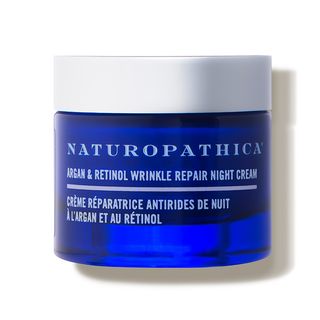
Naturopathica Argan & Retinol Wrinkle Repair Night Cream
Works for
2 of 2 advertised claims delivered
Moisturizing24 ingredients credited for this claimStrong support
“nighttime moisturizer”
This product can help improve hydration of the skin with the two types of ingredients.
The first type is called “humectants”:
these ingredients help attract water.
When humectants are on the surface of the skin, they “pull in” the moisture from the outside environment, or from
within deeper layers of the skin. The following ingredients in this product do the job:
anhydroxylitol, glycerin.
This product also contains ingredients called “occlusives”. They help reduce the speed with which our skin loses moisture to the outside environment. These ingredients also help soften the upper layer of the skin, so it feels less tight and nicer to the touch. The following ingredients in this product do the job: caprylic/capric triglyceride, ethylhexyl hydroxystearate.
The following ingredients in this product are especially good for supporting the skin barrier and helping with the hydration level: palmitoyl tripeptide-38
Anti-aging4 ingredients credited for this claimStrong support
“age defying nighttime moisturizer”
This product can help reduce and prevent fine lines and wrinkles, improve skin elasticity and firmness because it contains retinol.
These ingredients in the product can also be helpful, even though there is less evidence for their effectiveness: palmitoyl tripeptide-38.
Keep in mind that it typically takes at least 6 weeks to notice any results because the changes that are needed to improve fine lines and elasticity happen in the deeper layers of the skin. No topical anti-aging product can “erase” wrinkles or fully reverse signs of aging.
Anti-oxidationNot advertised by the brand · 9 ingredients credited for this claimStrong support
This product contains antioxidants (dimethylmethoxy chromanol, retinol) that can help neutralize free radicals in skin. By doing so, they can lessen the damage the skin gets from the UV light (sun).
ExfoliationNot advertised by the brand · 1 ingredient credited for this claimStrong support
This product can help exfoliate the skin. In other words, it helps break down the bonds between dead cells on the surface of the skin and speed up the skin turnover. Skin often appears softer and brighter after exfoliation, but overdoing it can result in disrupted skin barrier. The following ingredient is doing the exfoliating job in this product: retinol.
Anti-blemishNot advertised by the brand · 2 ingredients credited for this claimStrong support
This product can help reduce breakouts and clogged pores because it contains the following ingredient: retinol. This ingredient is used for treating acne and can have a noticeable effect.
Evens skin toneNot advertised by the brand · 1 ingredient credited for this claimStrong support
This product can help reduce hypepigmentation and even out the skin tone because it contains the following effective ingredients: retinol.
Keep in mind that you would need to apply any topical skincare targetted at hypigmentation consistently for a couple of months to get a result. No topical skincare product can help get rid of hyperpigmentation (including post-acne marks and age spots) instantly.
Can it cause trouble?
Irritancy10 strong irritants: Pelargonium graveolens leaf oil, Retinol + 8 more — patch-test recommendedHigh risk
Comedogenic3 ingredients rated 2 or more on the 0–5 pore-clogging scale3 flagged


User reviews
Be the first — your take helps the next person decide.
Ingredients
Filter by role to see what each ingredient is doing.
Water~45–55%
Cocoglycerides~4.3–5.3%
- Irritation risk
- High
Help soften the upper layer of the skin and make it easier for oil and water mix together. Recently, a rising number of allergic reactions to cocoglycerides and other coconut-derived surfactants has been reported. As there is a significant overlap between frequent irritants and allergens, we flag this ingredient for attention of those with very sensitive, reactive skin
More about CocoglyceridesGlycerin~4.1–5%
- Irritation risk
- Low
One of the best moisturizing ingredients. Naturally present in skin. It attracts water to the upper layer of the skin working as a humectant
More about GlycerinEthylhexyl hydroxystearate~3.3–4%
- Irritation risk
- Low
Helps soften the upper layer of the skin and reduce water loss from it
More about Ethylhexyl hydroxystearateCaprylic/capric triglyceride~2.5–3.1%
- Irritation risk
- Medium
A good mix of fatty acids that forms a protective layer on the skin. Improves the shelf life of products. Derived from coconut and glycerin
More about Caprylic/capric triglycerideC10-18 triglycerides~2–2.4%
- Irritation risk
- Low
Helps soften the skin and attract water to its upper layer. Helps create nice product texture
More about C10-18 triglyceridesCandelilla/jojoba/rice bran polyglyceryl-3 esters~1.7–2.1%
- Irritation risk
- Medium
Help oil and water mix together
More about Candelilla/jojoba/rice bran polyglyceryl-3 estersGlyceryl stearate~1.5–1.8%
- Irritation risk
- Low
An emollient that softens the skin and forms a protective layer on its surface. Helps water and oil mix together
More about Glyceryl stearateXylitylglucoside~1.2–1.4%
- Irritation risk
- Low
Helps attract water to the upper layer of the skin and repair the skin barrier function
More about XylitylglucosideCetearyl alcohol~1.1–1.3%
- Irritation risk
- Low
- Comedogenicity
- 2/5
A non-drying alcohol. Works as an emollient. Helps water and oil mix together and creates a nice product texture
More about Cetearyl alcoholSodium stearoyl lactylate~0.7–1%
- Irritation risk
- Medium
Helps oil and water mix together
More about Sodium stearoyl lactylateDipentaerythrityl tetrabehenate/polyhydroxystearate~0.55–0.8%
- Irritation risk
- Low
Helianthus annuus seed oil~0.55–0.8%
- Irritation risk
- Low
A great emollient due to its high linoleic acid content. One of the most effective plant oils in helping skin hydration and repairing skin barrier function
More about Helianthus annuus seed oilAnhydroxylitol~0.45–0.7%
- Irritation risk
- Low
Helps attract water to the upper layer of the skin and repair the skin barrir function
More about AnhydroxylitolSclerotium gum~0.4–0.6%
- Irritation risk
- Low
Used to create gel-like formulas and stabilize emulsions
More about Sclerotium gum1,2-hexanediol~0.4–0.6%
Caprylyl glycol~0.45–0.65%
- Irritation risk
- Medium
Helps preserve products and creates a nice product texture
More about Caprylyl glycolStearalkonium hectorite~0.3–0.6%
Xylitol~0.3–0.5%
- Irritation risk
- Low
Helps attract water to the upper layer of the skin and repair the skin barrier function
More about XylitolGlycine soja oil~0.3–0.5%
- Irritation risk
- Medium
- Comedogenicity
- 2/5
A good emollient that helps soften the skin and helps repair its barrier function. It can clog pores if used in high concentrations.
More about Glycine soja oilMangifera indica seed butter~0.25–0.45%
- Irritation risk
- Low
Helps to soften the upper layer of the skin and might have some anti-oxidant effect
More about Mangifera indica seed butterHippophae rhamnoides seed oil~0.25–0.45%
- Irritation risk
- Low
Propylene carbonate~0.25–0.45%
- Irritation risk
- Low
Is used to dissolve other ingredients and create nice product texture
More about Propylene carbonateLactobacillus ferment~0.2–0.35%
- Irritation risk
- Low
A fermentation product created by bacteria Lactobacillus. The fermented product has anti-bacterial properties and might be helpful in calming down inflammation, but studies are lacking. Helps attract water to the upper layer of the skin. Can be used as a preservative
More about Lactobacillus fermentBisabolol~0.2–0.35%
- Irritation risk
- Low
An active component of chamomile plant that historically has been used to calm down irritated skin. A recent study shows that bisabolol indeed can have some anti-inflammatory effect on skin, even though conclusive data is lacking. Bisabolol has a sweet floral scent and can be added to products for its aromatic properties
More about BisabololTocopheryl acetate~0.2–0.4%
- Irritation risk
- Medium
A more stable but less bio-available form of vitamin E compared to Tocopherol. Might help moisturize and protect the skin from free radicals, but mostly used in low concentrations to stabilize other ingredients.
More about Tocopheryl acetateXanthan gum~0.2–0.4%
- Irritation risk
- Low
Used to create a thicker product consistency
More about Xanthan gumIsomalt~0.2–0.4%
- Irritation risk
- Low
Helps attract water to the upper layer of the skin
More about IsomaltPelargonium graveolens leaf oil~0.2–0.4%
- Irritation risk
- High
An essential oil used as a fragrance. Can be irritating
More about Pelargonium graveolens leaf oilGlucose~0.2–0.4%
- Irritation risk
- Low
Helps attract water to the upper layer of the skin. Could be helpful in restoring the skin barrier function
More about GlucoseDimethylmethoxy chromanol~0.2–0.4%
- Irritation risk
- Low
Can help neutralize free radicals in skin
More about Dimethylmethoxy chromanolSodium phytate~0.2–0.4%
Citric acid~0.2–0.4%
- Irritation risk
- Medium
Can work as an exfoliant but is typically used to adjust the product pH
More about Citric acidRetinol~0.2–0.35%
- Irritation risk
- High
Two steps removed from the active form of vitamin A - retinoic acid. Once converted to the retinoic acid in the skin, retinol is proven to be effective against all signs of aging. It improves skin cell turnover, helps fight blemishes and clogged pores, can regulate excess oil production and even skin tone. It can, however, be quite irritating
More about RetinolAnthemis nobilis flower extract~0.2–0.35%
- Irritation risk
- High
A plant extract that one one hand, can contain compounds that can help calm down skin irritation, but, on the other hand, its other compounds (especially fragrant ones) can themselves be irritating
More about Anthemis nobilis flower extractHelichrysum angustifolium flower extract~0.2–0.35%
- Irritation risk
- Low
Plankton extract~0.2–0.4%
- Irritation risk
- Medium
- Comedogenicity
- 3/5
Can help attract water to the upper layer of the skin
More about Plankton extractHydroxypropyl cyclodextrin~0.25–0.5%
- Irritation risk
- Medium
Used to stabilize product formulations and help soften the upper layer of the skin
More about Hydroxypropyl cyclodextrinCitrus aurantium amara flower extract~0.2–0.4%
- Irritation risk
- High
Used as a fragrance for its citrus smell. Can be irritating
More about Citrus aurantium amara flower extractTocopherol~0.2–0.4%
- Irritation risk
- Low
Pure form of vitamin E. Can help moisturise and protect the skin from free radicals. Often used to help stabilise other ingredients or the formula itself
More about TocopherolTanacetum annuum flower oil~0.2–0.4%
- Irritation risk
- High
An essential oil that has anti-inflammatory properties but also contains irritating compounds
More about Tanacetum annuum flower oilArgania spinosa sprout cell extract~0.2–0.4%
- Irritation risk
- Low
Plant stem cell extract. Can help attract water to the upper layer of the skin and might be helpful in neutralizing free radicals
More about Argania spinosa sprout cell extractLecithin~0.25–0.45%
- Irritation risk
- Low
Used mostly for creating emulsions - helping oil and water mix together. Helps soften the upper layer of the skin
More about LecithinAlcohol~0.2–0.35%
- Irritation risk
- High
Can be drying and contribute to skin irritation. Used in formulars to dissolve other ingredients, create a thinner product consistency or for its antibacterial properties
More about AlcoholPalmitoyl tripeptide-38~0.2–0.35%
- Irritation risk
- Low
A type of peptide. Peptides are excellent moisturizers and might be able support collagen production reducing fine lines and wrinkles
More about Palmitoyl tripeptide-38Sodium benzoate~0.15–0.25%
Rosmarinus officinalis leaf extract~0.15–0.25%
- Irritation risk
- High
Can be helpful in reducing inflammation in skin, including inflamed acne. It can be irritating
More about Rosmarinus officinalis leaf extractCitronellol~0.15–0.3%
Geraniol~0.15–0.25%
Limonene~0.1–0.2%
- Irritation risk
- High
A common frangrance that can easily irritate skin, especially if exposed to air, light or heat
More about LimoneneLinalool~0.1–0.15%
Ingredient list view
Water, Cocoglycerides, Glycerin, Ethylhexyl hydroxystearate, Caprylic/capric triglyceride, C10-18 triglycerides, Candelilla/jojoba/rice bran polyglyceryl-3 esters, Glyceryl stearate, Xylitylglucoside, Cetearyl alcohol, Sodium stearoyl lactylate, Dipentaerythrityl tetrabehenate/polyhydroxystearate, Helianthus annuus seed oil, Anhydroxylitol, Sclerotium gum, 1,2-hexanediol, Caprylyl glycol, Stearalkonium hectorite, Xylitol, Glycine soja oil, Mangifera indica seed butter, Hippophae rhamnoides seed oil, Propylene carbonate, Lactobacillus ferment, Bisabolol, Tocopheryl acetate, Xanthan gum, Isomalt, Pelargonium graveolens leaf oil, Glucose, Dimethylmethoxy chromanol, Sodium phytate, Citric acid, Retinol, Anthemis nobilis flower extract, Helichrysum angustifolium flower extract, Plankton extract, Hydroxypropyl cyclodextrin, Citrus aurantium amara flower extract, Tocopherol, Tanacetum annuum flower oil, Argania spinosa sprout cell extract, Lecithin, Alcohol, Palmitoyl tripeptide-38, Sodium benzoate, Rosmarinus officinalis leaf extract, Citronellol, Geraniol, Limonene, Linalool
Compare prices
Retailers ranked by price — lowest first.

Worth comparing, line by line.
Match % combines shared ingredients, the first five ingredients, shared actives and hero ingredients, irritancy (lower counts in the alternative's favour), texture and body area. Only products in the same routine step are compared.
| NaturopathicaArgan & Retinol Wrinkle Repair Night CreamYOUR PRODUCT | Centellian24Madeca Cream Time Reverse 50ml | BlissYouth Got This Moisturizer | DermalogicaOvernight Retinol Repair with Buffer Cream | |
|---|---|---|---|---|
| Match | — | 78% | 78% | 76% |
| Price | $134.00 | $39.60−$94.40 | $27.76−$106.24 | $112.37−$21.63 |
| Shared key ingredients | — | 7 of 17 | 5 of 17 | 6 of 17 |
| Key difference | — | Madecassoside | Palmitoyl Tripeptide-5 | Sodium Ascorbyl Phosphate |
| Irritancy | High | High | Medium | High |
| Drying alcohol | Contains drying alcohol | — | — | — |
| View product | Shop | Shop | Shop |


Product summary
"Naturopathica - Argan & Retinol Wrinkle Repair Night Cream" is a well-rounded moisturizing product. The formulation is based on a combination of good humectants and emollients. Both are needed to increase the skin hydration level. Humectants in this product (anhydroxylitol, glycerin, isomalt, lactobacillus ferment and xylitylglucoside) help to increase the water content in the upper layer of the skin. (These ingredients do so by "capturing" water molecules from the outside air or from within the deeper layers of the skin). Hippophae rhamnoides oil, caprylic/capric triglyceride, ethylhexyl hydroxystearate, c10-18 triglycerides and canola oil in this product help decrease the water evoporation from the skin, so that it stays hydrated for longer. These ingredients also soften the skin and take away the feeling of tightness and dryness.
Ingredient callouts
- this moisturizer contains an effective form of retinoids (vitamin A): retinyl retinoate 0.30% - 0.55% and retinol 0.30% - 0.55%. Retinoids are potent multitasking actives. They work to improve and prevent early signs of aging, reduce hyperpigmentation (age spots and post-acne marks), and prevent inflamed blemishes and clogged pores. The downside of retinoids is that they can be irritating. If you are not already using a retinoid in your routine, it is best to start slowly and apply the retinoid product only a few times per week. If your skin tolerates it well, you can gradually increase the frequency to daily. Because of the irritation risk of retinoids, we recommend to have another, retinoid-free moisturizer in your routine to use on the alternative days or when your skin feels dry.
- This moistruizer also contains peptides (palmitoyl tripeptide-38 0.40% - 0.60%). Peptides is a very big group of ingredients. They all consist of a different combination of amino-acids. Our skin produces peptides naturally. Some of them work as natural anti-biotics, promote wound-healing and production of collagen. The scientists are still studying how effective the topical application of peptides is, but it is very likely that peptides in skincare are helpful. They might be able to support skin barrier restoration and even have an anti-aging benefit. At the very least, they certainly help attract water to the skin and support the hydration in this way.
- This moisturizer contains Bakuchiol (0.50% - 0.80%). It is a plant extract that is has a similar effect to that of retinoids but with less irritation. Bakuchiol can help reduce fine lines and wrinkles, improve skin tone, reduce clogged pores and blemishes, and reduce inflammation.
Irritation risk
This formulation includes some common irritants, including ingredients that do not provide a benefit for the skin. We assess the overall irritancy of this moisturizer to be high. For a detailed overview of all potential irritants: click here
You can see the detailed formula review with the breakdown of all actives in the product and the full ingredient list with estimated concentrations in the tables below.
Price
The product retails for 134.00$ in the United States and for 160.00CA$ in Canada.
For a detailed price comparison: click here.
Sources cited in this review
Every concentration estimate and effectiveness label is anchored to one of these 25 studies and safety reviews.
- 1
- 2
- 3
- 4
- 5Effect of topically applied lipids on surfactant-irritated skinonlinelibrary.wiley.com
- 6

Affiliate links · As an Amazon Associate, WIMJ earns from qualifying purchases.