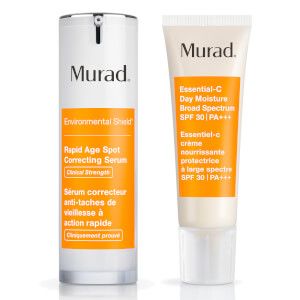
Murad The Super Brighteners
Works for
0 of 1 advertised claim delivered
Sun protectionSPF 30 · 2 UV filters · Partial spectrumWeak protection
This product does not offer good protection against UVA rays.
Anti-oxidationNot advertised by the brand · Vitis vinifera seed extract, Ascorbyl glucoside + 6 moreStrong evidence
This product contains antioxidants (vitis vinifera seed extract) that can help neutralize free radicals in skin. By doing so, they can lessen the damage the skin gets from the UV light (sun).
The following ingredients - ascorbyl glucoside, ginkgo biloba leaf extract, hexylresorcinol also can have an antioxidant effect, but there is less evidence to confirm their effectiveness in skin.
Anti-agingNot advertised by the brand · Niacinamide, Vitis vinifera seed extract + 5 moreStrong evidence
This product can help reduce and prevent fine lines and wrinkles, improve skin elasticity and firmness because it contains niacinamide.
These ingredients in the product can also be helpful, even though there is less evidence for their effectiveness: ascorbyl glucoside, hexapeptide-2, vitis vinifera seed extract.
Keep in mind that it typically takes at least 6 weeks to notice any results because the changes that are needed to improve fine lines and elasticity happen in the deeper layers of the skin. No topical anti-aging product can “erase” wrinkles or fully reverse signs of aging.
MoisturizingNot advertised by the brand · Urea, Hexapeptide-2 + 26 moreStrong evidence
This product can help improve hydration of the skin with the two types of ingredients.
The first type is called “humectants”:
these ingredients help attract water.
When humectants are on the surface of the skin, they “pull in” the moisture from the outside environment, or from
within deeper layers of the skin. The following ingredients in this product do the job:
betaine, glycerin.
This product also contains ingredients called “occlusives”. They help reduce the speed with which our skin loses moisture to the outside environment. These ingredients also help soften the upper layer of the skin, so it feels less tight and nicer to the touch. The following ingredients in this product do the job: caprylic/capric triglyceride, dimethicone.
The following ingredients in this product are especially good for supporting the skin barrier and helping with the hydration level: hexapeptide-2, niacinamide, panthenol, urea
Can it cause trouble?
Irritancy7 strong irritants: Parfum, Limonene + 5 more — patch-test recommendedHigh risk
Comedogenic2 ingredients rated 2 or more on the 0–5 pore-clogging scale2 flagged


User reviews
Be the first — your take helps the next person decide.
Ingredients
Filter by role to see what each ingredient is doing.
Water~45–55%
Glycerin~4.6–5.6%
- Irritation risk
- Low
One of the best moisturizing ingredients. Naturally present in skin. It attracts water to the upper layer of the skin working as a humectant
More about GlycerinDimethicone~4.2–5.1%
- Irritation risk
- Low
A silicone that helps to reduce water loss from the surface of the skin. Can temporarily "fill in" lines and wrinkles, absorb oil, and create a nice product finish
More about DimethiconePentylene glycol~3.1–3.8%
- Irritation risk
- Medium
Used to preserve products, dissolve other ingredients and create a nice product texture
More about Pentylene glycolNiacinamide~2.3–2.8%
- Irritation risk
- Low
Is proven to be effective in reducing blemishes, evening out skin tone and helping to improve lines and wrinkles. It helps the skin to repair sun damage, calm down inflammation and keep maintain good levels of moisture. The concentration of about 2% is effective for supporting the skin barrier and evening out the skin tone. Concentration of 4-6% is better for helping with acne and balancing the sebum production
More about NiacinamideButylene glycol~1.9–2.3%
- Irritation risk
- Low
Used to create a nice product texture and help delivery of other ingredients. Might be somewhat helpful in attracting water to the upper layer of the skin
More about Butylene glycolPpg-5-ceteth-20~1.6–2%
- Irritation risk
- Medium
A solvent with some emollient properties
More about Ppg-5-ceteth-20Caprylic/capric triglyceride~1.5–1.8%
- Irritation risk
- Medium
A good mix of fatty acids that forms a protective layer on the skin. Improves the shelf life of products. Derived from coconut and glycerin
More about Caprylic/capric triglycerideHexylresorcinol~1.2–1.4%
- Irritation risk
- Medium
Might be helpful in reducing hyperpigmentation and neutralizing free radicals in skin
More about HexylresorcinolAscorbyl glucoside~0.9–1.15%
- Irritation risk
- Medium
A vitamin C derivative that is more stable but less potent than pure form of vitamin C. Has a potential to boost collagen production, nutralise free radicals and reduce hyperpigmentation, but the required concentration is likely to be much higher than for the pure form of vitamin C, limiting the ingredient's effectiveness in products
More about Ascorbyl glucosideHexapeptide-2~0.65–1%
- Irritation risk
- Low
A type of peptide. Peptides are excellent moisturizers and might be able support collagen production reducing fine lines and wrinkles
More about Hexapeptide-2Oryza sativa bran extract~0.55–0.8%
Yeast extract~0.5–0.75%
- Irritation risk
- Low
Helps attract water to the upper layer of the skin and might have some anti-oxidant and skin lightening properties. It can help calm down inflammation in skin
More about Yeast extractPlankton extract~0.45–0.7%
- Irritation risk
- Medium
- Comedogenicity
- 3/5
Can help attract water to the upper layer of the skin
More about Plankton extractSoy amino acids~0.4–0.6%
- Irritation risk
- Low
Help attract water to the upper layer of the skin
More about Soy amino acidsLecithin~0.45–0.7%
- Irritation risk
- Low
Used mostly for creating emulsions - helping oil and water mix together. Helps soften the upper layer of the skin
More about LecithinSqualane~0.45–0.7%
- Irritation risk
- Low
An oil naturally present in skin. Works as an emollient to soften the skin and form a protective layer on its surface without a greasy feeling.
More about SqualaneDimethicone~0.45–0.65%
- Irritation risk
- Low
A silicone that helps to reduce water loss from the surface of the skin. Can temporarily "fill in" lines and wrinkles, absorb oil, and create a nice product finish
More about DimethiconeUrea~0.3–0.55%
- Irritation risk
- Low
Naturally present in skin (urea makes up about 7% of natural moisturizing factors in skin). Attracts water to the upper layer of the skin. Also has a positive effect on the skin barrier beyond the humectant action. Can enhance penetration of other ingredients. Is an exfoliating ingredient when used in high concentrations
More about UreaYeast amino acids~0.3–0.5%
- Irritation risk
- Low
Trehalose~0.25–0.5%
- Irritation risk
- Low
A sugar that attracts water to the upper layer of the skin
More about TrehaloseInositol~0.25–0.5%
Taurine~0.25–0.45%
- Irritation risk
- Medium
Could be helpful in reducing inflammation in skin, evening out the skin tone and neutralizing free radicals, but more research is needed to confirm its effectiveness
More about TaurineBetaine~0.25–0.45%
- Irritation risk
- Low
Helps attract water to the upper layer of the skin and improves the product texture
More about BetaineSodium pca~0.25–0.45%
- Irritation risk
- Low
Naturally present in skin and helps to attract water to its upper layer
More about Sodium pcaHydroxyethyl acrylate/sodium acryloyldimethyl taurate copolymer~0.25–0.45%
- Irritation risk
- Medium
A gelling agent that thickens the product consistency and leaves the skin with a velvety finish
More about Hydroxyethyl acrylate/sodium acryloyldimethyl taurate copolymerPolysorbate 60~0.25–0.5%
Ammonium acryloyldimethyltaurate/vp copolymer~0.25–0.45%
- Irritation risk
- Low
Increases thickness of a product. Texture enhancer for oil-in-water emulsions
More about Ammonium acryloyldimethyltaurate/vp copolymerXanthan gum~0.25–0.45%
- Irritation risk
- Low
Used to create a thicker product consistency
More about Xanthan gumSodium benzotriazolyl butylphenol sulfonate~0.25–0.45%
- Irritation risk
- Medium
Helps protect the ingredients in the formulation against UV light
More about Sodium benzotriazolyl butylphenol sulfonateSynthetic fluorphlogopite~0.25–0.5%
- Irritation risk
- Low
A mineral that is used as an optical filter (makes the skin looks nicer through light reflection) and to improve the texture of cosmetic products
More about Synthetic fluorphlogopiteSodium hydroxide~0.25–0.45%
Disodium edta~0.25–0.45%
Ethylhexylglycerin~0.25–0.45%
Phenoxyethanol~0.25–0.45%
- Irritation risk
- Low
A preservative. It helps prevent bacterial growth in cosmetic products
More about PhenoxyethanolParfum~0.2–0.4%
- Irritation risk
- High
An aromatic blend of unspecified and possibly irritating ingredients
More about ParfumLimonene~0.2–0.4%
- Irritation risk
- High
A common frangrance that can easily irritate skin, especially if exposed to air, light or heat
More about LimoneneCi 14700~0.25–0.45%
Ci 19140~0.25–0.45%
Ethylhexyl methoxycinnamate7.5%
- Irritation risk
- High
Octinoxate. When used in higher concentrations, works as a sunscreen protecting the skin from UVB rays. When used in lower concentration, helps to preserve the product formulation. Is shown to be harmful to coral reefs - consider avoiding bathing in coral reef areas when wearing a product with this ingredient. It can be irritating
More about Ethylhexyl methoxycinnamateTitanium dioxide2.2%
- Irritation risk
- Low
Works as a UV filter when used in high concentrations. It is photostable and is effective mostly against the UVB light, with some protection in the UVA range. In small concentrations, used for its ability to improve the color of cosmetic products. Is usually well tolerated by the skin
More about Titanium dioxideWater~0.25–0.45%
Butylene glycol~0.25–0.45%
- Irritation risk
- Low
Used to create a nice product texture and help delivery of other ingredients. Might be somewhat helpful in attracting water to the upper layer of the skin
More about Butylene glycolStearic acid~0.35–0.65%
- Irritation risk
- Low
Helps oil and water mix together and works as an emollient
More about Stearic acidCyclopentasiloxane~0.3–0.5%
- Irritation risk
- Low
A silicone that helps improve the product texture and spreadability. Can absorb oil creating a short-term mattifying effect on the skin
More about CyclopentasiloxaneDiisopropyl sebacate~0.25–0.5%
- Irritation risk
- Low
Helps soften the upper layer of the skin without creatng a greasy finish
More about Diisopropyl sebacateCocoglycerides~0.3–0.5%
- Irritation risk
- High
Help soften the upper layer of the skin and make it easier for oil and water mix together. Recently, a rising number of allergic reactions to cocoglycerides and other coconut-derived surfactants has been reported. As there is a significant overlap between frequent irritants and allergens, we flag this ingredient for attention of those with very sensitive, reactive skin
More about CocoglyceridesGlyceryl stearate~0.3–0.55%
- Irritation risk
- Low
An emollient that softens the skin and forms a protective layer on its surface. Helps water and oil mix together
More about Glyceryl stearatePeg-100 stearate~0.3–0.6%
- Irritation risk
- Low
Helps oil and water mix togehter and creates a nice product texture
More about Peg-100 stearateIsodecyl neopentanoate~0.25–0.5%
- Irritation risk
- Low
An emollient that helps soften the skin. It also forms a protective on its surface to reduce water loss.
More about Isodecyl neopentanoateLauryl lactate~0.25–0.5%
- Irritation risk
- Low
Cetyl alcohol~0.3–0.55%
- Irritation risk
- Low
A non-drying alcohol that works to soften the skin and stabilize product formulations helping oil and water mix together
More about Cetyl alcoholDimethicone~0.3–0.55%
- Irritation risk
- Low
A silicone that helps to reduce water loss from the surface of the skin. Can temporarily "fill in" lines and wrinkles, absorb oil, and create a nice product finish
More about DimethiconeLysine lauroyl methionate~0.25–0.45%
- Irritation risk
- Low
Rice amino acids~0.25–0.4%
- Irritation risk
- Low
Help attract water to the upper layer of the skin
More about Rice amino acidsZinc aspartate~0.25–0.4%
- Irritation risk
- Medium
Can help reduce acne and blemishes and reduce inflammation in skin
More about Zinc aspartateChitosan ascorbate~0.25–0.45%
- Irritation risk
- Low
Phospholipids~0.25–0.45%
- Irritation risk
- Low
Emollients that are naturaly present in skin. In addition, they help water and oil mix together in the product
More about PhospholipidsTocopheryl acetate~0.25–0.45%
- Irritation risk
- Medium
A more stable but less bio-available form of vitamin E compared to Tocopherol. Might help moisturize and protect the skin from free radicals, but mostly used in low concentrations to stabilize other ingredients.
More about Tocopheryl acetateRetinyl palmitate~0.2–0.4%
- Irritation risk
- High
Three steps removed from the active form of vitamin A - retinoic acid. To have an effect in the skin, it first needs to be converted twice to become the retinoic acid. This means it is less potent than retinol, but could also be less irritating. Once converted to the retinoic acid in the skin, it helps against all signs of aging, improves skin cell turnover and helps fight blemishes and clogged pores. However, in many cosmetic formulations, it is used in a concentration that is too low to have the full effect
More about Retinyl palmitateAscorbyl palmitate~0.25–0.45%
- Irritation risk
- Medium
Being a lipid soluble form of vitamin C, it is more stable and can penetrate the skin better than L-Ascorbic acid. It is effective in protecting the skin from free radicals, as well as evening the skin tone, but is less effective in stimulating collagen production compared to L-Ascorbic acid.
More about Ascorbyl palmitateEthyl linoleate~0.25–0.45%
- Irritation risk
- Medium
Helps reduce acne and blemishes. Helps to soften the upper layer of the skin and reduce inflammation. Might be helpful in reducing hyperpigmentation and evening out the skin tone, but evidence of effectiveness in skin are lacking
More about Ethyl linoleatePanthenol~0.25–0.45%
- Irritation risk
- Low
Helps attract water to the upper layer of the skin and can help improve skin barrier function
More about PanthenolGinkgo biloba leaf extract~0.25–0.45%
- Irritation risk
- High
A plant extract that might help neutralize free radicals and reduce inflammation in skin. It can be irritating
More about Ginkgo biloba leaf extractVitis vinifera seed extract~0.25–0.5%
- Irritation risk
- Low
A plant extract that contains resveratrol and other anti-oxidant compounds that can help neutralize free radicals, reduce inflammation in skin and even out its tone. Can be also used to stabilize the product formulation
More about Vitis vinifera seed extractPassiflora incarnata flower extract~0.25–0.45%
- Irritation risk
- Low
Hydrolyzed ulva lactuca extract~0.25–0.45%
- Irritation risk
- Low
Hydrolyzed enteromorpha compressa~0.25–0.45%
- Irritation risk
- Low
- Comedogenicity
- 3/5
Sodium pca~0.25–0.45%
- Irritation risk
- Low
Naturally present in skin and helps to attract water to its upper layer
More about Sodium pcaCetyl phosphate~0.25–0.45%
Magnesium aluminum silicate~0.25–0.45%
- Irritation risk
- Low
Might be helpful in restoring skin barrier function and, when combined with zinc carbonate and malonic acid, reducing fine lines and wrinkles by stimulating elastin production. Also helps stabilize the product formulation
More about Magnesium aluminum silicateGlycerin~0.25–0.5%
- Irritation risk
- Low
One of the best moisturizing ingredients. Naturally present in skin. It attracts water to the upper layer of the skin working as a humectant
More about GlycerinXanthan gum~0.25–0.45%
- Irritation risk
- Low
Used to create a thicker product consistency
More about Xanthan gumAminomethyl propanol~0.25–0.45%
Aluminum hydroxide~0.25–0.5%
- Irritation risk
- Low
Is used to add opaque (non-transparent) appearance to formulations. Can be used to coat other ingredients for even dispersion. This is a different ingredient compared to the ones used in antipersperants (aluminium chloride and aluminium chlorohydrate)
More about Aluminum hydroxideDisodium edta~0.2–0.4%
Phenoxyethanol~0.2–0.4%
- Irritation risk
- Low
A preservative. It helps prevent bacterial growth in cosmetic products
More about PhenoxyethanolMethylparaben~0.15–0.3%
Propylparaben~0.15–0.3%
Citrus aurantium dulcis oil~0.2–0.35%
- Irritation risk
- High
Used as a fragrance. It can be irritating and cause photosensitivity
More about Citrus aurantium dulcis oilCitrus nobilis peel oil~0.15–0.25%
- Irritation risk
- High
A plant oil with high content of volatile compounds that, especially when exposed to air, can cause allergic reactions and irritate the skin
More about Citrus nobilis peel oilOcimum basilicum oil~0.15–0.25%
Citrus grandis peel oil~0.15–0.25%
- Irritation risk
- High
A plant oil with high content of volatile compounds that, especially when exposed to air, can cause allergic reactions and irritate the skin
More about Citrus grandis peel oilFerula galbaniflua resin oil~0.1–0.2%
- Irritation risk
- Low
Ci 15985~0.1–0.15%
Ci 17200~0.1–0.15%
Ingredient list view
Water, Glycerin, Dimethicone, Pentylene glycol, Niacinamide, Butylene glycol, Ppg-5-ceteth-20, Caprylic/capric triglyceride, Hexylresorcinol, Ascorbyl glucoside, Hexapeptide-2, Oryza sativa bran extract, Yeast extract, Plankton extract, Soy amino acids, Lecithin, Squalane, Dimethicone, Urea, Yeast amino acids, Trehalose, Inositol, Taurine, Betaine, Sodium pca, Hydroxyethyl acrylate/sodium acryloyldimethyl taurate copolymer, Polysorbate 60, Ammonium acryloyldimethyltaurate/vp copolymer, Xanthan gum, Sodium benzotriazolyl butylphenol sulfonate, Synthetic fluorphlogopite, Sodium hydroxide, Disodium edta, Ethylhexylglycerin, Phenoxyethanol, Parfum, Limonene, Ci 14700, Ci 19140, Ethylhexyl methoxycinnamate, Titanium dioxide, Water, Butylene glycol, Stearic acid, Cyclopentasiloxane, Diisopropyl sebacate, Cocoglycerides, Glyceryl stearate, Peg-100 stearate, Isodecyl neopentanoate, Lauryl lactate, Cetyl alcohol, Dimethicone, Lysine lauroyl methionate, Rice amino acids, Zinc aspartate, Chitosan ascorbate, Phospholipids, Tocopheryl acetate, Retinyl palmitate, Ascorbyl palmitate, Ethyl linoleate, Panthenol, Ginkgo biloba leaf extract, Vitis vinifera seed extract, Passiflora incarnata flower extract, Hydrolyzed ulva lactuca extract, Hydrolyzed enteromorpha compressa, Sodium pca, Cetyl phosphate, Magnesium aluminum silicate, Glycerin, Xanthan gum, Aminomethyl propanol, Aluminum hydroxide, Disodium edta, Phenoxyethanol, Methylparaben, Propylparaben, Citrus aurantium dulcis oil, Citrus nobilis peel oil, Ocimum basilicum oil, Citrus grandis peel oil, Ferula galbaniflua resin oil, Ci 15985, Ci 17200
Compare prices
Retailers ranked by price — lowest first.
Affiliate links · prices updated regularly · As an Amazon Associate, WIMJ earns from qualifying purchases.
Worth comparing, line by line.
Match % combines shared ingredients, the first five ingredients, shared actives and hero ingredients, irritancy (lower counts in the alternative's favour), texture and body area. Only products in the same routine step are compared.
| MuradThe Super BrightenersYOUR PRODUCT | SkinMedicaTotal Defense and Repair SPF 50 | BarefacedSheer Protection SPF 50+ | CeraVeHydrating Sunscreen Face Lotion SPF 50 | |
|---|---|---|---|---|
| Match | — | 59% | 59% | 59% |
| Price | $132.68 | $61.20−$71.48 | $47.00−$85.68 | $13.97−$118.71 |
| Shared key ingredients | — | 8 of 25 | 5 of 25 | 5 of 25 |
| Key difference | — | Knotgrass Extract | Lactic Acid | Phytosphingosine |
| Irritancy | High | Low | Low | Medium |
| SPF | SPF 30 | SPF 50 | SPF 50 | SPF 50 |
| Drying alcohol | — | — | — | — |
| View product | Shop | Shop | Shop |


Product summary
We do not recommend "Murad - The Super Brighteners" because it does not provide good UVA protection. UVA sun rays don't burn the skin, but they still lead to photoaging and hyperpigmentation.
Because it includes good moisturizing ingredients, it can also work as a hydrating day cream. This product prevents early signs of aging by protecting against sun damage (all broad spectrum sunscreens do that).
Sunscreen filters
This sunscreen uses a mixture of both mineral and organic (so-called "chemical") UV filters. The organic filters in the product are: octinoxate. As for the mineral filters, this sunscreen uses titanium dioxide.
Irritation risk
There are quite a few common irritants in this product, including ingredients without particular skin benefits. We would not recommend it for sensitive skin. We assess the overall irritancy of this moisturizer to be high. For a detailed overview of all potential irritants: click here
You can see the detailed formula review with the breakdown of all actives in the product and the full ingredient list with estimated concentrations in the tables below.
About the brand
According to Cruelty-Free Kitty "Murad" is cruelty free, but its parent company is not.
Price
The product retails for 99.00£ in the United Kingdom.
For a detailed price comparison: click here.
Sources cited in this review
Every concentration estimate and effectiveness label is anchored to one of these 30 studies and safety reviews.
- 1
- 2
- 3Final Report on the Safety Assessment of Dimethicone Copolyoljournals.sagepub.com
- 4
- 5
- 6The Roles of Vitamin C in Skin Healthncbi.nlm.nih.gov

Affiliate links · As an Amazon Associate, WIMJ earns from qualifying purchases.