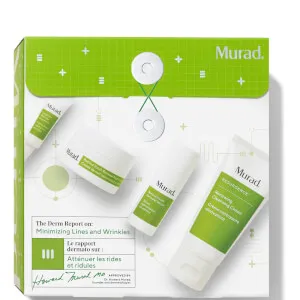
Murad The Derm Report on: Minimizing Lines and Wrinkles
Works for
CleansingSodium cocoyl isethionate, Glyceryl stearate se + 20 moreCan be harsh
“Renewing Cleansing Cream 60ml”
This product works by removing dirt and oil from the surface of the skin.
It contains the following cleansing agents that tend to be harsh on the skin: benzalkonium chloride.
The following cleansing agents are typically mild, but still can cause an irritation or allergy for some people cocamidopropyl dimethylamine, glyceryl oleate.
Keep in mind that cleansing can disrupt the skin barrier, and most people do not need to cleanse their skin more than once per day.
ExfoliationNot advertised by the brand · Retinol, Urea + 1 moreWorks well
This product can help exfoliate the skin. In other words, it helps break down the bonds between dead cells on the surface of the skin and speed up the skin turnover. Skin often appears softer and brighter after exfoliation, but overdoing it can result in disrupted skin barrier. The following ingredient is doing the exfoliating job in this product: retinol.
Anti-blemishNot advertised by the brand · Retinol, Retinyl propionate + 2 moreWorks well
This product can help reduce breakouts and clogged pores because it contains the following ingredient: retinol. This ingredient is used for treating acne and can have a noticeable effect.
The following ingredient (ingredients) in this product might be helpful, but there is no evidence to confirm that it actually works: retinyl propionate
Can it cause trouble?
Irritancy8 strong irritants: Benzophenone-4, Parfum + 6 more — patch-test recommendedHigh risk
Comedogenic7 ingredients rated 2 or more on the 0–5 pore-clogging scale7 flagged


User reviews
Be the first — your take helps the next person decide.
Ingredients
Filter by role to see what each ingredient is doing.
Water~40–60%
Sodium cocoyl isethionate~8–12%
- Irritation risk
- Medium
Helps water and oil mix together. Can be used as a cleansing agent
More about Sodium cocoyl isethionateGlyceryl stearate se~3.6–5.4%
- Irritation risk
- Low
- Comedogenicity
- 2/5
Used to stabilize the product formulations and works as an emollient
More about Glyceryl stearate seGlycerin~2.8–4.1%
- Irritation risk
- Low
One of the best moisturizing ingredients. Naturally present in skin. It attracts water to the upper layer of the skin working as a humectant
More about GlycerinStearic acid~2.1–3.2%
- Irritation risk
- Low
Helps oil and water mix together and works as an emollient
More about Stearic acidCetyl alcohol~1.7–2.6%
- Irritation risk
- Low
A non-drying alcohol that works to soften the skin and stabilize product formulations helping oil and water mix together
More about Cetyl alcoholPrunus armeniaca kernel oil~1.5–2.2%
- Irritation risk
- Medium
An emollient that helps soften the skin
More about Prunus armeniaca kernel oilPalmitoyl tripeptide-5~1.2–1.8%
- Irritation risk
- Low
A type of peptide. Peptides are excellent moisturizers and might be able support collagen production reducing fine lines and wrinkles
More about Palmitoyl tripeptide-5Butyrospermum parkii butter extract~1.1–1.6%
- Irritation risk
- Low
- Comedogenicity
- 3/5
A great moisturising ingredient that softens the skin and reduces water loss from its upper layer. It also can be helpful in protecting skin from free radicals
More about Butyrospermum parkii butter extractCocamidopropyl dimethylamine~0.85–1.25%
- Irritation risk
- High
Helps oil and water mix together. Can work as a cleansing agent. Can be irritating
More about Cocamidopropyl dimethylamineLactic acid~0.5–1.15%
- Irritation risk
- Medium
An exfoliating and moisturizing alpha-hydroxy acid (AHA). Typically causes less irritation than other AHAs, for example, glycolic acid. At high concentrations (about 15%), lactic acid can help reduce lines and wrinkles. Recent studies show that lactic acid can support the "good" bacteria living on skin's surface (healthy skin microbiome)
More about Lactic acidHydrated silica~0.85–1.25%
Phenylethyl resorcinol~0.4–0.95%
- Irritation risk
- High
Might help reduce hyperpigmentation in skin and help neutralize free radicals
More about Phenylethyl resorcinolHydrolyzed corn starch~0.35–0.85%
- Irritation risk
- Low
Helps improve the product texture
More about Hydrolyzed corn starchSodium hydroxide~0.35–0.8%
Urea~0.35–0.8%
- Irritation risk
- Low
Naturally present in skin (urea makes up about 7% of natural moisturizing factors in skin). Attracts water to the upper layer of the skin. Also has a positive effect on the skin barrier beyond the humectant action. Can enhance penetration of other ingredients. Is an exfoliating ingredient when used in high concentrations
More about UreaYeast amino acids~0.3–0.75%
- Irritation risk
- Low
Trehalose~0.2–0.8%
- Irritation risk
- Low
A sugar that attracts water to the upper layer of the skin
More about TrehaloseInositol~0.2–0.75%
Taurine~0.2–0.7%
- Irritation risk
- Medium
Could be helpful in reducing inflammation in skin, evening out the skin tone and neutralizing free radicals, but more research is needed to confirm its effectiveness
More about TaurineBetaine~0.15–0.65%
- Irritation risk
- Low
Helps attract water to the upper layer of the skin and improves the product texture
More about BetaineBorago officinalis seed oil~0.15–0.7%
- Irritation risk
- Low
A plant oil that is effective in reducing irritation in skin, restore the barrier function and support its hydration
More about Borago officinalis seed oilOenothera biennis seed extract~0.15–0.6%
- Irritation risk
- Medium
A plant extract that might have some anti-oxidant properties but evidence is lacking
More about Oenothera biennis seed extractSerenoa serrulata fruit extract~0.15–0.6%
- Irritation risk
- Medium
A plant extract that might help calm down inflammation in skin but evidence of effectiveness is lacking
More about Serenoa serrulata fruit extractPanthenol~0.15–0.6%
- Irritation risk
- Low
Helps attract water to the upper layer of the skin and can help improve skin barrier function
More about PanthenolChondrus crispus extract~0.15–0.65%
- Irritation risk
- Low
- Comedogenicity
- 3/5
Red algae extract that helps attract water to the upper layer of the skin and create a nicer product consistency
More about Chondrus crispus extractChamomilla recutita flower extract~0.15–0.6%
- Irritation risk
- High
Plant extract that can have healing and anti-inflammatory properties. It is a potential allergen and can be irritating
More about Chamomilla recutita flower extractSodium hyaluronate~0.15–0.6%
- Irritation risk
- Low
One of the best moisturizing ingredients. Attracts water into the upper layer of the skin
More about Sodium hyaluronateImperata cylindrica root extract~0.15–0.6%
- Irritation risk
- Medium
A plat extract that might help neutralize free radicals in skin and attract water to its upper layer
More about Imperata cylindrica root extractBenzophenone-4~0.35–0.85%
- Irritation risk
- High
Sulisobenzone. A UV filter. Is typically used to improve the product stability under exposure to UV light. It is effective against both UVA and UVB rays. It can be used is larger concentrations as a sun protection ingredient for the skin, but can be irritating
More about Benzophenone-4Butylene glycol~0.15–0.6%
- Irritation risk
- Low
Used to create a nice product texture and help delivery of other ingredients. Might be somewhat helpful in attracting water to the upper layer of the skin
More about Butylene glycolPeg-8~0.15–0.65%
- Irritation risk
- Medium
Used to create a nice product consistency
More about Peg-8Benzalkonium chloride~0.05–0.1%
- Irritation risk
- High
Helps water and oil mix together and works as a cleansing agent (detergent). Also used as a preservative. Can be irritating
More about Benzalkonium chlorideCarbomer~0.15–0.6%
- Irritation risk
- Low
Helps create a thicker or gel-like product texture. It is not a surfactant but can be used in gentle cleansing formulations
More about CarbomerXanthan gum~0.15–0.65%
- Irritation risk
- Low
Used to create a thicker product consistency
More about Xanthan gumPhenoxyethanol~0.15–0.65%
- Irritation risk
- Low
A preservative. It helps prevent bacterial growth in cosmetic products
More about PhenoxyethanolCaprylyl glycol~0.15–0.65%
- Irritation risk
- Medium
Helps preserve products and creates a nice product texture
More about Caprylyl glycolChlorphenesin~0.16–0.32%
Parfum~0.15–0.55%
- Irritation risk
- High
An aromatic blend of unspecified and possibly irritating ingredients
More about ParfumWater~0.15–0.6%
Polysilicone-11~0.15–0.7%
- Irritation risk
- Low
A silicone that forms a light film on the skin surface helping to bind water and temporarily absorb oils creating a matt and powdery feel
More about Polysilicone-11Squalane~0.2–0.7%
- Irritation risk
- Low
An oil naturally present in skin. Works as an emollient to soften the skin and form a protective layer on its surface without a greasy feeling.
More about SqualanePropanediol~0.15–0.65%
- Irritation risk
- Low
Acts as a solvent for other ingredients. Speeds up the absorption of other ingredients into the skin
More about PropanediolCetyl alcohol~0.2–0.7%
- Irritation risk
- Low
A non-drying alcohol that works to soften the skin and stabilize product formulations helping oil and water mix together
More about Cetyl alcoholSodium acrylates crosspolymer-2~0.15–0.6%
- Irritation risk
- Low
Potassium cetyl phosphate~0.15–0.65%
- Irritation risk
- Medium
Helps oil and water mix together
More about Potassium cetyl phosphatePolyglyceryl-3 laurate~0.15–0.65%
Urea~0.15–0.6%
- Irritation risk
- Low
Naturally present in skin (urea makes up about 7% of natural moisturizing factors in skin). Attracts water to the upper layer of the skin. Also has a positive effect on the skin barrier beyond the humectant action. Can enhance penetration of other ingredients. Is an exfoliating ingredient when used in high concentrations
More about UreaYeast amino acids~0.15–0.6%
- Irritation risk
- Low
Trehalose~0.15–0.6%
- Irritation risk
- Low
A sugar that attracts water to the upper layer of the skin
More about TrehaloseInositol~0.15–0.6%
Taurine~0.15–0.6%
- Irritation risk
- Medium
Could be helpful in reducing inflammation in skin, evening out the skin tone and neutralizing free radicals, but more research is needed to confirm its effectiveness
More about TaurineBetaine~0.15–0.6%
- Irritation risk
- Low
Helps attract water to the upper layer of the skin and improves the product texture
More about BetaineLaureth-12~0.15–0.65%
Chlorphenesin~0.16–0.32%
Barium sulfate~0.15–0.65%
- Irritation risk
- Low
Sodium acetylated hyaluronate~0.15–0.6%
- Irritation risk
- Low
A type of hyaluronic acid that works as an excellent moisturizer by attracting water into the upper layer of the skin. Is typically feels less sticky on the skin compared to the usual hyaluronic acid
More about Sodium acetylated hyaluronateSodium carbonate~0.15–0.65%
Disodium edta~0.15–0.6%
Glyceryl oleate~0.15–0.65%
- Irritation risk
- High
Helps oil and water mix together. Can be irritating
More about Glyceryl oleateEthylhexylglycerin~0.15–0.6%
Acetyl hexapeptide-8~0.15–0.6%
- Irritation risk
- Low
A type of peptide. Peptides are excellent moisturizers and might be able support collagen production reducing fine lines and wrinkles
More about Acetyl hexapeptide-8Potassium sorbate~0.3–0.6%
Sodium benzoate~0.25–0.5%
Phenoxyethanol~0.15–0.65%
- Irritation risk
- Low
A preservative. It helps prevent bacterial growth in cosmetic products
More about PhenoxyethanolTocopherol~0.15–0.65%
- Irritation risk
- Low
Pure form of vitamin E. Can help moisturise and protect the skin from free radicals. Often used to help stabilise other ingredients or the formula itself
More about TocopherolWater~0.15–0.6%
Dimethicone~0.2–0.75%
- Irritation risk
- Low
A silicone that helps to reduce water loss from the surface of the skin. Can temporarily "fill in" lines and wrinkles, absorb oil, and create a nice product finish
More about DimethiconeCyclopentasiloxane~0.15–0.7%
- Irritation risk
- Low
A silicone that helps improve the product texture and spreadability. Can absorb oil creating a short-term mattifying effect on the skin
More about CyclopentasiloxaneIsopropyl palmitate~0.15–0.65%
- Irritation risk
- Medium
- Comedogenicity
- 3/5
Helps soften the upper layer of the skin and create a thicker product consistency
More about Isopropyl palmitateC14-22 alcohols~0.15–0.6%
- Irritation risk
- Low
A non-drying alcohol that helps stabilize product formulations
More about C14-22 alcoholsPolymethylsilsesquioxane~0.15–0.65%
- Irritation risk
- Low
A silicone that improves product texture and helps dissolve other ingredients. Can form a non-greasy film on the skin to prevent moisture loss
More about PolymethylsilsesquioxanePropanediol~0.15–0.65%
- Irritation risk
- Low
Acts as a solvent for other ingredients. Speeds up the absorption of other ingredients into the skin
More about PropanediolGlyceryl stearate~0.2–0.7%
- Irritation risk
- Low
An emollient that softens the skin and forms a protective layer on its surface. Helps water and oil mix together
More about Glyceryl stearatePeg-100 stearate~0.2–0.8%
- Irritation risk
- Low
Helps oil and water mix togehter and creates a nice product texture
More about Peg-100 stearateShea butter ethyl esters~0.15–0.65%
- Irritation risk
- Low
Helps soften the upper layer of the skin
More about Shea butter ethyl estersRetinol~0.15–0.6%
- Irritation risk
- High
Two steps removed from the active form of vitamin A - retinoic acid. Once converted to the retinoic acid in the skin, retinol is proven to be effective against all signs of aging. It improves skin cell turnover, helps fight blemishes and clogged pores, can regulate excess oil production and even skin tone. It can, however, be quite irritating
More about RetinolRetinyl propionate~0.15–0.6%
- Irritation risk
- High
Three steps removed from the active form of vitamin A - retinoic acid. To have an effect in the skin, it first needs to be converted twice to become the retinoic acid. This means it is less potent than retinol, but could also be less irritating. Once converted to the retinoic acid in the skin, it helps against all signs of aging, improves skin cell turnover and helps fight blemishes and clogged pores, even thought its potency is not as well established as in case of retinol or retinaldehyde
More about Retinyl propionateCeramide np~0.15–0.7%
- Irritation risk
- Low
A type of lipid similar to ceramides naturally present in skin. Helps to soften the upper layer of the skin and supports the skin barrier function to keep it hydrated. Can help to prevent inflammation in skin
More about Ceramide npSodium hyaluronate~0.15–0.6%
- Irritation risk
- Low
One of the best moisturizing ingredients. Attracts water into the upper layer of the skin
More about Sodium hyaluronateSolanum lycopersicum fruit extract~0.15–0.65%
- Irritation risk
- Low
Swertia chirata extract~0.15–0.6%
- Irritation risk
- Medium
A plant extract that can have an anti-bacterial and anti-inflammatory effect, but evidence of effectiveness is lacking
More about Swertia chirata extractSqualane~0.2–0.7%
- Irritation risk
- Low
An oil naturally present in skin. Works as an emollient to soften the skin and form a protective layer on its surface without a greasy feeling.
More about SqualanePunica granatum extract~0.15–0.6%
- Irritation risk
- Medium
A plant extract that can help neutralize free radicals in skin and even out the skin tone, but is typically used in products in a concentration that is too low to be effective
More about Punica granatum extractTocopheryl acetate~0.15–0.65%
- Irritation risk
- Medium
A more stable but less bio-available form of vitamin E compared to Tocopherol. Might help moisturize and protect the skin from free radicals, but mostly used in low concentrations to stabilize other ingredients.
More about Tocopheryl acetateGlycine soja extract~0.15–0.6%
- Irritation risk
- Low
Urea~0.15–0.6%
- Irritation risk
- Low
Naturally present in skin (urea makes up about 7% of natural moisturizing factors in skin). Attracts water to the upper layer of the skin. Also has a positive effect on the skin barrier beyond the humectant action. Can enhance penetration of other ingredients. Is an exfoliating ingredient when used in high concentrations
More about UreaYeast amino acids~0.15–0.6%
- Irritation risk
- Low
Trehalose~0.15–0.6%
- Irritation risk
- Low
A sugar that attracts water to the upper layer of the skin
More about TrehaloseInositol~0.15–0.6%
Taurine~0.15–0.6%
- Irritation risk
- Medium
Could be helpful in reducing inflammation in skin, evening out the skin tone and neutralizing free radicals, but more research is needed to confirm its effectiveness
More about TaurineBetaine~0.15–0.6%
- Irritation risk
- Low
Helps attract water to the upper layer of the skin and improves the product texture
More about BetaineGlycerin~0.15–0.7%
- Irritation risk
- Low
One of the best moisturizing ingredients. Naturally present in skin. It attracts water to the upper layer of the skin working as a humectant
More about GlycerinCaprylic/capric triglyceride~0.2–0.75%
- Irritation risk
- Medium
A good mix of fatty acids that forms a protective layer on the skin. Improves the shelf life of products. Derived from coconut and glycerin
More about Caprylic/capric triglycerideDimethyl isosorbide~0.15–0.6%
- Irritation risk
- Low
Used to dissolve other ingredients in a product and can enhance their ability to penetrate the skin
More about Dimethyl isosorbideSilica~0.3–0.75%
Ethylhexyl palmitate~0.15–0.7%
- Irritation risk
- Low
- Comedogenicity
- 3/5
An emollient that helps soften the skin and create a nice product texture
More about Ethylhexyl palmitateSilica dimethyl silylate~0.15–0.7%
Butylene glycol~0.15–0.6%
- Irritation risk
- Low
Used to create a nice product texture and help delivery of other ingredients. Might be somewhat helpful in attracting water to the upper layer of the skin
More about Butylene glycolLecithin~0.15–0.7%
- Irritation risk
- Low
Used mostly for creating emulsions - helping oil and water mix together. Helps soften the upper layer of the skin
More about LecithinAmmonium acryloyldimethyltaurate/vp copolymer~0.15–0.6%
- Irritation risk
- Low
Increases thickness of a product. Texture enhancer for oil-in-water emulsions
More about Ammonium acryloyldimethyltaurate/vp copolymerC12-20 alkyl glucoside~0.15–0.65%
- Irritation risk
- Medium
Helps water and oil mix together
More about C12-20 alkyl glucosideCetyl palmitate~0.15–0.7%
- Irritation risk
- Low
An emollient that helps soften the skin and is used to improve product texture and stability
More about Cetyl palmitateLaureth-23~0.2–0.8%
- Irritation risk
- Medium
- Comedogenicity
- 2/5
Helps oil and water mix together
More about Laureth-23Polysorbate 20~0.15–0.65%
Trideceth-6 phosphate~0.15–0.65%
- Irritation risk
- Medium
Helps oil and water mix together
More about Trideceth-6 phosphateSynthetic fluorphlogopite~0.15–0.65%
- Irritation risk
- Low
A mineral that is used as an optical filter (makes the skin looks nicer through light reflection) and to improve the texture of cosmetic products
More about Synthetic fluorphlogopitePhenoxyethanol~0.15–0.65%
- Irritation risk
- Low
A preservative. It helps prevent bacterial growth in cosmetic products
More about PhenoxyethanolEthylhexylglycerin~0.15–0.6%
Chlorphenesin~0.16–0.32%
Disodium edta~0.15–0.6%
Sodium hydroxide~0.15–0.6%
Tris(tetramethylhydroxypiperidinol) citrate~0.15–0.6%
- Irritation risk
- Low
Sodium benzotriazolyl butylphenol sulfonate~0.15–0.6%
- Irritation risk
- Medium
Helps protect the ingredients in the formulation against UV light
More about Sodium benzotriazolyl butylphenol sulfonateTitanium dioxide~0.3–0.7%
- Irritation risk
- Low
Works as a UV filter when used in high concentrations. It is photostable and is effective mostly against the UVB light, with some protection in the UVA range. In small concentrations, used for its ability to improve the color of cosmetic products. Is usually well tolerated by the skin
More about Titanium dioxideCi 14700~0.15–0.6%
Ci 19140~0.15–0.6%
Alpha-isomethyl ionone~0.15–0.55%
- Irritation risk
- High
A fragrance. Potential allergen and can be irritating
More about Alpha-isomethyl iononeCitronellol~0.15–0.55%
Parfum~0.15–0.55%
- Irritation risk
- High
An aromatic blend of unspecified and possibly irritating ingredients
More about ParfumWater~0.15–0.6%
Butylene glycol~0.15–0.6%
- Irritation risk
- Low
Used to create a nice product texture and help delivery of other ingredients. Might be somewhat helpful in attracting water to the upper layer of the skin
More about Butylene glycolTricaprylyl citrate~0.15–0.65%
- Irritation risk
- Low
Pentylene glycol~0.2–0.7%
- Irritation risk
- Medium
Used to preserve products, dissolve other ingredients and create a nice product texture
More about Pentylene glycolBis-diglyceryl polyacyladipate-2~0.2–0.8%
- Irritation risk
- Low
Helps soften the upper layer of the skin and reduce water loss from its surface
More about Bis-diglyceryl polyacyladipate-2Jojoba esters~0.2–0.75%
- Irritation risk
- Medium
An emollient made of jojoba oil. Helps soften the skin and support its barrier function
More about Jojoba estersGlycerin~0.2–0.75%
- Irritation risk
- Low
One of the best moisturizing ingredients. Naturally present in skin. It attracts water to the upper layer of the skin working as a humectant
More about GlycerinBoron nitride~0.15–0.7%
- Irritation risk
- Low
Helps to absord oil and evenly disperse other ingredients (for example, pigment) in product formulation
More about Boron nitrideCaprylic/capric/myristic/stearic triglyceride~0.2–0.75%
- Irritation risk
- Low
Helps to soften the upper layer of the skin
More about Caprylic/capric/myristic/stearic triglycerideCetyl alcohol~0.2–0.8%
- Irritation risk
- Low
A non-drying alcohol that works to soften the skin and stabilize product formulations helping oil and water mix together
More about Cetyl alcoholStearic acid~0.35–0.8%
- Irritation risk
- Low
Helps oil and water mix together and works as an emollient
More about Stearic acidGlyceryl stearate~0.2–0.8%
- Irritation risk
- Low
An emollient that softens the skin and forms a protective layer on its surface. Helps water and oil mix together
More about Glyceryl stearatePeg-100 stearate~0.35–0.75%
- Irritation risk
- Low
Helps oil and water mix togehter and creates a nice product texture
More about Peg-100 stearateCitrus unshiu peel extract~0.15–0.7%
- Irritation risk
- High
Mangifera indica seed butter~0.15–0.65%
- Irritation risk
- Low
Helps to soften the upper layer of the skin and might have some anti-oxidant effect
More about Mangifera indica seed butterDimethicone~0.3–0.7%
- Irritation risk
- Low
A silicone that helps to reduce water loss from the surface of the skin. Can temporarily "fill in" lines and wrinkles, absorb oil, and create a nice product finish
More about DimethiconeCetyl phosphate~0.2–0.7%
Urea~0.15–0.7%
- Irritation risk
- Low
Naturally present in skin (urea makes up about 7% of natural moisturizing factors in skin). Attracts water to the upper layer of the skin. Also has a positive effect on the skin barrier beyond the humectant action. Can enhance penetration of other ingredients. Is an exfoliating ingredient when used in high concentrations
More about UreaYeast amino acids~0.15–0.7%
- Irritation risk
- Low
Trehalose~0.15–0.7%
- Irritation risk
- Low
A sugar that attracts water to the upper layer of the skin
More about TrehaloseInositol~0.15–0.7%
Taurine~0.15–0.7%
- Irritation risk
- Medium
Could be helpful in reducing inflammation in skin, evening out the skin tone and neutralizing free radicals, but more research is needed to confirm its effectiveness
More about TaurineBetaine~0.15–0.65%
- Irritation risk
- Low
Helps attract water to the upper layer of the skin and improves the product texture
More about BetaineGlycine soja seed extract~0.2–0.75%
- Irritation risk
- Medium
An emollient that helps soften the skin. Might be somewhat helpful in evening the skin tone.
More about Glycine soja seed extractIris florentina root extract~0.15–0.65%
- Irritation risk
- Low
Dioscorea villosa root extract~0.15–0.65%
- Irritation risk
- Low
Glycine soja sterols~0.2–0.75%
- Irritation risk
- Low
An emollient that helps soften the skin
More about Glycine soja sterolsTrifolium pratense flower extract~0.15–0.7%
- Irritation risk
- High
Red clover flower extract. Can contain anti-oxidants but also potential irritant compounds
More about Trifolium pratense flower extractPalmitoyl oligopeptide~0.3–0.75%
- Irritation risk
- Low
A type of peptide. Peptides are excellent moisturizers and might be able support collagen production reducing fine lines and wrinkles
More about Palmitoyl oligopeptidePalmitoyl tetrapeptide-7~0.2–0.75%
- Irritation risk
- Low
A type of peptide. Peptides are excellent moisturizers and might be able support collagen production reducing fine lines and wrinkles
More about Palmitoyl tetrapeptide-7Retinol~0.15–0.65%
- Irritation risk
- High
Two steps removed from the active form of vitamin A - retinoic acid. Once converted to the retinoic acid in the skin, retinol is proven to be effective against all signs of aging. It improves skin cell turnover, helps fight blemishes and clogged pores, can regulate excess oil production and even skin tone. It can, however, be quite irritating
More about RetinolSodium hyaluronate~0.15–0.7%
- Irritation risk
- Low
One of the best moisturizing ingredients. Attracts water into the upper layer of the skin
More about Sodium hyaluronateSerenoa serrulata fruit extract~0.15–0.65%
- Irritation risk
- Medium
A plant extract that might help calm down inflammation in skin but evidence of effectiveness is lacking
More about Serenoa serrulata fruit extractOenothera biennis oil~0.2–0.75%
- Irritation risk
- Medium
Helps soften the upper layer of the skin and can support skin barrier function
More about Oenothera biennis oilTocopherol~0.2–0.7%
- Irritation risk
- Low
Pure form of vitamin E. Can help moisturise and protect the skin from free radicals. Often used to help stabilise other ingredients or the formula itself
More about TocopherolAscorbyl palmitate~0.15–0.65%
- Irritation risk
- Medium
Being a lipid soluble form of vitamin C, it is more stable and can penetrate the skin better than L-Ascorbic acid. It is effective in protecting the skin from free radicals, as well as evening the skin tone, but is less effective in stimulating collagen production compared to L-Ascorbic acid.
More about Ascorbyl palmitateBorago officinalis seed oil~0.2–0.75%
- Irritation risk
- Low
A plant oil that is effective in reducing irritation in skin, restore the barrier function and support its hydration
More about Borago officinalis seed oilDipeptide-2~0.15–0.65%
- Irritation risk
- Low
A type of peptide. Peptides are excellent moisturizers and might be able support collagen production reducing fine lines and wrinkles
More about Dipeptide-2Hesperidin methyl chalcone~0.15–0.7%
- Irritation risk
- High
Might help neutralize free radicals in skin. Is claimed to be able to improve the appearance of undereye darkness but evidence is missing. Can be an allergen and cause irritation
More about Hesperidin methyl chalconeCaprylic/capric triglyceride~0.3–0.7%
- Irritation risk
- Medium
A good mix of fatty acids that forms a protective layer on the skin. Improves the shelf life of products. Derived from coconut and glycerin
More about Caprylic/capric triglycerideSodium pca~0.15–0.65%
- Irritation risk
- Low
Naturally present in skin and helps to attract water to its upper layer
More about Sodium pcaPanthenol~0.15–0.65%
- Irritation risk
- Low
Helps attract water to the upper layer of the skin and can help improve skin barrier function
More about PanthenolOleyl alcohol~0.15–0.65%
Steareth-20~0.3–0.7%
Lecithin~0.2–0.7%
- Irritation risk
- Low
Used mostly for creating emulsions - helping oil and water mix together. Helps soften the upper layer of the skin
More about LecithinCarbomer~0.15–0.55%
- Irritation risk
- Low
Helps create a thicker or gel-like product texture. It is not a surfactant but can be used in gentle cleansing formulations
More about CarbomerPolysorbate 20~0.15–0.6%
Sodium potassium aluminum silicate~0.15–0.55%
- Irritation risk
- Low
Aminomethyl propanol~0.1–0.45%
Disodium edta~0.1–0.35%
Silica~0.15–0.6%
Phenoxyethanol~0.1–0.35%
- Irritation risk
- Low
A preservative. It helps prevent bacterial growth in cosmetic products
More about PhenoxyethanolCaprylyl glycol~0.1–0.4%
- Irritation risk
- Medium
Helps preserve products and creates a nice product texture
More about Caprylyl glycolChlorphenesin~0.05–0.25%
Titanium dioxide~0.05–0.25%
- Irritation risk
- Low
Works as a UV filter when used in high concentrations. It is photostable and is effective mostly against the UVB light, with some protection in the UVA range. In small concentrations, used for its ability to improve the color of cosmetic products. Is usually well tolerated by the skin
More about Titanium dioxideIngredient list view
Water, Sodium cocoyl isethionate, Glyceryl stearate se, Glycerin, Stearic acid, Cetyl alcohol, Prunus armeniaca kernel oil, Palmitoyl tripeptide-5, Butyrospermum parkii butter extract, Cocamidopropyl dimethylamine, Lactic acid, Hydrated silica, Phenylethyl resorcinol, Hydrolyzed corn starch, Sodium hydroxide, Urea, Yeast amino acids, Trehalose, Inositol, Taurine, Betaine, Borago officinalis seed oil, Oenothera biennis seed extract, Serenoa serrulata fruit extract, Panthenol, Chondrus crispus extract, Chamomilla recutita flower extract, Sodium hyaluronate, Imperata cylindrica root extract, Benzophenone-4, Butylene glycol, Peg-8, Benzalkonium chloride, Carbomer, Xanthan gum, Phenoxyethanol, Caprylyl glycol, Chlorphenesin, Parfum, Water, Polysilicone-11, Squalane, Propanediol, Cetyl alcohol, Sodium acrylates crosspolymer-2, Potassium cetyl phosphate, Polyglyceryl-3 laurate, Urea, Yeast amino acids, Trehalose, Inositol, Taurine, Betaine, Laureth-12, Chlorphenesin, Barium sulfate, Sodium acetylated hyaluronate, Sodium carbonate, Disodium edta, Glyceryl oleate, Ethylhexylglycerin, Acetyl hexapeptide-8, Potassium sorbate, Sodium benzoate, Phenoxyethanol, Tocopherol, Water, Dimethicone, Cyclopentasiloxane, Isopropyl palmitate, C14-22 alcohols, Polymethylsilsesquioxane, Propanediol, Glyceryl stearate, Peg-100 stearate, Shea butter ethyl esters, Retinol, Retinyl propionate, Ceramide np, Sodium hyaluronate, Solanum lycopersicum fruit extract, Swertia chirata extract, Squalane, Punica granatum extract, Tocopheryl acetate, Glycine soja extract, Urea, Yeast amino acids, Trehalose, Inositol, Taurine, Betaine, Glycerin, Caprylic/capric triglyceride, Dimethyl isosorbide, Silica, Ethylhexyl palmitate, Silica dimethyl silylate, Butylene glycol, Lecithin, Ammonium acryloyldimethyltaurate/vp copolymer, C12-20 alkyl glucoside, Cetyl palmitate, Laureth-23, Polysorbate 20, Trideceth-6 phosphate, Synthetic fluorphlogopite, Phenoxyethanol, Ethylhexylglycerin, Chlorphenesin, Disodium edta, Sodium hydroxide, Tris(tetramethylhydroxypiperidinol) citrate, Sodium benzotriazolyl butylphenol sulfonate, Titanium dioxide, Ci 14700, Ci 19140, Alpha-isomethyl ionone, Citronellol, Parfum, Water, Butylene glycol, Tricaprylyl citrate, Pentylene glycol, Bis-diglyceryl polyacyladipate-2, Jojoba esters, Glycerin, Boron nitride, Caprylic/capric/myristic/stearic triglyceride, Cetyl alcohol, Stearic acid, Glyceryl stearate, Peg-100 stearate, Citrus unshiu peel extract, Mangifera indica seed butter, Dimethicone, Cetyl phosphate, Urea, Yeast amino acids, Trehalose, Inositol, Taurine, Betaine, Glycine soja seed extract, Iris florentina root extract, Dioscorea villosa root extract, Glycine soja sterols, Trifolium pratense flower extract, Palmitoyl oligopeptide, Palmitoyl tetrapeptide-7, Retinol, Sodium hyaluronate, Serenoa serrulata fruit extract, Oenothera biennis oil, Tocopherol, Ascorbyl palmitate, Borago officinalis seed oil, Dipeptide-2, Hesperidin methyl chalcone, Caprylic/capric triglyceride, Sodium pca, Panthenol, Oleyl alcohol, Steareth-20, Lecithin, Carbomer, Polysorbate 20, Sodium potassium aluminum silicate, Aminomethyl propanol, Disodium edta, Silica, Phenoxyethanol, Caprylyl glycol, Chlorphenesin, Titanium dioxide
Compare prices
Retailers ranked by price — lowest first.
Affiliate links · As an Amazon Associate, WIMJ earns from qualifying purchases.
Worth comparing, line by line.
Match % combines shared ingredients, the first five ingredients, shared actives and hero ingredients, irritancy (lower counts in the alternative's favour), texture and body area. Only products in the same routine step are compared.
| MuradThe Derm Report on: Minimizing Lines and WrinklesYOUR PRODUCT | YEOUTHVitamin C Facial Cleanser Day/Night Cream | REVOLUTION SKINCARERetinol Smoothing Cream Cleanser | Cleaning SupplyRetinol 24 + Peptide Face Wash, Smoothing, Sulfate-Free | |
|---|---|---|---|---|
| Match | — | 70% | 69% | 68% |
| Price | — | $41.90 | — | — |
| Shared key ingredients | — | 9 of 61 | 8 of 61 | 8 of 61 |
| Key difference | — | Sodium Ascorbyl Phosphate | Prunus Amygdalus Dulcis Seed | Mineral Oil |
| Irritancy | High | Medium | Medium | Medium |
| Drying alcohol | — | — | Contains drying alcohol | — |
| View product | Shop | Shop | Shop |


More alternatives: June Jacobs Spa June Jacobs Intensive Age Defying Hydrating CleanserMALIN + GOETZ retinol correcting serum
Sources cited in this review
Every concentration estimate and effectiveness label is anchored to one of these 51 studies and safety reviews.
- 1Final Report on the Safety Assessment of Sodium Cocoyl Isethionatejournals.sagepub.com
- 2
- 3
- 4Epidermal and dermal effects of topical lactic acidncbi.nlm.nih.gov
- 5Dual Effects of Alpha-Hydroxy Acids on the Skinpdfs.semanticscholar.org
- 6Topical urea in skincare: A reviewpubmed.ncbi.nlm.nih.gov

Affiliate links · As an Amazon Associate, WIMJ earns from qualifying purchases.