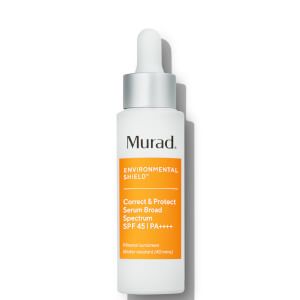
Murad Exclusive Correct and Protect Broad Spectrum SPF45 | PA++++ - Exclusive
Works for
3 of 3 advertised claims delivered
Sun protectionSPF 45 · 1 UV filterBroad spectrum
This product offers a good level of protection against both UVB and UVA rays.
It is a mineral sunscreen. In other words, it contains non-organic UV filters. It will probably not sting your eyes but might leave a white cast.
This product can be considered "reef safe" because it does not contain the UV filters (oxybenzone and octinoxate) that can be harmful to coral reefs when present in the water in high concentrations.
Moisturizing22 ingredients credited for this claimStrong support
“Flooding thirsty faces with moisturiser-levels of hydration is beet root extract that is quickly absorbed for weightless feel.”
This product can help improve hydration of the skin with the two types of ingredients.
The first type is called “humectants”:
these ingredients help attract water.
When humectants are on the surface of the skin, they “pull in” the moisture from the outside environment, or from
within deeper layers of the skin. The following ingredients in this product do the job:
betaine, fructooligosaccharides.
This product also contains ingredients called “occlusives”. They help reduce the speed with which our skin loses moisture to the outside environment. These ingredients also help soften the upper layer of the skin, so it feels less tight and nicer to the touch. The following ingredients in this product do the job: caprylic/capric triglyceride, dimethicone.
The following ingredients in this product are especially good for supporting the skin barrier and helping with the hydration level: urea
Evens skin tone5 ingredients credited for this claimStrong support
“Correcting discolouration as well as protecting your delicate skin from UV light with mineral filters, this is a match made in skin care heaven.”
This product offers broad spectrum sun protection. It means that it can prevent hyperpigmentation and help keep the skin tone even (sun damage is the main factor causing age spots, darkening of post-acne marks and other discolorations).
Anti-agingNot advertised by the brand · 5 ingredients credited for this claimStrong support
This product can help prevent early signs of skin aging because it offers a good level of broad spectrum sun protection. Sun damage is the main cause of premature skin aging, and protecting your skin from the sun is the best anti-aging strategy.
Can it cause trouble?
Irritancy1 strong irritant: Retinyl palmitateMedium risk
Comedogenic2 ingredients rated 2 or more on the 0–5 pore-clogging scale2 flagged

User reviews
Be the first — your take helps the next person decide.
Ingredients
Filter by role to see what each ingredient is doing.
Zinc oxide~44–54%
- Irritation risk
- Low
A broad spectrum sunblock (protects from both UVA and UVB rays). Is suitable for most sensitive skins. In small concentrations, can be used as a colorant
More about Zinc oxideIsododecane~5.4–6.6%
- Irritation risk
- Low
An emollient that helps soften the skin and can decrease moisture loss. Helps create a nice product texture
More about IsododecaneWater~4.4–5.3%
Dimethicone~3.4–4.1%
- Irritation risk
- Low
A silicone that helps to reduce water loss from the surface of the skin. Can temporarily "fill in" lines and wrinkles, absorb oil, and create a nice product finish
More about DimethiconePropanediol~2.6–3.2%
- Irritation risk
- Low
Acts as a solvent for other ingredients. Speeds up the absorption of other ingredients into the skin
More about PropanediolCaprylic/capric triglyceride~2.2–2.7%
- Irritation risk
- Medium
A good mix of fatty acids that forms a protective layer on the skin. Improves the shelf life of products. Derived from coconut and glycerin
More about Caprylic/capric triglyceridePolyglyceryl-6 polyricinoleate~1.8–2.2%
- Irritation risk
- Medium
Helps oil and water mix together
More about Polyglyceryl-6 polyricinoleatePolymethylsilsesquioxane/trimethylsiloxysilicate~1.5–1.8%
- Irritation risk
- Low
C12-15 alkyl benzoate~1.3–1.6%
- Irritation risk
- Low
Enhances the product texture and makes it more spreadable. Helps reduce water loss from the outer layer of skin. Extands the shelf life by preventing bacteria growth
More about C12-15 alkyl benzoateCoco-caprylate/caprate~1.1–1.3%
- Irritation risk
- Low
Helps to soften the upper layer of the skin without creating a greasy texture
More about Coco-caprylate/caprateEthylhexyl palmitate~0.95–1.15%
- Irritation risk
- Low
- Comedogenicity
- 3/5
An emollient that helps soften the skin and create a nice product texture
More about Ethylhexyl palmitatePolymethylsilsesquioxane~0.8–1.15%
- Irritation risk
- Low
A silicone that improves product texture and helps dissolve other ingredients. Can form a non-greasy film on the skin to prevent moisture loss
More about PolymethylsilsesquioxaneGlycerin~0.7–1.05%
- Irritation risk
- Low
One of the best moisturizing ingredients. Naturally present in skin. It attracts water to the upper layer of the skin working as a humectant
More about GlycerinTapioca starch~0.6–0.95%
Polyglyceryl-10 dioleate~0.65–0.95%
Polyhydroxystearic acid~0.6–0.95%
- Irritation risk
- Medium
Used to create a thicker product consistency and stabilize the formulation
More about Polyhydroxystearic acidFructooligosaccharides~0.55–0.8%
- Irritation risk
- Low
Help attract water to the upper layer of the skin
More about FructooligosaccharidesSimmondsia chinensis seed oil~0.6–0.85%
- Irritation risk
- Medium
Softens the upper layer of skin and helps restore the healthy skin barrier. Has shown to help calm down inflammation in skin. It is a stable oil, meaning that it retains its properties even when exposed to air.
More about Simmondsia chinensis seed oilLecithin~0.5–0.8%
- Irritation risk
- Low
Used mostly for creating emulsions - helping oil and water mix together. Helps soften the upper layer of the skin
More about LecithinButyrospermum parkii butter~0.5–0.75%
- Irritation risk
- Low
- Comedogenicity
- 3/5
A great moisturising ingredient that softens the skin and reduces water loss from its upper layer. It also can be helpful in protecting skin from free radicals
More about Butyrospermum parkii butterBeta vulgaris root extract~0.4–0.65%
- Irritation risk
- Medium
A plant extract that might have some antioxidant properties, but mostly used in cosmetics for its color
More about Beta vulgaris root extractHedychium coronarium root extract~0.4–0.6%
- Irritation risk
- Low
Solanum lycopersicum fruit extract~0.4–0.65%
- Irritation risk
- Low
Niacinamide~0.4–0.6%
- Irritation risk
- Low
Is proven to be effective in reducing blemishes, evening out skin tone and helping to improve lines and wrinkles. It helps the skin to repair sun damage, calm down inflammation and keep maintain good levels of moisture. The concentration of about 2% is effective for supporting the skin barrier and evening out the skin tone. Concentration of 4-6% is better for helping with acne and balancing the sebum production
More about NiacinamideSqualane~0.45–0.7%
- Irritation risk
- Low
An oil naturally present in skin. Works as an emollient to soften the skin and form a protective layer on its surface without a greasy feeling.
More about SqualaneUrea~0.4–0.6%
- Irritation risk
- Low
Naturally present in skin (urea makes up about 7% of natural moisturizing factors in skin). Attracts water to the upper layer of the skin. Also has a positive effect on the skin barrier beyond the humectant action. Can enhance penetration of other ingredients. Is an exfoliating ingredient when used in high concentrations
More about UreaYeast amino acids~0.4–0.6%
- Irritation risk
- Low
Trehalose~0.4–0.6%
- Irritation risk
- Low
A sugar that attracts water to the upper layer of the skin
More about TrehaloseTaurine~0.4–0.6%
- Irritation risk
- Medium
Could be helpful in reducing inflammation in skin, evening out the skin tone and neutralizing free radicals, but more research is needed to confirm its effectiveness
More about TaurineInositol~0.4–0.6%
Betaine~0.35–0.65%
- Irritation risk
- Low
Helps attract water to the upper layer of the skin and improves the product texture
More about BetaineTocopheryl acetate~0.4–0.65%
- Irritation risk
- Medium
A more stable but less bio-available form of vitamin E compared to Tocopherol. Might help moisturize and protect the skin from free radicals, but mostly used in low concentrations to stabilize other ingredients.
More about Tocopheryl acetateAscorbic acid~0.35–0.6%
- Irritation risk
- High
The most well-researched antioxidant that works in skin. Helps neutralize free radicals supporting collagen production, helping to even out the skin tone and preventing early signs of aging
More about Ascorbic acidRetinyl palmitate~0.25–0.45%
- Irritation risk
- High
Three steps removed from the active form of vitamin A - retinoic acid. To have an effect in the skin, it first needs to be converted twice to become the retinoic acid. This means it is less potent than retinol, but could also be less irritating. Once converted to the retinoic acid in the skin, it helps against all signs of aging, improves skin cell turnover and helps fight blemishes and clogged pores. However, in many cosmetic formulations, it is used in a concentration that is too low to have the full effect
More about Retinyl palmitatePotassium lactate~0.3–0.5%
- Irritation risk
- Low
Ethylhexylglycerin~0.3–0.5%
Lactic acid~0.25–0.5%
- Irritation risk
- Medium
An exfoliating and moisturizing alpha-hydroxy acid (AHA). Typically causes less irritation than other AHAs, for example, glycolic acid. At high concentrations (about 15%), lactic acid can help reduce lines and wrinkles. Recent studies show that lactic acid can support the "good" bacteria living on skin's surface (healthy skin microbiome)
More about Lactic acidLeuconostoc/radish root ferment filtrate~0.25–0.5%
- Irritation risk
- Medium
A preservative that comes from radishes fermented by a bacteria. New research suggests that the preservation properties in the ingredient come from an ammonium salt that is not present naturally in radish root but used in its cultivation. Is problematic because the exact amount of the preservative agents is difficult to determine
More about Leuconostoc/radish root ferment filtratePolysilicone-11~0.25–0.5%
- Irritation risk
- Low
A silicone that forms a light film on the skin surface helping to bind water and temporarily absorb oils creating a matt and powdery feel
More about Polysilicone-11Disteardimonium hectorite~0.2–0.4%
- Irritation risk
- Low
A type of clay that is used to thicken the product consistency
More about Disteardimonium hectoriteCaprylyl/capryl glucoside~0.3–0.55%
- Irritation risk
- Medium
Helps oil and water mix together. Can be used as a cleansing agent
More about Caprylyl/capryl glucosideDecyl glucoside~0.3–0.5%
- Irritation risk
- High
Helps oil and water mix together. Can be irritating
More about Decyl glucosidePropylene carbonate~0.2–0.4%
- Irritation risk
- Low
Is used to dissolve other ingredients and create nice product texture
More about Propylene carbonateCaprylyl glycol~0.15–0.3%
- Irritation risk
- Medium
Helps preserve products and creates a nice product texture
More about Caprylyl glycolHexylene glycol~0.1–0.25%
- Irritation risk
- Medium
Helps create a more spreadable product texture
More about Hexylene glycolTriethoxycaprylylsilane~0.15–0.25%
- Irritation risk
- Low
A type of silicone that helps oil and water mix well together. Helps to disperse other ingredients, e.g. pigments, evenly in a formulation
More about TriethoxycaprylylsilaneChlorphenesin~0.1–0.2%
Phenoxyethanol~0.1–0.2%
- Irritation risk
- Low
A preservative. It helps prevent bacterial growth in cosmetic products
More about PhenoxyethanolIron oxides~0.05–0.1%
- Irritation risk
- Low
An umbrella term for the following three colorants: CI 77491, CI 77492, CI 77499. They might be able to offer some protection against visible light, but the degree of the protection is not clear
More about Iron oxidesIngredient list view
Zinc oxide, Isododecane, Water, Dimethicone, Propanediol, Caprylic/capric triglyceride, Polyglyceryl-6 polyricinoleate, Polymethylsilsesquioxane/trimethylsiloxysilicate, C12-15 alkyl benzoate, Coco-caprylate/caprate, Ethylhexyl palmitate, Polymethylsilsesquioxane, Glycerin, Tapioca starch, Polyglyceryl-10 dioleate, Polyhydroxystearic acid, Fructooligosaccharides, Simmondsia chinensis seed oil, Lecithin, Butyrospermum parkii butter, Beta vulgaris root extract, Hedychium coronarium root extract, Solanum lycopersicum fruit extract, Niacinamide, Squalane, Urea, Yeast amino acids, Trehalose, Taurine, Inositol, Betaine, Tocopheryl acetate, Ascorbic acid, Retinyl palmitate, Potassium lactate, Ethylhexylglycerin, Lactic acid, Leuconostoc/radish root ferment filtrate, Polysilicone-11, Disteardimonium hectorite, Caprylyl/capryl glucoside, Decyl glucoside, Propylene carbonate, Caprylyl glycol, Hexylene glycol, Triethoxycaprylylsilane, Chlorphenesin, Phenoxyethanol, Iron oxides
Compare prices
Retailers ranked by price — lowest first.

Worth comparing, line by line.
Match % combines shared ingredients, the first five ingredients, shared actives and hero ingredients, irritancy (lower counts in the alternative's favour), texture and body area. Only products in the same routine step are compared.
| MuradExclusive Correct and Protect Broad Spectrum SPF45 | PA++++ - ExclusiveYOUR PRODUCT | Heliocare360 Pediatric Mineral SPF 50+ | KnoursKoolsol Ultra Light Invisible Mineral Sunscreen Broad Spectrum SPF 50 | CeraVeHydrating Mineral Face Sunscreen Lotion SPF 50 with Zinc Oxide | |
|---|---|---|---|---|
| Match | — | 74% | 73% | 72% |
| Price | $89.90 | $26.36−$63.54 | $25.00−$64.90 | $18.49−$71.41 |
| Shared key ingredients | — | 4 of 17 | 3 of 17 | 4 of 17 |
| Key difference | — | 3-O-Ethyl Ascorbic Acid | Madecassoside | Panthenol |
| Irritancy | Medium | Low | Low | Low |
| SPF | SPF 45 | SPF 50 | SPF 50 | SPF 50 |
| Drying alcohol | — | — | — | — |
| View product | Shop | Shop | Shop |


Product summary
We believe that "Murad - Exclusive Correct and Protect Broad Spectrum SPF45 | PA++++ - Exclusive" can provide reliable sun protection based on the ingredients listed. It can protect from both UVA and UVB rays. This is great news because not all sunscreens with SPF ratings give UVA protection. (UVA rays do not cause sunburn, but still damage our skin and lead to early aging).
It contains good moisturizing ingredients and can double as a hydrating day cream. Like all broad-spectrum sunscreens, this product helps prevent early signs of aging.
Sunscreen filters
This sunscreen is a mineral sunscreen. It uses zinc oxide for sun protection. Zinc oxide almost never irritates the skin or stings eyes, but it can leave a white cast.
Irritation risk
There are actives in this product that can be irritating. We assess the overall irritancy of this sunscreen to be medium. For a detailed overview of all potential irritants: click here
You can see the detailed formula review with the breakdown of all actives in the product and the full ingredient list with estimated concentrations in the tables below.
About the brand
According to Cruelty-Free Kitty "Murad" is cruelty free, but its parent company is not.
Price
The product retails from 30.99$ up to 93.90$ in the United States, from 41.61CA$ up to 119.00CA$ in Canada and from 68.00£ up to 70.00£ in the United Kingdom.
For a detailed price comparison: click here.
Sources cited in this review
Every concentration estimate and effectiveness label is anchored to one of these 16 studies and safety reviews.
- 1A review of inorganic UV filters zinc oxide and titanium dioxideonlinelibrary.wiley.com
- 2
- 3
- 4
- 5
- 6

Affiliate links · As an Amazon Associate, WIMJ earns from qualifying purchases.