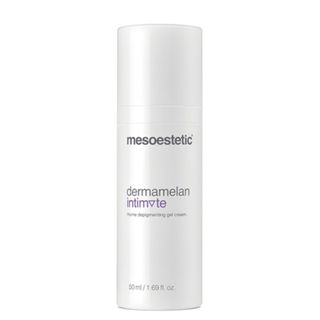
Mesoestetic Dermamelan Intimate Home Depigmenting Gel Cream
Works for
2 of 2 advertised claims delivered
Moisturizing17 ingredients credited for this claimStrong support
“Dermamelan Intimate Home Depigmenting Gel Cream”
This product can help improve hydration of the skin with the two types of ingredients.
The first type is called “humectants”:
these ingredients help attract water.
When humectants are on the surface of the skin, they “pull in” the moisture from the outside environment, or from
within deeper layers of the skin. The following ingredients in this product do the job:
glycerin, mannitol.
This product also contains ingredients called “occlusives”. They help reduce the speed with which our skin loses moisture to the outside environment. These ingredients also help soften the upper layer of the skin, so it feels less tight and nicer to the touch. The following ingredients in this product do the job: dimethicone, cholesterol.
The following ingredients in this product are especially good for supporting the skin barrier and helping with the hydration level: niacinamide
Evens skin tone6 ingredients credited for this claimStrong support
“This innovative home maintenance gel works by treating the mechanisms responsible for pigmentation formation, helping to prevent the appearance of dark spots and their reappearance.”
This product can help reduce hypepigmentation and even out the skin tone because it contains the following effective ingredients: kojic acid, niacinamide, potassium azeloyl diglycinate, tranexamic acid
The following ingredient (ingredients) in this product might be helpful, but there is no evidence to confirm that it actually can help even out the skin tone: glycyrrhiza glabra root extract.
Keep in mind that you would need to apply any topical skincare targetted at hypigmentation consistently for a couple of months to get a result. No topical skincare product can help get rid of hyperpigmentation (including post-acne marks and age spots) instantly.
Anti-agingNot advertised by the brand · 1 ingredient credited for this claimStrong support
This product can help reduce and prevent fine lines and wrinkles, improve skin elasticity and firmness because it contains niacinamide.
Keep in mind that it typically takes at least 6 weeks to notice any results because the changes that are needed to improve fine lines and elasticity happen in the deeper layers of the skin. No topical anti-aging product can “erase” wrinkles or fully reverse signs of aging.
Anti-oxidationNot advertised by the brand · 4 ingredients credited for this claimStrong support
This product contains antioxidants (kojic acid) that can help neutralize free radicals in skin. By doing so, they can lessen the damage the skin gets from the UV light (sun).
Anti-blemishNot advertised by the brand · 3 ingredients credited for this claimGood support
This product might be able to help reduce blemishes and clogged pores because it contains niacinamide, potassium azeloyl diglycinate.
Can it cause trouble?
Irritancy16 flagged ingredientsMedium risk
Comedogenic1 ingredient rated 2 or more on the 0–5 pore-clogging scale1 flagged


User reviews
Be the first — your take helps the next person decide.
Ingredients
Filter by role to see what each ingredient is doing.
Water~40–60%
Isodecyl neopentanoate~4.5–6.7%
- Irritation risk
- Low
An emollient that helps soften the skin. It also forms a protective on its surface to reduce water loss.
More about Isodecyl neopentanoateNiacinamide~3.7–5.5%
- Irritation risk
- Low
Is proven to be effective in reducing blemishes, evening out skin tone and helping to improve lines and wrinkles. It helps the skin to repair sun damage, calm down inflammation and keep maintain good levels of moisture. The concentration of about 2% is effective for supporting the skin barrier and evening out the skin tone. Concentration of 4-6% is better for helping with acne and balancing the sebum production
More about NiacinamidePotassium azeloyl diglycinate~2.7–4%
- Irritation risk
- Low
A derivative of azelaic acid. It is obtained by reacting the chloride of azelaic acid with two molecules of glycine (an amino acid) and potassium hydroxide. It is less studied than azelaic acid, but the available research suggests that it also can be effective in reducing skin redness, hyperpigmentation and blemishes. There are claims that it is more bio-available and more effective than azelaic acid, but no comparison study is available. Potassium azeloyl diglycinate is better soluble in water compared with azelaic acid. Because of this property, products with potassium azeloyl digclycinate can have a nicer texture
More about Potassium azeloyl diglycinateButylene glycol~2–3%
- Irritation risk
- Low
Used to create a nice product texture and help delivery of other ingredients. Might be somewhat helpful in attracting water to the upper layer of the skin
More about Butylene glycolTranexamic acid~1.6–2.4%
- Irritation risk
- Low
An amino acid that is effective in reducing hyperpigmentation and evening out the skin tone. It can also help in skin barrier recovery. It is used to treat melasma, especially with injections and when taken orally
More about Tranexamic acidIsostearyl alcohol~1.4–2.1%
- Irritation risk
- Low
Helps soften the upper layer of the skin
More about Isostearyl alcoholGlycerin~1.3–1.9%
- Irritation risk
- Low
One of the best moisturizing ingredients. Naturally present in skin. It attracts water to the upper layer of the skin working as a humectant
More about GlycerinPolymethylsilsesquioxane~1–1.6%
- Irritation risk
- Low
A silicone that improves product texture and helps dissolve other ingredients. Can form a non-greasy film on the skin to prevent moisture loss
More about PolymethylsilsesquioxaneSodium citrate~0.55–1.3%
- Irritation risk
- Medium
Helps to control the skin's pH level. Maintains the skin's natural film of amino-lactic acids and oils. Helps to preserve products
More about Sodium citrateIsononyl isononanoate~0.5–1.1%
- Irritation risk
- Low
Forms a protective film on the surface of the skin to prevent moisture loss. Gives a velvety feel to products while reducing tackiness
More about Isononyl isononanoatePhytic acid~0.35–0.85%
- Irritation risk
- Medium
An alpha-hydroxy acid (AHA), but is mostly used to stabilize product formulations in cosmetics
More about Phytic acidSalicylic acid~0.2–0.75%
- Irritation risk
- High
Used for skin exfoliation. It has an anti-inflammatory and anti-bacterial effect, helps to unclog pores, prevent blemishes and speed up healing of the existing ones. Sometimes referred to as a BHA (beta-hydroxy acid)
More about Salicylic acidArgania spinosa kernel oil~0.2–0.8%
- Irritation risk
- Medium
An emollient that helps soften the upper layer of the skin. Might have some weak anti-oxidant properties
More about Argania spinosa kernel oilKojic acid~0.15–0.65%
- Irritation risk
- High
Helps to reduce hyperpigmentation and neutralize free radicals. Can be irritating
More about Kojic acidSodium hyaluronate~0.15–0.65%
- Irritation risk
- Low
One of the best moisturizing ingredients. Attracts water into the upper layer of the skin
More about Sodium hyaluronatePlankton extract~0.15–0.65%
- Irritation risk
- Medium
- Comedogenicity
- 3/5
Can help attract water to the upper layer of the skin
More about Plankton extractJojoba esters~0.15–0.65%
- Irritation risk
- Medium
An emollient made of jojoba oil. Helps soften the skin and support its barrier function
More about Jojoba estersGlycyrrhiza glabra root extract~0.1–0.45%
- Irritation risk
- Medium
A plant extract that can help lighten the skin and calm down inflammation. Might be helpful in neutralizing free radicals
More about Glycyrrhiza glabra root extractBiosaccharide gum-2~0.1–0.45%
- Irritation risk
- Low
Tocopheryl acetate~0.1–0.45%
- Irritation risk
- Medium
A more stable but less bio-available form of vitamin E compared to Tocopherol. Might help moisturize and protect the skin from free radicals, but mostly used in low concentrations to stabilize other ingredients.
More about Tocopheryl acetateHelianthus annuus seed wax~0.1–0.45%
- Irritation risk
- Low
Helps soften the upper layer of the skin and support skin's barrier function while creating a thicker product consistency
More about Helianthus annuus seed waxAcacia decurrens flower wax~0.1–0.35%
Phosphatidylcholine~0.1–0.35%
- Irritation risk
- Medium
Used to enhance the delivery of other ingredients
More about PhosphatidylcholineCitric acid~0.1–0.3%
- Irritation risk
- Medium
Can work as an exfoliant but is typically used to adjust the product pH
More about Citric acidMannitol~0.1–0.3%
- Irritation risk
- Low
Helps to attract water to the upper layer of the skin
More about MannitolAminoethylphosphinic acid~0.1–0.3%
Cholesterol~0.1–0.45%
- Irritation risk
- Low
An emollient that is naturally found in skin
More about CholesterolPolysorbate 80~0.1–0.4%
Sodium chloride~0.1–0.4%
- Irritation risk
- Low
Used to stabilize mixtures of oil and water, and create thicker, gel-like product textures
More about Sodium chloridePolyisobutene~0.1–0.4%
Polyacrylate-13~0.1–0.4%
- Irritation risk
- Low
Used to create a thicker product consistency and stabilize the product formulation
More about Polyacrylate-13Sodium hydroxide~0.1–0.35%
Ethylcellulose~0.1–0.35%
- Irritation risk
- Low
Bht~0.1–0.3%
Sodium metabisulfite~0.1–0.2%
Dimethicone~0.1–0.4%
- Irritation risk
- Low
A silicone that helps to reduce water loss from the surface of the skin. Can temporarily "fill in" lines and wrinkles, absorb oil, and create a nice product finish
More about DimethiconePotassium sorbate~0.05–0.25%
Sodium benzoate~0.05–0.2%
Ethylhexylglycerin~0.05–0.1%
Phenoxyethanol~0.05–0.25%
- Irritation risk
- Low
A preservative. It helps prevent bacterial growth in cosmetic products
More about PhenoxyethanolIngredient list view
Water, Isodecyl neopentanoate, Niacinamide, Potassium azeloyl diglycinate, Butylene glycol, Tranexamic acid, Isostearyl alcohol, Glycerin, Polymethylsilsesquioxane, Sodium citrate, Unknown, Isononyl isononanoate, Phytic acid, Salicylic acid, Argania spinosa kernel oil, Kojic acid, Sodium hyaluronate, Plankton extract, Jojoba esters, Glycyrrhiza glabra root extract, Biosaccharide gum-2, Tocopheryl acetate, Helianthus annuus seed wax, Acacia decurrens flower wax, Phosphatidylcholine, Citric acid, Mannitol, Aminoethylphosphinic acid, Cholesterol, Polysorbate 80, Sodium chloride, Polyisobutene, Polyacrylate-13, Sodium hydroxide, Ethylcellulose, Bht, Sodium metabisulfite, Dimethicone, Potassium sorbate, Sodium benzoate, Ethylhexylglycerin, Phenoxyethanol
Compare prices
Retailers ranked by price — lowest first.

Affiliate links · prices updated regularly
Worth comparing, line by line.
Match % combines shared ingredients, the first five ingredients, shared actives and hero ingredients, irritancy (lower counts in the alternative's favour), texture and body area. Only products in the same routine step are compared.
| MesoesteticDermamelan Intimate Home Depigmenting Gel CreamYOUR PRODUCT | BiodermaHydrabio Gel-Creme | Paula's choiceInvisible Finish Moisture Gel | e.l.f. CosmeticsBlemish Breakthrough Blemish Calming Water Cream | |
|---|---|---|---|---|
| Match | — | 56% | 55% | 54% |
| Price | $112.36 | $17.50−$94.86 | $42.00−$70.36 | — |
| Shared key ingredients | — | 6 of 14 | 4 of 14 | 4 of 14 |
| Key difference | — | Peg/Ppg-18/18 Dimethicone | Oatmeal Extract | Acetyl Glucosamine |
| Irritancy | Medium | Medium | Low | Low |
| Drying alcohol | — | — | — | — |
| View product | Shop | Shop | Shop |

Product summary
"Mesoestetic - Dermamelan Intimate Home Depigmenting Gel Cream" is a well-rounded moisturizing product. To work well, any moisturizer needs to include a combination of water-binding and emollient ingredients. Mesoestetic - Dermamelan Intimate Home Depigmenting Gel Cream ticks this box. Glycerin, mannitol, sodium hyaluronate and butylene glycol in this product (humectants) attract water molecules to the upper layer of the skin (the water comes from the outside air or from the deeper layers of the skin if the air is dry). Emollients in this formulation (cholesterol, helianthus annuus seed wax, jojoba esters, dimethicone and isostearyl alcohol) help to reduce the moisture loss from the skin. They also soften the skin surface and relieve the feeling of dryness and tightness.
Ingredient callouts
- We love that this moisturizer contains a good concentration of niacinamide 3.70% - 5.50%. Niacinamide is a perfect active in a moistruizer because it helps calm down inflamation in skin and support the skin barrier. More than that, it is helpful for most common skin concerns: it helps regulat oil production, help reduce acne and clogged pores, improve skin tone and prevent pigmentation marks. It also helps fight photodamage.
- There is also Potassium Azeloyl Diglycinate (2.70% - 4.00%). In this formulation. It is a derivative of azelaic acid. It is less studied than azelaic acid, but the available research suggests that it also can be effective in reducing skin redness, hyperpigmentation and blemishes. There are claims that it is more bio-available and more effective than azelaic acid, but no comparison study is available. Potassium Azeloyl Diglycinate is better soluble in water compared with Azelaic Acid. Because of this property, products with Potassium Azeloyl Digclycinate can have a nicer texture.
Irritation risk
This formulation includes some common irritants, including ingredients that do not provide a benefit for the skin. We assess the overall irritancy of this moisturizer to be medium. For a detailed overview of all potential irritants: click here
You can see the detailed formula review with the breakdown of all actives in the product and the full ingredient list with estimated concentrations in the tables below.
Price
The product retails for 84.99£ in the United Kingdom.
For a detailed price comparison: click here.
Sources cited in this review
Every concentration estimate and effectiveness label is anchored to one of these 28 studies and safety reviews.
- 1
- 2
- 3
- 4
- 5Azeloyl-Glycine: A new active in skin disequilibriumresearchgate.net
- 6

Affiliate links · As an Amazon Associate, WIMJ earns from qualifying purchases.