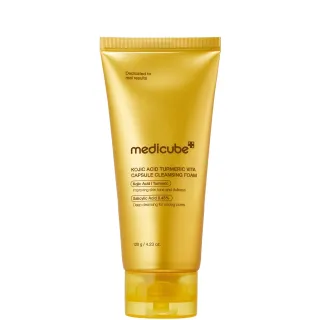
Medicube Kojic Acid Turmeric Vita Capsule Cleansing Foam
Works for
CleansingSodium cocoyl glycinate, Sodium lauroyl glutamate + 9 moreCleanses gently
“The formula cleanses away makeup and daily impurities, making it a simple first step in a glow-focused routine.”
This product works by removing dirt and oil from the surface of the skin. It uses a combination of mild cleansing agents (coco-glucoside, disodium cocoyl glutamate, disodium succinate, glyceryl stearate, hydrogenated lecithin, lauryl hydroxysultaine, sodium cocoyl glycinate, sodium lauroyl glutamate, sucrose distearate, xanthan gum) and should be able to cleanse the skin gently. Still keep in mind that any cleansing can disrupt the skin barrier, and most people do not need to cleanse their skin more than once per day.
Even though this formulation is mild, the following cleansing agents could trigger an irritation or allergy for some people: coco-glucoside
ExfoliationSide benefit · Salicylic acid, Retinol + 1 moreWorks well
This product can help exfoliate the skin. In other words, it helps break down the bonds between dead cells on the surface of the skin and speed up the skin turnover. Skin often appears softer and brighter after exfoliation, but overdoing it can result in disrupted skin barrier. The following ingredient is doing the exfoliating job in this product: retinol, salicylic acid.
Anti-blemishSide benefit · Niacinamide, Salicylic acid + 5 moreWorks well
This product can help reduce breakouts and clogged pores because it contains the following ingredient: niacinamide, retinol, salicylic acid. These ingredients is used for treating acne and can have a noticeable effect.
Can it cause trouble?
Irritancy3 strong irritants: Parfum, Retinol + 1 more — patch-test recommendedHigh risk
ComedogenicClean of flagged comedogenic ingredientsNone flagged

User reviews
Be the first — your take helps the next person decide.
Ingredients
Filter by role to see what each ingredient is doing.
Water~45–55%
Glycerin~4.3–5.2%
- Irritation risk
- Low
One of the best moisturizing ingredients. Naturally present in skin. It attracts water to the upper layer of the skin working as a humectant
More about GlycerinSodium cocoyl glycinate~4.7–5.7%
- Irritation risk
- Medium
Helps oil and water mix together
More about Sodium cocoyl glycinateSodium lauroyl glutamate~3–3.7%
- Irritation risk
- Medium
Used as a cleansing agent. It creates foam
More about Sodium lauroyl glutamateLauryl hydroxysultaine~2.8–3.4%
Coco-glucoside~2–2.4%
- Irritation risk
- High
Used as a cleansing agent (surfactant) in cleansers. Helps water and oil mix together in lotions. Can be irritating
More about Coco-glucosideDisodium cocoyl glutamate~1.6–2%
- Irritation risk
- Medium
Helps water and oil mix together and works as a cleansing agent
More about Disodium cocoyl glutamate1,2-hexanediol~0.65–0.95%
Niacinamide~1.1–1.4%
- Irritation risk
- Low
Is proven to be effective in reducing blemishes, evening out skin tone and helping to improve lines and wrinkles. It helps the skin to repair sun damage, calm down inflammation and keep maintain good levels of moisture. The concentration of about 2% is effective for supporting the skin barrier and evening out the skin tone. Concentration of 4-6% is better for helping with acne and balancing the sebum production
More about NiacinamideSodium chloride~1–1.2%
- Irritation risk
- Low
Used to stabilize mixtures of oil and water, and create thicker, gel-like product textures
More about Sodium chlorideHydroxypropyl starch phosphate~0.7–1.05%
- Irritation risk
- Medium
Helps oil and water mix together and used to stabilize product formulations
More about Hydroxypropyl starch phosphateCaprylyl glycol~0.55–0.85%
- Irritation risk
- Medium
Helps preserve products and creates a nice product texture
More about Caprylyl glycolSalicylic acid~0.45–0.65%
- Irritation risk
- High
Used for skin exfoliation. It has an anti-inflammatory and anti-bacterial effect, helps to unclog pores, prevent blemishes and speed up healing of the existing ones. Sometimes referred to as a BHA (beta-hydroxy acid)
More about Salicylic acidAcrylates/c10-30 alkyl acrylate crosspolymer~0.45–0.7%
- Irritation risk
- Medium
Maintains the texture of skincare products. Allows the product to spread evenly. Helps oil and water mix together
More about Acrylates/c10-30 alkyl acrylate crosspolymerCitric acid~0.4–0.6%
- Irritation risk
- Medium
Can work as an exfoliant but is typically used to adjust the product pH
More about Citric acidPolyquaternium-67~0.45–0.65%
- Irritation risk
- Low
Helps soften the upper layer of the skin and create a nice product finish
More about Polyquaternium-67Parfum~0.35–0.6%
- Irritation risk
- High
An aromatic blend of unspecified and possibly irritating ingredients
More about ParfumGlyceryl stearate~0.4–0.65%
- Irritation risk
- Low
An emollient that softens the skin and forms a protective layer on its surface. Helps water and oil mix together
More about Glyceryl stearateXanthan gum~0.3–0.55%
- Irritation risk
- Low
Used to create a thicker product consistency
More about Xanthan gumDisodium edta~0.3–0.5%
Hydrolyzed collagen~0.3–0.55%
- Irritation risk
- Low
A typically plant-derived compound that is supposed mimic human collagen. Cannot penetrate the skin barrier so is not particularly useful in skincare products beyond attracting water to the upper layer of the skin
More about Hydrolyzed collagenDisodium succinate~0.25–0.5%
Retinol~0.2–0.4%
- Irritation risk
- High
Two steps removed from the active form of vitamin A - retinoic acid. Once converted to the retinoic acid in the skin, retinol is proven to be effective against all signs of aging. It improves skin cell turnover, helps fight blemishes and clogged pores, can regulate excess oil production and even skin tone. It can, however, be quite irritating
More about RetinolBeta-carotene~0.25–0.45%
Zeaxanthin~0.25–0.5%
- Irritation risk
- Low
Lecithin~0.3–0.55%
- Irritation risk
- Low
Used mostly for creating emulsions - helping oil and water mix together. Helps soften the upper layer of the skin
More about LecithinSucrose distearate~0.3–0.55%
Sodium hyaluronate~0.25–0.45%
- Irritation risk
- Low
One of the best moisturizing ingredients. Attracts water into the upper layer of the skin
More about Sodium hyaluronateTocopherol~0.25–0.5%
- Irritation risk
- Low
Pure form of vitamin E. Can help moisturise and protect the skin from free radicals. Often used to help stabilise other ingredients or the formula itself
More about TocopherolHydrogenated lecithin~0.25–0.5%
- Irritation risk
- Low
Helps to retain moisture by creating a protective barrier on the skin. Rich in fatty acids. Improves product texture and helps with the penetration of other ingredients.
More about Hydrogenated lecithinAscorbic acid~0.25–0.45%
- Irritation risk
- High
The most well-researched antioxidant that works in skin. Helps neutralize free radicals supporting collagen production, helping to even out the skin tone and preventing early signs of aging
More about Ascorbic acidLycopene~0.25–0.45%
- Irritation risk
- Medium
Helps neutralize free radicals in skin combating sun damage. Adds a red color to the product
More about LycopeneTocopheryl acetate~0.25–0.5%
- Irritation risk
- Medium
A more stable but less bio-available form of vitamin E compared to Tocopherol. Might help moisturize and protect the skin from free radicals, but mostly used in low concentrations to stabilize other ingredients.
More about Tocopheryl acetateAllantoin~0.25–0.45%
- Irritation risk
- Low
Helps calm down inflammation in skin and can help reduce itching. Helps to repair the skin barrier and keep skin hydrated
More about AllantoinPentylene glycol~0.3–0.5%
- Irritation risk
- Medium
Used to preserve products, dissolve other ingredients and create a nice product texture
More about Pentylene glycolCurcuma longa root extract~0.2–0.4%
- Irritation risk
- High
A plant extract that can contain an active compound curcumin, that may have some anti-inflammatory properties when applied to the skin, but solid research is lacking and the typical concentration used in skincare products is too low. Can be an irritant
More about Curcuma longa root extractOryza sativa extract~0.25–0.45%
- Irritation risk
- Low
A grain extract that helps to create a thicker product consistency. It might have some anti-oxidant properties and help attract water to the upper layer of the skin
More about Oryza sativa extractCamellia sinensis leaf extract~0.25–0.4%
- Irritation risk
- Low
Can contain potent anti-oxidant compounds (abbreviated ECG, GCG, EGC, and EGCG) that might help protect the skin from free radicals. Can help calm down inflammation and has some anti-bacterial properties. Unfortunately, these antioxidants are unstable and lose their effectiveness very quickly in products. The concentration of the antioxidant compounds in the extract also tends to be low to be effective in topical formulation
More about Camellia sinensis leaf extractCentella asiatica extract~0.25–0.5%
- Irritation risk
- Medium
A plant extract that has been shown to be able to reduce inflammation in skin, support restoration of skin barrier function, as well as support collagen production. Contains active compounds called centelloids: asiaticoside, madecasosside, asiatic acid and madecassic acid. Might be helpful in preventing stretch marks. It can be itself be irritating though.
More about Centella asiatica extractHouttuynia cordata extract~0.2–0.35%
- Irritation risk
- Low
Ocimum sanctum leaf extract~0.2–0.35%
- Irritation risk
- High
A plant extract that is rich in a fragrance compound eugenol that is a frequent allergen and can be irritating. It might also contain anti-oxidants to help neutralize free radicals
More about Ocimum sanctum leaf extractCamellia japonica flower extract~0.2–0.35%
- Irritation risk
- High
A plant extract that might help neutralize free radicals in skin
More about Camellia japonica flower extractMagnolia officinalis bark extract~0.1–0.25%
- Irritation risk
- Low
Sophora flavescens root extract~0.15–0.25%
- Irritation risk
- Low
Piper methysticum root extract~0.15–0.25%
- Irritation risk
- Low
Beta-glucan~0.05–0.1%
- Irritation risk
- Low
Helps attract water to the upper layer of the skin, calm down inflammation and irritation, restore the barrier function and support wound healing. It can be helpful in reducing fine lines and wrinkles
More about Beta-glucanPinus densiflora leaf extract~0.1–0.15%
- Irritation risk
- Low
Ingredient list view
Water, Glycerin, Sodium cocoyl glycinate, Sodium lauroyl glutamate, Lauryl hydroxysultaine, Coco-glucoside, Disodium cocoyl glutamate, 1,2-hexanediol, Niacinamide, Sodium chloride, Hydroxypropyl starch phosphate, Caprylyl glycol, Salicylic acid, Acrylates/c10-30 alkyl acrylate crosspolymer, Citric acid, Polyquaternium-67, Parfum, Glyceryl stearate, Xanthan gum, Disodium edta, Hydrolyzed collagen, Disodium succinate, Retinol, Beta-carotene, Zeaxanthin, Lecithin, Sucrose distearate, Sodium hyaluronate, Tocopherol, Hydrogenated lecithin, Ascorbic acid, Lycopene, Tocopheryl acetate, Allantoin, Pentylene glycol, Curcuma longa root extract, Oryza sativa extract, Camellia sinensis leaf extract, Centella asiatica extract, Houttuynia cordata extract, Ocimum sanctum leaf extract, Camellia japonica flower extract, Magnolia officinalis bark extract, Sophora flavescens root extract, Piper methysticum root extract, Beta-glucan, Pinus densiflora leaf extract
Compare prices
Retailers ranked by price — lowest first.

Worth comparing, line by line.
Match % combines shared ingredients, the first five ingredients, shared actives and hero ingredients, irritancy (lower counts in the alternative's favour), texture and body area. Only products in the same routine step are compared.
| MedicubeKojic Acid Turmeric Vita Capsule Cleansing FoamYOUR PRODUCT | YEOUTHVitamin C Facial Cleanser Day/Night Cream | Cleaning SupplyRetinol 24 + Peptide Face Wash, Smoothing, Sulfate-Free | VichyNormaderm Phytosolution Volcanic Mattifying Cleansing Cream | |
|---|---|---|---|---|
| Match | — | 66% | 66% | 65% |
| Price | — | $41.90 | — | $21.73 |
| Shared key ingredients | — | 5 of 24 | 3 of 24 | 4 of 24 |
| Key difference | — | Sodium Ascorbyl Phosphate | Mineral Oil | Kaolin |
| Irritancy | High | Medium | Medium | Medium |
| Drying alcohol | — | — | — | — |
| View product | Shop | Shop | Shop |


More alternatives: CeraVe Balancing Air Foam Facial CleanserMerci Handy Facial Cleansing Gel
Sources cited in this review
Every concentration estimate and effectiveness label is anchored to one of these 37 studies and safety reviews.
- 1
- 2
- 3Allergen of the Year—Alkyl Glucosidepracticeupdate.com
- 4
- 5
- 6

Affiliate links · As an Amazon Associate, WIMJ earns from qualifying purchases.