Works for
MoisturizingPanthenol, Ceramide np + 41 moreWorks well
“5000PPM of four types of Collagen Complex that offers moisturization from the deep inside the skin with only once.”
This product can help improve hydration of the skin with the two types of ingredients.
The first type is called “humectants”:
these ingredients help attract water.
When humectants are on the surface of the skin, they “pull in” the moisture from the outside environment, or from
within deeper layers of the skin. The following ingredients in this product do the job:
alanine, arginine.
This product also contains ingredients called “occlusives”. They help reduce the speed with which our skin loses moisture to the outside environment. These ingredients also help soften the upper layer of the skin, so it feels less tight and nicer to the touch. The following ingredients in this product do the job: arginine, hydrolyzed collagen.
The following ingredients in this product are especially good for supporting the skin barrier and helping with the hydration level: ceramide np, panthenol
Anti-agingAspartic acid, Lysine + 5 moreWorks well
“Triple function sunscreen with wrinkle improvement and protection from skin exposure.”
This product can help reduce and prevent fine lines and wrinkles, improve skin elasticity and firmness because it contains adenosine.
These ingredients in the product can also be helpful, even though there is less evidence for their effectiveness: aspartic acid, lysine, serine, threonine.
Keep in mind that it typically takes at least 6 weeks to notice any results because the changes that are needed to improve fine lines and elasticity happen in the deeper layers of the skin. No topical anti-aging product can “erase” wrinkles or fully reverse signs of aging.
Anti-oxidationSide benefit · Cysteine, Adenosine + 1 moreMay help
This product contains antioxidants (cysteine) that can help neutralize free radicals in skin to lessen the damage it gets from the UV light (sun). There is some human evidence for this effect in skin, though it is smaller or less consistent than the evidence for the best antioxidants.
Can it cause trouble?
Irritancy1 strong irritant: ParfumMedium risk
Comedogenic1 ingredient rated 2 or more on the 0–5 pore-clogging scale1 flagged

User reviews
Be the first — your take helps the next person decide.
Ingredients
Filter by role to see what each ingredient is doing.
Water~45–55%
Propanediol~4.3–5.3%
- Irritation risk
- Low
Acts as a solvent for other ingredients. Speeds up the absorption of other ingredients into the skin
More about PropanediolTitanium dioxide~4.4–5.4%
- Irritation risk
- Low
Works as a UV filter when used in high concentrations. It is photostable and is effective mostly against the UVB light, with some protection in the UVA range. In small concentrations, used for its ability to improve the color of cosmetic products. Is usually well tolerated by the skin
More about Titanium dioxideIsononyl isononanoate~3.3–4.1%
- Irritation risk
- Low
Forms a protective film on the surface of the skin to prevent moisture loss. Gives a velvety feel to products while reducing tackiness
More about Isononyl isononanoateAluminum hydroxide~2.8–3.4%
- Irritation risk
- Low
Is used to add opaque (non-transparent) appearance to formulations. Can be used to coat other ingredients for even dispersion. This is a different ingredient compared to the ones used in antipersperants (aluminium chloride and aluminium chlorohydrate)
More about Aluminum hydroxideStearic acid~2.3–2.8%
- Irritation risk
- Low
Helps oil and water mix together and works as an emollient
More about Stearic acidPolyhydroxystearic acid~1.9–2.3%
- Irritation risk
- Medium
Used to create a thicker product consistency and stabilize the formulation
More about Polyhydroxystearic acidPolyglyceryl-2 dipolyhydroxystearate~1.6–2%
- Irritation risk
- Low
Helps to soften the upper layer of the skin
More about Polyglyceryl-2 dipolyhydroxystearateTitanium dioxide~1.8–2.2%
- Irritation risk
- Low
Works as a UV filter when used in high concentrations. It is photostable and is effective mostly against the UVB light, with some protection in the UVA range. In small concentrations, used for its ability to improve the color of cosmetic products. Is usually well tolerated by the skin
More about Titanium dioxideButyloctyl salicylate~1.1–1.3%
- Irritation risk
- Medium
A synthetic ester of salicylic acid that is used to help disperse pigments and boost effectiveness of sunscreen ingredients. It is able to absorb UV light (working as an organic, or chemical filter), but is not approved as a sunscreen ingredient on its own
More about Butyloctyl salicylateC12-15 alkyl benzoate~0.95–1.15%
- Irritation risk
- Low
Enhances the product texture and makes it more spreadable. Helps reduce water loss from the outer layer of skin. Extands the shelf life by preventing bacteria growth
More about C12-15 alkyl benzoateCoco-caprylate/caprate~0.7–1.1%
- Irritation risk
- Low
Helps to soften the upper layer of the skin without creating a greasy texture
More about Coco-caprylate/caprateDiisostearyl malate~0.6–0.95%
- Irritation risk
- Medium
Helps to soften the upper layer of the skin
More about Diisostearyl malateDipentaerythrityl hexa c5-9 acid esters~0.55–0.85%
- Irritation risk
- Low
Polyglyceryl-6 stearate~0.6–0.85%
- Irritation risk
- Low
Helps soften the upper layer of the skin
More about Polyglyceryl-6 stearatePolyglyceryl-6 behenate~0.55–0.8%
Acrylates copolymer~0.55–0.8%
- Irritation risk
- Medium
Used to stabilize product formulation, help create an even product layer over skin (for example, in sunscreen) and create a thicker product consistency
More about Acrylates copolymerDiethylamino hydroxybenzoyl hexyl benzoate~0.7–1.05%
- Irritation risk
- Medium
Uvinul A Plus. A new generation broad spectrum sunscreen that offers an effective protection especially in the UVA range. It is stable in formulations. Unfortunately, is not approved by the FDA (US) yet
More about Diethylamino hydroxybenzoyl hexyl benzoateNiacinamide~0.5–0.75%
- Irritation risk
- Low
Is proven to be effective in reducing blemishes, evening out skin tone and helping to improve lines and wrinkles. It helps the skin to repair sun damage, calm down inflammation and keep maintain good levels of moisture. The concentration of about 2% is effective for supporting the skin barrier and evening out the skin tone. Concentration of 4-6% is better for helping with acne and balancing the sebum production
More about NiacinamideC14-22 alcohols~0.45–0.7%
- Irritation risk
- Low
A non-drying alcohol that helps stabilize product formulations
More about C14-22 alcoholsC12-20 alkyl glucoside~0.45–0.7%
- Irritation risk
- Medium
Helps water and oil mix together
More about C12-20 alkyl glucosideWater~0.4–0.65%
Glucose~0.35–0.65%
- Irritation risk
- Low
Helps attract water to the upper layer of the skin. Could be helpful in restoring the skin barrier function
More about GlucoseEthylhexyl triazone~0.55–0.85%
- Irritation risk
- Medium
Uvinul T. A UV filter. Effective against UVB rays. It is photostable. Can increase water resistance properties of the sunscreen. Unfortunately, not approved by the FDA (US) yet
More about Ethylhexyl triazoneWater~0.35–0.65%
Chlorella vulgaris extract~0.35–0.6%
- Irritation risk
- Medium
- Comedogenicity
- 3/5
A plant extract that can help to attract water to the upper layer of the skin and might have some anti-oxidant and anti-inflammatory properties
More about Chlorella vulgaris extractFructooligosaccharides~0.35–0.6%
- Irritation risk
- Low
Help attract water to the upper layer of the skin
More about FructooligosaccharidesFructose~0.35–0.65%
- Irritation risk
- Low
Helps attract water to the upper layer of the skin
More about FructoseButylene glycol~0.35–0.65%
- Irritation risk
- Low
Used to create a nice product texture and help delivery of other ingredients. Might be somewhat helpful in attracting water to the upper layer of the skin
More about Butylene glycol1,2-hexanediol~0.35–0.65%
Ethylhexylglycerin~0.35–0.65%
Methylene bis-benzotriazolyl tetramethylbutylphenol~0.55–0.85%
- Irritation risk
- Medium
Tinosorb M. A UV filter. Is effective against both UVA and UVB rays. It also provides some protection against visible light. It is photostable and can also be used to improve photostability of other sunscreen ingredients. Its physical properties help to create lightweight sunscreen formulations. It can leave a slight white cast. Unfortunately, it is not approved by the FDA (US) yet
More about Methylene bis-benzotriazolyl tetramethylbutylphenolDecyl glucoside~0.45–0.65%
- Irritation risk
- High
Helps oil and water mix together. Can be irritating
More about Decyl glucosideGlycerin~0.45–0.65%
- Irritation risk
- Low
One of the best moisturizing ingredients. Naturally present in skin. It attracts water to the upper layer of the skin working as a humectant
More about GlycerinXanthan gum~0.4–0.6%
- Irritation risk
- Low
Used to create a thicker product consistency
More about Xanthan gum1,2-hexanediol~0.35–0.65%
Polyacrylate-13~0.4–0.65%
- Irritation risk
- Low
Used to create a thicker product consistency and stabilize the product formulation
More about Polyacrylate-13Polyisobutene~0.4–0.65%
Polysorbate 20~0.4–0.65%
Sorbitan isostearate~0.4–0.6%
- Irritation risk
- Low
Helps oil and water mix together
More about Sorbitan isostearateBehenyl alcohol~0.45–0.7%
- Irritation risk
- Low
Non-drying alcohol that helps water and oil mix together. Also serves as an emollient
More about Behenyl alcoholPotassium cetyl phosphate~0.4–0.65%
- Irritation risk
- Medium
Helps oil and water mix together
More about Potassium cetyl phosphatePolyhydroxystearic acid~0.4–0.65%
- Irritation risk
- Medium
Used to create a thicker product consistency and stabilize the formulation
More about Polyhydroxystearic acidPanthenol~0.35–0.65%
- Irritation risk
- Low
Helps attract water to the upper layer of the skin and can help improve skin barrier function
More about PanthenolAmmonium acryloyldimethyltaurate/vp copolymer~0.35–0.65%
- Irritation risk
- Low
Increases thickness of a product. Texture enhancer for oil-in-water emulsions
More about Ammonium acryloyldimethyltaurate/vp copolymerHydroxyacetophenone~0.35–0.65%
Water~0.35–0.65%
Hydrolyzed collagen~0.45–0.65%
- Irritation risk
- Low
A typically plant-derived compound that is supposed mimic human collagen. Cannot penetrate the skin barrier so is not particularly useful in skincare products beyond attracting water to the upper layer of the skin
More about Hydrolyzed collagenIron oxides~0.3–0.6%
- Irritation risk
- Low
An umbrella term for the following three colorants: CI 77491, CI 77492, CI 77499. They might be able to offer some protection against visible light, but the degree of the protection is not clear
More about Iron oxidesIsododecane~0.35–0.65%
- Irritation risk
- Low
An emollient that helps soften the skin and can decrease moisture loss. Helps create a nice product texture
More about IsododecaneOctyldodecanol~0.4–0.6%
- Irritation risk
- Low
An emollient that helps to soften the skin and create a pleasant product texture and stabilize the formulation
More about OctyldodecanolPolyglyceryl-4 isostearate~0.4–0.65%
- Irritation risk
- Medium
Helps water and oil mix together
More about Polyglyceryl-4 isostearateIsopropyl titanium triisostearate~0.45–0.65%
- Irritation risk
- Medium
Helps water and oil mix together
More about Isopropyl titanium triisostearateParfum~0.3–0.6%
- Irritation risk
- High
An aromatic blend of unspecified and possibly irritating ingredients
More about ParfumHydroxyethyl acrylate/sodium acryloyldimethyl taurate copolymer~0.35–0.65%
- Irritation risk
- Medium
A gelling agent that thickens the product consistency and leaves the skin with a velvety finish
More about Hydroxyethyl acrylate/sodium acryloyldimethyl taurate copolymerWater~0.35–0.65%
Collagen extract~0.35–0.6%
- Irritation risk
- Low
Water~0.35–0.65%
Soluble collagen~0.35–0.65%
- Irritation risk
- Low
A typically plant-derived compound that is supposed mimic human collagen. Cannot penetrate the skin barrier so is not particularly useful in skincare products beyond attracting water to the upper layer of the skin
More about Soluble collagenParfum~0.3–0.6%
- Irritation risk
- High
An aromatic blend of unspecified and possibly irritating ingredients
More about ParfumXanthan gum~0.4–0.6%
- Irritation risk
- Low
Used to create a thicker product consistency
More about Xanthan gumSodium hyaluronate~0.35–0.65%
- Irritation risk
- Low
One of the best moisturizing ingredients. Attracts water into the upper layer of the skin
More about Sodium hyaluronateIron oxides~0.3–0.6%
- Irritation risk
- Low
An umbrella term for the following three colorants: CI 77491, CI 77492, CI 77499. They might be able to offer some protection against visible light, but the degree of the protection is not clear
More about Iron oxidesAdenosine~0.35–0.6%
- Irritation risk
- Low
Might help improve cell turnover and reduce inflammation in skin. One study shows that the ingredients might be able to help reduce dynamic wrinkles (for example, in the corners of the eyes or on the forehead)
More about AdenosineDisodium edta~0.35–0.65%
Water~0.4–0.6%
Glycine~0.35–0.65%
- Irritation risk
- Low
Helps to attract water to the upper layer of the skin and can help restore the skin barrier function
More about GlycineSerine~0.35–0.65%
- Irritation risk
- Low
An amino-acid that helps to attract water to the upper layer of the skin. In combination with other amino-acids, might help to reduce fine lines and wrinkles
More about SerineGlutamic acid~0.4–0.6%
- Irritation risk
- Low
An amino-acid that helps attract water to the upper layer of the skin
More about Glutamic acidAspartic acid~0.4–0.6%
- Irritation risk
- Low
An amino-acid that helps increase skin hydration and might help to slightly improve skin firmness, potentially reducing lines and wrinkles
More about Aspartic acidLeucine~0.4–0.6%
- Irritation risk
- Low
Alanine~0.4–0.6%
- Irritation risk
- Low
An amino-acid that helps to attract water to the upper layer of the skin and might help to lighten the skin, but solid evidence is lacking
More about AlanineLysine~0.4–0.6%
- Irritation risk
- Low
An amino-acid that helps to attract water to the upper layer of the skin. In combination with other amino-acids, might help to reduce fine lines and wrinkles
More about LysineArginine~0.35–0.65%
- Irritation risk
- Low
An amino acid that is naturally present in skin and helps keep it hydrated. When used together with AHAs, it can reduce their irritating effect on the skin
More about ArginineTyrosine~0.35–0.65%
Phenylalanine~0.4–0.6%
- Irritation risk
- Low
Proline~0.4–0.65%
Threonine~0.4–0.6%
- Irritation risk
- Low
An amino-acid that helps to attract water to the upper layer of the skin. In combination with other amino-acids, might help to reduce fine lines and wrinkles
More about ThreonineValine~0.35–0.65%
- Irritation risk
- Low
Isoleucine~0.35–0.65%
- Irritation risk
- Low
An amino acid that can help attract water to the upper layer of the skin and support skin's barrier function
More about IsoleucineHistidine~0.35–0.65%
Cysteine~0.35–0.65%
- Irritation risk
- Low
Might help neutralize free radicals in skin and might be helpful against hyperpigmentation
More about CysteineMethionine~0.35–0.6%
- Irritation risk
- Low
Water~0.25–0.5%
Propanediol~0.3–0.55%
- Irritation risk
- Low
Acts as a solvent for other ingredients. Speeds up the absorption of other ingredients into the skin
More about PropanediolBenzyl glycol~0.25–0.5%
- Irritation risk
- Medium
Helps dissolve other ingredients and preserve products
More about Benzyl glycolHydrolyzed glycosaminoglycans~0.25–0.45%
- Irritation risk
- Low
Long sugars that help attract water to the upper layer of the skin
More about Hydrolyzed glycosaminoglycansSodium hyaluronate~0.25–0.4%
- Irritation risk
- Low
One of the best moisturizing ingredients. Attracts water into the upper layer of the skin
More about Sodium hyaluronateSodium hyaluronate crosspolymer~0.2–0.4%
- Irritation risk
- Medium
Attracts water into the upper layer of the skin
More about Sodium hyaluronate crosspolymerHydrolyzed hyaluronic acid~0.2–0.35%
- Irritation risk
- Low
One of the best moisturizing ingredients. Attracts water into the upper layer of the skin. A version of it is naturally present in skin
More about Hydrolyzed hyaluronic acidHydroxypropyltrimonium hyaluronate~0.2–0.4%
- Irritation risk
- Low
Hyaluronic acid~0.2–0.35%
- Irritation risk
- Low
One of the best moisturizing ingredients. Attracts water into the upper layer of the skin. Naturally present in skin. Typically has large molecule size unless advertised otherwise on the product label. Helps support skin's barrier function and may help to reduce inflammation
More about Hyaluronic acidSodium acetylated hyaluronate~0.15–0.3%
- Irritation risk
- Low
A type of hyaluronic acid that works as an excellent moisturizer by attracting water into the upper layer of the skin. Is typically feels less sticky on the skin compared to the usual hyaluronic acid
More about Sodium acetylated hyaluronateGlycerin~0.2–0.35%
- Irritation risk
- Low
One of the best moisturizing ingredients. Naturally present in skin. It attracts water to the upper layer of the skin working as a humectant
More about GlycerinCaprylic/capric triglyceride~0.2–0.4%
- Irritation risk
- Medium
A good mix of fatty acids that forms a protective layer on the skin. Improves the shelf life of products. Derived from coconut and glycerin
More about Caprylic/capric triglycerideHydrogenated lecithin~0.15–0.3%
- Irritation risk
- Low
Helps to retain moisture by creating a protective barrier on the skin. Rich in fatty acids. Improves product texture and helps with the penetration of other ingredients.
More about Hydrogenated lecithinCeramide np~0.2–0.35%
- Irritation risk
- Low
A type of lipid similar to ceramides naturally present in skin. Helps to soften the upper layer of the skin and supports the skin barrier function to keep it hydrated. Can help to prevent inflammation in skin
More about Ceramide npSodium stearoyl glutamate~0.15–0.3%
- Irritation risk
- Medium
Helps oil and water mix together
More about Sodium stearoyl glutamateCollagen~0.1–0.15%
- Irritation risk
- Low
Cannot penetrate the skin barrier so is not particularly useful in skincare products
More about CollagenIngredient list view
Water, Propanediol, Titanium dioxide, Isononyl isononanoate, Aluminum hydroxide, Stearic acid, Polyhydroxystearic acid, Polyglyceryl-2 dipolyhydroxystearate, Titanium dioxide, Butyloctyl salicylate, C12-15 alkyl benzoate, Coco-caprylate/caprate, Diisostearyl malate, Dipentaerythrityl hexa c5-9 acid esters, Polyglyceryl-6 stearate, Polyglyceryl-6 behenate, Acrylates copolymer, Diethylamino hydroxybenzoyl hexyl benzoate, Niacinamide, C14-22 alcohols, C12-20 alkyl glucoside, Water, Glucose, Ethylhexyl triazone, Water, Chlorella vulgaris extract, Fructooligosaccharides, Fructose, Butylene glycol, 1,2-hexanediol, Ethylhexylglycerin, Methylene bis-benzotriazolyl tetramethylbutylphenol, Decyl glucoside, Glycerin, Xanthan gum, 1,2-hexanediol, Polyacrylate-13, Polyisobutene, Polysorbate 20, Sorbitan isostearate, Behenyl alcohol, Potassium cetyl phosphate, Polyhydroxystearic acid, Panthenol, Ammonium acryloyldimethyltaurate/vp copolymer, Hydroxyacetophenone, Water, Hydrolyzed collagen, Iron oxides, Isododecane, Octyldodecanol, Polyglyceryl-4 isostearate, Isopropyl titanium triisostearate, Parfum, Hydroxyethyl acrylate/sodium acryloyldimethyl taurate copolymer, Water, Collagen extract, Water, Soluble collagen, Parfum, Xanthan gum, Sodium hyaluronate, Iron oxides, Adenosine, Disodium edta, Water, Glycine, Serine, Glutamic acid, Aspartic acid, Leucine, Alanine, Lysine, Arginine, Tyrosine, Phenylalanine, Proline, Threonine, Valine, Isoleucine, Histidine, Cysteine, Methionine, Water, Propanediol, Benzyl glycol, Hydrolyzed glycosaminoglycans, Sodium hyaluronate, Sodium hyaluronate crosspolymer, Hydrolyzed hyaluronic acid, Hydroxypropyltrimonium hyaluronate, Hyaluronic acid, Sodium acetylated hyaluronate, Glycerin, Caprylic/capric triglyceride, Hydrogenated lecithin, Ceramide np, Sodium stearoyl glutamate, Collagen
Compare prices
Retailers ranked by price — lowest first.

Worth comparing, line by line.
Match % combines shared ingredients, the first five ingredients, shared actives and hero ingredients, irritancy (lower counts in the alternative's favour), texture and body area. Only products in the same routine step are compared.
| MedicubeCollagen Firming Sun CreamYOUR PRODUCT | SupereggSoft Strength Rich Resilience Cream | MISSHAActibarrier Strong Moist Cream INTENSIVE | ACWELLLicorice pH Balancing Extreme Moisture Cream | |
|---|---|---|---|---|
| Match | — | 85% | 85% | 85% |
| Price | — | $110.00 | $28.11 | $15.88 |
| Shared key ingredients | — | 20 of 33 | 20 of 33 | 20 of 33 |
| Key difference | — | Copper Tripeptide-1 | Copper Tripeptide-1 | Ceramide Ns |
| Irritancy | Medium | Medium | Medium | Medium |
| Drying alcohol | — | — | — | Contains drying alcohol |
| View product | Shop | Shop | Shop |


More alternatives: Evercell Radiance Lifting Creamhwarang' Bellflower Moisturizing Barrier Cream
Product summary
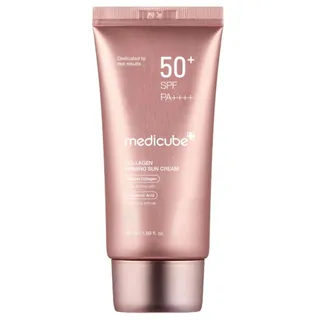
"Medicube - Buy Collagen Firming Sun Cream in Australia - Korean Skincare Online" is a well-rounded moisturizing product. As we expect from a proper moisturizer, the formula includes a combo of effective humectants and emollients. These are the two different types of ingredients that are essential for improving the skin hydration and supporting a healthy skin barrier. Humectants in this product (panthenol, alanine, arginine, aspartic acid and fructooligosaccharides) help to increase the water content in the upper layer of the skin. (These ingredients do so by "capturing" water molecules from the outside air or from within the deeper layers of the skin). Ceramide np, hydrolyzed collagen, arginine, c12-15 alkyl benzoate and coco-caprylate/caprate in this product help decrease the water evoporation from the skin, so that it stays hydrated for longer. These ingredients also soften the skin and take away the feeling of tightness and dryness.
Ingredient callouts
- Another benefit is that this moisturizer contain ceramides (ceramide np 0.15% - 0.55%). Ceramides are an important part of our natural skin barrier. The Ceramides used in skincare are synthetic or come from plants. They help soften the skin and can help "fill the gaps" in the skin barrier, keeping the skin hydrated and resilient for longer.
- Adenosine 0.45% - 1.10%. It is a compound that in involved in many biological processes inside the skin cells. According one high-quality clinical trial, topical Adenosine in low concentrations can somewhat help improve "deep wrinkles" - the wrinkles that appear with age in places where our faces are most dynamic (for example, on the forehead or in the corners of the eyes).
- An effective concentration of Panthenol (pro-vitamin B5) - about 0.50% - 1.15%. Panthenol helps strengthen the skin barrier, improve hydration and reduce inflammation in skin.
Irritation risk
This formulation includes some common irritants, including ingredients that do not provide a benefit for the skin. We assess the overall irritancy of this moisturizer to be high. For a detailed overview of all potential irritants: click here
You can see the detailed formula review with the breakdown of all actives in the product and the full ingredient list with estimated concentrations in the tables below.
Price
The product retails for 33.66A$ in Australia.
For a detailed price comparison: click here.
Sources cited in this review
Every concentration estimate and effectiveness label is anchored to one of these 34 studies and safety reviews.
- 1
- 2
- 3Safety Assessment of Alkyl Esters as Used in Cosmeticscir-safety.org
- 4
- 5
- 6

Affiliate links · As an Amazon Associate, WIMJ earns from qualifying purchases.