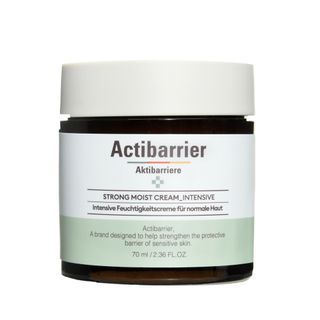
MISSHA Actibarrier Strong Moist Cream INTENSIVE
Works for
2 of 2 advertised claims delivered
MoisturizingNiacinamide, Panthenol + 43 moreStrong evidence
“Actibarrier Strong Moist Cream INTENSIVE”
This product can help improve hydration of the skin with the two types of ingredients.
The first type is called “humectants”:
these ingredients help attract water.
When humectants are on the surface of the skin, they “pull in” the moisture from the outside environment, or from
within deeper layers of the skin. The following ingredients in this product do the job:
alanine, arginine.
This product also contains ingredients called “occlusives”. They help reduce the speed with which our skin loses moisture to the outside environment. These ingredients also help soften the upper layer of the skin, so it feels less tight and nicer to the touch. The following ingredients in this product do the job: arginine, caprylic/capric triglyceride.
The following ingredients in this product are especially good for supporting the skin barrier and helping with the hydration level: ceramide np, copper tripeptide-1, niacinamide, panthenol
Anti-agingAdenosine, Niacinamide + 7 moreStrong evidence
“Brand from South Korea MISSHA. Benefits Helps brighten the skin and reduce wrinkles.”
This product can help reduce and prevent fine lines and wrinkles, improve skin elasticity and firmness because it contains adenosine, niacinamide.
These ingredients in the product can also be helpful, even though there is less evidence for their effectiveness: aspartic acid, copper tripeptide-1, lysine, serine, threonine.
Keep in mind that it typically takes at least 6 weeks to notice any results because the changes that are needed to improve fine lines and elasticity happen in the deeper layers of the skin. No topical anti-aging product can “erase” wrinkles or fully reverse signs of aging.
Evens skin toneNot advertised by the brand · Niacinamide, Glucosamine hcl + 4 moreStrong evidence
This product can help reduce hypepigmentation and even out the skin tone because it contains the following effective ingredients: niacinamide
The following ingredient (ingredients) in this product might be helpful, but there is no evidence to confirm that it actually can help even out the skin tone: alanine, cysteine, glucosamine hcl.
Keep in mind that you would need to apply any topical skincare targetted at hypigmentation consistently for a couple of months to get a result. No topical skincare product can help get rid of hyperpigmentation (including post-acne marks and age spots) instantly.
Anti-blemishNot advertised by the brand · Niacinamide, TaurineStrong evidence
This product can help reduce breakouts and clogged pores because it contains the following ingredient: niacinamide. This ingredient is used for treating acne and can have a noticeable effect.
Anti-oxidationNot advertised by the brand · Cysteine, Taurine + 2 moreModerate evidence
This product contains antioxidants (cysteine) that might be able to help neutralize free radicals in skin to lessen the damage it gets from the UV light (sun). There is not enough evidence to confirm their effectiveness in skin though.
Can it cause trouble?
Irritancy16 flagged ingredientsMedium risk
Comedogenic2 ingredients rated 2 or more on the 0–5 pore-clogging scale2 flagged


User reviews
Be the first — your take helps the next person decide.
Ingredients
Filter by role to see what each ingredient is doing.
Water~45–55%
Glycerin~4.4–5.3%
- Irritation risk
- Low
One of the best moisturizing ingredients. Naturally present in skin. It attracts water to the upper layer of the skin working as a humectant
More about GlycerinCaprylic/capric triglyceride~4.2–5.2%
- Irritation risk
- Medium
A good mix of fatty acids that forms a protective layer on the skin. Improves the shelf life of products. Derived from coconut and glycerin
More about Caprylic/capric triglyceridePentaerythrityl tetraethylhexanoate~3.1–3.8%
- Irritation risk
- Low
Used to create a nice product consistency while softening the upper layer of the skin
More about Pentaerythrityl tetraethylhexanoateHydrogenated polydecene~2.3–2.8%
- Irritation risk
- Low
Helps to soften the upper layer of the skin and create a nice product texture
More about Hydrogenated polydeceneCetearyl alcohol~1.9–2.4%
- Irritation risk
- Low
- Comedogenicity
- 2/5
A non-drying alcohol. Works as an emollient. Helps water and oil mix together and creates a nice product texture
More about Cetearyl alcoholNiacinamide~1.6–2%
- Irritation risk
- Low
Is proven to be effective in reducing blemishes, evening out skin tone and helping to improve lines and wrinkles. It helps the skin to repair sun damage, calm down inflammation and keep maintain good levels of moisture. The concentration of about 2% is effective for supporting the skin barrier and evening out the skin tone. Concentration of 4-6% is better for helping with acne and balancing the sebum production
More about Niacinamide1,2-hexanediol~0.7–1.05%
Ectoin~1.1–1.4%
- Irritation risk
- Low
Softens the upper layer of the skin and can support skin barrier function
More about EctoinPanthenol~0.9–1.15%
- Irritation risk
- Low
Helps attract water to the upper layer of the skin and can help improve skin barrier function
More about PanthenolCetearyl glucoside~0.65–1%
- Irritation risk
- Medium
Helps water and oil in the product mix well together and improves product texture
More about Cetearyl glucosideGlyceryl stearate~0.6–0.9%
- Irritation risk
- Low
An emollient that softens the skin and forms a protective layer on its surface. Helps water and oil mix together
More about Glyceryl stearatePentylene glycol~0.55–0.8%
- Irritation risk
- Medium
Used to preserve products, dissolve other ingredients and create a nice product texture
More about Pentylene glycolPolymethylsilsesquioxane~0.55–0.8%
- Irritation risk
- Low
A silicone that improves product texture and helps dissolve other ingredients. Can form a non-greasy film on the skin to prevent moisture loss
More about PolymethylsilsesquioxaneC12-16 alcohols~0.45–0.7%
- Irritation risk
- Medium
Helps soften the upper layer of the skin and improve the product's texture
More about C12-16 alcoholsPalmitic acid~0.5–0.7%
- Irritation risk
- Low
An emollient that is naturally present in skin and helps soften it
More about Palmitic acidButylene glycol~0.4–0.6%
- Irritation risk
- Low
Used to create a nice product texture and help delivery of other ingredients. Might be somewhat helpful in attracting water to the upper layer of the skin
More about Butylene glycolHydrogenated lecithin~0.35–0.65%
- Irritation risk
- Low
Helps to retain moisture by creating a protective barrier on the skin. Rich in fatty acids. Improves product texture and helps with the penetration of other ingredients.
More about Hydrogenated lecithinCarbomer~0.3–0.55%
- Irritation risk
- Low
Helps create a thicker or gel-like product texture. It is not a surfactant but can be used in gentle cleansing formulations
More about CarbomerTromethamine~0.3–0.55%
Raffinose~0.25–0.45%
- Irritation risk
- Low
Stearic acid~0.4–0.65%
- Irritation risk
- Low
Helps oil and water mix together and works as an emollient
More about Stearic acidCaprylyl glycol~0.25–0.5%
- Irritation risk
- Medium
Helps preserve products and creates a nice product texture
More about Caprylyl glycolSodium acrylate/sodium acryloyldimethyl taurate copolymer~0.25–0.45%
- Irritation risk
- Low
Used to create a thicker product consistency
More about Sodium acrylate/sodium acryloyldimethyl taurate copolymerCaramel~0.25–0.45%
- Irritation risk
- Low
Polyisobutene~0.25–0.5%
Ethylhexylglycerin~0.25–0.45%
Adenosine~0.25–0.45%
- Irritation risk
- Low
Might help improve cell turnover and reduce inflammation in skin. One study shows that the ingredients might be able to help reduce dynamic wrinkles (for example, in the corners of the eyes or on the forehead)
More about AdenosineCaprylyl/capryl glucoside~0.35–0.6%
- Irritation risk
- Medium
Helps oil and water mix together. Can be used as a cleansing agent
More about Caprylyl/capryl glucosideSorbitan oleate~0.25–0.5%
- Irritation risk
- Medium
- Comedogenicity
- 2/5
Helps oil and water mix together
More about Sorbitan oleateDisodium edta~0.25–0.45%
Hydrolyzed hibiscus esculentus extract~0.25–0.45%
- Irritation risk
- Medium
A plant extract that might contain a peptide (Myoxinol). It could be helpful in attracting water to the upper layer of the skin and might have some anti-aging effect, but the research is lacking and it is rarely used in a high enough concentration
More about Hydrolyzed hibiscus esculentus extractLupinus albus seed extract~0.25–0.45%
- Irritation risk
- Medium
A plant extract that helps soften the upper layer of the skin
More about Lupinus albus seed extractMoringa pterygosperma seed extract~0.2–0.4%
- Irritation risk
- Low
Might help attract water to the upper layer of the skin
More about Moringa pterygosperma seed extractCeramide np~0.3–0.5%
- Irritation risk
- Low
A type of lipid similar to ceramides naturally present in skin. Helps to soften the upper layer of the skin and supports the skin barrier function to keep it hydrated. Can help to prevent inflammation in skin
More about Ceramide npCholesterol~0.3–0.55%
- Irritation risk
- Low
An emollient that is naturally found in skin
More about CholesterolCholeth-24~0.25–0.5%
Dipropylene glycol~0.2–0.4%
- Irritation risk
- Low
Helps to dissolve other ingredients in a formulation. Slows down the rate of product drying
More about Dipropylene glycolHydrolyzed hyaluronic acid~0.25–0.45%
- Irritation risk
- Low
One of the best moisturizing ingredients. Attracts water into the upper layer of the skin. A version of it is naturally present in skin
More about Hydrolyzed hyaluronic acidStreptococcus thermophilus ferment~0.25–0.4%
- Irritation risk
- Low
Milk protein extract~0.25–0.45%
- Irritation risk
- Low
Serine~0.25–0.45%
- Irritation risk
- Low
An amino-acid that helps to attract water to the upper layer of the skin. In combination with other amino-acids, might help to reduce fine lines and wrinkles
More about SerineGlycine~0.25–0.45%
- Irritation risk
- Low
Helps to attract water to the upper layer of the skin and can help restore the skin barrier function
More about GlycineHistidine~0.25–0.45%
Arginine~0.25–0.4%
- Irritation risk
- Low
An amino acid that is naturally present in skin and helps keep it hydrated. When used together with AHAs, it can reduce their irritating effect on the skin
More about ArginineLecithin~0.3–0.5%
- Irritation risk
- Low
Used mostly for creating emulsions - helping oil and water mix together. Helps soften the upper layer of the skin
More about LecithinHydrolyzed collagen~0.25–0.5%
- Irritation risk
- Low
A typically plant-derived compound that is supposed mimic human collagen. Cannot penetrate the skin barrier so is not particularly useful in skincare products beyond attracting water to the upper layer of the skin
More about Hydrolyzed collagenDipotassium glycyrrhizate~0.25–0.45%
- Irritation risk
- Low
A salt derived from licorice. Works as an emollient to soften the upper layer of the skin and can help calm down inflammation. Might be helpful for skin lightening
More about Dipotassium glycyrrhizateMagnesium pca~0.25–0.45%
- Irritation risk
- Low
Helps attract water to the upper layer of the skin
More about Magnesium pcaCopper tripeptide-1~0.25–0.45%
- Irritation risk
- Low
A naturally occurring peptide. One of the most studied peptides in dermatology. It is sometimes abbreviated GHK-Cu. Belongs to the class of carrier peptides. It stimulates both synthesis and breakdown of collagen in skin. It is released in skin wounds and inflammation to support healing. It accelerates wound-healing of the skin and can stimulate hair growth. There are preliminary studies that confirm that copper tripeptide can help support collagen production reducing fine lines and wrinkles and decrease inflammation in skin.
More about Copper tripeptide-1Sucrose~0.2–0.4%
- Irritation risk
- Low
Can help attract water to the upper layer of the skin. In crystal form, it can work as a gentle exfoliant, gentler than the salt scrub. Helps stabilize the emulsion
More about SucroseCalcium chloride~0.25–0.45%
- Irritation risk
- Medium
Helps create a thicker product consistency. Might be irritating
More about Calcium chlorideOrnithine~0.25–0.45%
- Irritation risk
- Low
An amino-acid. Helps attract water to the upper layer of the skin
More about OrnithineSea salt~0.25–0.45%
- Irritation risk
- Medium
Used to thicken the product formulation and might help to add minerals to the surface of the skin. It is used in scrubs as a physical exfoliant. Can increase sensitivity to other ingredients if left on the skin or used in high concentration
More about Sea saltAlanine~0.25–0.45%
- Irritation risk
- Low
An amino-acid that helps to attract water to the upper layer of the skin and might help to lighten the skin, but solid evidence is lacking
More about AlanineMagnesium chloride~0.25–0.45%
Threonine~0.25–0.45%
- Irritation risk
- Low
An amino-acid that helps to attract water to the upper layer of the skin. In combination with other amino-acids, might help to reduce fine lines and wrinkles
More about ThreonineAspartic acid~0.25–0.45%
- Irritation risk
- Low
An amino-acid that helps increase skin hydration and might help to slightly improve skin firmness, potentially reducing lines and wrinkles
More about Aspartic acidValine~0.25–0.45%
- Irritation risk
- Low
Proline~0.25–0.45%
Dipotassium phosphate~0.25–0.45%
Lysine~0.25–0.45%
- Irritation risk
- Low
An amino-acid that helps to attract water to the upper layer of the skin. In combination with other amino-acids, might help to reduce fine lines and wrinkles
More about LysineLeucine~0.25–0.45%
- Irritation risk
- Low
Tyrosine~0.25–0.4%
Isoleucine~0.25–0.45%
- Irritation risk
- Low
An amino acid that can help attract water to the upper layer of the skin and support skin's barrier function
More about IsoleucineMagnesium citrate~0.25–0.4%
- Irritation risk
- Low
Glucosamine hcl~0.25–0.45%
- Irritation risk
- Low
Might be able to stimulate production of skin's natural moisturizing compounds such as hyaluronic acid. Could be helpful for evening the skin tone.
More about Glucosamine hclPhenylalanine~0.25–0.45%
- Irritation risk
- Low
Glutamic acid~0.2–0.4%
- Irritation risk
- Low
An amino-acid that helps attract water to the upper layer of the skin
More about Glutamic acid1-methylhydantoin-2-imide~0.2–0.4%
- Irritation risk
- Low
Asparagine~0.2–0.35%
- Irritation risk
- Low
Citrulline~0.2–0.35%
- Irritation risk
- Low
An amino-acid that helps attract water to the upper layer of the skin
More about CitrullineMethionine~0.15–0.3%
- Irritation risk
- Low
Taurine~0.15–0.25%
- Irritation risk
- Medium
Could be helpful in reducing inflammation in skin, evening out the skin tone and neutralizing free radicals, but more research is needed to confirm its effectiveness
More about TaurineTryptophan~0.15–0.3%
- Irritation risk
- Low
Formic acid~0.15–0.25%
- Irritation risk
- Low
Glutamine~0.1–0.15%
- Irritation risk
- Low
Cysteine~0.05–0.1%
- Irritation risk
- Low
Might help neutralize free radicals in skin and might be helpful against hyperpigmentation
More about CysteineIngredient list view
Water, Glycerin, Caprylic/capric triglyceride, Pentaerythrityl tetraethylhexanoate, Hydrogenated polydecene, Cetearyl alcohol, Niacinamide, 1,2-hexanediol, Ectoin, Panthenol, Cetearyl glucoside, Glyceryl stearate, Pentylene glycol, Polymethylsilsesquioxane, C12-16 alcohols, Palmitic acid, Butylene glycol, Hydrogenated lecithin, Carbomer, Tromethamine, Raffinose, Stearic acid, Caprylyl glycol, Sodium acrylate/sodium acryloyldimethyl taurate copolymer, Caramel, Polyisobutene, Ethylhexylglycerin, Adenosine, Caprylyl/capryl glucoside, Sorbitan oleate, Disodium edta, Hydrolyzed hibiscus esculentus extract, Lupinus albus seed extract, Moringa pterygosperma seed extract, Ceramide np, Cholesterol, Choleth-24, Dipropylene glycol, Hydrolyzed hyaluronic acid, Streptococcus thermophilus ferment, Milk protein extract, Serine, Glycine, Histidine, Arginine, Lecithin, Hydrolyzed collagen, Dipotassium glycyrrhizate, Magnesium pca, Copper tripeptide-1, Sucrose, Calcium chloride, Ornithine, Sea salt, Alanine, Magnesium chloride, Threonine, Aspartic acid, Valine, Proline, Dipotassium phosphate, Lysine, Leucine, Tyrosine, Isoleucine, Magnesium citrate, Glucosamine hcl, Phenylalanine, Glutamic acid, 1-methylhydantoin-2-imide, Asparagine, Citrulline, Methionine, Taurine, Tryptophan, Formic acid, Glutamine, Cysteine
Compare prices
Retailers ranked by price — lowest first.

Affiliate links · prices updated regularly
Worth comparing, line by line.
Match % combines shared ingredients, the first five ingredients, shared actives and hero ingredients, irritancy (lower counts in the alternative's favour), texture and body area. Only products in the same routine step are compared.
| MISSHAActibarrier Strong Moist Cream INTENSIVEYOUR PRODUCT | ACWELLLicorice pH Balancing Extreme Moisture Cream 55ml | MedicubeDeep Lifting Peptide Eye Cream Mini | TOSOWOONGCica Snail Cream | |
|---|---|---|---|---|
| Match | — | 85% | 83% | 83% |
| Price | $28.11 | $39.60+$11.49 | $11.83−$16.28 | $16.40−$11.71 |
| Shared key ingredients | — | 21 of 30 | 26 of 30 | 10 of 30 |
| Key difference | — | Ceramide Ns | Acetyl Hexapeptide-1 | Madecassoside |
| Irritancy | Medium | Medium | High | Medium |
| Drying alcohol | — | Contains drying alcohol | — | — |
| View product | Shop | Shop | Shop |


Product summary
"MISSHA - Actibarrier Strong Moist Cream INTENSIVE" has a good moisturizing formula. As we expect from a proper moisturizer, the formula includes a combo of effective humectants and emollients. These are the two different types of ingredients that are essential for improving the skin hydration and supporting a healthy skin barrier. Panthenol, alanine, arginine, aspartic acid and citrulline in this product (humectants) attract water molecules to the upper layer of the skin (the water comes from the outside air or from the deeper layers of the skin if the air is dry). Emollients in this formulation (ceramide np, cholesterol, hydrolyzed collagen, arginine and caprylic/capric triglyceride) help to reduce the moisture loss from the skin. They also soften the skin surface and relieve the feeling of dryness and tightness.
Ingredient callouts
- We love that this moisturizer contains a good concentration of niacinamide 1.60% - 2.00%. Niacinamide is a perfect active in a moistruizer because it helps calm down inflamation in skin and support the skin barrier. More than that, it is helpful for most common skin concerns: it helps regulat oil production, help reduce acne and clogged pores, improve skin tone and prevent pigmentation marks. It also helps fight photodamage.
- As a plus, this moisturizer also contains Ceramides (ceramide np 0.30% - 0.50%). Ceramides are a type of lipids that our skin produces itself. They are a building block of the skin's barrier. Ceramides used in skincare are synthetic or extracted from plants. They work well for softening the skin surface and "patch holes" in the skin's barrier.
- We like that this moisturizer contains peptides (copper tripeptide-1 0.25% - 0.45%). There are many different kind of Peptides and they are naturally present in our skin. They all are a combination of aminoacids. Some of them work as natural antibiotics, promote wound-healing and production of collagen. The science is still not settled on how effective Peptides are in skincare, but it is very likely that they have a benefit. Peptides might help restore the skin barrier and fight the signs of aging. At the very least, Peptides work as humectants: they attract water to the upper layer of the skin and improve its hydration.
- Adenosine 0.25% - 0.45%. It is a compound that in involved in many biological processes inside the skin cells. According one high-quality clinical trial, topical Adenosine in low concentrations can somewhat help improve "deep wrinkles" - the wrinkles that appear with age in places where our faces are most dynamic (for example, on the forehead or in the corners of the eyes).
- Panthenol (pro-vitamin B5) at about 0.90% - 1.15% concentration. In this concentration, Panthenol works effectively to improve the skin barrier and reduce inflammation.
Irritation risk
This product does not contain known common irritants and is suitable for sensitive skin. We assess the overall irritancy of this moisturizer to be medium. For a detailed overview of all potential irritants: click here
You can see the detailed formula review with the breakdown of all actives in the product and the full ingredient list with estimated concentrations in the tables below.
Price
The product retails for 28.11$ in the United States.
For a detailed price comparison: click here.
Sources cited in this review
Every concentration estimate and effectiveness label is anchored to one of these 36 studies and safety reviews.
- 1
- 2Safety Assessment of Pentaerythrityl Tetraesters as Used in Cosmeticsjournals.sagepub.com
- 3Safety Assessment of Polyene Group as Used in Cosmeticscir-safety.org
- 4
- 5
- 6

Affiliate links · As an Amazon Associate, WIMJ earns from qualifying purchases.