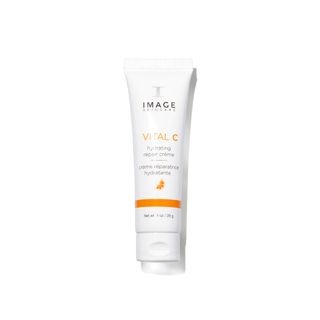
Image skincare Discovery-size VITAL C hydrating repair crème
Works for
1 of 1 advertised claim delivered
Moisturizing25 ingredients credited for this claimGood support
“Discovery-size VITAL C hydrating repair crème”
This product can help improve hydration of the skin with the two types of ingredients.
The first type is called “humectants”:
these ingredients help attract water.
When humectants are on the surface of the skin, they “pull in” the moisture from the outside environment, or from
within deeper layers of the skin. The following ingredients in this product do the job:
glucosamine hcl, glycerin.
This product also contains ingredients called “occlusives”. They help reduce the speed with which our skin loses moisture to the outside environment. These ingredients also help soften the upper layer of the skin, so it feels less tight and nicer to the touch. The following ingredients in this product do the job: caprylic/capric triglyceride, dimethicone.
Anti-oxidationNot advertised by the brand · 9 ingredients credited for this claimStrong support
This product contains antioxidants (vitis vinifera seed extract) that can help neutralize free radicals in skin. By doing so, they can lessen the damage the skin gets from the UV light (sun).
Evens skin toneNot advertised by the brand · 7 ingredients credited for this claimModerate support
The following ingredient (ingredients) in this product might be helpful, but there is no evidence to confirm that it actually works: glucosamine hcl.
Anti-agingNot advertised by the brand · 10 ingredients credited for this claimModerate support
This product contains vitis vinifera seed extract. This ingredient might be able to help reduce and prevent fine lines and wrinkles, improve skin elasticity and firmness, but there is not enough evidence that it actually works.
Can it cause trouble?
Irritancy4 strong irritants: Citrus aurantium dulcis oil, Limonene + 2 more — patch-test recommendedHigh risk
Comedogenic2 ingredients rated 2 or more on the 0–5 pore-clogging scale2 flagged
User reviews
Be the first — your take helps the next person decide.
Ingredients
Filter by role to see what each ingredient is doing.
Water~45–55%
Glycerin~5–6.1%
- Irritation risk
- Low
One of the best moisturizing ingredients. Naturally present in skin. It attracts water to the upper layer of the skin working as a humectant
More about GlycerinDimethicone~4.2–5.1%
- Irritation risk
- Low
A silicone that helps to reduce water loss from the surface of the skin. Can temporarily "fill in" lines and wrinkles, absorb oil, and create a nice product finish
More about DimethiconeC12-15 alkyl benzoate~3.1–3.8%
- Irritation risk
- Low
Enhances the product texture and makes it more spreadable. Helps reduce water loss from the outer layer of skin. Extands the shelf life by preventing bacteria growth
More about C12-15 alkyl benzoateGlyceryl stearate~2.3–2.9%
- Irritation risk
- Low
An emollient that softens the skin and forms a protective layer on its surface. Helps water and oil mix together
More about Glyceryl stearateIsostearyl neopentanoate~1.9–2.4%
- Irritation risk
- Medium
- Comedogenicity
- 2/5
Used to create a nice product texture and helps soften the upper layer of the skin. Could be comedogenic
More about Isostearyl neopentanoatePeg-100 stearate~1.7–2.1%
- Irritation risk
- Low
Helps oil and water mix togehter and creates a nice product texture
More about Peg-100 stearateSimmondsia chinensis seed oil~1.5–1.9%
- Irritation risk
- Medium
Softens the upper layer of skin and helps restore the healthy skin barrier. Has shown to help calm down inflammation in skin. It is a stable oil, meaning that it retains its properties even when exposed to air.
More about Simmondsia chinensis seed oilCaprylic/capric triglyceride~1.3–1.6%
- Irritation risk
- Medium
A good mix of fatty acids that forms a protective layer on the skin. Improves the shelf life of products. Derived from coconut and glycerin
More about Caprylic/capric triglycerideAloe barbadensis leaf juice~0.95–1.2%
- Irritation risk
- Medium
Traditionally used to treat sunburns, dermatitis and inflammation, but evidence for its effectiveness is lacking. The extract can contain humectants that help attract water into the skin
More about Aloe barbadensis leaf juiceCetearyl alcohol~0.8–1.2%
- Irritation risk
- Low
- Comedogenicity
- 2/5
A non-drying alcohol. Works as an emollient. Helps water and oil mix together and creates a nice product texture
More about Cetearyl alcoholCitrus aurantium dulcis oil~0.6–0.85%
- Irritation risk
- High
Used as a fragrance. It can be irritating and cause photosensitivity
More about Citrus aurantium dulcis oilLimonene~0.5–0.75%
- Irritation risk
- High
A common frangrance that can easily irritate skin, especially if exposed to air, light or heat
More about LimoneneBrassica campestris/aleurites fordi oil copolymer~0.5–0.75%
- Irritation risk
- Low
Cetyl alcohol~0.5–0.75%
- Irritation risk
- Low
A non-drying alcohol that works to soften the skin and stabilize product formulations helping oil and water mix together
More about Cetyl alcoholTetrahexyldecyl ascorbate~0.45–0.65%
- Irritation risk
- Medium
Being a lipid soluble form of vitamin C, it is more stable than ascorbic acid, but still degrades quickly and needs to be stabilized in a formulation with another ingredient. It is claimed to penetrate skin better than pure vitamin C and have the the similar benefits, but solid studies of its effectiveness are lacking. Is likely to require a higher concentration in a product than pure vitamin C to be effective. It might be able to help reduce pore clogging.
More about Tetrahexyldecyl ascorbateStearyl alcohol~0.5–0.7%
- Irritation risk
- Low
An emollient that helps soften the skin
More about Stearyl alcoholPhenoxyethanol~0.4–0.6%
- Irritation risk
- Low
A preservative. It helps prevent bacterial growth in cosmetic products
More about PhenoxyethanolCyclopentasiloxane~0.4–0.6%
- Irritation risk
- Low
A silicone that helps improve the product texture and spreadability. Can absorb oil creating a short-term mattifying effect on the skin
More about CyclopentasiloxaneCeteth-10 phosphate~0.4–0.65%
Dicetyl phosphate~0.3–0.55%
Magnesium ascorbyl phosphate~0.25–0.5%
- Irritation risk
- Medium
A derivative of vitamin C that is more stable, but less bioavailable than the pure form of vitamin C. It does not penetrate the skin well, but has been shown to convert to pure vitamin C once in skin. It can be helpful in stimulating collagen production and lightening the skin tone, but the required concentration is likely to be very high
More about Magnesium ascorbyl phosphatePanthenol~0.25–0.45%
- Irritation risk
- Low
Helps attract water to the upper layer of the skin and can help improve skin barrier function
More about PanthenolSqualane~0.3–0.55%
- Irritation risk
- Low
An oil naturally present in skin. Works as an emollient to soften the skin and form a protective layer on its surface without a greasy feeling.
More about SqualaneTocopheryl acetate~0.25–0.5%
- Irritation risk
- Medium
A more stable but less bio-available form of vitamin E compared to Tocopherol. Might help moisturize and protect the skin from free radicals, but mostly used in low concentrations to stabilize other ingredients.
More about Tocopheryl acetateCaprylyl glycol~0.3–0.5%
- Irritation risk
- Medium
Helps preserve products and creates a nice product texture
More about Caprylyl glycolGlycine soja sterols~0.3–0.55%
- Irritation risk
- Low
An emollient that helps soften the skin
More about Glycine soja sterolsLinoleic acid~0.4–0.6%
- Irritation risk
- Low
An excellent emollient. Helps soften the skin, restore its barrier function, and can help to calm down inflammation. It can be helpful to prevent blemishes and clogged pores
More about Linoleic acidPhospholipids~0.25–0.45%
- Irritation risk
- Low
Emollients that are naturaly present in skin. In addition, they help water and oil mix together in the product
More about PhospholipidsEthylhexylglycerin~0.25–0.5%
Glucosamine hcl~0.25–0.45%
- Irritation risk
- Low
Might be able to stimulate production of skin's natural moisturizing compounds such as hyaluronic acid. Could be helpful for evening the skin tone.
More about Glucosamine hclHexylene glycol~0.25–0.45%
- Irritation risk
- Medium
Helps create a more spreadable product texture
More about Hexylene glycolXanthan gum~0.25–0.5%
- Irritation risk
- Low
Used to create a thicker product consistency
More about Xanthan gumMagnesium aluminum silicate~0.25–0.5%
- Irritation risk
- Low
Might be helpful in restoring skin barrier function and, when combined with zinc carbonate and malonic acid, reducing fine lines and wrinkles by stimulating elastin production. Also helps stabilize the product formulation
More about Magnesium aluminum silicatePeg-8~0.25–0.5%
- Irritation risk
- Medium
Used to create a nice product consistency
More about Peg-8Butylene glycol~0.25–0.45%
- Irritation risk
- Low
Used to create a nice product texture and help delivery of other ingredients. Might be somewhat helpful in attracting water to the upper layer of the skin
More about Butylene glycolPhytic acid~0.25–0.5%
- Irritation risk
- Medium
An alpha-hydroxy acid (AHA), but is mostly used to stabilize product formulations in cosmetics
More about Phytic acidSodium hydroxide~0.25–0.45%
Pisum sativum extract~0.25–0.45%
- Irritation risk
- Medium
Might be helpful in protecting skin collagen and elastin from breaking down but solid research is lacking
More about Pisum sativum extractAllantoin~0.2–0.4%
- Irritation risk
- Low
Helps calm down inflammation in skin and can help reduce itching. Helps to repair the skin barrier and keep skin hydrated
More about AllantoinRetinyl palmitate~0.25–0.45%
- Irritation risk
- High
Three steps removed from the active form of vitamin A - retinoic acid. To have an effect in the skin, it first needs to be converted twice to become the retinoic acid. This means it is less potent than retinol, but could also be less irritating. Once converted to the retinoic acid in the skin, it helps against all signs of aging, improves skin cell turnover and helps fight blemishes and clogged pores. However, in many cosmetic formulations, it is used in a concentration that is too low to have the full effect
More about Retinyl palmitateBambusa vulgaris leaf/stem extract~0.25–0.5%
- Irritation risk
- Medium
The extract can contain up to 70% of silica. In cosmetics, silica helps absorb oil and creates a thicker product texture
More about Bambusa vulgaris leaf/stem extractCitrus nobilis peel oil~0.2–0.4%
- Irritation risk
- High
A plant oil with high content of volatile compounds that, especially when exposed to air, can cause allergic reactions and irritate the skin
More about Citrus nobilis peel oilYeast polysaccharides~0.25–0.45%
- Irritation risk
- Low
Tocopherol~0.2–0.4%
- Irritation risk
- Low
Pure form of vitamin E. Can help moisturise and protect the skin from free radicals. Often used to help stabilise other ingredients or the formula itself
More about TocopherolDipotassium glycyrrhizate~0.2–0.4%
- Irritation risk
- Low
A salt derived from licorice. Works as an emollient to soften the upper layer of the skin and can help calm down inflammation. Might be helpful for skin lightening
More about Dipotassium glycyrrhizateDisodium edta~0.2–0.35%
Sodium hyaluronate~0.2–0.35%
- Irritation risk
- Low
One of the best moisturizing ingredients. Attracts water into the upper layer of the skin
More about Sodium hyaluronateBenzoic acid~0.15–0.3%
Ascorbyl palmitate~0.15–0.25%
- Irritation risk
- Medium
Being a lipid soluble form of vitamin C, it is more stable and can penetrate the skin better than L-Ascorbic acid. It is effective in protecting the skin from free radicals, as well as evening the skin tone, but is less effective in stimulating collagen production compared to L-Ascorbic acid.
More about Ascorbyl palmitateTremella fuciformis sporocarp extract~0.15–0.3%
- Irritation risk
- Low
Mushroom extract that helps attract water to the upper layer of the skin
More about Tremella fuciformis sporocarp extractCitric acid~0.15–0.25%
- Irritation risk
- Medium
Can work as an exfoliant but is typically used to adjust the product pH
More about Citric acidAscorbic acid~0.1–0.15%
- Irritation risk
- High
The most well-researched antioxidant that works in skin. Helps neutralize free radicals supporting collagen production, helping to even out the skin tone and preventing early signs of aging
More about Ascorbic acidVitis vinifera seed extract~0.1–0.2%
- Irritation risk
- Low
A plant extract that contains resveratrol and other anti-oxidant compounds that can help neutralize free radicals, reduce inflammation in skin and even out its tone. Can be also used to stabilize the product formulation
More about Vitis vinifera seed extractIngredient list view
Water, Glycerin, Dimethicone, C12-15 alkyl benzoate, Glyceryl stearate, Isostearyl neopentanoate, Peg-100 stearate, Simmondsia chinensis seed oil, Caprylic/capric triglyceride, Aloe barbadensis leaf juice, Cetearyl alcohol, Citrus aurantium dulcis oil, Limonene, Brassica campestris/aleurites fordi oil copolymer, Cetyl alcohol, Tetrahexyldecyl ascorbate, Stearyl alcohol, Phenoxyethanol, Cyclopentasiloxane, Ceteth-10 phosphate, Dicetyl phosphate, Magnesium ascorbyl phosphate, Panthenol, Squalane, Tocopheryl acetate, Caprylyl glycol, Glycine soja sterols, Linoleic acid, Phospholipids, Ethylhexylglycerin, Glucosamine hcl, Hexylene glycol, Xanthan gum, Magnesium aluminum silicate, Peg-8, Butylene glycol, Phytic acid, Sodium hydroxide, Pisum sativum extract, Allantoin, Retinyl palmitate, Bambusa vulgaris leaf/stem extract, Citrus nobilis peel oil, Yeast polysaccharides, Tocopherol, Dipotassium glycyrrhizate, Disodium edta, Sodium hyaluronate, Benzoic acid, Ascorbyl palmitate, Tremella fuciformis sporocarp extract, Citric acid, Ascorbic acid, Vitis vinifera seed extract
Compare prices
Retailers ranked by price — lowest first.

Worth comparing, line by line.
Match % combines shared ingredients, the first five ingredients, shared actives and hero ingredients, irritancy (lower counts in the alternative's favour), texture and body area. Only products in the same routine step are compared.
| Image skincareDiscovery-size VITAL C hydrating repair crèmeYOUR PRODUCT | PillowtalkDermMajor Fade Active Seal Moisturizer | |
|---|---|---|
| Match | — | 53% |
| Price | $46.00 | — |
| Shared key ingredients | — | 8 of 18 |
| Key difference | — | Hexapeptide-2 |
| Irritancy | High | Low |
| Drying alcohol | — | — |
| View product | Shop |


Sources cited in this review
Every concentration estimate and effectiveness label is anchored to one of these 31 studies and safety reviews.
- 1
- 2
- 3Final Report on the Safety Assessment of Dimethicone Copolyoljournals.sagepub.com
- 4
- 5
- 6

Affiliate links · As an Amazon Associate, WIMJ earns from qualifying purchases.