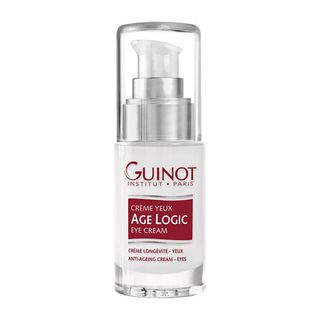
Guinot Age Logic Eye Cream

Guinot Age Logic Eye Cream

Efficacy100/100IrritancyHigh
Edit

Works for

1 of 1 advertised claim delivered

Anti-aging
13 ingredients credited for this claim
Strong support
What the product description says
“Age Logic Eye Cream”
From product name

This product can help reduce and prevent fine lines and wrinkles, improve skin elasticity and firmness because it contains adenosine.

These ingredients in the product can also be helpful, even though there is less evidence for their effectiveness: acetyl tetrapeptide-5, aspartic acid, folic acid, palmitoyl tripeptide-1, serine, threonine.

Keep in mind that it typically takes at least 6 weeks to notice any results because the changes that are needed to improve fine lines and elasticity happen in the deeper layers of the skin. No topical anti-aging product can “erase” wrinkles or fully reverse signs of aging.

AdenosineKey activeEffect: HighMight help improve cell turnover and reduce inflammation in skin. One study shows that the ingredients might be able to help reduce dynamic wrinkles (for example, in the corners of the eyes or on the forehead)~0.15–0.3%
Palmitoyl tripeptide-1Key activeEffect: MediumA type of peptide. Peptides are excellent moisturizers and might be able support collagen production reducing fine lines and wrinkles~0.25–0.45%
SerineKey activeEffect: MediumAn amino-acid that helps to attract water to the upper layer of the skin. In combination with other amino-acids, might help to reduce fine lines and wrinkles~0.2–0.35%
Aspartic acidKey activeEffect: MediumAn amino-acid that helps increase skin hydration and might help to slightly improve skin firmness, potentially reducing lines and wrinkles~0.15–0.3%
Acetyl tetrapeptide-5Key activeEffect: MediumA type of peptide. Peptides are excellent moisturizers and might be able support collagen production reducing fine lines and wrinkles~0.15–0.3%
Folic acidKey activeEffect: MediumCan help stimulate collagen production in skin. While available studies are promising, more research is needed to confirm the efficacy in skin~0.15–0.3%
ThreonineKey activeEffect: MediumAn amino-acid that helps to attract water to the upper layer of the skin. In combination with other amino-acids, might help to reduce fine lines and wrinkles~0.15–0.3%
HydroxyprolineEffect: LowIs helpful in restoring skin barrier function supporting its moisture levels. Is claimed to stimulte collagen production in skin but evidence is lacking~0.2–0.35%
Ascorbic acidUnder-dosedEffect: HighThe most well-researched antioxidant that works in skin. Helps neutralize free radicals supporting collagen production, helping to even out the skin tone and preventing early signs of aging~0.2–0.35%
NiacinamideUnder-dosedEffect: HighIs proven to be effective in reducing blemishes, evening out skin tone and helping to improve lines and wrinkles. It helps the skin to repair sun damage, calm down inflammation and keep maintain good levels of moisture. The concentration of about 2% is effective for supporting the skin barrier and evening out the skin tone. Concentration of 4-6% is better for helping with acne and balancing the sebum production~0.2–0.35%
NiacinUnder-dosedEffect: MediumA form of vitamin B3. It is similar in action to niacinamide, but is more likely to cause red flashes in skin as the side effect~0.2–0.35%
TocopherolEffect: Low, below effective dosePure form of vitamin E. Can help moisturise and protect the skin from free radicals. Often used to help stabilise other ingredients or the formula itself~0.15–0.25%
Sodium ascorbyl phosphateEffect: Low, below effective doseA stable derivative of vitamin C. It is oil-soluble which means it is more likely to penetrate the skin compared to the pure form of vitamin C (which is water-soluble), but it is less bio-available and is way less effective in stimulating collagen and reducing wrinkles compared to the pure form of vitamin C (L-ascorbic acid) and its other derivatives (for example, magnesium ascorbyl phosphate). At the same time, this vitamin C derivative has been shown in studies to be effective in reducing acne, blemishes and clogged pores. It is less irritating then the pure form of vitamin C~0.45–0.65%
Anti-oxidation
Not advertised by the brand · 8 ingredients credited for this claim
Strong support

This product contains antioxidants (glutathione) that can help neutralize free radicals in skin. By doing so, they can lessen the damage the skin gets from the UV light (sun).

The following ingredients - cysteine also can have an antioxidant effect, but there is less evidence to confirm their effectiveness in skin.

GlutathioneKey activeEffect: HighA peptide that can help neutralize free radicals in skin and reduce melanin production resulting in skin lightening effect and reduction in hyperpigmentation. It can also help attract moisture to the upper layer of the skin~0.2–0.35%
CysteineKey activeEffect: MediumMight help neutralize free radicals in skin and might be helpful against hyperpigmentation~0.2–0.35%
AdenosineEffect: LowMight help improve cell turnover and reduce inflammation in skin. One study shows that the ingredients might be able to help reduce dynamic wrinkles (for example, in the corners of the eyes or on the forehead)~0.15–0.3%
Pyridoxine hclEffect: LowMight help neutralize free radicals in skin~0.15–0.3%
Ascorbic acidUnder-dosedEffect: HighThe most well-researched antioxidant that works in skin. Helps neutralize free radicals supporting collagen production, helping to even out the skin tone and preventing early signs of aging~0.2–0.35%
TocopherolUnder-dosedEffect: HighPure form of vitamin E. Can help moisturise and protect the skin from free radicals. Often used to help stabilise other ingredients or the formula itself~0.15–0.25%
Sodium ascorbyl phosphateUnder-dosedEffect: MediumA stable derivative of vitamin C. It is oil-soluble which means it is more likely to penetrate the skin compared to the pure form of vitamin C (which is water-soluble), but it is less bio-available and is way less effective in stimulating collagen and reducing wrinkles compared to the pure form of vitamin C (L-ascorbic acid) and its other derivatives (for example, magnesium ascorbyl phosphate). At the same time, this vitamin C derivative has been shown in studies to be effective in reducing acne, blemishes and clogged pores. It is less irritating then the pure form of vitamin C~0.45–0.65%
Tocopheryl acetateEffect: Low, below effective doseA more stable but less bio-available form of vitamin E compared to Tocopherol. Might help moisturize and protect the skin from free radicals, but mostly used in low concentrations to stabilize other ingredients.~0.2–0.4%
Evens skin tone
Not advertised by the brand · 7 ingredients credited for this claim
Strong support

This product can help reduce hypepigmentation and even out the skin tone because it contains the following effective ingredients: glutathione

The following ingredient (ingredients) in this product might be helpful, but there is no evidence to confirm that it actually can help even out the skin tone: alanine, cysteine, ethyl linoleate.

Keep in mind that you would need to apply any topical skincare targetted at hypigmentation consistently for a couple of months to get a result. No topical skincare product can help get rid of hyperpigmentation (including post-acne marks and age spots) instantly.

GlutathioneKey activeEffect: HighA peptide that can help neutralize free radicals in skin and reduce melanin production resulting in skin lightening effect and reduction in hyperpigmentation. It can also help attract moisture to the upper layer of the skin~0.2–0.35%
Ethyl linoleateEffect: LowHelps reduce acne and blemishes. Helps to soften the upper layer of the skin and reduce inflammation. Might be helpful in reducing hyperpigmentation and evening out the skin tone, but evidence of effectiveness in skin are lacking~0.2–0.4%
CysteineEffect: LowMight help neutralize free radicals in skin and might be helpful against hyperpigmentation~0.2–0.35%
AlanineEffect: LowAn amino-acid that helps to attract water to the upper layer of the skin and might help to lighten the skin, but solid evidence is lacking~0.15–0.3%
Ascorbic acidUnder-dosedEffect: HighThe most well-researched antioxidant that works in skin. Helps neutralize free radicals supporting collagen production, helping to even out the skin tone and preventing early signs of aging~0.2–0.35%
NiacinamideUnder-dosedEffect: HighIs proven to be effective in reducing blemishes, evening out skin tone and helping to improve lines and wrinkles. It helps the skin to repair sun damage, calm down inflammation and keep maintain good levels of moisture. The concentration of about 2% is effective for supporting the skin barrier and evening out the skin tone. Concentration of 4-6% is better for helping with acne and balancing the sebum production~0.2–0.35%
NiacinUnder-dosedEffect: MediumA form of vitamin B3. It is similar in action to niacinamide, but is more likely to cause red flashes in skin as the side effect~0.2–0.35%
Moisturizing
Not advertised by the brand · 43 ingredients credited for this claim
Strong support

This product can help improve hydration of the skin with the two types of ingredients.

The first type is called “humectants”:
these ingredients help attract water. When humectants are on the surface of the skin, they “pull in” the moisture from the outside environment, or from within deeper layers of the skin. The following ingredients in this product do the job: alanine, arginine.

This product also contains ingredients called “occlusives”. They help reduce the speed with which our skin loses moisture to the outside environment. These ingredients also help soften the upper layer of the skin, so it feels less tight and nicer to the touch. The following ingredients in this product do the job: arginine, dimethicone.

The following ingredients in this product are especially good for supporting the skin barrier and helping with the hydration level: acetyl tetrapeptide-5, palmitoyl tripeptide-1

Glutamic acidKey active· HumectantEffect: HighAn amino-acid that helps attract water to the upper layer of the skin~0.15–0.3%
GlycerinKey active· HumectantEffect: HighOne of the best moisturizing ingredients. Naturally present in skin. It attracts water to the upper layer of the skin working as a humectant~0.35–0.65%
Glyceryl acrylate/acrylic acid copolymerKey active· HumectantEffect: HighHelps attract water to the upper layer of the skin and provide a longer-lasting hydration. Can create a thicker product consistency~0.15–0.3%
Sodium hyaluronateKey active· HumectantEffect: HighOne of the best moisturizing ingredients. Attracts water into the upper layer of the skin~0.15–0.3%
Sodium lactateKey active· HumectantEffect: HighHelps attract water to the upper layer of the skin. Is often used to adjust the pH level of the product~0.15–0.3%
SucroseKey active· HumectantEffect: HighCan help attract water to the upper layer of the skin. In crystal form, it can work as a gentle exfoliant, gentler than the salt scrub. Helps stabilize the emulsion~0.15–0.25%
ThreonineKey activeEffect: HighAn amino-acid that helps to attract water to the upper layer of the skin. In combination with other amino-acids, might help to reduce fine lines and wrinkles~0.15–0.3%
TyrosineKey activeEffect: High~0.15–0.3%
Acetyl tetrapeptide-5Hero· HumectantEffect: HighA type of peptide. Peptides are excellent moisturizers and might be able support collagen production reducing fine lines and wrinkles~0.15–0.3%
AlanineKey active· HumectantEffect: HighAn amino-acid that helps to attract water to the upper layer of the skin and might help to lighten the skin, but solid evidence is lacking~0.15–0.3%
ArginineKey active· Humectant, OcclusiveEffect: HighAn amino acid that is naturally present in skin and helps keep it hydrated. When used together with AHAs, it can reduce their irritating effect on the skin~0.15–0.25%
Aspartic acidKey active· HumectantEffect: HighAn amino-acid that helps increase skin hydration and might help to slightly improve skin firmness, potentially reducing lines and wrinkles~0.15–0.3%
BetaineKey active· HumectantEffect: HighHelps attract water to the upper layer of the skin and improves the product texture~0.15–0.3%
Calcium pantothenateKey activeEffect: HighHelps support skin barrier function improving skin hydration and reducing sensitivity~0.15–0.3%
CholesterolKey active· EmollientEffect: HighAn emollient that is naturally found in skin~0.25–0.45%
CysteineKey activeEffect: HighMight help neutralize free radicals in skin and might be helpful against hyperpigmentation~0.2–0.35%
DimethiconeKey active· Emollient, OcclusiveEffect: HighA silicone that helps to reduce water loss from the surface of the skin. Can temporarily "fill in" lines and wrinkles, absorb oil, and create a nice product finish~5.3–6.5%
Ethyl linoleateKey active· EmollientEffect: HighHelps reduce acne and blemishes. Helps to soften the upper layer of the skin and reduce inflammation. Might be helpful in reducing hyperpigmentation and evening out the skin tone, but evidence of effectiveness in skin are lacking~0.2–0.4%
GlutathioneKey activeEffect: HighA peptide that can help neutralize free radicals in skin and reduce melanin production resulting in skin lightening effect and reduction in hyperpigmentation. It can also help attract moisture to the upper layer of the skin~0.2–0.35%
GlycineKey active· HumectantEffect: HighHelps to attract water to the upper layer of the skin and can help restore the skin barrier function~0.15–0.3%
HistidineKey active· HumectantEffect: High~0.2–0.35%
HydroxyprolineKey activeEffect: HighIs helpful in restoring skin barrier function supporting its moisture levels. Is claimed to stimulte collagen production in skin but evidence is lacking~0.2–0.35%
InositolKey active· HumectantEffect: High~0.2–0.35%
IsoleucineKey activeEffect: HighAn amino acid that can help attract water to the upper layer of the skin and support skin's barrier function~0.2–0.35%
Lysine hclKey activeEffect: High~0.15–0.3%
Palmitoyl tripeptide-1Hero· EmollientEffect: HighA type of peptide. Peptides are excellent moisturizers and might be able support collagen production reducing fine lines and wrinkles~0.25–0.45%
SerineKey activeEffect: HighAn amino-acid that helps to attract water to the upper layer of the skin. In combination with other amino-acids, might help to reduce fine lines and wrinkles~0.2–0.35%
Dimethicone crosspolymerKey activeEffect: MediumUsed to create a thicker product texture. Helps soften the upper layer of the skin and might be able to prevent moisture loss from its surface~0.8–1.15%
AdenosineKey activeEffect: MediumMight help improve cell turnover and reduce inflammation in skin. One study shows that the ingredients might be able to help reduce dynamic wrinkles (for example, in the corners of the eyes or on the forehead)~0.15–0.3%
GlucoseKey active· HumectantEffect: MediumHelps attract water to the upper layer of the skin. Could be helpful in restoring the skin barrier function~0.15–0.3%
CyclopentasiloxaneKey active· EmollientEffect: MediumA silicone that helps improve the product texture and spreadability. Can absorb oil creating a short-term mattifying effect on the skin~1.4–1.7%
Cetearyl alcoholKey active· EmollientEffect: MediumA non-drying alcohol. Works as an emollient. Helps water and oil mix together and creates a nice product texture~1.9–2.4%
ProlineKey activeEffect: Medium~0.2–0.35%
Capryloyl glycineKey activeEffect: MediumHelps oil and water mix together, preserve cosmetic products, and attract water to the upper layer of the skin~0.25–0.45%
Butylene glycol· HumectantEffect: LowUsed to create a nice product texture and help delivery of other ingredients. Might be somewhat helpful in attracting water to the upper layer of the skin~0.2–0.4%
BiotinEffect: LowMight have some moisturising properties. Is not effective when applied topically beyond some moisturizing effect~0.15–0.3%
Ethyl oleate· EmollientEffect: LowEthyl oleate is a long-chain fatty acid ethyl ester resulting from the formal condensation of the carboxy group of oleic acid with the hydroxy group of ethanol. It derives from an oleic acid. In skincare, it is used to soften the upper layer of the skin, improve the product texture and smell~0.2–0.4%
Isohexadecane· EmollientEffect: LowImproves the texture of the product and helps soften the skin. Helps oil and water mix together and can be used as a cleansing agent~3–3.7%
Propylene glycol· HumectantEffect: LowHelps oil and water mix together and can enhance the penetration of other ingredients into the skin. It can be irritating~3.9–4.8%
Glyceryl polymethacrylate· Humectant, EmollientEffect: LowUsed to create a nice product texture~0.25–0.5%
NiacinamideUnder-dosedEffect: HighIs proven to be effective in reducing blemishes, evening out skin tone and helping to improve lines and wrinkles. It helps the skin to repair sun damage, calm down inflammation and keep maintain good levels of moisture. The concentration of about 2% is effective for supporting the skin barrier and evening out the skin tone. Concentration of 4-6% is better for helping with acne and balancing the sebum production~0.2–0.35%
NiacinUnder-dosedEffect: HighA form of vitamin B3. It is similar in action to niacinamide, but is more likely to cause red flashes in skin as the side effect~0.2–0.35%
TocopherolEffect: Low, below effective dosePure form of vitamin E. Can help moisturise and protect the skin from free radicals. Often used to help stabilise other ingredients or the formula itself~0.15–0.25%

Can it cause trouble?

Irritancy
5 strong irritants: Alcohol denat., Parfum + 3 more — patch-test recommended
High risk
We flagged 24 ingredients with irritancy potential. Severity depends on your sensitivity threshold; the table lists the worst offenders first.
IngredientFunctionIrritationEst. amount
Propylene glycolHelps oil and water mix together and can enhance the penetration of other ingredients into the skin. It can be irritatingHigh~3.9–4.8%est.
Alcohol denat.Produces temporary toning effect. Can help dissolve other ingredients or preserve productsHigh~0.5–0.75%est.
ParfumAn aromatic blend of unspecified and possibly irritating ingredientsHigh~0.3–0.55%est.
Hexyl cinnamalA fragrance with jasmine smell. A likely irritantHigh~0.15–0.3%est.
Spilanthes acmella flower extractPlant extract that might hep calm down inflammation in skinHigh~0.15–0.3%est.
LinaloolA fragrance. Can be irritatingHigh~0.15–0.25%est.
LimoneneA common frangrance that can easily irritate skin, especially if exposed to air, light or heatHigh~0.15–0.25%est.
Zinc sulfateA preservative. It can be irritatingHigh~0.15–0.25%est.
Ascorbic acidThe most well-researched antioxidant that works in skin. Helps neutralize free radicals supporting collagen production, helping to even out the skin tone and preventing early signs of agingHigh~0.2–0.35%est.
NiacinA form of vitamin B3. It is similar in action to niacinamide, but is more likely to cause red flashes in skin as the side effectHigh~0.2–0.35%est.
Sodium ascorbyl phosphateA stable derivative of vitamin C. It is oil-soluble which means it is more likely to penetrate the skin compared to the pure form of vitamin C (which is water-soluble), but it is less bio-available and is way less effective in stimulating collagen and reducing wrinkles compared to the pure form of vitamin C (L-ascorbic acid) and its other derivatives (for example, magnesium ascorbyl phosphate). At the same time, this vitamin C derivative has been shown in studies to be effective in reducing acne, blemishes and clogged pores. It is less irritating then the pure form of vitamin CMedium~0.45–0.65%est.
EthylhexylglycerinA preservativeMedium~0.35–0.65%est.
Tocopheryl acetateA more stable but less bio-available form of vitamin E compared to Tocopherol. Might help moisturize and protect the skin from free radicals, but mostly used in low concentrations to stabilize other ingredients.Medium~0.2–0.4%est.
Chlorhexidine digluconateA preservativeMedium~0.15–0.3%est.
Disodium edtaStabilizes the product formulationMedium~0.15–0.3%est.
Glyceryl acrylate/acrylic acid copolymerHelps attract water to the upper layer of the skin and provide a longer-lasting hydration. Can create a thicker product consistencyMedium~0.15–0.3%est.
Sodium lactateHelps attract water to the upper layer of the skin. Is often used to adjust the pH level of the productMedium~0.15–0.3%est.
Calcium chlorideHelps create a thicker product consistency. Might be irritatingMedium~0.15–0.3%est.
Sodium sulfateUsed to improve the product consistency and stabilize formulationsMedium~0.2–0.35%est.
Ethyl linoleateHelps reduce acne and blemishes. Helps to soften the upper layer of the skin and reduce inflammation. Might be helpful in reducing hyperpigmentation and evening out the skin tone, but evidence of effectiveness in skin are lackingMedium~0.2–0.4%est.
Ethyl oleateEthyl oleate is a long-chain fatty acid ethyl ester resulting from the formal condensation of the carboxy group of oleic acid with the hydroxy group of ethanol. It derives from an oleic acid. In skincare, it is used to soften the upper layer of the skin, improve the product texture and smellMedium~0.2–0.4%est.
GlutathioneA peptide that can help neutralize free radicals in skin and reduce melanin production resulting in skin lightening effect and reduction in hyperpigmentation. It can also help attract moisture to the upper layer of the skinMedium~0.2–0.35%est.
Pyridoxine hclMight help neutralize free radicals in skinMedium~0.15–0.3%est.
Thiamine hclCan help attract water to the upper layer of the skin. Is studied as a mosquito repellentMedium~0.15–0.25%est.
Comedogenic
1 ingredient rated 2 or more on the 0–5 pore-clogging scale
1 flagged
These ingredients have a comedogenic rating of 2 or more on a 0–5 scale; the table shows each one's rating. In leave-on products they can clog pores in acne-prone skin.
IngredientFunctionRatingEst. amount
Cetearyl alcoholA non-drying alcohol. Works as an emollient. Helps water and oil mix together and creates a nice product texture2/5~1.9–2.4%est.
Edit

User reviews

Would you recommend?
No community reviews yet.

Be the first — your take helps the next person decide.

Write a review · ~30s

Ingredients

Filter by role to see what each ingredient is doing.

Water~45–55%
Formula
Irritation risk
Low

Plain old water

More about Water
Dimethicone~5.3–6.5%
Key active
Irritation risk
Low
Works for
MoisturizingMattifying

A silicone that helps to reduce water loss from the surface of the skin. Can temporarily "fill in" lines and wrinkles, absorb oil, and create a nice product finish

More about Dimethicone
Propylene glycol~3.9–4.8%
Irritant · high
Irritation risk
High
Works for
Moisturizing

Helps oil and water mix together and can enhance the penetration of other ingredients into the skin. It can be irritating

More about Propylene glycol
Isohexadecane~3–3.7%
Formula
Irritation risk
Low
Works for
CleansingMoisturizing

Improves the texture of the product and helps soften the skin. Helps oil and water mix together and can be used as a cleansing agent

More about Isohexadecane
Beheneth-25~2.4–2.9%
Formula
Irritation risk
Low
Works for
Cleansing
More about Beheneth-25
Cetearyl alcohol~1.9–2.4%
Key activeComedogenic 2/5
Irritation risk
Low
Comedogenicity
2/5
Works for
CleansingMoisturizing

A non-drying alcohol. Works as an emollient. Helps water and oil mix together and creates a nice product texture

More about Cetearyl alcohol
Hydrogenated olive oil caprylyl esters~1.7–2%
Formula
Cyclopentasiloxane~1.4–1.7%
Key active
Irritation risk
Low
Works for
MattifyingMoisturizing

A silicone that helps improve the product texture and spreadability. Can absorb oil creating a short-term mattifying effect on the skin

More about Cyclopentasiloxane
Sodium polyacrylate~1.2–1.4%
Formula
Irritation risk
Low
Works for
Mattifying

Used to create a gel-like product texture, as well as to stabilize emulsions

More about Sodium polyacrylate
Dimethicone crosspolymer~0.8–1.15%
Key active
Irritation risk
Low
Works for
Moisturizing

Used to create a thicker product texture. Helps soften the upper layer of the skin and might be able to prevent moisture loss from its surface

More about Dimethicone crosspolymer
Mica~0.75–1.1%
Formula
Irritation risk
Low

Creates an illusion of smoother and more radiant skin tone. Adds shimmer to the skin by reflecting light

More about Mica
Alcohol denat.~0.5–0.75%
Irritant · high
Irritation risk
High

Produces temporary toning effect. Can help dissolve other ingredients or preserve products

More about Alcohol denat.
Sodium ascorbyl phosphate~0.45–0.65%
Under-dosedIrritant · medium
Irritation risk
Medium
Works for
Anti-blemishAnti-oxidationAnti-aging

A stable derivative of vitamin C. It is oil-soluble which means it is more likely to penetrate the skin compared to the pure form of vitamin C (which is water-soluble), but it is less bio-available and is way less effective in stimulating collagen and reducing wrinkles compared to the pure form of vitamin C (L-ascorbic acid) and its other derivatives (for example, magnesium ascorbyl phosphate). At the same time, this vitamin C derivative has been shown in studies to be effective in reducing acne, blemishes and clogged pores. It is less irritating then the pure form of vitamin C

More about Sodium ascorbyl phosphate
Ethylhexylglycerin~0.35–0.65%
Irritant · medium
Irritation risk
Medium

A preservative

More about Ethylhexylglycerin
Glycerin~0.35–0.65%
Key active
Irritation risk
Low
Works for
Moisturizing

One of the best moisturizing ingredients. Naturally present in skin. It attracts water to the upper layer of the skin working as a humectant

More about Glycerin
Parfum~0.3–0.55%
Irritant · high
Irritation risk
High

An aromatic blend of unspecified and possibly irritating ingredients

More about Parfum
Diphenyl dimethicone~0.35–0.6%
Formula
Irritation risk
Low
Works for
Cleansing
More about Diphenyl dimethicone
Silica~0.4–0.65%
Formula
Irritation risk
Low

Used to absorb oil and can temporarily mattify skin

More about Silica
Glyceryl polymethacrylate~0.25–0.5%
Formula
Irritation risk
Low
Works for
Moisturizing

Used to create a nice product texture

More about Glyceryl polymethacrylate
Butylene glycol~0.2–0.4%
Formula
Irritation risk
Low
Works for
Moisturizing

Used to create a nice product texture and help delivery of other ingredients. Might be somewhat helpful in attracting water to the upper layer of the skin

More about Butylene glycol
Tocopheryl acetate~0.2–0.4%
Irritant · medium
Irritation risk
Medium
Works for
Anti-oxidation

A more stable but less bio-available form of vitamin E compared to Tocopherol. Might help moisturize and protect the skin from free radicals, but mostly used in low concentrations to stabilize other ingredients.

More about Tocopheryl acetate
Hexyl cinnamal~0.15–0.3%
Irritant · high
Irritation risk
High

A fragrance with jasmine smell. A likely irritant

More about Hexyl cinnamal
Betaine~0.15–0.3%
Key active
Irritation risk
Low
Works for
Moisturizing

Helps attract water to the upper layer of the skin and improves the product texture

More about Betaine
Spilanthes acmella flower extract~0.15–0.3%
Irritant · high
Irritation risk
High
Works for
Anti-inflammatory

Plant extract that might hep calm down inflammation in skin

More about Spilanthes acmella flower extract
Chlorhexidine digluconate~0.15–0.3%
Irritant · medium
Irritation risk
Medium

A preservative

More about Chlorhexidine digluconate
Disodium edta~0.15–0.3%
Irritant · medium
Irritation risk
Medium

Stabilizes the product formulation

More about Disodium edta
Linalool~0.15–0.25%
Irritant · high
Irritation risk
High

A fragrance. Can be irritating

More about Linalool
Pectin~0.15–0.3%
Formula
Irritation risk
Low
More about Pectin
Sodium chloride~0.2–0.35%
Formula
Irritation risk
Low

Used to stabilize mixtures of oil and water, and create thicker, gel-like product textures

More about Sodium chloride
Hydrolyzed corn protein~0.15–0.3%
Formula
Sucrose~0.15–0.25%
Key active
Irritation risk
Low
Works for
Moisturizing

Can help attract water to the upper layer of the skin. In crystal form, it can work as a gentle exfoliant, gentler than the salt scrub. Helps stabilize the emulsion

More about Sucrose
Titanium dioxide~0.25–0.45%
Formula
Irritation risk
Low
Works for
Sun protection

Works as a UV filter when used in high concentrations. It is photostable and is effective mostly against the UVB light, with some protection in the UVA range. In small concentrations, used for its ability to improve the color of cosmetic products. Is usually well tolerated by the skin

More about Titanium dioxide
Ci 77891~0.15–0.25%
Formula
Irritation risk
Low
More about Ci 77891
Glyceryl acrylate/acrylic acid copolymer~0.15–0.3%
Key activeIrritant · medium
Irritation risk
Medium
Works for
Moisturizing

Helps attract water to the upper layer of the skin and provide a longer-lasting hydration. Can create a thicker product consistency

More about Glyceryl acrylate/acrylic acid copolymer
Limonene~0.15–0.25%
Irritant · high
Irritation risk
High

A common frangrance that can easily irritate skin, especially if exposed to air, light or heat

More about Limonene
Sodium lactate~0.15–0.3%
Key activeIrritant · medium
Irritation risk
Medium
Works for
Moisturizing

Helps attract water to the upper layer of the skin. Is often used to adjust the pH level of the product

More about Sodium lactate
Capryloyl glycine~0.25–0.45%
Key active
Irritation risk
Low
Works for
CleansingMoisturizing

Helps oil and water mix together, preserve cosmetic products, and attract water to the upper layer of the skin

More about Capryloyl glycine
Disodium adenosine triphosphate~0.15–0.3%
Formula
Sodium hyaluronate~0.15–0.3%
Key active
Irritation risk
Low
Works for
Moisturizing

One of the best moisturizing ingredients. Attracts water into the upper layer of the skin

More about Sodium hyaluronate
Glucose~0.15–0.3%
Key active
Irritation risk
Low
Works for
Moisturizing

Helps attract water to the upper layer of the skin. Could be helpful in restoring the skin barrier function

More about Glucose
Prolyl histamine hcl~0.15–0.3%
Formula
Potassium chloride~0.15–0.3%
Formula
Calcium chloride~0.15–0.3%
Irritant · medium
Irritation risk
Medium

Helps create a thicker product consistency. Might be irritating

More about Calcium chloride
Magnesium sulfate~0.2–0.35%
Formula
Irritation risk
Low

Used to create a thicker product consistency

More about Magnesium sulfate
Glutamic acid~0.15–0.3%
Key active
Irritation risk
Low
Works for
Moisturizing

An amino-acid that helps attract water to the upper layer of the skin

More about Glutamic acid
Sodium phosphate~0.15–0.3%
Formula
Irritation risk
Low

Helps stabilize the product formulation

More about Sodium phosphate
Glutamine~0.15–0.3%
Formula
Irritation risk
Low
More about Glutamine
Acetyl tetrapeptide-5~0.15–0.3%
Hero · Moisturizing
Irritation risk
Low
Works for
MoisturizingAnti-aging

A type of peptide. Peptides are excellent moisturizers and might be able support collagen production reducing fine lines and wrinkles

More about Acetyl tetrapeptide-5
Lysine hcl~0.15–0.3%
Key active
Irritation risk
Low
Works for
Moisturizing
More about Lysine hcl
Arginine~0.15–0.25%
Key active
Irritation risk
Low
Works for
Moisturizing

An amino acid that is naturally present in skin and helps keep it hydrated. When used together with AHAs, it can reduce their irritating effect on the skin

More about Arginine
Zinc sulfate~0.15–0.25%
Irritant · high
Irritation risk
High

A preservative. It can be irritating

More about Zinc sulfate
Copper sulfate~0.15–0.3%
Formula
Irritation risk
Low
More about Copper sulfate
Leucine~0.15–0.3%
Formula
Irritation risk
Low
More about Leucine
Alanine~0.15–0.3%
Key active
Irritation risk
Low
Works for
MoisturizingEvens skin tone

An amino-acid that helps to attract water to the upper layer of the skin and might help to lighten the skin, but solid evidence is lacking

More about Alanine
Glycine~0.15–0.3%
Key active
Irritation risk
Low
Works for
Moisturizing

Helps to attract water to the upper layer of the skin and can help restore the skin barrier function

More about Glycine
Potassium nitrate~0.2–0.35%
Formula
Sodium acetate~0.15–0.3%
Formula
Irritation risk
Low
More about Sodium acetate
Sodium sulfate~0.2–0.35%
Irritant · medium
Irritation risk
Medium

Used to improve the product consistency and stabilize formulations

More about Sodium sulfate
Valine~0.15–0.3%
Formula
Irritation risk
Low
More about Valine
Proline~0.2–0.35%
Key active
Irritation risk
Low
Works for
Moisturizing
More about Proline
Tyrosine~0.15–0.3%
Key active
Irritation risk
Low
Works for
Moisturizing
More about Tyrosine
Aspartic acid~0.15–0.3%
Key active
Irritation risk
Low
Works for
MoisturizingAnti-aging

An amino-acid that helps increase skin hydration and might help to slightly improve skin firmness, potentially reducing lines and wrinkles

More about Aspartic acid
Methionine~0.15–0.3%
Formula
Irritation risk
Low
More about Methionine
Threonine~0.15–0.3%
Key active
Irritation risk
Low
Works for
MoisturizingAnti-aging

An amino-acid that helps to attract water to the upper layer of the skin. In combination with other amino-acids, might help to reduce fine lines and wrinkles

More about Threonine
Adenine~0.2–0.35%
Formula
Irritation risk
Low
More about Adenine
Phenylalanine~0.2–0.35%
Formula
Irritation risk
Low
More about Phenylalanine
Serine~0.2–0.35%
Key active
Irritation risk
Low
Works for
MoisturizingAnti-aging

An amino-acid that helps to attract water to the upper layer of the skin. In combination with other amino-acids, might help to reduce fine lines and wrinkles

More about Serine
Histidine~0.2–0.35%
Key active
Irritation risk
Low
Works for
Moisturizing
More about Histidine
Isoleucine~0.2–0.35%
Key active
Irritation risk
Low
Works for
Moisturizing

An amino acid that can help attract water to the upper layer of the skin and support skin's barrier function

More about Isoleucine
Hydroxyproline~0.2–0.35%
Key active
Irritation risk
Low
Works for
CleansingMoisturizingAnti-aging

Is helpful in restoring skin barrier function supporting its moisture levels. Is claimed to stimulte collagen production in skin but evidence is lacking

More about Hydroxyproline
Tryptophan~0.2–0.35%
Formula
Irritation risk
Low
More about Tryptophan
Palmitoyl tripeptide-1~0.25–0.45%
Hero · Moisturizing
Irritation risk
Low
Works for
MoisturizingAnti-aging

A type of peptide. Peptides are excellent moisturizers and might be able support collagen production reducing fine lines and wrinkles

More about Palmitoyl tripeptide-1
Cysteine~0.2–0.35%
Key active
Irritation risk
Low
Works for
MoisturizingAnti-oxidationEvens skin tone

Might help neutralize free radicals in skin and might be helpful against hyperpigmentation

More about Cysteine
Dna~0.2–0.35%
Formula
Irritation risk
Low
More about Dna
Rna~0.2–0.35%
Formula
Irritation risk
Low
More about Rna
Cholesterol~0.25–0.45%
Key active
Irritation risk
Low
Works for
MoisturizingCleansing

An emollient that is naturally found in skin

More about Cholesterol
Disodium adenosine phosphate~0.2–0.35%
Formula
Ascorbic acid~0.2–0.35%
Under-dosedIrritant · high
Irritation risk
High
Works for
Evens skin toneAnti-agingAnti-oxidation

The most well-researched antioxidant that works in skin. Helps neutralize free radicals supporting collagen production, helping to even out the skin tone and preventing early signs of aging

More about Ascorbic acid
Ethyl linoleate~0.2–0.4%
Key activeIrritant · medium
Irritation risk
Medium
Works for
MoisturizingAnti-blemishAnti-inflammatoryEvens skin tone

Helps reduce acne and blemishes. Helps to soften the upper layer of the skin and reduce inflammation. Might be helpful in reducing hyperpigmentation and evening out the skin tone, but evidence of effectiveness in skin are lacking

More about Ethyl linoleate
Ethyl linolenate~0.25–0.45%
Formula
Ethyl oleate~0.2–0.4%
Irritant · medium
Irritation risk
Medium
Works for
Moisturizing

Ethyl oleate is a long-chain fatty acid ethyl ester resulting from the formal condensation of the carboxy group of oleic acid with the hydroxy group of ethanol. It derives from an oleic acid. In skincare, it is used to soften the upper layer of the skin, improve the product texture and smell

More about Ethyl oleate
Glutathione~0.2–0.35%
Key activeIrritant · medium
Irritation risk
Medium
Works for
Evens skin toneMoisturizingAnti-oxidation

A peptide that can help neutralize free radicals in skin and reduce melanin production resulting in skin lightening effect and reduction in hyperpigmentation. It can also help attract moisture to the upper layer of the skin

More about Glutathione
Inositol~0.2–0.35%
Key active
Irritation risk
Low
Works for
Moisturizing
More about Inositol
Niacin~0.2–0.35%
Under-dosedIrritant · high
Irritation risk
High
Works for
MoisturizingAnti-agingAnti-blemishEvens skin tone

A form of vitamin B3. It is similar in action to niacinamide, but is more likely to cause red flashes in skin as the side effect

More about Niacin
Niacinamide~0.2–0.35%
Under-dosed
Irritation risk
Low
Works for
Anti-agingEvens skin toneMoisturizingAnti-blemishReduces irritationAnti-inflammatoryReduces rednessAntibacterial

Is proven to be effective in reducing blemishes, evening out skin tone and helping to improve lines and wrinkles. It helps the skin to repair sun damage, calm down inflammation and keep maintain good levels of moisture. The concentration of about 2% is effective for supporting the skin barrier and evening out the skin tone. Concentration of 4-6% is better for helping with acne and balancing the sebum production

More about Niacinamide
Pyridoxine hcl~0.15–0.3%
Irritant · medium
Irritation risk
Medium
Works for
Anti-oxidation

Might help neutralize free radicals in skin

More about Pyridoxine hcl
Adenosine~0.15–0.3%
Key active
Irritation risk
Low
Works for
Anti-agingMoisturizingAnti-oxidation

Might help improve cell turnover and reduce inflammation in skin. One study shows that the ingredients might be able to help reduce dynamic wrinkles (for example, in the corners of the eyes or on the forehead)

More about Adenosine
Biotin~0.15–0.3%
Formula
Irritation risk
Low
Works for
Moisturizing

Might have some moisturising properties. Is not effective when applied topically beyond some moisturizing effect

More about Biotin
Calcium pantothenate~0.15–0.3%
Key active
Irritation risk
Low
Works for
MoisturizingReduces irritation

Helps support skin barrier function improving skin hydration and reducing sensitivity

More about Calcium pantothenate
Cytosine~0.15–0.3%
Formula
Irritation risk
Low
More about Cytosine
Folic acid~0.15–0.3%
Key active
Irritation risk
Low
Works for
Anti-aging

Can help stimulate collagen production in skin. While available studies are promising, more research is needed to confirm the efficacy in skin

More about Folic acid
Guanine~0.15–0.3%
Formula
Irritation risk
Low
More about Guanine
Riboflavin~0.15–0.25%
Formula
Irritation risk
Low
More about Riboflavin
Thiamine hcl~0.15–0.25%
Irritant · medium
Irritation risk
Medium

Can help attract water to the upper layer of the skin. Is studied as a mosquito repellent

More about Thiamine hcl
Thymine~0.15–0.25%
Formula
Irritation risk
Low
More about Thymine
Tocopherol~0.15–0.25%
Under-dosed
Irritation risk
Low
Works for
Anti-oxidationAnti-agingMoisturizingAnti-inflammatory

Pure form of vitamin E. Can help moisturise and protect the skin from free radicals. Often used to help stabilise other ingredients or the formula itself

More about Tocopherol
Uracil~0.1–0.15%
Formula
Irritation risk
Low
More about Uracil
Xanthine~0.05–0.15%
Formula
Irritation risk
Low
More about Xanthine
Ingredient list view

Water, Dimethicone, Propylene glycol, Isohexadecane, Beheneth-25, Cetearyl alcohol, Hydrogenated olive oil caprylyl esters, Cyclopentasiloxane, Sodium polyacrylate, Dimethicone crosspolymer, Mica, Alcohol denat., Sodium ascorbyl phosphate, Ethylhexylglycerin, Glycerin, Parfum, Diphenyl dimethicone, Silica, Glyceryl polymethacrylate, Butylene glycol, Tocopheryl acetate, Hexyl cinnamal, Betaine, Spilanthes acmella flower extract, Chlorhexidine digluconate, Disodium edta, Linalool, Pectin, Sodium chloride, Hydrolyzed corn protein, Sucrose, Titanium dioxide, Ci 77891, Glyceryl acrylate/acrylic acid copolymer, Limonene, Sodium lactate, Capryloyl glycine, Disodium adenosine triphosphate, Sodium hyaluronate, Glucose, Prolyl histamine hcl, Potassium chloride, Calcium chloride, Magnesium sulfate, Glutamic acid, Sodium phosphate, Glutamine, Acetyl tetrapeptide-5, Lysine hcl, Arginine, Zinc sulfate, Copper sulfate, Leucine, Alanine, Glycine, Potassium nitrate, Sodium acetate, Sodium sulfate, Valine, Proline, Tyrosine, Aspartic acid, Methionine, Threonine, Adenine, Phenylalanine, Serine, Histidine, Isoleucine, Hydroxyproline, Tryptophan, Palmitoyl tripeptide-1, Cysteine, Dna, Rna, Cholesterol, Disodium adenosine phosphate, Ascorbic acid, Ethyl linoleate, Ethyl linolenate, Ethyl oleate, Glutathione, Inositol, Niacin, Niacinamide, Pyridoxine hcl, Adenosine, Biotin, Calcium pantothenate, Cytosine, Folic acid, Guanine, Riboflavin, Thiamine hcl, Thymine, Tocopherol, Uracil, Xanthine

Compare prices

Retailers ranked by price — lowest first.

Amazon USPrice as of 10/9/2026 21:26 GMT
$80.00
Buy

Affiliate links · prices updated regularly · As an Amazon Associate, WIMJ earns from qualifying purchases.

Worth comparing, line by line.

Match % combines shared ingredients, the first five ingredients, shared actives and hero ingredients, irritancy (lower counts in the alternative's favour), texture and body area. Only products in the same routine step are compared.

Side-by-side comparison of this product against its closest alternatives
GuinotAge Logic Eye CreamYOUR PRODUCTGlowiestDREAM GLOW Collagen 82 Eye CreamELENSILIACPP 80 Collagen Eye Cream Timeless GoldNATUREKINDMiracle Eye Bags Cream
Match—85%85%83%
Price$80.00$19.99−$60.01$39.00−$41.00$22.60−$57.40
Shared key ingredients—18 of 3418 of 3417 of 34
Key difference—Palmitoyl Tetrapeptide-7Palmitoyl Tetrapeptide-7Copper Tripeptide-1
Irritancy High Medium Medium Medium
Drying alcohol Contains drying alcohol ———
View product Shop Shop Shop
Cheaper alternatives? See how this stacks up against similar formulas.
We compare ingredient profiles across our catalog — pick the closest match for your budget.
Open dupe finder

Product summary

"Guinot - Age Logic Eye Cream" has a good moisturizing formula. To work well, any moisturizer needs to include a combination of water-binding and emollient ingredients. Guinot - Age Logic Eye Cream ticks this box. Acetyl tetrapeptide-5, alanine, arginine, aspartic acid and betaine in this product (humectants) attract water molecules to the upper layer of the skin (the water comes from the outside air or from the deeper layers of the skin if the air is dry). Emollients in this formulation (palmitoyl tripeptide-1, cholesterol, ethyl linoleate, arginine and dimethicone) help to reduce the moisture loss from the skin. They also soften the skin surface and relieve the feeling of dryness and tightness.

Ingredient callouts

  • This product also contains Vitamin C (Ascorbic Acid). It can be an effective active for anti-aging and evening out the skin tone, but in this moisturizer it is used for stabilizing other ingredients in the formulation. In this concentration (0.20% - 0.35%) it cannot have a noticeable benefit for the skin.
  • We like that this moisturizer contains peptides (palmitoyl tripeptide-1 0.25% - 0.45% and acetyl tetrapeptide-5 0.15% - 0.30%). There are many different kind of Peptides and they are naturally present in our skin. They all are a combination of aminoacids. Some of them work as natural antibiotics, promote wound-healing and production of collagen. The science is still not settled on how effective Peptides are in skincare, but it is very likely that they have a benefit. Peptides might help restore the skin barrier and fight the signs of aging. At the very least, Peptides work as humectants: they attract water to the upper layer of the skin and improve its hydration.
  • Adenosine 0.15% - 0.30%. It is a compound that in involved in many biological processes inside the skin cells. According one high-quality clinical trial, topical Adenosine in low concentrations can somewhat help improve "deep wrinkles" - the wrinkles that appear with age in places where our faces are most dynamic (for example, on the forehead or in the corners of the eyes).
This product contains ingredients that could be beneficial, but their concentrations are too low in this formulation: vitamin e, niacinamide, niacin, vitamin c, sodium ascorbyl phosphate and titanium dioxide

Irritation risk

This moisturizer contains a bunch of common irritants, including ingredients that do not provide any known benefit for the skin. It might not be the best choice if your skin is sensitive. We assess the overall irritancy of this moisturizer to be high. For a detailed overview of all potential irritants: click here

You can see the detailed formula review with the breakdown of all actives in the product and the full ingredient list with estimated concentrations in the tables below.

Sources cited in this review

Every concentration estimate and effectiveness label is anchored to one of these 45 studies and safety reviews.

  1. 1
  2. 2
  3. 3
  4. 4
    Propylene Glycolpubmed.ncbi.nlm.nih.gov
  5. 5
  6. 6

Affiliate links · As an Amazon Associate, WIMJ earns from qualifying purchases.

As an Amazon Associate, WIMJ earns from qualifying purchases.