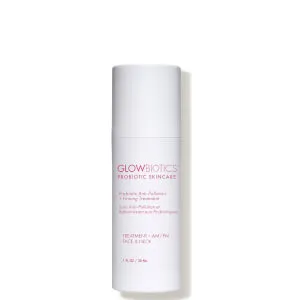
Glowbiotics MD GLOWBIOTICS Probiotic AntiPollution Firming Treatment

Glowbiotics MD GLOWBIOTICS Probiotic AntiPollution Firming Treatment

Efficacy100/100IrritancyHigh

Works for

Anti-aging
Bakuchiol, Lactococcus ferment lysate + 2 more
Works well
What the product description says
“This skin-defense treatment creates a web-like matrix to help shelter the skin against pollution, dirt and eco-factors that may contribute to signs of aging .”
Source: Skinstore

This product can help reduce and prevent fine lines and wrinkles, improve skin elasticity and firmness because it contains bakuchiol.

Keep in mind that it typically takes at least 6 weeks to notice any results because the changes that are needed to improve fine lines and elasticity happen in the deeper layers of the skin. No topical anti-aging product can “erase” wrinkles or fully reverse signs of aging.

BakuchiolKey activeEffect: HighA plant extract that is, though different in chemical structure, acts similar to retinoids. First studies show that it can help reduce fine lines and wrinkles, improve skin tone, reduce clogged pores and blemishes, and reduce inflammation. There is no conclusive evidence that bakuchiol is as effective as retinol however. The study that directly compared retinol with bakuchiol used bakuchiol applied twice daily compared to once per day for the retinol. According to this study, bakuchiol is less irritating than retinol. Bakuchiol is extracted from seeds of Babchi plant. Other parts of the plant contain coumarins that could cause allergic and irritant reactions. These compounds should be removed in the extraction process when bakuchiol is produced, but it is a good idea to be cautious and stay away from products that include the Babchi plant extracts other than purified bakuchiol to avoid irritation~0.55–0.85%
Lactococcus ferment lysateEffect: LowConsists of remains of dead bacteria cells. Is likely helpful in attracting water to the upper layer of the skin. Might be helpful in reducing inflammation and neutralizing free radicals in skin~3–3.6%
Beta-glucanEffect: LowHelps attract water to the upper layer of the skin, calm down inflammation and irritation, restore the barrier function and support wound healing. It can be helpful in reducing fine lines and wrinkles~0.2–0.35%
TocopherolEffect: Low, below effective dosePure form of vitamin E. Can help moisturise and protect the skin from free radicals. Often used to help stabilise other ingredients or the formula itself~0.25–0.45%
Anti-oxidation
Side benefit · Bakuchiol, Polygonum aviculare extract + 10 more
Works well

This product contains antioxidants (bakuchiol, lycopene, polygonum aviculare extract) that can help neutralize free radicals in skin. By doing so, they can lessen the damage the skin gets from the UV light (sun).

The following ingredients - vaccinium macrocarpon seed oil also can have an antioxidant effect, but there is less evidence to confirm their effectiveness in skin.

BakuchiolKey activeEffect: HighA plant extract that is, though different in chemical structure, acts similar to retinoids. First studies show that it can help reduce fine lines and wrinkles, improve skin tone, reduce clogged pores and blemishes, and reduce inflammation. There is no conclusive evidence that bakuchiol is as effective as retinol however. The study that directly compared retinol with bakuchiol used bakuchiol applied twice daily compared to once per day for the retinol. According to this study, bakuchiol is less irritating than retinol. Bakuchiol is extracted from seeds of Babchi plant. Other parts of the plant contain coumarins that could cause allergic and irritant reactions. These compounds should be removed in the extraction process when bakuchiol is produced, but it is a good idea to be cautious and stay away from products that include the Babchi plant extracts other than purified bakuchiol to avoid irritation~0.55–0.85%
Polygonum aviculare extractKey activeEffect: HighA plant extract that contains a flavanol Juglanin. It can help neutralize free radicals in skin and reduce inflammation~0.2–0.4%
Vaccinium macrocarpon seed oilKey activeEffect: MediumA plant oil that can help neutralize free radicals, soften the upper layer of the skin, and support skin's barrier function~0.2–0.4%
LycopeneKey activeEffect: HighHelps neutralize free radicals in skin combating sun damage. Adds a red color to the product~0.05–0.1%
Lactococcus ferment lysateEffect: LowConsists of remains of dead bacteria cells. Is likely helpful in attracting water to the upper layer of the skin. Might be helpful in reducing inflammation and neutralizing free radicals in skin~3–3.6%
Palmaria palmata extractEffect: LowRed algae extract that helps attract water to the upper layer of the skin~0.25–0.5%
Terminalia ferdinandiana fruit extractEffect: LowA plant extract that might have some anti-oxidant effect in skin, but evidence is lacking~0.25–0.45%
Kappaphycus alvarezii extractEffect: LowA red algae extract that can help attract water to the upper layer of the skin and might have some antioxidant properties~0.2–0.4%
Beta-glucanEffect: LowHelps attract water to the upper layer of the skin, calm down inflammation and irritation, restore the barrier function and support wound healing. It can be helpful in reducing fine lines and wrinkles~0.2–0.35%
TocopherolUnder-dosedPure form of vitamin E. Can help moisturise and protect the skin from free radicals. Often used to help stabilise other ingredients or the formula itself~0.25–0.45%
Yeast extractUnder-dosedHelps attract water to the upper layer of the skin and might have some anti-oxidant and skin lightening properties. It can help calm down inflammation in skin~0.2–0.4%
ErgothioneineUnder-dosedCan help neutralize free radicals in skin. Preliminary studies show that it can be more effective than coenzyme Q10 but studies on effective concentration for topical applications are lacking~0.1–0.2%
Evens skin tone
Side benefit · Bakuchiol, Ethyl linoleate + 1 more
Works well

This product can help reduce hypepigmentation and even out the skin tone because it contains the following effective ingredients: bakuchiol

The following ingredient (ingredients) in this product might be helpful, but there is no evidence to confirm that it actually can help even out the skin tone: ethyl linoleate.

Keep in mind that you would need to apply any topical skincare targetted at hypigmentation consistently for a couple of months to get a result. No topical skincare product can help get rid of hyperpigmentation (including post-acne marks and age spots) instantly.

BakuchiolKey activeEffect: HighA plant extract that is, though different in chemical structure, acts similar to retinoids. First studies show that it can help reduce fine lines and wrinkles, improve skin tone, reduce clogged pores and blemishes, and reduce inflammation. There is no conclusive evidence that bakuchiol is as effective as retinol however. The study that directly compared retinol with bakuchiol used bakuchiol applied twice daily compared to once per day for the retinol. According to this study, bakuchiol is less irritating than retinol. Bakuchiol is extracted from seeds of Babchi plant. Other parts of the plant contain coumarins that could cause allergic and irritant reactions. These compounds should be removed in the extraction process when bakuchiol is produced, but it is a good idea to be cautious and stay away from products that include the Babchi plant extracts other than purified bakuchiol to avoid irritation~0.55–0.85%
Ethyl linoleateEffect: LowHelps reduce acne and blemishes. Helps to soften the upper layer of the skin and reduce inflammation. Might be helpful in reducing hyperpigmentation and evening out the skin tone, but evidence of effectiveness in skin are lacking~1.5–1.8%
Yeast extractEffect: Low, below effective doseHelps attract water to the upper layer of the skin and might have some anti-oxidant and skin lightening properties. It can help calm down inflammation in skin~0.2–0.4%
Moisturizing
Side benefit · Glycerin, Lactococcus ferment lysate + 26 more
Works

This product can help improve hydration of the skin with the two types of ingredients.

The first type is called “humectants”:
these ingredients help attract water. When humectants are on the surface of the skin, they “pull in” the moisture from the outside environment, or from within deeper layers of the skin. The following ingredients in this product do the job: glycerin, sodium hyaluronate.

This product also contains ingredients called “occlusives”. They help reduce the speed with which our skin loses moisture to the outside environment. These ingredients also help soften the upper layer of the skin, so it feels less tight and nicer to the touch. The following ingredients in this product do the job: caprylic/capric triglyceride, dimethicone.

GlycerinKey active· HumectantEffect: HighOne of the best moisturizing ingredients. Naturally present in skin. It attracts water to the upper layer of the skin working as a humectant~4.4–5.4%
Lactococcus ferment lysateKey activeEffect: HighConsists of remains of dead bacteria cells. Is likely helpful in attracting water to the upper layer of the skin. Might be helpful in reducing inflammation and neutralizing free radicals in skin~3–3.6%
Ethyl linoleateKey active· EmollientEffect: HighHelps reduce acne and blemishes. Helps to soften the upper layer of the skin and reduce inflammation. Might be helpful in reducing hyperpigmentation and evening out the skin tone, but evidence of effectiveness in skin are lacking~1.5–1.8%
Caprylic/capric triglycerideKey active· Emollient, OcclusiveEffect: HighA good mix of fatty acids that forms a protective layer on the skin. Improves the shelf life of products. Derived from coconut and glycerin~1.2–1.4%
DimethiconeKey active· Emollient, OcclusiveEffect: HighA silicone that helps to reduce water loss from the surface of the skin. Can temporarily "fill in" lines and wrinkles, absorb oil, and create a nice product finish~0.7–1.05%
PolymethylsilsesquioxaneKey activeEffect: HighA silicone that improves product texture and helps dissolve other ingredients. Can form a non-greasy film on the skin to prevent moisture loss~0.55–0.85%
Dimethicone crosspolymerKey activeEffect: MediumUsed to create a thicker product texture. Helps soften the upper layer of the skin and might be able to prevent moisture loss from its surface~0.3–0.6%
Palmaria palmata extractKey activeEffect: HighRed algae extract that helps attract water to the upper layer of the skin~0.25–0.5%
Solanum lycopersicum seed oilKey active· EmollientEffect: HighA good emollient that helps soften the upper layer of the skin and, due to the high linoleic acid content, can support the skin's barrier function~0.25–0.45%
Phytosteryl canola glyceridesKey activeEffect: MediumHelps soften the upper layer of the skin~0.25–0.4%
PhospholipidsKey activeEffect: MediumEmollients that are naturaly present in skin. In addition, they help water and oil mix together in the product~0.25–0.45%
Sodium hyaluronateKey active· HumectantEffect: HighOne of the best moisturizing ingredients. Attracts water into the upper layer of the skin~0.2–0.4%
Kappaphycus alvarezii extractKey activeEffect: HighA red algae extract that can help attract water to the upper layer of the skin and might have some antioxidant properties~0.2–0.4%
Beta-glucanKey activeEffect: HighHelps attract water to the upper layer of the skin, calm down inflammation and irritation, restore the barrier function and support wound healing. It can be helpful in reducing fine lines and wrinkles~0.2–0.35%
Vaccinium macrocarpon seed oilKey active· EmollientEffect: HighA plant oil that can help neutralize free radicals, soften the upper layer of the skin, and support skin's barrier function~0.2–0.4%
Helianthus annuus seed oilKey active· Emollient, OcclusiveEffect: HighA great emollient due to its high linoleic acid content. One of the most effective plant oils in helping skin hydration and repairing skin barrier function~0.15–0.3%
TrioleinKey activeEffect: HighHelps soften the upper layer of the skin~0.1–0.25%
Pentylene glycol· EmollientEffect: LowUsed to preserve products, dissolve other ingredients and create a nice product texture~1.4–1.7%
Caprylyl glycol· Humectant, EmollientEffect: LowHelps preserve products and creates a nice product texture~0.45–0.65%
Palmitic acid· EmollientEffect: LowAn emollient that is naturally present in skin and helps soften it~0.25–0.45%
Butylene glycol· HumectantEffect: LowUsed to create a nice product texture and help delivery of other ingredients. Might be somewhat helpful in attracting water to the upper layer of the skin~0.25–0.5%
Oleic acid· EmollientEffect: LowHelps soften the upper layer of the skin. At the same time, it can weaken the skin's barrier enhancing penetration of other ingredients and increasing the risk of skin dryness~0.25–0.45%
Stearic acidEffect: Low, below effective doseHelps oil and water mix together and works as an emollient~0.25–0.5%
LecithinEffect: Low, below effective doseUsed mostly for creating emulsions - helping oil and water mix together. Helps soften the upper layer of the skin~0.25–0.5%
TocopherolEffect: Low, below effective dosePure form of vitamin E. Can help moisturise and protect the skin from free radicals. Often used to help stabilise other ingredients or the formula itself~0.25–0.45%
Simmondsia chinensis seed oilUnder-dosedSoftens the upper layer of skin and helps restore the healthy skin barrier. Has shown to help calm down inflammation in skin. It is a stable oil, meaning that it retains its properties even when exposed to air.~0.95–1.15%
Linoleic acidUnder-dosedAn excellent emollient. Helps soften the skin, restore its barrier function, and can help to calm down inflammation. It can be helpful to prevent blemishes and clogged pores~0.35–0.6%
Yeast extractUnder-dosedHelps attract water to the upper layer of the skin and might have some anti-oxidant and skin lightening properties. It can help calm down inflammation in skin~0.2–0.4%
Anti-blemish
Side benefit · Ethyl linoleate, Bakuchiol + 2 more
May help

This product might be able to help reduce blemishes and clogged pores because it contains bakuchiol, ethyl linoleate.

Ethyl linoleateKey activeEffect: HighHelps reduce acne and blemishes. Helps to soften the upper layer of the skin and reduce inflammation. Might be helpful in reducing hyperpigmentation and evening out the skin tone, but evidence of effectiveness in skin are lacking~1.5–1.8%
BakuchiolKey activeEffect: HighA plant extract that is, though different in chemical structure, acts similar to retinoids. First studies show that it can help reduce fine lines and wrinkles, improve skin tone, reduce clogged pores and blemishes, and reduce inflammation. There is no conclusive evidence that bakuchiol is as effective as retinol however. The study that directly compared retinol with bakuchiol used bakuchiol applied twice daily compared to once per day for the retinol. According to this study, bakuchiol is less irritating than retinol. Bakuchiol is extracted from seeds of Babchi plant. Other parts of the plant contain coumarins that could cause allergic and irritant reactions. These compounds should be removed in the extraction process when bakuchiol is produced, but it is a good idea to be cautious and stay away from products that include the Babchi plant extracts other than purified bakuchiol to avoid irritation~0.55–0.85%
Beta-glucanEffect: LowHelps attract water to the upper layer of the skin, calm down inflammation and irritation, restore the barrier function and support wound healing. It can be helpful in reducing fine lines and wrinkles~0.2–0.35%
Linoleic acidUnder-dosedAn excellent emollient. Helps soften the skin, restore its barrier function, and can help to calm down inflammation. It can be helpful to prevent blemishes and clogged pores~0.35–0.6%

Can it cause trouble?

Irritancy
3 strong irritants: Alcohol denat., Lavandula angustifolia oil + 1 more — patch-test recommended
High risk
We flagged 21 ingredients with irritancy potential. Severity depends on your sensitivity threshold; the table lists the worst offenders first.
IngredientFunctionIrritationEst. amount
PullulanCreates a thin drying film on the skin resulting in a short-term tightening effectHigh~1.8–2.2%est.
Benzyl alcoholA preservative. Can be used to mask unpleasant smell. Can be irritatingHigh~0.25–0.5%est.
Alcohol denat.Produces temporary toning effect. Can help dissolve other ingredients or preserve productsHigh~0.25–0.45%est.
Lavandula angustifolia oilAn essential oil. Potential allergen and can be irritating. It has some anti-bacterial propertiesHigh~0.2–0.4%est.
Eucalyptus globulus leaf oilAn essential oil that can be very irritating. Has some anti-bacterial propertiesHigh~0.2–0.35%est.
Ethyl linoleateHelps reduce acne and blemishes. Helps to soften the upper layer of the skin and reduce inflammation. Might be helpful in reducing hyperpigmentation and evening out the skin tone, but evidence of effectiveness in skin are lackingMedium~1.5–1.8%est.
Pentylene glycolUsed to preserve products, dissolve other ingredients and create a nice product textureMedium~1.4–1.7%est.
Caprylic/capric triglycerideA good mix of fatty acids that forms a protective layer on the skin. Improves the shelf life of products. Derived from coconut and glycerinMedium~1.2–1.4%est.
Simmondsia chinensis seed oilSoftens the upper layer of skin and helps restore the healthy skin barrier. Has shown to help calm down inflammation in skin. It is a stable oil, meaning that it retains its properties even when exposed to air.Medium~0.95–1.15%est.
BakuchiolA plant extract that is, though different in chemical structure, acts similar to retinoids. First studies show that it can help reduce fine lines and wrinkles, improve skin tone, reduce clogged pores and blemishes, and reduce inflammation. There is no conclusive evidence that bakuchiol is as effective as retinol however. The study that directly compared retinol with bakuchiol used bakuchiol applied twice daily compared to once per day for the retinol. According to this study, bakuchiol is less irritating than retinol. Bakuchiol is extracted from seeds of Babchi plant. Other parts of the plant contain coumarins that could cause allergic and irritant reactions. These compounds should be removed in the extraction process when bakuchiol is produced, but it is a good idea to be cautious and stay away from products that include the Babchi plant extracts other than purified bakuchiol to avoid irritationMedium~0.55–0.85%est.
Caprylyl glycolHelps preserve products and creates a nice product textureMedium~0.45–0.65%est.
Benzoic acidA preservativeMedium~0.25–0.45%est.
Citric acidCan work as an exfoliant but is typically used to adjust the product pHMedium~0.25–0.4%est.
Sodium citrateHelps to control the skin's pH level. Maintains the skin's natural film of amino-lactic acids and oils. Helps to preserve productsMedium~0.2–0.4%est.
EthylhexylglycerinA preservativeMedium~0.25–0.45%est.
Terminalia ferdinandiana fruit extractA plant extract that might have some anti-oxidant effect in skin, but evidence is lackingMedium~0.25–0.45%est.
1,2-hexanediolA preservativeMedium~0.2–0.4%est.
Oleic acidHelps soften the upper layer of the skin. At the same time, it can weaken the skin's barrier enhancing penetration of other ingredients and increasing the risk of skin drynessMedium~0.25–0.45%est.
Vaccinium macrocarpon seed oilA plant oil that can help neutralize free radicals, soften the upper layer of the skin, and support skin's barrier functionMedium~0.2–0.4%est.
Polygonum aviculare extractA plant extract that contains a flavanol Juglanin. It can help neutralize free radicals in skin and reduce inflammationMedium~0.2–0.4%est.
LycopeneHelps neutralize free radicals in skin combating sun damage. Adds a red color to the productMedium~0.05–0.1%est.
Comedogenic
1 ingredient rated 2 or more on the 0–5 pore-clogging scale
1 flagged
These ingredients have a comedogenic rating of 2 or more on a 0–5 scale; the table shows each one's rating. In leave-on products they can clog pores in acne-prone skin.
IngredientFunctionRatingEst. amount
Palmaria palmata extractRed algae extract that helps attract water to the upper layer of the skin3/5~0.25–0.5%est.
Did this help you decide?

User reviews

Would you recommend?
No community reviews yet.

Be the first — your take helps the next person decide.

Ingredients

Filter by role to see what each ingredient is doing.

Water~45–55%
Formula
Irritation risk
Low

Plain old water

More about Water
Glycerin~4.4–5.4%
Key active
Irritation risk
Low
Works for
Moisturizing

One of the best moisturizing ingredients. Naturally present in skin. It attracts water to the upper layer of the skin working as a humectant

More about Glycerin
Propanediol~3.9–4.7%
Formula
Irritation risk
Low

Acts as a solvent for other ingredients. Speeds up the absorption of other ingredients into the skin

More about Propanediol
Lactococcus ferment lysate~3–3.6%
Key active
Irritation risk
Low
Works for
MoisturizingAnti-agingAnti-inflammatoryAnti-oxidation

Consists of remains of dead bacteria cells. Is likely helpful in attracting water to the upper layer of the skin. Might be helpful in reducing inflammation and neutralizing free radicals in skin

More about Lactococcus ferment lysate
Polyglyceryl-10 myristate~2.2–2.7%
Formula
Pullulan~1.8–2.2%
Irritant · high
Irritation risk
High
Works for
Mattifying

Creates a thin drying film on the skin resulting in a short-term tightening effect

More about Pullulan
Ethyl linoleate~1.5–1.8%
Key activeIrritant · medium
Irritation risk
Medium
Works for
Anti-blemishMoisturizingAnti-inflammatoryEvens skin tone

Helps reduce acne and blemishes. Helps to soften the upper layer of the skin and reduce inflammation. Might be helpful in reducing hyperpigmentation and evening out the skin tone, but evidence of effectiveness in skin are lacking

More about Ethyl linoleate
Pentylene glycol~1.4–1.7%
Irritant · medium
Irritation risk
Medium
Works for
Moisturizing

Used to preserve products, dissolve other ingredients and create a nice product texture

More about Pentylene glycol
Caprylic/capric triglyceride~1.2–1.4%
Key activeIrritant · medium
Irritation risk
Medium
Works for
Moisturizing

A good mix of fatty acids that forms a protective layer on the skin. Improves the shelf life of products. Derived from coconut and glycerin

More about Caprylic/capric triglyceride
Simmondsia chinensis seed oil~0.95–1.15%
Under-dosedIrritant · medium
Irritation risk
Medium
Works for
Moisturizing

Softens the upper layer of skin and helps restore the healthy skin barrier. Has shown to help calm down inflammation in skin. It is a stable oil, meaning that it retains its properties even when exposed to air.

More about Simmondsia chinensis seed oil
Dimethicone~0.7–1.05%
Key active
Irritation risk
Low
Works for
MoisturizingMattifying

A silicone that helps to reduce water loss from the surface of the skin. Can temporarily "fill in" lines and wrinkles, absorb oil, and create a nice product finish

More about Dimethicone
Bakuchiol~0.55–0.85%
Key activeIrritant · medium
Irritation risk
Medium
Works for
Anti-oxidationAnti-agingAnti-blemishEvens skin toneAnti-inflammatory

A plant extract that is, though different in chemical structure, acts similar to retinoids. First studies show that it can help reduce fine lines and wrinkles, improve skin tone, reduce clogged pores and blemishes, and reduce inflammation. There is no conclusive evidence that bakuchiol is as effective as retinol however. The study that directly compared retinol with bakuchiol used bakuchiol applied twice daily compared to once per day for the retinol. According to this study, bakuchiol is less irritating than retinol. Bakuchiol is extracted from seeds of Babchi plant. Other parts of the plant contain coumarins that could cause allergic and irritant reactions. These compounds should be removed in the extraction process when bakuchiol is produced, but it is a good idea to be cautious and stay away from products that include the Babchi plant extracts other than purified bakuchiol to avoid irritation

More about Bakuchiol
Polymethylsilsesquioxane~0.55–0.85%
Key active
Irritation risk
Low
Works for
Moisturizing

A silicone that improves product texture and helps dissolve other ingredients. Can form a non-greasy film on the skin to prevent moisture loss

More about Polymethylsilsesquioxane
Phenoxyethanol~0.45–0.65%
Formula
Irritation risk
Low

A preservative. It helps prevent bacterial growth in cosmetic products

More about Phenoxyethanol
Aminomethyl propanol~0.4–0.6%
Formula
Irritation risk
Low

Used to adjust the pH in formulations

More about Aminomethyl propanol
Caprylyl glycol~0.45–0.65%
Irritant · medium
Irritation risk
Medium
Works for
Moisturizing

Helps preserve products and creates a nice product texture

More about Caprylyl glycol
Caesalpinia spinosa fruit extract~0.35–0.65%
Formula
Dimethicone crosspolymer~0.3–0.6%
Key active
Irritation risk
Low
Works for
Moisturizing

Used to create a thicker product texture. Helps soften the upper layer of the skin and might be able to prevent moisture loss from its surface

More about Dimethicone crosspolymer
Benzyl alcohol~0.25–0.5%
Irritant · high
Irritation risk
High

A preservative. Can be used to mask unpleasant smell. Can be irritating

More about Benzyl alcohol
Butylene glycol~0.25–0.5%
Formula
Irritation risk
Low
Works for
Moisturizing

Used to create a nice product texture and help delivery of other ingredients. Might be somewhat helpful in attracting water to the upper layer of the skin

More about Butylene glycol
Palmaria palmata extract~0.25–0.5%
Key activeComedogenic 3/5
Irritation risk
Low
Comedogenicity
3/5
Works for
MoisturizingAnti-oxidation

Red algae extract that helps attract water to the upper layer of the skin

More about Palmaria palmata extract
Carbomer~0.25–0.45%
Formula
Irritation risk
Low
Works for
Cleansing

Helps create a thicker or gel-like product texture. It is not a surfactant but can be used in gentle cleansing formulations

More about Carbomer
Hydrogenated lecithin~0.25–0.45%
Formula
Irritation risk
Low
Works for
Cleansing

Helps to retain moisture by creating a protective barrier on the skin. Rich in fatty acids. Improves product texture and helps with the penetration of other ingredients.

More about Hydrogenated lecithin
Benzoic acid~0.25–0.45%
Irritant · medium
Irritation risk
Medium

A preservative

More about Benzoic acid
Citric acid~0.25–0.4%
Irritant · medium
Irritation risk
Medium

Can work as an exfoliant but is typically used to adjust the product pH

More about Citric acid
Xanthan gum~0.25–0.45%
Formula
Irritation risk
Low
Works for
Cleansing

Used to create a thicker product consistency

More about Xanthan gum
Lecithin~0.25–0.5%
Formula
Irritation risk
Low
Works for
CleansingMoisturizing

Used mostly for creating emulsions - helping oil and water mix together. Helps soften the upper layer of the skin

More about Lecithin
Alcohol denat.~0.25–0.45%
Irritant · high
Irritation risk
High

Produces temporary toning effect. Can help dissolve other ingredients or preserve products

More about Alcohol denat.
Tocopherol~0.25–0.45%
Under-dosed
Irritation risk
Low
Works for
Anti-oxidationAnti-inflammatoryMoisturizingAnti-aging

Pure form of vitamin E. Can help moisturise and protect the skin from free radicals. Often used to help stabilise other ingredients or the formula itself

More about Tocopherol
Sodium citrate~0.2–0.4%
Irritant · medium
Irritation risk
Medium

Helps to control the skin's pH level. Maintains the skin's natural film of amino-lactic acids and oils. Helps to preserve products

More about Sodium citrate
Kappaphycus alvarezii extract~0.2–0.4%
Key active
Irritation risk
Low
Works for
MoisturizingAnti-oxidation

A red algae extract that can help attract water to the upper layer of the skin and might have some antioxidant properties

More about Kappaphycus alvarezii extract
Linoleic acid~0.35–0.6%
Under-dosed
Irritation risk
Low
Works for
CleansingMoisturizingAnti-blemish

An excellent emollient. Helps soften the skin, restore its barrier function, and can help to calm down inflammation. It can be helpful to prevent blemishes and clogged pores

More about Linoleic acid
Ethylhexylglycerin~0.25–0.45%
Irritant · medium
Irritation risk
Medium

A preservative

More about Ethylhexylglycerin
Sclerotium gum~0.2–0.4%
Formula
Irritation risk
Low

Used to create gel-like formulas and stabilize emulsions

More about Sclerotium gum
Solanum lycopersicum seed oil~0.25–0.45%
Key active
Irritation risk
Low
Works for
Moisturizing

A good emollient that helps soften the upper layer of the skin and, due to the high linoleic acid content, can support the skin's barrier function

More about Solanum lycopersicum seed oil
Lavandula angustifolia oil~0.2–0.4%
Irritant · high
Irritation risk
High

An essential oil. Potential allergen and can be irritating. It has some anti-bacterial properties

More about Lavandula angustifolia oil
Phytosteryl canola glycerides~0.25–0.4%
Key active
Irritation risk
Low
Works for
Moisturizing

Helps soften the upper layer of the skin

More about Phytosteryl canola glycerides
Eucalyptus globulus leaf oil~0.2–0.35%
Irritant · high
Irritation risk
High
Works for
Antibacterial

An essential oil that can be very irritating. Has some anti-bacterial properties

More about Eucalyptus globulus leaf oil
Yeast extract~0.2–0.4%
Under-dosed
Irritation risk
Low
Works for
MoisturizingReduces irritationAnti-oxidationAnti-inflammatoryEvens skin tone

Helps attract water to the upper layer of the skin and might have some anti-oxidant and skin lightening properties. It can help calm down inflammation in skin

More about Yeast extract
Terminalia ferdinandiana fruit extract~0.25–0.45%
Irritant · medium
Irritation risk
Medium
Works for
Anti-oxidation

A plant extract that might have some anti-oxidant effect in skin, but evidence is lacking

More about Terminalia ferdinandiana fruit extract
Phospholipids~0.25–0.45%
Key active
Irritation risk
Low
Works for
Moisturizing

Emollients that are naturaly present in skin. In addition, they help water and oil mix together in the product

More about Phospholipids
Sodium hyaluronate~0.2–0.4%
Key active
Irritation risk
Low
Works for
Moisturizing

One of the best moisturizing ingredients. Attracts water into the upper layer of the skin

More about Sodium hyaluronate
1,2-hexanediol~0.2–0.4%
Irritant · medium
Irritation risk
Medium

A preservative

More about 1,2-hexanediol
Beta-glucan~0.2–0.35%
Key active
Irritation risk
Low
Works for
MoisturizingReduces irritationAnti-inflammatoryAnti-oxidationAnti-blemishAnti-aging

Helps attract water to the upper layer of the skin, calm down inflammation and irritation, restore the barrier function and support wound healing. It can be helpful in reducing fine lines and wrinkles

More about Beta-glucan
Oleic acid~0.25–0.45%
Irritant · medium
Irritation risk
Medium
Works for
CleansingMoisturizingAnti-inflammatory

Helps soften the upper layer of the skin. At the same time, it can weaken the skin's barrier enhancing penetration of other ingredients and increasing the risk of skin dryness

More about Oleic acid
Palmitic acid~0.25–0.45%
Formula
Irritation risk
Low
Works for
CleansingMoisturizing

An emollient that is naturally present in skin and helps soften it

More about Palmitic acid
Vaccinium macrocarpon seed oil~0.2–0.4%
Key activeIrritant · medium
Irritation risk
Medium
Works for
MoisturizingAnti-oxidationAnti-inflammatory

A plant oil that can help neutralize free radicals, soften the upper layer of the skin, and support skin's barrier function

More about Vaccinium macrocarpon seed oil
Polygonum aviculare extract~0.2–0.4%
Key activeIrritant · medium
Irritation risk
Medium
Works for
Anti-inflammatoryAnti-oxidation

A plant extract that contains a flavanol Juglanin. It can help neutralize free radicals in skin and reduce inflammation

More about Polygonum aviculare extract
Stearic acid~0.25–0.5%
Formula
Irritation risk
Low
Works for
CleansingMoisturizing

Helps oil and water mix together and works as an emollient

More about Stearic acid
Triolein~0.1–0.25%
Key active
Irritation risk
Low
Works for
Moisturizing

Helps soften the upper layer of the skin

More about Triolein
Helianthus annuus seed oil~0.15–0.3%
Key active
Irritation risk
Low
Works for
Moisturizing

A great emollient due to its high linoleic acid content. One of the most effective plant oils in helping skin hydration and repairing skin barrier function

More about Helianthus annuus seed oil
Ergothioneine~0.1–0.2%
Under-dosed
Irritation risk
Low
Works for
Anti-oxidation

Can help neutralize free radicals in skin. Preliminary studies show that it can be more effective than coenzyme Q10 but studies on effective concentration for topical applications are lacking

More about Ergothioneine
Polyphosphorylcholine glycol acrylate~0.1–0.15%
Formula
Lycopene~0.05–0.1%
Key activeIrritant · medium
Irritation risk
Medium
Works for
Anti-oxidation

Helps neutralize free radicals in skin combating sun damage. Adds a red color to the product

More about Lycopene
Ingredient list view

Water, Glycerin, Propanediol, Lactococcus ferment lysate, Polyglyceryl-10 myristate, Pullulan, Ethyl linoleate, Pentylene glycol, Caprylic/capric triglyceride, Simmondsia chinensis seed oil, Dimethicone, Bakuchiol, Polymethylsilsesquioxane, Phenoxyethanol, Aminomethyl propanol, Caprylyl glycol, Caesalpinia spinosa fruit extract, Dimethicone crosspolymer, Benzyl alcohol, Butylene glycol, Palmaria palmata extract, Carbomer, Hydrogenated lecithin, Benzoic acid, Citric acid, Xanthan gum, Lecithin, Alcohol denat., Tocopherol, Sodium citrate, Kappaphycus alvarezii extract, Linoleic acid, Ethylhexylglycerin, Sclerotium gum, Solanum lycopersicum seed oil, Lavandula angustifolia oil, Phytosteryl canola glycerides, Eucalyptus globulus leaf oil, Yeast extract, Terminalia ferdinandiana fruit extract, Phospholipids, Sodium hyaluronate, 1,2-hexanediol, Beta-glucan, Oleic acid, Palmitic acid, Vaccinium macrocarpon seed oil, Polygonum aviculare extract, Stearic acid, Triolein, Helianthus annuus seed oil, Ergothioneine, Polyphosphorylcholine glycol acrylate, Lycopene

Compare prices

Retailers ranked by price — lowest first.

Amazon US
Price unavailable Out of stock
Check

Affiliate links · As an Amazon Associate, WIMJ earns from qualifying purchases.

Worth comparing, line by line.

Match % combines shared ingredients, the first five ingredients, shared actives and hero ingredients, irritancy (lower counts in the alternative's favour), texture and body area. Only products in the same routine step are compared.

Side-by-side comparison of this product against its closest alternatives
Glowbiotics MDGLOWBIOTICS Probiotic AntiPollution Firming TreatmentYOUR PRODUCTDr Dennis GrossAdvanced Retinol + Ferulic Texture Renewal Serum PacketteTruforaNight Serum 85OARS + ALPSOvernight Renewal Serum
Match—72%68%68%
Price—$67.15—$24.50
Shared key ingredients—5 of 225 of 224 of 22
Key difference—RetinolPalmitoyl Hexapeptide-19N-Prolyl Palmitoyl Tripeptide-56 Acetate
Irritancy High Medium Medium Low
Drying alcohol Contains drying alcohol ———
View product Shop Shop Shop

More alternatives: Philosophy Nature in A Jar Skin Reset Serum with BakuchiolAPLB Bakuchiol Propolis Ampoule Serum

Cheaper alternatives? Browse formulas in the same category.
We compare ingredient profiles across our catalog — pick the closest match for your budget.
Open dupe finder

Sources cited in this review

Every concentration estimate and effectiveness label is anchored to one of these 40 studies and safety reviews.

  1. 1
  2. 2
  3. 3
  4. 4
  5. 5
  6. 6
Glowbiotics MD GLOWBIOTICS Probiotic AntiPollution Firming Treatment
Glowbiotics MDGLOWBIOTICS Probiotic AntiPollution Firming Treatment

Affiliate links · As an Amazon Associate, WIMJ earns from qualifying purchases.

As an Amazon Associate, WIMJ earns from qualifying purchases.