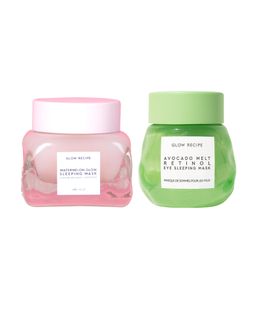
Works for
1 of 1 advertised claim delivered
Anti-aging9 ingredients credited for this claimStrong support
“A must-have for all skin care buffs looking to brighten, moisturise, smooth fine lines and de-puff their eye area without the harsh side effects often associated with retinol, the brand's Eye Woke Up Like This duo does all the hard work while you catch up on your zzz's.”
This product can help reduce and prevent fine lines and wrinkles, improve skin elasticity and firmness because it contains retinol, glycolic acid.
Keep in mind that it typically takes at least 6 weeks to notice any results because the changes that are needed to improve fine lines and elasticity happen in the deeper layers of the skin. No topical anti-aging product can “erase” wrinkles or fully reverse signs of aging.
Anti-oxidationNot advertised by the brand · 13 ingredients credited for this claimStrong support
This product contains antioxidants (retinol) that can help neutralize free radicals in skin. By doing so, they can lessen the damage the skin gets from the UV light (sun).
The following ingredients - hexylresorcinol also can have an antioxidant effect, but there is less evidence to confirm their effectiveness in skin.
ExfoliationNot advertised by the brand · 3 ingredients credited for this claimStrong support
This product can help exfoliate the skin. In other words, it helps break down the bonds between dead cells on the surface of the skin and speed up the skin turnover. Skin often appears softer and brighter after exfoliation, but overdoing it can result in disrupted skin barrier. The following ingredient is doing the exfoliating job in this product: glycolic acid, retinol.
Evens skin toneNot advertised by the brand · 6 ingredients credited for this claimStrong support
This product can help reduce hypepigmentation and even out the skin tone because it contains the following effective ingredients: retinol.
In addition, this product contains glycolic acid. This ingredient (ingredients) might help reduce hyperpigmentation, but the effect, if any, is likely to be small.
The following ingredient (ingredients) in this product might be helpful, but there is no evidence to confirm that it actually can help even out the skin tone: glycyrrhiza glabra root extract, hexylresorcinol.
Keep in mind that you would need to apply any topical skincare targetted at hypigmentation consistently for a couple of months to get a result. No topical skincare product can help get rid of hyperpigmentation (including post-acne marks and age spots) instantly.
MoisturizingNot advertised by the brand · 23 ingredients credited for this claimGood support
This product can help improve hydration of the skin with the two types of ingredients.
The first type is called “humectants”:
these ingredients help attract water.
When humectants are on the surface of the skin, they “pull in” the moisture from the outside environment, or from
within deeper layers of the skin. The following ingredients in this product do the job:
arginine, betaine.
This product also contains ingredients called “occlusives”. They help reduce the speed with which our skin loses moisture to the outside environment. These ingredients also help soften the upper layer of the skin, so it feels less tight and nicer to the touch. The following ingredients in this product do the job: arginine, squalane.
Can it cause trouble?
Irritancy7 strong irritants: Alcohol, Benzyl benzoate + 5 more — patch-test recommendedHigh risk
Comedogenic4 ingredients rated 2 or more on the 0–5 pore-clogging scale4 flagged


User reviews
Be the first — your take helps the next person decide.
Ingredients
Filter by role to see what each ingredient is doing.
Water~45–55%
Glycerin~4.7–5.8%
- Irritation risk
- Low
One of the best moisturizing ingredients. Naturally present in skin. It attracts water to the upper layer of the skin working as a humectant
More about GlycerinSodium hyaluronate~3.8–4.6%
- Irritation risk
- Low
One of the best moisturizing ingredients. Attracts water into the upper layer of the skin
More about Sodium hyaluronateCaulerpa lentillifera extract~3–3.7%
- Irritation risk
- Low
Simethicone~2.3–2.8%
- Irritation risk
- Low
A type of silicone that helps to create nice product texture and is used as an anti-foaming agent
More about SimethiconeCitrullus lanatus fruit extract~1.8–2.2%
- Irritation risk
- Medium
A plant extract that can contain an antioxidant compound
More about Citrullus lanatus fruit extractSilica~1.7–2.1%
Propanediol~1.4–1.7%
- Irritation risk
- Low
Acts as a solvent for other ingredients. Speeds up the absorption of other ingredients into the skin
More about PropanediolGlycolic acid~1.1–1.3%
- Irritation risk
- High
An alpha-hydroxy acid (AHA) that helps to remove the dead skin cells on the surface of the skin reveling a more even, smoother complexation. It is also able to stimulate collagen production with long-term use. Could help to reduce pore congestion. It can be irritating to the skin. Apply sunscreen daily if using products with glycolic acid
More about Glycolic acidLactic acid~0.8–1.15%
- Irritation risk
- Medium
An exfoliating and moisturizing alpha-hydroxy acid (AHA). Typically causes less irritation than other AHAs, for example, glycolic acid. At high concentrations (about 15%), lactic acid can help reduce lines and wrinkles. Recent studies show that lactic acid can support the "good" bacteria living on skin's surface (healthy skin microbiome)
More about Lactic acidCucurbita pepo fruit extract~0.6–0.95%
- Irritation risk
- Low
Punica granatum fruit extract~0.5–0.75%
- Irritation risk
- High
A fruit extract that is used to add a fragrance to the product. It might have some antioxidant properties
More about Punica granatum fruit extractMusa sapientum fruit extract~0.45–0.65%
- Irritation risk
- Low
Paeonia suffruticosa root extract~0.4–0.65%
Glycyrrhiza glabra root extract~0.3–0.6%
- Irritation risk
- Medium
A plant extract that can help lighten the skin and calm down inflammation. Might be helpful in neutralizing free radicals
More about Glycyrrhiza glabra root extractBrassica oleracea capitata leaf extract~0.35–0.6%
- Irritation risk
- Medium
Plant extract that might help calm down inflammation and have some anti-oxidant properties
More about Brassica oleracea capitata leaf extractIpomoea batatas root extract~0.3–0.6%
- Irritation risk
- Low
Scutellaria baicalensis root extract~0.25–0.5%
- Irritation risk
- High
A plant extract that might contain a compound baicalin that could be helpful in neutralizing free radicals and reducing inflammation in skin. The baicalin concentration in skincare products is often too low for an effective action. Can be used for its fragrant properties
More about Scutellaria baicalensis root extractBetaine~0.25–0.5%
- Irritation risk
- Low
Helps attract water to the upper layer of the skin and improves the product texture
More about BetaineBeta-glucan~0.25–0.45%
- Irritation risk
- Low
Helps attract water to the upper layer of the skin, calm down inflammation and irritation, restore the barrier function and support wound healing. It can be helpful in reducing fine lines and wrinkles
More about Beta-glucanHydroxyethylcellulose~0.25–0.45%
- Irritation risk
- Low
Used to thicken product formulations and create gel-like textures
More about HydroxyethylcelluloseXanthan gum~0.25–0.45%
- Irritation risk
- Low
Used to create a thicker product consistency
More about Xanthan gumAlcohol~0.2–0.4%
- Irritation risk
- High
Can be drying and contribute to skin irritation. Used in formulars to dissolve other ingredients, create a thinner product consistency or for its antibacterial properties
More about AlcoholButylene glycol~0.2–0.4%
- Irritation risk
- Low
Used to create a nice product texture and help delivery of other ingredients. Might be somewhat helpful in attracting water to the upper layer of the skin
More about Butylene glycol1,2-hexanediol~0.2–0.4%
Benzyl benzoate~0.2–0.35%
- Irritation risk
- High
Fragrance with sweet balsamic smell. Help to preserve products and dissolve other ingredients. Could trigger allergic reactions and be irritating
More about Benzyl benzoateLimonene~0.2–0.35%
- Irritation risk
- High
A common frangrance that can easily irritate skin, especially if exposed to air, light or heat
More about LimoneneParfum~0.2–0.35%
- Irritation risk
- High
An aromatic blend of unspecified and possibly irritating ingredients
More about ParfumWater~0.2–0.4%
Glycerin~0.25–0.45%
- Irritation risk
- Low
One of the best moisturizing ingredients. Naturally present in skin. It attracts water to the upper layer of the skin working as a humectant
More about GlycerinPropanediol~0.25–0.4%
- Irritation risk
- Low
Acts as a solvent for other ingredients. Speeds up the absorption of other ingredients into the skin
More about PropanediolCetearyl alcohol~0.25–0.45%
- Irritation risk
- Low
- Comedogenicity
- 2/5
A non-drying alcohol. Works as an emollient. Helps water and oil mix together and creates a nice product texture
More about Cetearyl alcoholGlyceryl stearate~0.25–0.5%
- Irritation risk
- Low
An emollient that softens the skin and forms a protective layer on its surface. Helps water and oil mix together
More about Glyceryl stearatePersea gratissima oil~0.25–0.45%
- Irritation risk
- Medium
An emollient that helps soften the skin and could be helpful in repairing its barrier function
More about Persea gratissima oilC9-12 alkane~0.2–0.4%
Stearic acid~0.4–0.6%
- Irritation risk
- Low
Helps oil and water mix together and works as an emollient
More about Stearic acidButyrospermum parkii butter~0.3–0.55%
- Irritation risk
- Low
- Comedogenicity
- 3/5
A great moisturising ingredient that softens the skin and reduces water loss from its upper layer. It also can be helpful in protecting skin from free radicals
More about Butyrospermum parkii butterKaolin~0.4–0.6%
- Irritation risk
- Low
A type of clay that consists mainly of aluminum silicate. Helps absorb oil and creates a thicker product consistency. Can be used to add a white color
More about KaolinSodium lauroyl glutamate~0.25–0.45%
- Irritation risk
- Medium
Used as a cleansing agent. It creates foam
More about Sodium lauroyl glutamatePersea gratissima fruit extract~0.25–0.45%
Squalane~0.3–0.55%
- Irritation risk
- Low
An oil naturally present in skin. Works as an emollient to soften the skin and form a protective layer on its surface without a greasy feeling.
More about SqualaneNiacinamide~0.25–0.45%
- Irritation risk
- Low
Is proven to be effective in reducing blemishes, evening out skin tone and helping to improve lines and wrinkles. It helps the skin to repair sun damage, calm down inflammation and keep maintain good levels of moisture. The concentration of about 2% is effective for supporting the skin barrier and evening out the skin tone. Concentration of 4-6% is better for helping with acne and balancing the sebum production
More about NiacinamideMalachite extract~0.25–0.45%
- Irritation risk
- Low
A mineral that is claimed to be able to support collagen product in skin, but evidence of effectiveness is missing
More about Malachite extractEthylhexylglycerin~0.25–0.45%
Hexylresorcinol~0.25–0.45%
- Irritation risk
- Medium
Might be helpful in reducing hyperpigmentation and neutralizing free radicals in skin
More about HexylresorcinolOryza sativa extract~0.25–0.5%
- Irritation risk
- Low
A grain extract that helps to create a thicker product consistency. It might have some anti-oxidant properties and help attract water to the upper layer of the skin
More about Oryza sativa extractTocopheryl acetate~0.25–0.5%
- Irritation risk
- Medium
A more stable but less bio-available form of vitamin E compared to Tocopherol. Might help moisturize and protect the skin from free radicals, but mostly used in low concentrations to stabilize other ingredients.
More about Tocopheryl acetateAloe barbadensis leaf juice~0.25–0.45%
- Irritation risk
- Medium
Traditionally used to treat sunburns, dermatitis and inflammation, but evidence for its effectiveness is lacking. The extract can contain humectants that help attract water into the skin
More about Aloe barbadensis leaf juiceCoffea arabica fruit extract~0.25–0.45%
- Irritation risk
- Low
Hyaluronic acid~0.25–0.45%
- Irritation risk
- Low
One of the best moisturizing ingredients. Attracts water into the upper layer of the skin. Naturally present in skin. Typically has large molecule size unless advertised otherwise on the product label. Helps support skin's barrier function and may help to reduce inflammation
More about Hyaluronic acidEthylhexyl palmitate~0.3–0.5%
- Irritation risk
- Low
- Comedogenicity
- 3/5
An emollient that helps soften the skin and create a nice product texture
More about Ethylhexyl palmitateSodium hyaluronate~0.25–0.45%
- Irritation risk
- Low
One of the best moisturizing ingredients. Attracts water into the upper layer of the skin
More about Sodium hyaluronateRetinol~0.25–0.45%
- Irritation risk
- High
Two steps removed from the active form of vitamin A - retinoic acid. Once converted to the retinoic acid in the skin, retinol is proven to be effective against all signs of aging. It improves skin cell turnover, helps fight blemishes and clogged pores, can regulate excess oil production and even skin tone. It can, however, be quite irritating
More about RetinolPei-10~0.25–0.45%
- Irritation risk
- Low
Hydrated silica~0.4–0.6%
Sodium chloride~0.3–0.5%
- Irritation risk
- Low
Used to stabilize mixtures of oil and water, and create thicker, gel-like product textures
More about Sodium chlorideFructan~0.25–0.45%
- Irritation risk
- Low
Maltodextrin~0.25–0.45%
- Irritation risk
- Low
Used to stabilize the product formulation and can help absorb oil
More about MaltodextrinSpirulina maxima extract~0.25–0.45%
- Irritation risk
- Low
- Comedogenicity
- 3/5
Ci 75300~0.25–0.45%
- Irritation risk
- Low
Potassium chloride~0.25–0.45%
- Irritation risk
- Low
Potassium phosphate~0.25–0.45%
Butylene glycol~0.25–0.45%
- Irritation risk
- Low
Used to create a nice product texture and help delivery of other ingredients. Might be somewhat helpful in attracting water to the upper layer of the skin
More about Butylene glycolSodium phosphate~0.25–0.45%
Hydrogenated starch hydrolysate~0.25–0.45%
- Irritation risk
- Low
Helps to attract water to the upper layer of the skin. Can add sweet taste to lip products
More about Hydrogenated starch hydrolysateMaltooligosyl glucoside~0.25–0.45%
- Irritation risk
- Low
Helps water and oil mix together and can help attract water to the upper layer of the skin
More about Maltooligosyl glucosideArginine~0.25–0.4%
- Irritation risk
- Low
An amino acid that is naturally present in skin and helps keep it hydrated. When used together with AHAs, it can reduce their irritating effect on the skin
More about ArginineSilica dimethyl silylate~0.3–0.5%
Sodium dilauramidoglutamide lysine~0.25–0.45%
- Irritation risk
- Low
Sodium hydroxide~0.25–0.45%
Citric acid~0.25–0.45%
- Irritation risk
- Medium
Can work as an exfoliant but is typically used to adjust the product pH
More about Citric acidCaprylyl glycol~0.25–0.5%
- Irritation risk
- Medium
Helps preserve products and creates a nice product texture
More about Caprylyl glycolCarthamus tinctorius seed extract~0.25–0.45%
- Irritation risk
- Low
Lavandula angustifolia flower/leaf/stem extract~0.2–0.4%
Rosmarinus officinalis leaf extract~0.2–0.35%
- Irritation risk
- High
Can be helpful in reducing inflammation in skin, including inflamed acne. It can be irritating
More about Rosmarinus officinalis leaf extractPpg-3 benzyl ether myristate~0.25–0.5%
- Irritation risk
- Low
Polyisobutene~0.2–0.4%
Pvp~0.2–0.35%
- Irritation risk
- Medium
Helps evenly disperse other ingredients in a formulation and create an even layer on the surface of the skin
More about PvpC13-15 alkane~0.2–0.35%
Acrylates/c10-30 alkyl acrylate crosspolymer~0.2–0.35%
- Irritation risk
- Medium
Maintains the texture of skincare products. Allows the product to spread evenly. Helps oil and water mix together
More about Acrylates/c10-30 alkyl acrylate crosspolymerSodium hydroxypropylsulfonate laurylglucoside crosspolymer~0.25–0.45%
- Irritation risk
- Low
Parfum~0.1–0.2%
- Irritation risk
- High
An aromatic blend of unspecified and possibly irritating ingredients
More about ParfumHexylene glycol~0.15–0.25%
- Irritation risk
- Medium
Helps create a more spreadable product texture
More about Hexylene glycolPotassium sorbate~0.15–0.25%
Sodium benzoate~0.1–0.2%
Phenoxyethanol~0.1–0.2%
- Irritation risk
- Low
A preservative. It helps prevent bacterial growth in cosmetic products
More about PhenoxyethanolIngredient list view
Water, Glycerin, Sodium hyaluronate, Caulerpa lentillifera extract, Simethicone, Citrullus lanatus fruit extract, Silica, Propanediol, Glycolic acid, Lactic acid, Cucurbita pepo fruit extract, Punica granatum fruit extract, Musa sapientum fruit extract, Paeonia suffruticosa root extract, Glycyrrhiza glabra root extract, Brassica oleracea capitata leaf extract, Ipomoea batatas root extract, Scutellaria baicalensis root extract, Betaine, Beta-glucan, Hydroxyethylcellulose, Xanthan gum, Alcohol, Butylene glycol, 1,2-hexanediol, Benzyl benzoate, Limonene, Parfum, Water, Glycerin, Propanediol, Cetearyl alcohol, Glyceryl stearate, Persea gratissima oil, C9-12 alkane, Stearic acid, Butyrospermum parkii butter, Kaolin, Sodium lauroyl glutamate, Persea gratissima fruit extract, Squalane, Niacinamide, Malachite extract, Ethylhexylglycerin, Hexylresorcinol, Oryza sativa extract, Tocopheryl acetate, Aloe barbadensis leaf juice, Coffea arabica fruit extract, Hyaluronic acid, Ethylhexyl palmitate, Sodium hyaluronate, Retinol, Pei-10, Hydrated silica, Sodium chloride, Fructan, Maltodextrin, Spirulina maxima extract, Ci 75300, Potassium chloride, Potassium phosphate, Butylene glycol, Sodium phosphate, Hydrogenated starch hydrolysate, Maltooligosyl glucoside, Arginine, Silica dimethyl silylate, Sodium dilauramidoglutamide lysine, Sodium hydroxide, Citric acid, Caprylyl glycol, Carthamus tinctorius seed extract, Lavandula angustifolia flower/leaf/stem extract, Rosmarinus officinalis leaf extract, Ppg-3 benzyl ether myristate, Polyisobutene, Pvp, C13-15 alkane, Acrylates/c10-30 alkyl acrylate crosspolymer, Sodium hydroxypropylsulfonate laurylglucoside crosspolymer, Parfum, Hexylene glycol, Potassium sorbate, Sodium benzoate, Phenoxyethanol
Compare prices
Retailers ranked by price — lowest first.
Worth comparing, line by line.
Match % combines shared ingredients, the first five ingredients, shared actives and hero ingredients, irritancy (lower counts in the alternative's favour), texture and body area. Only products in the same routine step are compared.
| Glow RecipeEye Woke Up Like ThisYOUR PRODUCT | ColorescienceTotal Eye Firm Repair Cream | Colorescience UKTotal Eye Firm & Repair Cream | GeologieAnti Aging Eye Cream | |
|---|---|---|---|---|
| Match | — | 70% | 70% | 70% |
| Price | $50.24 | $98.00+$47.76 | $85.93+$35.69 | $45.00−$5.24 |
| Shared key ingredients | — | 6 of 18 | 4 of 18 | 5 of 18 |
| Key difference | — | Salicylic Acid | Palmitoyl Tripeptide-5 | Gluconolactone |
| Irritancy | High | Medium | Medium | Medium |
| Drying alcohol | Contains drying alcohol | — | — | — |
| View product | Shop | Shop | Shop |


Sources cited in this review
Every concentration estimate and effectiveness label is anchored to one of these 39 studies and safety reviews.
- 1
- 2Hyaluronic acid: A key molecule in skin agingncbi.nlm.nih.gov
- 3
- 4Analyzing Lycopene Content in Fruitssciencedirect.com
- 5
- 6Glycolic acid peel therapy – a current reviewncbi.nlm.nih.gov

Affiliate links · As an Amazon Associate, WIMJ earns from qualifying purchases.