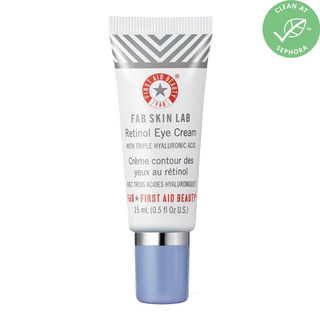
First Aid Beauty Skin Lab Retinol Eye Cream
Works for
3 of 3 advertised claims delivered
Moisturizing28 ingredients credited for this claimStrong support
“What it is A rejuvenating eye cream that helps combat the appearance of fine lines and wrinkles, while leaving the eye area looking smoother, firmer, and more youthful.”
This product can help improve hydration of the skin with the two types of ingredients.
The first type is called “humectants”:
these ingredients help attract water.
When humectants are on the surface of the skin, they “pull in” the moisture from the outside environment, or from
within deeper layers of the skin. The following ingredients in this product do the job:
glycerin, sodium chondroitin sulfate.
This product also contains ingredients called “occlusives”. They help reduce the speed with which our skin loses moisture to the outside environment. These ingredients also help soften the upper layer of the skin, so it feels less tight and nicer to the touch. The following ingredients in this product do the job: caprylic/capric triglyceride, squalane.
The following ingredients in this product are especially good for supporting the skin barrier and helping with the hydration level: ceramide ng
Anti-aging5 ingredients credited for this claimStrong support
“Skin Lab Retinol Eye Cream”
This product can help reduce and prevent fine lines and wrinkles, improve skin elasticity and firmness because it contains retinol.
These ingredients in the product can also be helpful, even though there is less evidence for their effectiveness: atelocollagen.
Keep in mind that it typically takes at least 6 weeks to notice any results because the changes that are needed to improve fine lines and elasticity happen in the deeper layers of the skin. No topical anti-aging product can “erase” wrinkles or fully reverse signs of aging.
Evens skin tone2 ingredients credited for this claimStrong support
“Key Results After just 2 weeks , 81% of participants saw an improvement in skin tone and texture.”
This product can help reduce hypepigmentation and even out the skin tone because it contains the following effective ingredients: retinol.
Keep in mind that you would need to apply any topical skincare targetted at hypigmentation consistently for a couple of months to get a result. No topical skincare product can help get rid of hyperpigmentation (including post-acne marks and age spots) instantly.
Anti-oxidationNot advertised by the brand · 6 ingredients credited for this claimStrong support
This product contains antioxidants (retinol) that can help neutralize free radicals in skin. By doing so, they can lessen the damage the skin gets from the UV light (sun).
ExfoliationNot advertised by the brand · 2 ingredients credited for this claimStrong support
This product can help exfoliate the skin. In other words, it helps break down the bonds between dead cells on the surface of the skin and speed up the skin turnover. Skin often appears softer and brighter after exfoliation, but overdoing it can result in disrupted skin barrier. The following ingredient is doing the exfoliating job in this product: retinol.
Can it cause trouble?
Irritancy1 strong irritant: Retinol — patch-test recommendedHigh risk
Comedogenic4 ingredients rated 2 or more on the 0–5 pore-clogging scale4 flagged


User reviews
Be the first — your take helps the next person decide.
Ingredients
Filter by role to see what each ingredient is doing.
Water~45–55%
Caprylic/capric triglyceride~5.7–7%
- Irritation risk
- Medium
A good mix of fatty acids that forms a protective layer on the skin. Improves the shelf life of products. Derived from coconut and glycerin
More about Caprylic/capric triglyceridePolymethyl methacrylate~4.5–5.5%
- Irritation risk
- Low
Is used to enhance product texture and can help to optically mask skin imperfections
More about Polymethyl methacrylateGlycerin~3.1–3.7%
- Irritation risk
- Low
One of the best moisturizing ingredients. Naturally present in skin. It attracts water to the upper layer of the skin working as a humectant
More about GlycerinSqualane~2.4–3%
- Irritation risk
- Low
An oil naturally present in skin. Works as an emollient to soften the skin and form a protective layer on its surface without a greasy feeling.
More about SqualaneGlyceryl stearate~1.9–2.4%
- Irritation risk
- Low
An emollient that softens the skin and forms a protective layer on its surface. Helps water and oil mix together
More about Glyceryl stearateButylene glycol~1.6–2%
- Irritation risk
- Low
Used to create a nice product texture and help delivery of other ingredients. Might be somewhat helpful in attracting water to the upper layer of the skin
More about Butylene glycolPolysorbate 20~1.4–1.7%
Glyceryl stearate citrate~1.1–1.4%
- Irritation risk
- Low
Helps oil and water mix together while softening the upper layer of the skin
More about Glyceryl stearate citrateButyrospermum parkii butter~0.95–1.15%
- Irritation risk
- Low
- Comedogenicity
- 3/5
A great moisturising ingredient that softens the skin and reduces water loss from its upper layer. It also can be helpful in protecting skin from free radicals
More about Butyrospermum parkii butterPhenoxyethanol~0.6–0.9%
- Irritation risk
- Low
A preservative. It helps prevent bacterial growth in cosmetic products
More about PhenoxyethanolPolyglyceryl-3 stearate~0.55–0.8%
- Irritation risk
- Low
Helps oil and water mix together
More about Polyglyceryl-3 stearateHydrogenated poly(c6-12 olefin)~0.45–0.65%
- Irritation risk
- Low
Stearyl alcohol~0.5–0.75%
- Irritation risk
- Low
An emollient that helps soften the skin
More about Stearyl alcoholCetyl alcohol~0.45–0.65%
- Irritation risk
- Low
A non-drying alcohol that works to soften the skin and stabilize product formulations helping oil and water mix together
More about Cetyl alcoholSodium acrylates copolymer~0.3–0.6%
- Irritation risk
- Medium
Used to create a thicker product consistency
More about Sodium acrylates copolymerHydrogenated lecithin~0.35–0.65%
- Irritation risk
- Low
Helps to retain moisture by creating a protective barrier on the skin. Rich in fatty acids. Improves product texture and helps with the penetration of other ingredients.
More about Hydrogenated lecithinLecithin~0.35–0.6%
- Irritation risk
- Low
Used mostly for creating emulsions - helping oil and water mix together. Helps soften the upper layer of the skin
More about LecithinPolyethylene~0.45–0.65%
Titanium dioxide~0.35–0.65%
- Irritation risk
- Low
Works as a UV filter when used in high concentrations. It is photostable and is effective mostly against the UVB light, with some protection in the UVA range. In small concentrations, used for its ability to improve the color of cosmetic products. Is usually well tolerated by the skin
More about Titanium dioxideCi 77891~0.3–0.5%
- Irritation risk
- Low
Dipropylene glycol~0.2–0.4%
- Irritation risk
- Low
Helps to dissolve other ingredients in a formulation. Slows down the rate of product drying
More about Dipropylene glycolHydroxypropyl cyclodextrin~0.25–0.45%
- Irritation risk
- Medium
Used to stabilize product formulations and help soften the upper layer of the skin
More about Hydroxypropyl cyclodextrinLinoleic acid~0.3–0.6%
- Irritation risk
- Low
An excellent emollient. Helps soften the skin, restore its barrier function, and can help to calm down inflammation. It can be helpful to prevent blemishes and clogged pores
More about Linoleic acidChlorphenesin~0.16–0.32%
Tocopherol~0.2–0.4%
- Irritation risk
- Low
Pure form of vitamin E. Can help moisturise and protect the skin from free radicals. Often used to help stabilise other ingredients or the formula itself
More about TocopherolSodium polyacrylate~0.25–0.45%
- Irritation risk
- Low
Used to create a gel-like product texture, as well as to stabilize emulsions
More about Sodium polyacrylatePolysilicone-11~0.25–0.45%
- Irritation risk
- Low
A silicone that forms a light film on the skin surface helping to bind water and temporarily absorb oils creating a matt and powdery feel
More about Polysilicone-11Xanthan gum~0.2–0.4%
- Irritation risk
- Low
Used to create a thicker product consistency
More about Xanthan gumCaprylyl glycol~0.25–0.45%
- Irritation risk
- Medium
Helps preserve products and creates a nice product texture
More about Caprylyl glycolAllantoin~0.2–0.35%
- Irritation risk
- Low
Helps calm down inflammation in skin and can help reduce itching. Helps to repair the skin barrier and keep skin hydrated
More about AllantoinMica~0.25–0.45%
- Irritation risk
- Low
Creates an illusion of smoother and more radiant skin tone. Adds shimmer to the skin by reflecting light
More about MicaPhytosteryl canola glycerides~0.2–0.4%
- Irritation risk
- Low
Helps soften the upper layer of the skin
More about Phytosteryl canola glyceridesGlycine soja oil~0.2–0.4%
- Irritation risk
- Medium
- Comedogenicity
- 2/5
A good emollient that helps soften the skin and helps repair its barrier function. It can clog pores if used in high concentrations.
More about Glycine soja oilRetinol~0.2–0.35%
- Irritation risk
- High
Two steps removed from the active form of vitamin A - retinoic acid. Once converted to the retinoic acid in the skin, retinol is proven to be effective against all signs of aging. It improves skin cell turnover, helps fight blemishes and clogged pores, can regulate excess oil production and even skin tone. It can, however, be quite irritating
More about RetinolCaffeine~0.2–0.4%
- Irritation risk
- Medium
Might be helpful in neutralizing free radicals. Can have a dehydration effect that might somewhat decrease the look of puffy eyes
More about CaffeinePalmitic acid~0.25–0.5%
- Irritation risk
- Low
An emollient that is naturally present in skin and helps soften it
More about Palmitic acidOleic acid~0.25–0.5%
- Irritation risk
- Medium
Helps soften the upper layer of the skin. At the same time, it can weaken the skin's barrier enhancing penetration of other ingredients and increasing the risk of skin dryness
More about Oleic acidEthylene/propylene/styrene copolymer~0.2–0.4%
- Irritation risk
- Low
Used to create a thicker product consistency
More about Ethylene/propylene/styrene copolymerMaltodextrin~0.2–0.4%
- Irritation risk
- Low
Used to stabilize the product formulation and can help absorb oil
More about MaltodextrinStearic acid~0.35–0.6%
- Irritation risk
- Low
Helps oil and water mix together and works as an emollient
More about Stearic acidTriolein~0.2–0.35%
Avena sativa kernel extract~0.25–0.45%
- Irritation risk
- Low
An effective moisturizing and skin barrier repair ingredient. Helps calm down inflammation and has some anti-oxidant properties
More about Avena sativa kernel extractSodium metabisulfite~0.1–0.2%
Magnesium ascorbyl phosphate~0.2–0.4%
- Irritation risk
- Medium
A derivative of vitamin C that is more stable, but less bioavailable than the pure form of vitamin C. It does not penetrate the skin well, but has been shown to convert to pure vitamin C once in skin. It can be helpful in stimulating collagen production and lightening the skin tone, but the required concentration is likely to be very high
More about Magnesium ascorbyl phosphateCeramide ng~0.25–0.45%
- Irritation risk
- Low
A type of lipid similar to ceramides naturally present in skin. Helps to soften the upper layer of the skin and supports the skin barrier function to keep it hydrated. Can help to prevent inflammation in skin
More about Ceramide ngSteareth-30~0.3–0.55%
- Irritation risk
- Medium
Helps water and oil mix together and create a gel-like product consistency
More about Steareth-30Aloe barbadensis leaf juice powder~0.2–0.35%
- Irritation risk
- Medium
Traditionally used to treat sunburns, dermatitis and inflammation, but evidence for its effectiveness is lacking. The extract can contain humectants that help attract water into the skin
More about Aloe barbadensis leaf juice powderCholesterol~0.25–0.5%
- Irritation risk
- Low
An emollient that is naturally found in skin
More about CholesterolBht~0.2–0.4%
Butylene/ethylene/styrene copolymer~0.2–0.4%
- Irritation risk
- Low
Used to create a gel-like product texture
More about Butylene/ethylene/styrene copolymerSodium chondroitin sulfate~0.2–0.35%
- Irritation risk
- Low
Is naturally present in skin. Helps to attract water to its upper layer
More about Sodium chondroitin sulfateTin oxide~0.3–0.6%
- Irritation risk
- Low
A colorant that can add a pearl-like appearance to the formulation
More about Tin oxideAtelocollagen~0.2–0.35%
- Irritation risk
- Low
A protein that helps to attract moisture to the upper layer of the skin and might be helpful in reducing fine lines and wrinkles
More about AtelocollagenPentaerythrityl tetra-di-t-butyl hydroxyhydrocinnamate~0.25–0.45%
- Irritation risk
- Low
Used to increase stability of product formulations
More about Pentaerythrityl tetra-di-t-butyl hydroxyhydrocinnamateSodium hyaluronate~0.2–0.4%
- Irritation risk
- Low
One of the best moisturizing ingredients. Attracts water into the upper layer of the skin
More about Sodium hyaluronateCitric acid~0.2–0.4%
- Irritation risk
- Medium
Can work as an exfoliant but is typically used to adjust the product pH
More about Citric acidEthylhexylglycerin~0.2–0.4%
Water~0.2–0.4%
Caprylic/capric triglyceride~0.25–0.5%
- Irritation risk
- Medium
A good mix of fatty acids that forms a protective layer on the skin. Improves the shelf life of products. Derived from coconut and glycerin
More about Caprylic/capric triglyceridePolymethyl methacrylate~0.25–0.45%
- Irritation risk
- Low
Is used to enhance product texture and can help to optically mask skin imperfections
More about Polymethyl methacrylateGlycerin~0.25–0.45%
- Irritation risk
- Low
One of the best moisturizing ingredients. Naturally present in skin. It attracts water to the upper layer of the skin working as a humectant
More about GlycerinSqualane~0.25–0.5%
- Irritation risk
- Low
An oil naturally present in skin. Works as an emollient to soften the skin and form a protective layer on its surface without a greasy feeling.
More about SqualaneGlyceryl stearate~0.25–0.5%
- Irritation risk
- Low
An emollient that softens the skin and forms a protective layer on its surface. Helps water and oil mix together
More about Glyceryl stearateButylene glycol~0.2–0.4%
- Irritation risk
- Low
Used to create a nice product texture and help delivery of other ingredients. Might be somewhat helpful in attracting water to the upper layer of the skin
More about Butylene glycolPolysorbate 20~0.25–0.5%
Glyceryl stearate citrate~0.3–0.5%
- Irritation risk
- Low
Helps oil and water mix together while softening the upper layer of the skin
More about Glyceryl stearate citrateButyrospermum parkii butter~0.3–0.55%
- Irritation risk
- Low
- Comedogenicity
- 3/5
A great moisturising ingredient that softens the skin and reduces water loss from its upper layer. It also can be helpful in protecting skin from free radicals
More about Butyrospermum parkii butterPhenoxyethanol~0.25–0.5%
- Irritation risk
- Low
A preservative. It helps prevent bacterial growth in cosmetic products
More about PhenoxyethanolPolyglyceryl-3 stearate~0.25–0.5%
- Irritation risk
- Low
Helps oil and water mix together
More about Polyglyceryl-3 stearateHydrogenated poly(c6-12 olefin)~0.25–0.45%
- Irritation risk
- Low
Stearyl alcohol~0.3–0.55%
- Irritation risk
- Low
An emollient that helps soften the skin
More about Stearyl alcoholCetyl alcohol~0.3–0.55%
- Irritation risk
- Low
A non-drying alcohol that works to soften the skin and stabilize product formulations helping oil and water mix together
More about Cetyl alcoholSodium acrylates copolymer~0.25–0.45%
- Irritation risk
- Medium
Used to create a thicker product consistency
More about Sodium acrylates copolymerHydrogenated lecithin~0.25–0.5%
- Irritation risk
- Low
Helps to retain moisture by creating a protective barrier on the skin. Rich in fatty acids. Improves product texture and helps with the penetration of other ingredients.
More about Hydrogenated lecithinLecithin~0.3–0.55%
- Irritation risk
- Low
Used mostly for creating emulsions - helping oil and water mix together. Helps soften the upper layer of the skin
More about LecithinPolyethylene~0.4–0.6%
Titanium dioxide~0.35–0.65%
- Irritation risk
- Low
Works as a UV filter when used in high concentrations. It is photostable and is effective mostly against the UVB light, with some protection in the UVA range. In small concentrations, used for its ability to improve the color of cosmetic products. Is usually well tolerated by the skin
More about Titanium dioxideCi 77891~0.25–0.45%
- Irritation risk
- Low
Dipropylene glycol~0.25–0.45%
- Irritation risk
- Low
Helps to dissolve other ingredients in a formulation. Slows down the rate of product drying
More about Dipropylene glycolHydroxypropyl cyclodextrin~0.3–0.55%
- Irritation risk
- Medium
Used to stabilize product formulations and help soften the upper layer of the skin
More about Hydroxypropyl cyclodextrinLinoleic acid~0.4–0.65%
- Irritation risk
- Low
An excellent emollient. Helps soften the skin, restore its barrier function, and can help to calm down inflammation. It can be helpful to prevent blemishes and clogged pores
More about Linoleic acidChlorphenesin~0.16–0.32%
Tocopherol~0.25–0.5%
- Irritation risk
- Low
Pure form of vitamin E. Can help moisturise and protect the skin from free radicals. Often used to help stabilise other ingredients or the formula itself
More about TocopherolSodium polyacrylate~0.3–0.55%
- Irritation risk
- Low
Used to create a gel-like product texture, as well as to stabilize emulsions
More about Sodium polyacrylatePolysilicone-11~0.3–0.55%
- Irritation risk
- Low
A silicone that forms a light film on the skin surface helping to bind water and temporarily absorb oils creating a matt and powdery feel
More about Polysilicone-11Xanthan gum~0.25–0.5%
- Irritation risk
- Low
Used to create a thicker product consistency
More about Xanthan gumCaprylyl glycol~0.3–0.55%
- Irritation risk
- Medium
Helps preserve products and creates a nice product texture
More about Caprylyl glycolAllantoin~0.25–0.45%
- Irritation risk
- Low
Helps calm down inflammation in skin and can help reduce itching. Helps to repair the skin barrier and keep skin hydrated
More about AllantoinMica~0.3–0.55%
- Irritation risk
- Low
Creates an illusion of smoother and more radiant skin tone. Adds shimmer to the skin by reflecting light
More about MicaPhytosteryl canola glycerides~0.25–0.5%
- Irritation risk
- Low
Helps soften the upper layer of the skin
More about Phytosteryl canola glyceridesGlycine soja oil~0.25–0.5%
- Irritation risk
- Medium
- Comedogenicity
- 2/5
A good emollient that helps soften the skin and helps repair its barrier function. It can clog pores if used in high concentrations.
More about Glycine soja oilRetinol~0.25–0.45%
- Irritation risk
- High
Two steps removed from the active form of vitamin A - retinoic acid. Once converted to the retinoic acid in the skin, retinol is proven to be effective against all signs of aging. It improves skin cell turnover, helps fight blemishes and clogged pores, can regulate excess oil production and even skin tone. It can, however, be quite irritating
More about RetinolCaffeine~0.25–0.45%
- Irritation risk
- Medium
Might be helpful in neutralizing free radicals. Can have a dehydration effect that might somewhat decrease the look of puffy eyes
More about CaffeinePalmitic acid~0.3–0.55%
- Irritation risk
- Low
An emollient that is naturally present in skin and helps soften it
More about Palmitic acidOleic acid~0.3–0.55%
- Irritation risk
- Medium
Helps soften the upper layer of the skin. At the same time, it can weaken the skin's barrier enhancing penetration of other ingredients and increasing the risk of skin dryness
More about Oleic acidEthylene/propylene/styrene copolymer~0.25–0.5%
- Irritation risk
- Low
Used to create a thicker product consistency
More about Ethylene/propylene/styrene copolymerMaltodextrin~0.25–0.5%
- Irritation risk
- Low
Used to stabilize the product formulation and can help absorb oil
More about MaltodextrinStearic acid~0.4–0.65%
- Irritation risk
- Low
Helps oil and water mix together and works as an emollient
More about Stearic acidTriolein~0.25–0.45%
Avena sativa kernel extract~0.25–0.5%
- Irritation risk
- Low
An effective moisturizing and skin barrier repair ingredient. Helps calm down inflammation and has some anti-oxidant properties
More about Avena sativa kernel extractSodium metabisulfite~0.1–0.2%
Magnesium ascorbyl phosphate~0.25–0.5%
- Irritation risk
- Medium
A derivative of vitamin C that is more stable, but less bioavailable than the pure form of vitamin C. It does not penetrate the skin well, but has been shown to convert to pure vitamin C once in skin. It can be helpful in stimulating collagen production and lightening the skin tone, but the required concentration is likely to be very high
More about Magnesium ascorbyl phosphateCeramide ng~0.25–0.5%
- Irritation risk
- Low
A type of lipid similar to ceramides naturally present in skin. Helps to soften the upper layer of the skin and supports the skin barrier function to keep it hydrated. Can help to prevent inflammation in skin
More about Ceramide ngSteareth-30~0.35–0.6%
- Irritation risk
- Medium
Helps water and oil mix together and create a gel-like product consistency
More about Steareth-30Aloe barbadensis leaf juice powder~0.25–0.45%
- Irritation risk
- Medium
Traditionally used to treat sunburns, dermatitis and inflammation, but evidence for its effectiveness is lacking. The extract can contain humectants that help attract water into the skin
More about Aloe barbadensis leaf juice powderCholesterol~0.3–0.5%
- Irritation risk
- Low
An emollient that is naturally found in skin
More about CholesterolBht~0.2–0.4%
Butylene/ethylene/styrene copolymer~0.2–0.4%
- Irritation risk
- Low
Used to create a gel-like product texture
More about Butylene/ethylene/styrene copolymerSodium chondroitin sulfate~0.2–0.35%
- Irritation risk
- Low
Is naturally present in skin. Helps to attract water to its upper layer
More about Sodium chondroitin sulfateTin oxide~0.3–0.55%
- Irritation risk
- Low
A colorant that can add a pearl-like appearance to the formulation
More about Tin oxideAtelocollagen~0.15–0.3%
- Irritation risk
- Low
A protein that helps to attract moisture to the upper layer of the skin and might be helpful in reducing fine lines and wrinkles
More about AtelocollagenPentaerythrityl tetra-di-t-butyl hydroxyhydrocinnamate~0.2–0.35%
- Irritation risk
- Low
Used to increase stability of product formulations
More about Pentaerythrityl tetra-di-t-butyl hydroxyhydrocinnamateSodium hyaluronate~0.15–0.25%
- Irritation risk
- Low
One of the best moisturizing ingredients. Attracts water into the upper layer of the skin
More about Sodium hyaluronateCitric acid~0.05–0.1%
- Irritation risk
- Medium
Can work as an exfoliant but is typically used to adjust the product pH
More about Citric acidEthylhexylglycerin~0.1–0.15%
Ingredient list view
Water, Caprylic/capric triglyceride, Polymethyl methacrylate, Glycerin, Squalane, Glyceryl stearate, Butylene glycol, Polysorbate 20, Glyceryl stearate citrate, Butyrospermum parkii butter, Phenoxyethanol, Polyglyceryl-3 stearate, Hydrogenated poly(c6-12 olefin), Stearyl alcohol, Cetyl alcohol, Sodium acrylates copolymer, Hydrogenated lecithin, Lecithin, Polyethylene, Titanium dioxide, Ci 77891, Dipropylene glycol, Hydroxypropyl cyclodextrin, Linoleic acid, Chlorphenesin, Tocopherol, Sodium polyacrylate, Polysilicone-11, Xanthan gum, Caprylyl glycol, Allantoin, Mica, Phytosteryl canola glycerides, Glycine soja oil, Retinol, Caffeine, Palmitic acid, Oleic acid, Ethylene/propylene/styrene copolymer, Maltodextrin, Stearic acid, Triolein, Avena sativa kernel extract, Sodium metabisulfite, Magnesium ascorbyl phosphate, Ceramide ng, Steareth-30, Aloe barbadensis leaf juice powder, Cholesterol, Bht, Butylene/ethylene/styrene copolymer, Sodium chondroitin sulfate, Tin oxide, Atelocollagen, Pentaerythrityl tetra-di-t-butyl hydroxyhydrocinnamate, Sodium hyaluronate, Citric acid, Ethylhexylglycerin, Water, Caprylic/capric triglyceride, Polymethyl methacrylate, Glycerin, Squalane, Glyceryl stearate, Butylene glycol, Polysorbate 20, Glyceryl stearate citrate, Butyrospermum parkii butter, Phenoxyethanol, Polyglyceryl-3 stearate, Hydrogenated poly(c6-12 olefin), Stearyl alcohol, Cetyl alcohol, Sodium acrylates copolymer, Hydrogenated lecithin, Lecithin, Polyethylene, Titanium dioxide, Ci 77891, Dipropylene glycol, Hydroxypropyl cyclodextrin, Linoleic acid, Chlorphenesin, Tocopherol, Sodium polyacrylate, Polysilicone-11, Xanthan gum, Caprylyl glycol, Allantoin, Mica, Phytosteryl canola glycerides, Glycine soja oil, Retinol, Caffeine, Palmitic acid, Oleic acid, Ethylene/propylene/styrene copolymer, Maltodextrin, Stearic acid, Triolein, Avena sativa kernel extract, Sodium metabisulfite, Magnesium ascorbyl phosphate, Ceramide ng, Steareth-30, Aloe barbadensis leaf juice powder, Cholesterol, Bht, Butylene/ethylene/styrene copolymer, Sodium chondroitin sulfate, Tin oxide, Atelocollagen, Pentaerythrityl tetra-di-t-butyl hydroxyhydrocinnamate, Sodium hyaluronate, Citric acid, Ethylhexylglycerin
Compare prices
Retailers ranked by price — lowest first.


Worth comparing, line by line.
Match % combines shared ingredients, the first five ingredients, shared actives and hero ingredients, irritancy (lower counts in the alternative's favour), texture and body area. Only products in the same routine step are compared.
| First Aid BeautySkin Lab Retinol Eye CreamYOUR PRODUCT | Jan MariniAge Intervention Eye Cream | ReplenixAll-Trans-Retinol Enriched Eye Repair | NaturiumRetinol Cream 2.5% | |
|---|---|---|---|---|
| Match | — | 78% | 76% | 75% |
| Price | $30.80 | $75.00+$44.20 | $92.00+$61.20 | $15.99−$14.81 |
| Shared key ingredients | — | 7 of 19 | 6 of 19 | 9 of 19 |
| Key difference | — | Myristoyl Pentapeptide-8 | Vitamin C | Retinyl Palmitate |
| Irritancy | High | Medium | Medium | Medium |
| Drying alcohol | — | — | — | — |
| View product | Shop | Shop | Shop |


Product summary
"First Aid Beauty - Skin Lab Retinol Eye Cream" is a well-rounded moisturizing product. The formulation is based on a combination of good humectants and emollients. Both are needed to increase the skin hydration level. Humectants in this product (glycerin, sodium chondroitin sulfate, sodium hyaluronate, butylene glycol and caprylyl glycol) help to increase the water content in the upper layer of the skin. (These ingredients do so by "capturing" water molecules from the outside air or from within the deeper layers of the skin). Emollients in this formulation (ceramide ng, cholesterol, glycine soja oil, caprylic/capric triglyceride and squalane) help to reduce the moisture loss from the skin. They also soften the skin surface and relieve the feeling of dryness and tightness.
Ingredient callouts
- this moisturizer contains an effective form of Retinoids (vitamin A): retinol 0.25% - 0.45% and retinol 0.20% - 0.35%. Retinoids are potent multitasking actives. They work to improve and prevent early signs of aging, reduce hyperpigmentation (age spots and post-acne marks), and prevent inflamed blemishes and clogged pores. The downside of Retinoids is that they can be irritating. If you are not already using a Retinoid in your routine, it is best to start slowly and apply the Retinoid product only a few times per week. If your skin tolerates it well, you can gradually increase the frequency to daily. Because of the irritation risk of Retinoids, we recommend to have another, retinoid-free moisturizer in your routine to use on the alternate days or when your skin feels dry.
- Another benefit is that this moisturizer contain ceramides (ceramide ng 0.25% - 0.50% and ceramide ng 0.25% - 0.45%). Ceramides are an important part of our natural skin barrier. The Ceramides used in skincare are synthetic or come from plants. They help soften the skin and can help "fill the gaps" in the skin barrier, keeping the skin hydrated and resilient for longer.
Irritation risk
There are actives in this product that can be irritating. We assess the overall irritancy of this moisturizer to be high. For a detailed overview of all potential irritants: click here
You can see the detailed formula review with the breakdown of all actives in the product and the full ingredient list with estimated concentrations in the tables below.
About the brand
According to Cruelty-Free Kitty "First Aid Beauty" is cruelty free, but its parent company is not.
Price
The product retails from 28.50£ up to 38.00£ in the United Kingdom, from 30.80$ up to 60.00$ in the United States, for 56.00CA$ in Canada and for 58.50A$ in Australia.
For a detailed price comparison: click here.
Sources cited in this review
Every concentration estimate and effectiveness label is anchored to one of these 24 studies and safety reviews.
- 1
- 2
- 3
- 4
- 5Vitamin E in dermatologyncbi.nlm.nih.gov
- 6Vitamin E and Skin Healthlpi.oregonstate.edu

Affiliate links · As an Amazon Associate, WIMJ earns from qualifying purchases.