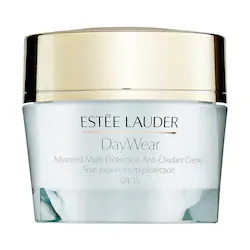
Estée Lauder DayWear Advanced Multi-Protection Anti-Oxidant Creme, Dry
Works for
3 of 3 advertised claims delivered
Moisturizing29 ingredients credited for this claimStrong support
“DayWear Advanced Multi-Protection Anti-Oxidant Creme, Dry”
This product can help improve hydration of the skin with the two types of ingredients.
The first type is called “humectants”:
these ingredients help attract water.
When humectants are on the surface of the skin, they “pull in” the moisture from the outside environment, or from
within deeper layers of the skin. The following ingredients in this product do the job:
artemia extract, glycerin.
This product also contains ingredients called “occlusives”. They help reduce the speed with which our skin loses moisture to the outside environment. These ingredients also help soften the upper layer of the skin, so it feels less tight and nicer to the touch. The following ingredients in this product do the job: dimethicone, squalane.
The following ingredients in this product are especially good for supporting the skin barrier and helping with the hydration level: linoleic acid, urea
Anti-aging3 ingredients credited for this claimModerate support
“It reduces the first visible signs of aging, like dullness and fine, dry lines, and refreshes skin with lasting hydration.”
This product contains vitis vinifera seed extract. This ingredient might be able to help reduce and prevent fine lines and wrinkles, improve skin elasticity and firmness, but there is not enough evidence that it actually works.
Evens skin tone4 ingredients credited for this claimModerate support
“Dryness, Fine Lines and Wrinkles, and Dullness and Uneven Texture Formulation.”
The following ingredient (ingredients) in this product might be helpful, but there is no evidence to confirm that it actually works: glycyrrhetinic acid.
Anti-oxidationNot advertised by the brand · 14 ingredients credited for this claimStrong support
This product contains antioxidants (ethylbisiminomethylguaiacol manganese chloride, glycyrrhetinic acid, vitis vinifera seed extract) that can help neutralize free radicals in skin. By doing so, they can lessen the damage the skin gets from the UV light (sun).
Can it cause trouble?
Irritancy3 strong irritants: Rosmarinus officinalis leaf extract, Citrus limon fruit extract + 1 more — patch-test recommendedHigh risk
Comedogenic2 ingredients rated 2 or more on the 0–5 pore-clogging scale2 flagged

User reviews
Be the first — your take helps the next person decide.
Ingredients
Filter by role to see what each ingredient is doing.
Butyl methoxydibenzoylmethane3%
- Irritation risk
- Medium
Avobenzone. An organic, or so-called "chemical" UV filter. Protects against both UVA and UVB rays. Needs to be combined with other filters in a formulation to be stable.
More about Butyl methoxydibenzoylmethaneEthylhexyl salicylate5%
- Irritation risk
- Low
Octisalate. A UV filter. It offers some protection against the sun rays that cause sunburn (UVB), but does not protect against the most aging sun rays (UVA). It loses its effectiveness quickly when exposed to sunlight. It is an organic, or so called "chemical" sunscreen
More about Ethylhexyl salicylateWater~45–55%
Dimethicone~4.3–5.3%
- Irritation risk
- Low
A silicone that helps to reduce water loss from the surface of the skin. Can temporarily "fill in" lines and wrinkles, absorb oil, and create a nice product finish
More about DimethiconeButyloctyl salicylate~4.6–5.6%
- Irritation risk
- Medium
A synthetic ester of salicylic acid that is used to help disperse pigments and boost effectiveness of sunscreen ingredients. It is able to absorb UV light (working as an organic, or chemical filter), but is not approved as a sunscreen ingredient on its own
More about Butyloctyl salicylateButylene glycol~3.2–3.9%
- Irritation risk
- Low
Used to create a nice product texture and help delivery of other ingredients. Might be somewhat helpful in attracting water to the upper layer of the skin
More about Butylene glycolPolyester-8~2.6–3.1%
- Irritation risk
- Medium
Used to stabilize product formulations and individual ingredients (for example, sunscreens). Can be an allergen
More about Polyester-8Cetyl ricinoleate~2–2.4%
- Irritation risk
- Low
An emollient that helps soften the upper layer of the skin
More about Cetyl ricinoleateSteareth-21~1.7–2.1%
Steareth-2~1.4–1.8%
Di-c12-15 alkyl fumarate~1.3–1.6%
- Irritation risk
- Medium
Used to soften the upper layer of the skin and create a nice product texture
More about Di-c12-15 alkyl fumarateCaprylic/capric/myristic/stearic triglyceride~1.1–1.4%
- Irritation risk
- Low
Helps to soften the upper layer of the skin
More about Caprylic/capric/myristic/stearic triglyceridePolysilicone-11~1–1.2%
- Irritation risk
- Low
A silicone that forms a light film on the skin surface helping to bind water and temporarily absorb oils creating a matt and powdery feel
More about Polysilicone-11Psidium guajava fruit extract~0.7–1%
- Irritation risk
- High
A fruit extract that might have some anti-oxidant effect
More about Psidium guajava fruit extractGentiana lutea root extract~0.65–0.95%
- Irritation risk
- Medium
A plant extract that can help strengthen the skin barrier function and improve skin moisture levels
More about Gentiana lutea root extractPolygonum cuspidatum root extract~0.6–0.9%
- Irritation risk
- Medium
A plant extract that can contain resveratrol, an antioxidant that can help neutralize free radicals in skin. The effectiveness depends on the extract quality and concentration in the product
More about Polygonum cuspidatum root extractStearyl alcohol~0.7–1%
- Irritation risk
- Low
An emollient that helps soften the skin
More about Stearyl alcoholHordeum vulgare extract~0.65–0.95%
- Irritation risk
- Medium
A plant extract that might have some anti-oxidant properties. Avoid if you are sensitive to gluten
More about Hordeum vulgare extractLaminaria ochroleuca extract~0.55–0.8%
- Irritation risk
- Low
- Comedogenicity
- 3/5
Helps attract water to the upper layer of the skin
More about Laminaria ochroleuca extractRosmarinus officinalis leaf extract~0.45–0.7%
- Irritation risk
- High
Can be helpful in reducing inflammation in skin, including inflamed acne. It can be irritating
More about Rosmarinus officinalis leaf extractTriticum vulgare germ extract~0.55–0.8%
- Irritation risk
- Medium
- Comedogenicity
- 3/5
Plant extract that might have moisturizing properties. Avoid if you suffer from wheat or gluten intolerance
More about Triticum vulgare germ extractArtemia extract~0.4–0.6%
- Irritation risk
- Low
Zooplankton extract that can attract water to the upper level of the skin and might have some anti-oxidant effect
More about Artemia extractFumaria officinalis flower/leaf/stem extract~0.35–0.65%
- Irritation risk
- Low
Caffeine~0.35–0.6%
- Irritation risk
- Medium
Might be helpful in neutralizing free radicals. Can have a dehydration effect that might somewhat decrease the look of puffy eyes
More about CaffeinePentylene glycol~0.45–0.65%
- Irritation risk
- Medium
Used to preserve products, dissolve other ingredients and create a nice product texture
More about Pentylene glycolCitrus limon fruit extract~0.3–0.6%
- Irritation risk
- High
Used as a fragrance. Can be irritating and cause photosensitivity
More about Citrus limon fruit extractHydrolyzed rice extract~0.35–0.65%
- Irritation risk
- Low
A plant extract that is claimed to be helpful in moisturizing and lightening the skin, but evidence is missing
More about Hydrolyzed rice extractVitis vinifera seed extract~0.4–0.6%
- Irritation risk
- Low
A plant extract that contains resveratrol and other anti-oxidant compounds that can help neutralize free radicals, reduce inflammation in skin and even out its tone. Can be also used to stabilize the product formulation
More about Vitis vinifera seed extractHydrolyzed rice bran extract~0.35–0.65%
- Irritation risk
- Low
A plant extract that might contain an active compound orthosilicic acid that could be helpful to regulate the level of pigment in skin, but solid research is lacking
More about Hydrolyzed rice bran extractLauryl peg-9 polydimethylsiloxyethyl dimethicone~0.4–0.6%
- Irritation risk
- Low
A type of silicone that helps to soften upper layer of the skin and create a nice product texture
More about Lauryl peg-9 polydimethylsiloxyethyl dimethiconeThermus thermophillus ferment~0.35–0.65%
- Irritation risk
- Medium
Might be helpful in neutralising free radicals in skin and have some hydration properties
More about Thermus thermophillus fermentBehenyl alcohol~0.5–0.75%
- Irritation risk
- Low
Non-drying alcohol that helps water and oil mix together. Also serves as an emollient
More about Behenyl alcoholAcrylic acid/vp crosspolymer~0.4–0.6%
Triacontanyl pvp~0.5–0.75%
- Irritation risk
- Low
Glycerin~0.45–0.65%
- Irritation risk
- Low
One of the best moisturizing ingredients. Naturally present in skin. It attracts water to the upper layer of the skin working as a humectant
More about GlycerinC12-15 alkyl benzoate~0.45–0.7%
- Irritation risk
- Low
Enhances the product texture and makes it more spreadable. Helps reduce water loss from the outer layer of skin. Extands the shelf life by preventing bacteria growth
More about C12-15 alkyl benzoateLinoleic acid~0.5–0.75%
- Irritation risk
- Low
An excellent emollient. Helps soften the skin, restore its barrier function, and can help to calm down inflammation. It can be helpful to prevent blemishes and clogged pores
More about Linoleic acidCholesterol~0.5–0.75%
- Irritation risk
- Low
An emollient that is naturally found in skin
More about CholesterolSqualane~0.5–0.75%
- Irritation risk
- Low
An oil naturally present in skin. Works as an emollient to soften the skin and form a protective layer on its surface without a greasy feeling.
More about SqualaneSodium pca~0.35–0.65%
- Irritation risk
- Low
Naturally present in skin and helps to attract water to its upper layer
More about Sodium pca1,2-hexanediol~0.35–0.65%
Urea~0.35–0.65%
- Irritation risk
- Low
Naturally present in skin (urea makes up about 7% of natural moisturizing factors in skin). Attracts water to the upper layer of the skin. Also has a positive effect on the skin barrier beyond the humectant action. Can enhance penetration of other ingredients. Is an exfoliating ingredient when used in high concentrations
More about UreaCaprylic/capric triglyceride~0.5–0.75%
- Irritation risk
- Medium
A good mix of fatty acids that forms a protective layer on the skin. Improves the shelf life of products. Derived from coconut and glycerin
More about Caprylic/capric triglycerideDipropylene glycol dibenzoate~0.5–0.75%
- Irritation risk
- Low
Tocopheryl acetate~0.4–0.65%
- Irritation risk
- Medium
A more stable but less bio-available form of vitamin E compared to Tocopherol. Might help moisturize and protect the skin from free radicals, but mostly used in low concentrations to stabilize other ingredients.
More about Tocopheryl acetateAcrylamide/sodium acryloyldimethyltaurate copolymer~0.4–0.65%
- Irritation risk
- Low
Helps water and oil mix together and create gel-like textures
More about Acrylamide/sodium acryloyldimethyltaurate copolymerTetrahexyldecyl ascorbate~0.4–0.65%
- Irritation risk
- Medium
Being a lipid soluble form of vitamin C, it is more stable than ascorbic acid, but still degrades quickly and needs to be stabilized in a formulation with another ingredient. It is claimed to penetrate skin better than pure vitamin C and have the the similar benefits, but solid studies of its effectiveness are lacking. Is likely to require a higher concentration in a product than pure vitamin C to be effective. It might be able to help reduce pore clogging.
More about Tetrahexyldecyl ascorbateSodium hyaluronate~0.4–0.6%
- Irritation risk
- Low
One of the best moisturizing ingredients. Attracts water into the upper layer of the skin
More about Sodium hyaluronateErgothioneine~0.4–0.6%
- Irritation risk
- Low
Can help neutralize free radicals in skin. Preliminary studies show that it can be more effective than coenzyme Q10 but studies on effective concentration for topical applications are lacking
More about ErgothioneineIsohexadecane~0.5–0.8%
- Irritation risk
- Low
Improves the texture of the product and helps soften the skin. Helps oil and water mix together and can be used as a cleansing agent
More about IsohexadecanePpg-15 stearyl ether benzoate~0.5–0.75%
- Irritation risk
- Low
Glycyrrhetinic acid~0.4–0.65%
- Irritation risk
- Medium
Active compound of licorice root. Works to calm down inflammation, as an anti-oxidant, and might be helpful in lightening the skin and reducing hyperpigmentation
More about Glycyrrhetinic acidTrehalose~0.4–0.6%
- Irritation risk
- Low
A sugar that attracts water to the upper layer of the skin
More about TrehalosePolyquaternium-51~0.55–0.8%
- Irritation risk
- Low
An emollient that helps create a nice silky finish on the skin
More about Polyquaternium-51Polysorbate 80~0.45–0.7%
Lecithin~0.5–0.75%
- Irritation risk
- Low
Used mostly for creating emulsions - helping oil and water mix together. Helps soften the upper layer of the skin
More about LecithinHydrogenated lecithin~0.45–0.65%
- Irritation risk
- Low
Helps to retain moisture by creating a protective barrier on the skin. Rich in fatty acids. Improves product texture and helps with the penetration of other ingredients.
More about Hydrogenated lecithinFumaric acid~0.4–0.6%
- Irritation risk
- Low
Palmitoyl hydroxypropyltrimonium amylopectin/glycerin crosspolymer~0.4–0.6%
Caprylyl glycol~0.45–0.7%
- Irritation risk
- Medium
Helps preserve products and creates a nice product texture
More about Caprylyl glycolCyclodextrin~0.35–0.6%
- Irritation risk
- Low
A type of sugar that is used to support delivery of active ingredients and can enhance their penetration into the skin without disrupting the skin's barrier
More about CyclodextrinSodium hydroxide~0.25–0.5%
Nordihydroguaiaretic acid~0.3–0.55%
- Irritation risk
- Medium
Used to stabilize the formula of product formulation. Might be helpful in neutralizing free radicals in skin
More about Nordihydroguaiaretic acidSodium chloride~0.3–0.55%
- Irritation risk
- Low
Used to stabilize mixtures of oil and water, and create thicker, gel-like product textures
More about Sodium chlorideAscorbyl tocopheryl maleate~0.35–0.65%
- Irritation risk
- Low
Parfum~0.25–0.45%
- Irritation risk
- High
An aromatic blend of unspecified and possibly irritating ingredients
More about ParfumCitric acid~0.25–0.5%
- Irritation risk
- Medium
Can work as an exfoliant but is typically used to adjust the product pH
More about Citric acidEthylbisiminomethylguaiacol manganese chloride~0.25–0.45%
- Irritation risk
- Medium
A potent anti-oxidant that can help neutralize free radicals in skin and protect from harmful effects of sun exposure, even though more studies are needed to confirm its effectiveness in topical applications
More about Ethylbisiminomethylguaiacol manganese chloridePentaerythrityl tetra-di-t-butyl hydroxyhydrocinnamate~0.25–0.45%
- Irritation risk
- Low
Used to increase stability of product formulations
More about Pentaerythrityl tetra-di-t-butyl hydroxyhydrocinnamateDisodium edta~0.2–0.4%
Bht~0.2–0.35%
Sodium dehydroacetate~0.15–0.3%
Phenoxyethanol~0.15–0.3%
- Irritation risk
- Low
A preservative. It helps prevent bacterial growth in cosmetic products
More about PhenoxyethanolCi 42090~0.2–0.35%
Ci 19140~0.15–0.3%
Chromium hydroxide green~0.15–0.25%
Ci 77289~0.15–0.25%
Ingredient list view
Butyl methoxydibenzoylmethane, Ethylhexyl salicylate, Water, Dimethicone, Butyloctyl salicylate, Butylene glycol, Polyester-8, Cetyl ricinoleate, Steareth-21, Steareth-2, Di-c12-15 alkyl fumarate, Caprylic/capric/myristic/stearic triglyceride, Polysilicone-11, Psidium guajava fruit extract, Gentiana lutea root extract, Polygonum cuspidatum root extract, Stearyl alcohol, Hordeum vulgare extract, Laminaria ochroleuca extract, Rosmarinus officinalis leaf extract, Triticum vulgare germ extract, Artemia extract, Fumaria officinalis flower/leaf/stem extract, Caffeine, Pentylene glycol, Citrus limon fruit extract, Hydrolyzed rice extract, Vitis vinifera seed extract, Hydrolyzed rice bran extract, Lauryl peg-9 polydimethylsiloxyethyl dimethicone, Thermus thermophillus ferment, Behenyl alcohol, Acrylic acid/vp crosspolymer, Triacontanyl pvp, Glycerin, C12-15 alkyl benzoate, Linoleic acid, Cholesterol, Squalane, Sodium pca, 1,2-hexanediol, Urea, Caprylic/capric triglyceride, Dipropylene glycol dibenzoate, Tocopheryl acetate, Acrylamide/sodium acryloyldimethyltaurate copolymer, Tetrahexyldecyl ascorbate, Sodium hyaluronate, Ergothioneine, Isohexadecane, Ppg-15 stearyl ether benzoate, Glycyrrhetinic acid, Trehalose, Polyquaternium-51, Polysorbate 80, Lecithin, Hydrogenated lecithin, Fumaric acid, Palmitoyl hydroxypropyltrimonium amylopectin/glycerin crosspolymer, Caprylyl glycol, Cyclodextrin, Sodium hydroxide, Nordihydroguaiaretic acid, Sodium chloride, Ascorbyl tocopheryl maleate, Parfum, Citric acid, Ethylbisiminomethylguaiacol manganese chloride, Pentaerythrityl tetra-di-t-butyl hydroxyhydrocinnamate, Disodium edta, Bht, Sodium dehydroacetate, Phenoxyethanol, Ci 42090, Ci 19140, Chromium hydroxide green, Ci 77289
Compare prices
Retailers ranked by price — lowest first.

Worth comparing, line by line.
Match % combines shared ingredients, the first five ingredients, shared actives and hero ingredients, irritancy (lower counts in the alternative's favour), texture and body area. Only products in the same routine step are compared.
| Estée LauderDayWear Advanced Multi-Protection Anti-Oxidant Creme, DryYOUR PRODUCT | DieuxAir Angel Peptide Plumping Gel Cream | Medik8Total Moisture Daily Facial Cream | Skinbetter ScienceTrio Rebalancing Moisture Treatment | |
|---|---|---|---|---|
| Match | — | 53% | 52% | 51% |
| Price | $59.00 | $35.00−$24.00 | $49.00−$10.00 | — |
| Shared key ingredients | — | 9 of 22 | 8 of 22 | 10 of 22 |
| Key difference | — | Ceramide Ng | Ceramide Np | Salicylic Acid |
| Irritancy | High | Medium | Medium | Medium |
| Drying alcohol | — | — | — | — |
| View product | Shop | Shop | Shop |


Product summary
"Estée Lauder - DayWear Advanced Multi-Protection Anti-Oxidant Creme, Dry" has a good moisturizing formula. The formulation is based on a combination of good humectants and emollients. Both are needed to increase the skin hydration level. Urea, artemia extract, glycerin, sodium hyaluronate and sodium pca in this product (humectants) attract water molecules to the upper layer of the skin (the water comes from the outside air or from the deeper layers of the skin if the air is dry). Linoleic acid, cholesterol, dimethicone, squalane and c12-15 alkyl benzoate in this product help decrease the water evoporation from the skin, so that it stays hydrated for longer. These ingredients also soften the skin and take away the feeling of tightness and dryness.
Irritation risk
We assess the overall irritancy of this moisturizer to be high. For a detailed overview of all potential irritants: click here
You can see the detailed formula review with the breakdown of all actives in the product and the full ingredient list with estimated concentrations in the tables below.
Price
The product retails for 59.00$ in the United States.
For a detailed price comparison: click here.
Sources cited in this review
Every concentration estimate and effectiveness label is anchored to one of these 48 studies and safety reviews.
- 1
- 2Final Report on the Safety Assessment of Dimethicone Copolyoljournals.sagepub.com
- 3
- 4
- 5
- 6

Affiliate links · As an Amazon Associate, WIMJ earns from qualifying purchases.