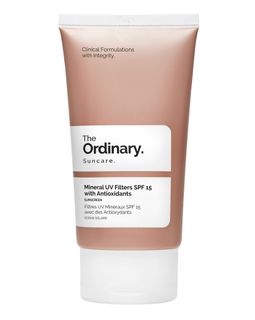
The Ordinary Mineral UV Filters SPF 15 with Antioxidants
Works for
2 of 3 advertised claims delivered
Sun protectionSPF 15 · 2 UV filters · Broad spectrumWeak protectionSPF under 30
This product offers broad spectrum sun protection, but it is weak. We recommend to use a broad spectrum sunscreen with at least SPF 30.
This product can be considered "reef safe" because it does not contain the UV filters (oxybenzone and octinoxate) that can be harmful to coral reefs when present in the water in high concentrations.
Moisturizing36 ingredients credited for this claimStrong support
“Working to replenish deep hydration and soothe any irritation, the nourishing formula leaves skin strengthened, fortified and healthy.”
This product can help improve hydration of the skin with the two types of ingredients.
The first type is called “humectants”:
these ingredients help attract water.
When humectants are on the surface of the skin, they “pull in” the moisture from the outside environment, or from
within deeper layers of the skin. The following ingredients in this product do the job:
alanine, arginine.
This product also contains ingredients called “occlusives”. They help reduce the speed with which our skin loses moisture to the outside environment. These ingredients also help soften the upper layer of the skin, so it feels less tight and nicer to the touch. The following ingredients in this product do the job: arginine, caprylic/capric triglyceride.
The following ingredients in this product are especially good for supporting the skin barrier and helping with the hydration level: linoleic acid, urea
Anti-aging5 ingredients credited for this claimModerate support
“An innovative take on sunscreen that does so much more than guard your complexion against the harmful, ageing effects of the sun (though it does that very well indeed) The Ordinary’s Mineral UV Filters SPF 15 with Antioxidants offers unrivalled protection.”
This product contains aspartic acid, astaxanthin, serine, threonine. These ingredients might be able to help reduce and prevent fine lines and wrinkles, improve skin elasticity and firmness, but there is not enough evidence that it actually works. The biggest anti-aging effect in this product comes from sun protection. Sun damage is the main factor causing early signs of skin aging. We, however, do not recommend using this product as a sunscreen because the protection it offers is not strong enough).
Anti-oxidationNot advertised by the brand · 4 ingredients credited for this claimStrong support
This product contains antioxidants (astaxanthin) that can help neutralize free radicals in skin. By doing so, they can lessen the damage the skin gets from the UV light (sun).
The following ingredients - haematococcus pluvialis extract also can have an antioxidant effect, but there is less evidence to confirm their effectiveness in skin.
Can it cause trouble?
Irritancy1 strong irritant: Rosmarinus officinalis leaf extractMedium risk
ComedogenicClean of flagged comedogenic ingredientsNone flagged
User reviews
Ingredients
Filter by role to see what each ingredient is doing.
Water~45–55%
Cyclopentasiloxane~5.9–7.3%
- Irritation risk
- Low
A silicone that helps improve the product texture and spreadability. Can absorb oil creating a short-term mattifying effect on the skin
More about CyclopentasiloxaneZinc oxide~5.3–6.5%
- Irritation risk
- Low
A broad spectrum sunblock (protects from both UVA and UVB rays). Is suitable for most sensitive skins. In small concentrations, can be used as a colorant
More about Zinc oxideTitanium dioxide~4–4.9%
- Irritation risk
- Low
Works as a UV filter when used in high concentrations. It is photostable and is effective mostly against the UVB light, with some protection in the UVA range. In small concentrations, used for its ability to improve the color of cosmetic products. Is usually well tolerated by the skin
More about Titanium dioxideGlycerin~2.9–3.6%
- Irritation risk
- Low
One of the best moisturizing ingredients. Naturally present in skin. It attracts water to the upper layer of the skin working as a humectant
More about GlycerinPeg-10 dimethicone~2.5–3%
- Irritation risk
- Low
A silicone that works to soften the upper layer of the skin and reduce its water loss
More about Peg-10 dimethiconeHelianthus annuus seed oil~2–2.5%
- Irritation risk
- Low
A great emollient due to its high linoleic acid content. One of the most effective plant oils in helping skin hydration and repairing skin barrier function
More about Helianthus annuus seed oilPeg-9 polydimethylsiloxyethyl dimethicone~1.5–1.9%
- Irritation risk
- Medium
A type of silicone that helps water and oil mix together
More about Peg-9 polydimethylsiloxyethyl dimethiconeCaprylic/capric triglyceride~1.4–1.8%
- Irritation risk
- Medium
A good mix of fatty acids that forms a protective layer on the skin. Improves the shelf life of products. Derived from coconut and glycerin
More about Caprylic/capric triglycerideHexyl laurate~1.1–1.4%
- Irritation risk
- Medium
Helps soften the upper layer of the skin and create a nice product consistency
More about Hexyl laurateDimethicone/peg-10/15 crosspolymer~0.95–1.2%
Polyglyceryl-4 isostearate~0.75–1.15%
- Irritation risk
- Medium
Helps water and oil mix together
More about Polyglyceryl-4 isostearateAstaxanthin~0.7–1.05%
- Irritation risk
- Medium
Helps neutralize free radicals in skin and might help to calm down inflammation
More about AstaxanthinDisodium uridine phosphate~0.65–1%
- Irritation risk
- Low
Ethyl ferulate~0.65–0.95%
- Irritation risk
- Low
Rosmarinus officinalis leaf extract~0.6–0.9%
- Irritation risk
- High
Can be helpful in reducing inflammation in skin, including inflamed acne. It can be irritating
More about Rosmarinus officinalis leaf extractTasmannia lanceolata fruit/leaf extract~0.6–0.9%
- Irritation risk
- High
Haematococcus pluvialis extract~0.55–0.85%
- Irritation risk
- Medium
Green algae extract that might contain antioxidant astaxanthin
More about Haematococcus pluvialis extractPicea mariana bark extract~0.55–0.8%
- Irritation risk
- Low
Arginine~0.5–0.75%
- Irritation risk
- Low
An amino acid that is naturally present in skin and helps keep it hydrated. When used together with AHAs, it can reduce their irritating effect on the skin
More about ArginineAspartic acid~0.5–0.75%
- Irritation risk
- Low
An amino-acid that helps increase skin hydration and might help to slightly improve skin firmness, potentially reducing lines and wrinkles
More about Aspartic acidGlycine~0.5–0.75%
- Irritation risk
- Low
Helps to attract water to the upper layer of the skin and can help restore the skin barrier function
More about GlycineAlanine~0.5–0.75%
- Irritation risk
- Low
An amino-acid that helps to attract water to the upper layer of the skin and might help to lighten the skin, but solid evidence is lacking
More about AlanineSerine~0.5–0.75%
- Irritation risk
- Low
An amino-acid that helps to attract water to the upper layer of the skin. In combination with other amino-acids, might help to reduce fine lines and wrinkles
More about SerineValine~0.5–0.75%
- Irritation risk
- Low
Isoleucine~0.5–0.75%
- Irritation risk
- Low
An amino acid that can help attract water to the upper layer of the skin and support skin's barrier function
More about IsoleucineProline~0.5–0.75%
Threonine~0.5–0.75%
- Irritation risk
- Low
An amino-acid that helps to attract water to the upper layer of the skin. In combination with other amino-acids, might help to reduce fine lines and wrinkles
More about ThreonineHistidine~0.5–0.75%
Phenylalanine~0.5–0.75%
- Irritation risk
- Low
Sodium pca~0.5–0.75%
- Irritation risk
- Low
Naturally present in skin and helps to attract water to its upper layer
More about Sodium pcaPca~0.5–0.75%
- Irritation risk
- Low
Naturally present in skin and helps to attract water to its upper layer
More about PcaSodium lactate~0.5–0.75%
- Irritation risk
- Medium
Helps attract water to the upper layer of the skin. Is often used to adjust the pH level of the product
More about Sodium lactateGlucose~0.5–0.75%
- Irritation risk
- Low
Helps attract water to the upper layer of the skin. Could be helpful in restoring the skin barrier function
More about GlucoseMaltose~0.5–0.75%
- Irritation risk
- Low
Fructose~0.5–0.75%
- Irritation risk
- Low
Helps attract water to the upper layer of the skin
More about FructoseTrehalose~0.5–0.75%
- Irritation risk
- Low
A sugar that attracts water to the upper layer of the skin
More about TrehaloseUrea~0.5–0.75%
- Irritation risk
- Low
Naturally present in skin (urea makes up about 7% of natural moisturizing factors in skin). Attracts water to the upper layer of the skin. Also has a positive effect on the skin barrier beyond the humectant action. Can enhance penetration of other ingredients. Is an exfoliating ingredient when used in high concentrations
More about UreaAllantoin~0.5–0.7%
- Irritation risk
- Low
Helps calm down inflammation in skin and can help reduce itching. Helps to repair the skin barrier and keep skin hydrated
More about AllantoinSodium hyaluronate~0.5–0.75%
- Irritation risk
- Low
One of the best moisturizing ingredients. Attracts water into the upper layer of the skin
More about Sodium hyaluronateLinoleic acid~0.6–0.9%
- Irritation risk
- Low
An excellent emollient. Helps soften the skin, restore its barrier function, and can help to calm down inflammation. It can be helpful to prevent blemishes and clogged pores
More about Linoleic acidOleic acid~0.55–0.8%
- Irritation risk
- Medium
Helps soften the upper layer of the skin. At the same time, it can weaken the skin's barrier enhancing penetration of other ingredients and increasing the risk of skin dryness
More about Oleic acidPhytosteryl canola glycerides~0.45–0.7%
- Irritation risk
- Low
Helps soften the upper layer of the skin
More about Phytosteryl canola glyceridesPalmitic acid~0.55–0.8%
- Irritation risk
- Low
An emollient that is naturally present in skin and helps soften it
More about Palmitic acidStearic acid~0.6–0.9%
- Irritation risk
- Low
Helps oil and water mix together and works as an emollient
More about Stearic acidIsochrysis galbana extract~0.45–0.65%
- Irritation risk
- Low
Lysolecithin~0.35–0.6%
- Irritation risk
- Low
Lecithin derivative. It helps oil and water mix together and can enhance penetration of other ingredients. It helps soften the upper layer of the skin
More about LysolecithinLecithin~0.4–0.6%
- Irritation risk
- Low
Used mostly for creating emulsions - helping oil and water mix together. Helps soften the upper layer of the skin
More about LecithinTriolein~0.3–0.6%
Pentylene glycol~0.4–0.6%
- Irritation risk
- Medium
Used to preserve products, dissolve other ingredients and create a nice product texture
More about Pentylene glycolDipropylene glycol~0.3–0.5%
- Irritation risk
- Low
Helps to dissolve other ingredients in a formulation. Slows down the rate of product drying
More about Dipropylene glycolPolyglyceryl-10 oleate~0.3–0.55%
- Irritation risk
- Low
Helps soften the upper layer of the skin
More about Polyglyceryl-10 oleatePolyglyceryl-5 trioleate~0.3–0.6%
Polyglyceryl-10 stearate~0.25–0.5%
- Irritation risk
- Medium
Helps water and oil mix together and softens the upper layer of the skin
More about Polyglyceryl-10 stearateTocopherol~0.25–0.45%
- Irritation risk
- Low
Pure form of vitamin E. Can help moisturise and protect the skin from free radicals. Often used to help stabilise other ingredients or the formula itself
More about TocopherolAlumina~0.35–0.65%
- Irritation risk
- Low
The same compound that is used safely in dental implants and bone cements. In cosmetics, it is used to improve the consistency of products
More about AluminaCitric acid~0.15–0.3%
- Irritation risk
- Medium
Can work as an exfoliant but is typically used to adjust the product pH
More about Citric acidTrisodium ethylenediamine disuccinate~0.15–0.25%
- Irritation risk
- Medium
Used to improve stability of the formulation
More about Trisodium ethylenediamine disuccinateSodium chloride~0.2–0.35%
- Irritation risk
- Low
Used to stabilize mixtures of oil and water, and create thicker, gel-like product textures
More about Sodium chlorideSodium hydroxide~0.15–0.25%
Phenoxyethanol~0.15–0.25%
- Irritation risk
- Low
A preservative. It helps prevent bacterial growth in cosmetic products
More about PhenoxyethanolChlorphenesin~0.1–0.2%
Ingredient list view
Water, Cyclopentasiloxane, Zinc oxide, Titanium dioxide, Glycerin, Peg-10 dimethicone, Helianthus annuus seed oil, Peg-9 polydimethylsiloxyethyl dimethicone, Caprylic/capric triglyceride, Hexyl laurate, Dimethicone/peg-10/15 crosspolymer, Polyglyceryl-4 isostearate, Astaxanthin, Disodium uridine phosphate, Ethyl ferulate, Rosmarinus officinalis leaf extract, Tasmannia lanceolata fruit/leaf extract, Haematococcus pluvialis extract, Picea mariana bark extract, Arginine, Aspartic acid, Glycine, Alanine, Serine, Valine, Isoleucine, Proline, Threonine, Histidine, Phenylalanine, Sodium pca, Pca, Sodium lactate, Glucose, Maltose, Fructose, Trehalose, Urea, Allantoin, Sodium hyaluronate, Linoleic acid, Oleic acid, Phytosteryl canola glycerides, Palmitic acid, Stearic acid, Isochrysis galbana extract, Lysolecithin, Lecithin, Triolein, Pentylene glycol, Dipropylene glycol, Polyglyceryl-10 oleate, Polyglyceryl-5 trioleate, Polyglyceryl-10 stearate, Tocopherol, Alumina, Citric acid, Trisodium ethylenediamine disuccinate, Sodium chloride, Sodium hydroxide, Phenoxyethanol, Chlorphenesin
Compare prices
Retailers ranked by price — lowest first.

Product summary
"The Ordinary - Mineral UV Filters SPF 15 with Antioxidants" "is a broad spectrum sunscreen meaning that it protects both from UVB rays (" burning "- they cause sunburn) and UVA rays (" aging "- they don't cause sunburn but lead to premature aging and pigmentation issues). However, it does not offer enough sun protection. We recommend to use a sunscreen with at least SPF 30 daily.
It contains good moisturizing ingredients and can double as a hydrating day cream.
Sunscreen filters
This product is a mineral sunscreen. It uses titanium dioxide and zinc oxide for sun protection. Both titanium dioxide and zinc oxide almost never irritate even the most sensitive skin and eyes, but can leave a white cast.
Irritation risk
There are some common irritants in this product, including ingredients that do not have benefits for the skin. We assess the overall irritancy of this product to be medium. For a detailed overview of all potential irritants: click here
You can see the detailed formula review with the breakdown of all actives in the product and the full ingredient list with estimated concentrations in the tables below.
About the brand
According to Cruelty-Free Kitty" The Ordinary "is cruelty free and so is its parent company.
Price
The product retails from 7.90$ up to 10900.00$ in the United States, from 9.70CA$ up to 13.90CA$ in Canada, for 38.57A$ in Australia and from 7.90£ up to 9.99£ in the United Kingdom.
For a detailed price comparison: click here.
Sources cited in this review
Every concentration estimate and effectiveness label is anchored to one of these 41 studies and safety reviews.
- 1A review of inorganic UV filters zinc oxide and titanium dioxideonlinelibrary.wiley.com
- 2
- 3
- 4
- 5
- 6

Affiliate links · As an Amazon Associate, WIMJ earns from qualifying purchases.