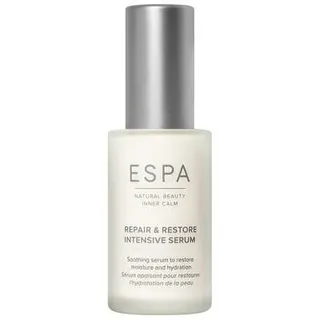
ESPA Face Serums Repair & Restore Intensive Serum

ESPA Face Serums Repair & Restore Intensive Serum

Efficacy75/100IrritancyHigh

Works for

Moisturizing
Canola oil, Triticum vulgare germ oil + 18 more
Works
What the product description says
“ESPA, Face Serums A potent serum that helps soothe and restore moisture.”
Source: Allbeauty

This product can help improve hydration of the skin with the two types of ingredients.

The first type is called “humectants”:
these ingredients help attract water. When humectants are on the surface of the skin, they “pull in” the moisture from the outside environment, or from within deeper layers of the skin. The following ingredients in this product do the job: glycerin, sodium lactate.

This product also contains ingredients called “occlusives”. They help reduce the speed with which our skin loses moisture to the outside environment. These ingredients also help soften the upper layer of the skin, so it feels less tight and nicer to the touch. The following ingredients in this product do the job: chondrus crispus extract, plukenetia volubilis seed oil.

Canola oilKey active· EmollientEffect: MediumA plant oil that can help soften the upper layer of the skin~4.5–5.5%
Triticum vulgare germ oilKey active· EmollientEffect: HighA good emoillient. Contains vitamin E which can help neutralise free radicals, however the oil is unstable. Avoid if you have gluten or wheat sensitivity (including food allergies).~3.3–4%
GlycerinKey active· HumectantEffect: HighOne of the best moisturizing ingredients. Naturally present in skin. It attracts water to the upper layer of the skin working as a humectant~2.5–3.1%
Beta-glucanKey activeEffect: HighHelps attract water to the upper layer of the skin, calm down inflammation and irritation, restore the barrier function and support wound healing. It can be helpful in reducing fine lines and wrinkles~2–2.5%
Plukenetia volubilis seed oilKey active· Emollient, OcclusiveEffect: HighA plant oil that works as a good moisturizer by softening the upper layer of the skin. Might be helpful in reducing inflammation in skin and reducing blemishes due to the large content of linoleic acid~1.5–1.8%
Sodium pcaKey active· HumectantEffect: HighNaturally present in skin and helps to attract water to its upper layer~0.4–0.6%
Chondrus crispus extractKey active· OcclusiveEffect: HighRed algae extract that helps attract water to the upper layer of the skin and create a nicer product consistency~0.3–0.55%
Sodium lactateKey active· HumectantEffect: HighHelps attract water to the upper layer of the skin. Is often used to adjust the pH level of the product~0.25–0.5%
GlucoseKey active· HumectantEffect: MediumHelps attract water to the upper layer of the skin. Could be helpful in restoring the skin barrier function~0.25–0.5%
Chlorella vulgaris extractKey activeEffect: MediumA plant extract that can help to attract water to the upper layer of the skin and might have some anti-oxidant and anti-inflammatory properties~0.25–0.5%
Aloe barbadensis leaf juice· HumectantEffect: LowTraditionally used to treat sunburns, dermatitis and inflammation, but evidence for its effectiveness is lacking. The extract can contain humectants that help attract water into the skin~6.5–7.9%
Sorbitol· HumectantEffect: LowHelps attract water to the upper layer of the skin and improves the product texture~1.1–1.3%
Butylene glycol· HumectantEffect: LowUsed to create a nice product texture and help delivery of other ingredients. Might be somewhat helpful in attracting water to the upper layer of the skin~0.6–0.85%
Caprylyl glycol· Humectant, EmollientEffect: LowHelps preserve products and creates a nice product texture~0.4–0.6%
Tephrosia purpurea seed extractEffect: LowA plant extract that might help attract water to the upper layer of the skin. The manufacturer claims that it can help "break down cortisol production in skin production in skin cells", but actual benefits to the skin are not clear~0.25–0.45%
Calcium gluconate· HumectantEffect: LowHelps attract water to the upper layer of the skin and helps to improve appearance of the product~0.2–0.4%
TocopherolEffect: Low, below effective dosePure form of vitamin E. Can help moisturise and protect the skin from free radicals. Often used to help stabilise other ingredients or the formula itself~0.2–0.35%
Rosa canina fruit oilUnder-dosedA great emollient. Contains vitamin E (tocopherol) which may give it some anti-oxidant properties. Can contain volatile compounds and can be irritating~1.7–2%
AllantoinUnder-dosedHelps calm down inflammation in skin and can help reduce itching. Helps to repair the skin barrier and keep skin hydrated~0.3–0.6%
GluconolactoneUnder-dosedA polyhydroxy acid (PHA) that helps shed the dead cells from the skin surface revealing smoother skin. Is believed to be genter than AHAs. It helps attract water to the upper layer of the skin and can stimulate production of skin's own hyaluronic acid resulting in improved hydration levels. It has been shown to be helpful against acne and clogged pores if used consistently (e.g over a period of 12 weeks) in high enough concentration. It can help reduce fine lines and wrinkles and improve skin tone with long-term application. Can help neutralize free radicals~0.25–0.45%

Can it cause trouble?

Irritancy
15 strong irritants: Pelargonium graveolens oil, Parfum + 13 more — patch-test recommended
High risk
We flagged 29 ingredients with irritancy potential. Severity depends on your sensitivity threshold; the table lists the worst offenders first.
IngredientFunctionIrritationEst. amount
Pelargonium graveolens oilUsed as a fragrance. Can be irritatingHigh~0.3–0.6%est.
ParfumAn aromatic blend of unspecified and possibly irritating ingredientsHigh~0.25–0.45%est.
LinaloolA fragrance. Can be irritatingHigh~0.25–0.45%est.
GeraniolA fragrance. Can be irritatingHigh~0.25–0.45%est.
Cananga odorata flower oilAn essential oil. Can be irritatingHigh~0.25–0.45%est.
Anthemis nobilis flower oilAn essential oil that is used as a fragrance and can be irritating. It might have some anti-oxidant effect in skinHigh~0.25–0.5%est.
Cymbopogon martini oilAromatic plant oil used in cosmetics as a fragrance. A likely irritantHigh~0.25–0.45%est.
Benzyl benzoateFragrance with sweet balsamic smell. Help to preserve products and dissolve other ingredients. Could trigger allergic reactions and be irritatingHigh~0.25–0.45%est.
Jasminum officinale flower extractFragrance. Can be irritatingHigh~0.25–0.45%est.
Lavandula angustifolia oilAn essential oil. Potential allergen and can be irritating. It has some anti-bacterial propertiesHigh~0.25–0.5%est.
Rosa centifolia flower extractContains essential oil. Can be irritatingHigh~0.25–0.5%est.
Rosmarinus officinalis leaf oilA plant oil with high content of volatile compounds that can irritate the skin. Can be used as a fragrance. Has anti-bacterial properties and might help neutralize free radicals on the surface of the skinHigh~0.25–0.5%est.
LimoneneA common frangrance that can easily irritate skin, especially if exposed to air, light or heatHigh~0.2–0.4%est.
Benzyl salicylateA fragrance. Is a likely irritantHigh~0.2–0.35%est.
CitralA fragrance with a lemon scent. A likely irritantHigh~0.15–0.3%est.
Aloe barbadensis leaf juiceTraditionally used to treat sunburns, dermatitis and inflammation, but evidence for its effectiveness is lacking. The extract can contain humectants that help attract water into the skinMedium~6.5–7.9%est.
Canola oilA plant oil that can help soften the upper layer of the skinMedium~4.5–5.5%est.
Rosa canina fruit oilA great emollient. Contains vitamin E (tocopherol) which may give it some anti-oxidant properties. Can contain volatile compounds and can be irritatingMedium~1.7–2%est.
Caprylyl glycolHelps preserve products and creates a nice product textureMedium~0.4–0.6%est.
EthylhexylglycerinA preservativeMedium~0.25–0.5%est.
Tephrosia purpurea seed extractA plant extract that might help attract water to the upper layer of the skin. The manufacturer claims that it can help "break down cortisol production in skin production in skin cells", but actual benefits to the skin are not clearMedium~0.25–0.45%est.
Sodium lactateHelps attract water to the upper layer of the skin. Is often used to adjust the pH level of the productMedium~0.25–0.5%est.
Benzoic acidA preservativeMedium~0.25–0.5%est.
Chlorella vulgaris extractA plant extract that can help to attract water to the upper layer of the skin and might have some anti-oxidant and anti-inflammatory propertiesMedium~0.25–0.5%est.
Dehydroacetic acidA preservativeMedium~0.25–0.5%est.
GluconolactoneA polyhydroxy acid (PHA) that helps shed the dead cells from the skin surface revealing smoother skin. Is believed to be genter than AHAs. It helps attract water to the upper layer of the skin and can stimulate production of skin's own hyaluronic acid resulting in improved hydration levels. It has been shown to be helpful against acne and clogged pores if used consistently (e.g over a period of 12 weeks) in high enough concentration. It can help reduce fine lines and wrinkles and improve skin tone with long-term application. Can help neutralize free radicalsMedium~0.25–0.45%est.
Phytic acidAn alpha-hydroxy acid (AHA), but is mostly used to stabilize product formulations in cosmeticsMedium~0.25–0.5%est.
Citric acidCan work as an exfoliant but is typically used to adjust the product pHMedium~0.05–0.15%est.
Comedogenic
3 ingredients rated 2 or more on the 0–5 pore-clogging scale
3 flagged
These ingredients have a comedogenic rating of 2 or more on a 0–5 scale; the table shows each one's rating. In leave-on products they can clog pores in acne-prone skin.
IngredientFunctionRatingEst. amount
Triticum vulgare germ oilA good emoillient. Contains vitamin E which can help neutralise free radicals, however the oil is unstable. Avoid if you have gluten or wheat sensitivity (including food allergies).3/5~3.3–4%est.
Chlorella vulgaris extractA plant extract that can help to attract water to the upper layer of the skin and might have some anti-oxidant and anti-inflammatory properties3/5~0.25–0.5%est.
Chondrus crispus extractRed algae extract that helps attract water to the upper layer of the skin and create a nicer product consistency3/5~0.3–0.55%est.

User reviews

Would you recommend?
No community reviews yet.

Be the first — your take helps the next person decide.

Ingredients

Filter by role to see what each ingredient is doing.

Water~45–55%
Formula
Irritation risk
Low

Plain old water

More about Water
Aloe barbadensis leaf juice~6.5–7.9%
Irritant · medium
Irritation risk
Medium
Works for
MoisturizingReduces rednessReduces irritationAntibacterialAnti-inflammatoryAnti-blemishAnti-aging

Traditionally used to treat sunburns, dermatitis and inflammation, but evidence for its effectiveness is lacking. The extract can contain humectants that help attract water into the skin

More about Aloe barbadensis leaf juice
Canola oil~4.5–5.5%
Key activeIrritant · medium
Irritation risk
Medium
Works for
Moisturizing

A plant oil that can help soften the upper layer of the skin

More about Canola oil
Triticum vulgare germ oil~3.3–4%
Key activeComedogenic 3/5
Irritation risk
Low
Comedogenicity
3/5
Works for
MoisturizingAnti-oxidation

A good emoillient. Contains vitamin E which can help neutralise free radicals, however the oil is unstable. Avoid if you have gluten or wheat sensitivity (including food allergies).

More about Triticum vulgare germ oil
Glycerin~2.5–3.1%
Key active
Irritation risk
Low
Works for
Moisturizing

One of the best moisturizing ingredients. Naturally present in skin. It attracts water to the upper layer of the skin working as a humectant

More about Glycerin
Beta-glucan~2–2.5%
Key active
Irritation risk
Low
Works for
Anti-inflammatoryReduces irritationMoisturizingAnti-oxidationAnti-agingAnti-blemish

Helps attract water to the upper layer of the skin, calm down inflammation and irritation, restore the barrier function and support wound healing. It can be helpful in reducing fine lines and wrinkles

More about Beta-glucan
Rosa canina fruit oil~1.7–2%
Under-dosedIrritant · medium
Irritation risk
Medium
Works for
MoisturizingAnti-oxidation

A great emollient. Contains vitamin E (tocopherol) which may give it some anti-oxidant properties. Can contain volatile compounds and can be irritating

More about Rosa canina fruit oil
Plukenetia volubilis seed oil~1.5–1.8%
Key active
Irritation risk
Low
Works for
Moisturizing

A plant oil that works as a good moisturizer by softening the upper layer of the skin. Might be helpful in reducing inflammation in skin and reducing blemishes due to the large content of linoleic acid

More about Plukenetia volubilis seed oil
Sorbitol~1.1–1.3%
Formula
Irritation risk
Low
Works for
Moisturizing

Helps attract water to the upper layer of the skin and improves the product texture

More about Sorbitol
Phenoxyethanol~0.65–1%
Formula
Irritation risk
Low

A preservative. It helps prevent bacterial growth in cosmetic products

More about Phenoxyethanol
Butylene glycol~0.6–0.85%
Formula
Irritation risk
Low
Works for
Moisturizing

Used to create a nice product texture and help delivery of other ingredients. Might be somewhat helpful in attracting water to the upper layer of the skin

More about Butylene glycol
Xanthan gum~0.5–0.75%
Formula
Irritation risk
Low
Works for
Cleansing

Used to create a thicker product consistency

More about Xanthan gum
Chitin~0.65–1%
Formula
Irritation risk
Low
More about Chitin
Sodium pca~0.4–0.6%
Key active
Irritation risk
Low
Works for
Moisturizing

Naturally present in skin and helps to attract water to its upper layer

More about Sodium pca
Caprylyl glycol~0.4–0.6%
Irritant · medium
Irritation risk
Medium
Works for
Moisturizing

Helps preserve products and creates a nice product texture

More about Caprylyl glycol
Pelargonium graveolens oil~0.3–0.6%
Irritant · high
Irritation risk
High

Used as a fragrance. Can be irritating

More about Pelargonium graveolens oil
Allantoin~0.3–0.6%
Under-dosed
Irritation risk
Low
Works for
MoisturizingAnti-inflammatoryReduces irritationReduces rednessAnti-blemishExfoliation

Helps calm down inflammation in skin and can help reduce itching. Helps to repair the skin barrier and keep skin hydrated

More about Allantoin
Bisabolol~0.25–0.5%
Formula
Irritation risk
Low
Works for
Reduces irritationAnti-inflammatoryAnti-oxidation

An active component of chamomile plant that historically has been used to calm down irritated skin. A recent study shows that bisabolol indeed can have some anti-inflammatory effect on skin, even though conclusive data is lacking. Bisabolol has a sweet floral scent and can be added to products for its aromatic properties

More about Bisabolol
Inulin lauryl carbamate~0.3–0.55%
Formula
Irritation risk
Low
Works for
Cleansing
More about Inulin lauryl carbamate
Ethylhexylglycerin~0.25–0.5%
Irritant · medium
Irritation risk
Medium

A preservative

More about Ethylhexylglycerin
Tephrosia purpurea seed extract~0.25–0.45%
Irritant · medium
Irritation risk
Medium
Works for
Moisturizing

A plant extract that might help attract water to the upper layer of the skin. The manufacturer claims that it can help "break down cortisol production in skin production in skin cells", but actual benefits to the skin are not clear

More about Tephrosia purpurea seed extract
Sodium lactate~0.25–0.5%
Key activeIrritant · medium
Irritation risk
Medium
Works for
Moisturizing

Helps attract water to the upper layer of the skin. Is often used to adjust the pH level of the product

More about Sodium lactate
Parfum~0.25–0.45%
Irritant · high
Irritation risk
High

An aromatic blend of unspecified and possibly irritating ingredients

More about Parfum
Benzoic acid~0.25–0.5%
Irritant · medium
Irritation risk
Medium

A preservative

More about Benzoic acid
Linalool~0.25–0.45%
Irritant · high
Irritation risk
High

A fragrance. Can be irritating

More about Linalool
Geraniol~0.25–0.45%
Irritant · high
Irritation risk
High

A fragrance. Can be irritating

More about Geraniol
Chlorella vulgaris extract~0.25–0.5%
Key activeComedogenic 3/5Irritant · medium
Irritation risk
Medium
Comedogenicity
3/5
Works for
MoisturizingAnti-inflammatoryAnti-oxidation

A plant extract that can help to attract water to the upper layer of the skin and might have some anti-oxidant and anti-inflammatory properties

More about Chlorella vulgaris extract
Dehydroacetic acid~0.25–0.5%
Irritant · medium
Irritation risk
Medium

A preservative

More about Dehydroacetic acid
Gluconolactone~0.25–0.45%
Under-dosedIrritant · medium
Irritation risk
Medium
Works for
MoisturizingAnti-agingEvens skin toneExfoliationAnti-blemishAnti-oxidation

A polyhydroxy acid (PHA) that helps shed the dead cells from the skin surface revealing smoother skin. Is believed to be genter than AHAs. It helps attract water to the upper layer of the skin and can stimulate production of skin's own hyaluronic acid resulting in improved hydration levels. It has been shown to be helpful against acne and clogged pores if used consistently (e.g over a period of 12 weeks) in high enough concentration. It can help reduce fine lines and wrinkles and improve skin tone with long-term application. Can help neutralize free radicals

More about Gluconolactone
Cananga odorata flower oil~0.25–0.45%
Irritant · high
Irritation risk
High

An essential oil. Can be irritating

More about Cananga odorata flower oil
Glucose~0.25–0.5%
Key active
Irritation risk
Low
Works for
Moisturizing

Helps attract water to the upper layer of the skin. Could be helpful in restoring the skin barrier function

More about Glucose
Anthemis nobilis flower oil~0.25–0.5%
Irritant · high
Irritation risk
High
Works for
Anti-inflammatoryAnti-oxidation

An essential oil that is used as a fragrance and can be irritating. It might have some anti-oxidant effect in skin

More about Anthemis nobilis flower oil
Cistus ladaniferus resin~0.25–0.5%
Formula
Citrus aurantium amara leaf/twig oil~0.25–0.5%
Irritant · high
Cymbopogon martini oil~0.25–0.45%
Irritant · high
Irritation risk
High

Aromatic plant oil used in cosmetics as a fragrance. A likely irritant

More about Cymbopogon martini oil
Sodium benzoate~0.25–0.5%
Formula
Irritation risk
Low

A preservative

More about Sodium benzoate
Phytic acid~0.25–0.5%
Irritant · medium
Irritation risk
Medium

An alpha-hydroxy acid (AHA), but is mostly used to stabilize product formulations in cosmetics

More about Phytic acid
Chondrus crispus extract~0.3–0.55%
Key activeComedogenic 3/5
Irritation risk
Low
Comedogenicity
3/5
Works for
Moisturizing

Red algae extract that helps attract water to the upper layer of the skin and create a nicer product consistency

More about Chondrus crispus extract
Benzyl benzoate~0.25–0.45%
Irritant · high
Irritation risk
High

Fragrance with sweet balsamic smell. Help to preserve products and dissolve other ingredients. Could trigger allergic reactions and be irritating

More about Benzyl benzoate
Jasminum officinale flower extract~0.25–0.45%
Irritant · high
Irritation risk
High

Fragrance. Can be irritating

More about Jasminum officinale flower extract
Lavandula angustifolia oil~0.25–0.5%
Irritant · high
Irritation risk
High

An essential oil. Potential allergen and can be irritating. It has some anti-bacterial properties

More about Lavandula angustifolia oil
Rosa centifolia flower extract~0.25–0.5%
Irritant · high
Irritation risk
High

Contains essential oil. Can be irritating

More about Rosa centifolia flower extract
Rosmarinus officinalis leaf oil~0.25–0.5%
Irritant · high
Irritation risk
High
Works for
AntibacterialAnti-oxidation

A plant oil with high content of volatile compounds that can irritate the skin. Can be used as a fragrance. Has anti-bacterial properties and might help neutralize free radicals on the surface of the skin

More about Rosmarinus officinalis leaf oil
Vetiveria zizanoides root oil~0.25–0.4%
Formula
Limonene~0.2–0.4%
Irritant · high
Irritation risk
High

A common frangrance that can easily irritate skin, especially if exposed to air, light or heat

More about Limonene
Benzyl salicylate~0.2–0.35%
Irritant · high
Irritation risk
High

A fragrance. Is a likely irritant

More about Benzyl salicylate
Citral~0.15–0.3%
Irritant · high
Irritation risk
High

A fragrance with a lemon scent. A likely irritant

More about Citral
Tocopherol~0.2–0.35%
Formula
Irritation risk
Low
Works for
Anti-oxidationMoisturizingAnti-inflammatoryAnti-aging

Pure form of vitamin E. Can help moisturise and protect the skin from free radicals. Often used to help stabilise other ingredients or the formula itself

More about Tocopherol
Calcium gluconate~0.2–0.4%
Formula
Irritation risk
Low
Works for
Moisturizing

Helps attract water to the upper layer of the skin and helps to improve appearance of the product

More about Calcium gluconate
Citric acid~0.05–0.15%
Irritant · medium
Irritation risk
Medium

Can work as an exfoliant but is typically used to adjust the product pH

More about Citric acid
Sodium hydroxide~0.1–0.2%
Formula
Irritation risk
Low

Used to adjust the product's pH

More about Sodium hydroxide
Ingredient list view

Water, Aloe barbadensis leaf juice, Canola oil, Triticum vulgare germ oil, Glycerin, Beta-glucan, Rosa canina fruit oil, Plukenetia volubilis seed oil, Sorbitol, Phenoxyethanol, Butylene glycol, Xanthan gum, Chitin, Sodium pca, Caprylyl glycol, Pelargonium graveolens oil, Allantoin, Bisabolol, Inulin lauryl carbamate, Ethylhexylglycerin, Tephrosia purpurea seed extract, Sodium lactate, Parfum, Benzoic acid, Linalool, Geraniol, Chlorella vulgaris extract, Dehydroacetic acid, Gluconolactone, Cananga odorata flower oil, Glucose, Anthemis nobilis flower oil, Cistus ladaniferus resin, Citrus aurantium amara leaf/twig oil, Cymbopogon martini oil, Sodium benzoate, Phytic acid, Chondrus crispus extract, Benzyl benzoate, Jasminum officinale flower extract, Lavandula angustifolia oil, Rosa centifolia flower extract, Rosmarinus officinalis leaf oil, Vetiveria zizanoides root oil, Limonene, Benzyl salicylate, Citral, Tocopherol, Calcium gluconate, Citric acid, Sodium hydroxide

Compare prices

Retailers ranked by price — lowest first.

No pricing data available yet for this product.

Worth comparing, line by line.

Match % combines shared ingredients, the first five ingredients, shared actives and hero ingredients, irritancy (lower counts in the alternative's favour), texture and body area. Only products in the same routine step are compared.

Side-by-side comparison of this product against its closest alternatives
ESPAFace Serums Repair & Restore Intensive SerumYOUR PRODUCTPSA SkinThe Most: Hyaluronic Super Nutrient Hydration SerumBloomeffectsTulip Dew DropsILIATrue Skin Radiant Priming Serum – Light It Up
Match—59%58%57%
Price——$55.00$50.48
Shared key ingredients—6 of 123 of 124 of 12
Key difference—MadecassosideNiacinamideCaprylic/Capric Triglyceride
Irritancy High Low Medium Medium
Drying alcohol—— Contains drying alcohol —
View product Shop Shop Shop

More alternatives: OSKIA Deal Two: OSKIA Isotonic Hydra-SerumLuzern Laboratories Luzern WE3 Triple Action Serum Wrinkle Corrector

Cheaper alternatives? Browse formulas in the same category.
We compare ingredient profiles across our catalog — pick the closest match for your budget.
Open dupe finder

Product summary

"ESPA - Face Serums Repair & Restore Intensive Serum" could be helpful for: Moisturizing, but its actives are not the most effective or are not well-studied.

Ingredient callouts

  • Humectants (sodium lactate 0.25% - 0.50%, sodium pca 0.40% - 0.60% and glycerin 2.50% - 3.10%). These ingredients help attract water to the upper layer of the skin and improve the skin hydration.

Sources cited in this review

Every concentration estimate and effectiveness label is anchored to one of these 38 studies and safety reviews.

  1. 1
    Canola Oilsciencedirect.com
  2. 2
  3. 3
  4. 4
  5. 5
  6. 6
ESPA Face Serums Repair & Restore Intensive Serum
ESPAFace Serums Repair & Restore Intensive Serum

Affiliate links · As an Amazon Associate, WIMJ earns from qualifying purchases.

As an Amazon Associate, WIMJ earns from qualifying purchases.