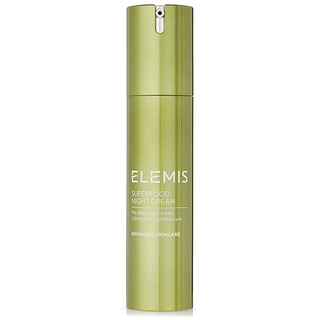
ELEMIS Superfood Night Cream
Works for
1 of 1 advertised claim delivered
Moisturizing20 ingredients credited for this claimGood support
“Hydrates, restores, replenishes.”
This product can help improve hydration of the skin with the two types of ingredients.
The first type is called “humectants”:
these ingredients help attract water.
When humectants are on the surface of the skin, they “pull in” the moisture from the outside environment, or from
within deeper layers of the skin. The following ingredients in this product do the job:
betaine, glycerin.
This product also contains ingredients called “occlusives”. They help reduce the speed with which our skin loses moisture to the outside environment. These ingredients also help soften the upper layer of the skin, so it feels less tight and nicer to the touch. The following ingredients in this product do the job: helianthus annuus seed oil, nigella sativa seed oil.
Can it cause trouble?
Irritancy7 strong irritants: Parfum, Limonene + 5 more — patch-test recommendedHigh risk
Comedogenic1 ingredient rated 2 or more on the 0–5 pore-clogging scale1 flagged
User reviews
Be the first — your take helps the next person decide.
Ingredients
Filter by role to see what each ingredient is doing.
Water~45–55%
Coco-caprylate~4.9–6%
- Irritation risk
- Medium
An emollient that softens skin and creates a nice product texture
More about Coco-caprylateLinum usitatissimum seed oil~4.4–5.4%
Propanediol~3.1–3.8%
- Irritation risk
- Low
Acts as a solvent for other ingredients. Speeds up the absorption of other ingredients into the skin
More about PropanediolGlycerin~2.5–3%
- Irritation risk
- Low
One of the best moisturizing ingredients. Naturally present in skin. It attracts water to the upper layer of the skin working as a humectant
More about GlycerinGlyceryl stearate~2–2.5%
- Irritation risk
- Low
An emollient that softens the skin and forms a protective layer on its surface. Helps water and oil mix together
More about Glyceryl stearatePeg-100 stearate~1.8–2.2%
- Irritation risk
- Low
Helps oil and water mix togehter and creates a nice product texture
More about Peg-100 stearatePotassium cetyl phosphate~1.4–1.8%
- Irritation risk
- Medium
Helps oil and water mix together
More about Potassium cetyl phosphateAlpha-glucan oligosaccharide~1.2–1.5%
- Irritation risk
- Low
Helps attract water to the upper layer of the skin
More about Alpha-glucan oligosaccharideNigella sativa seed oil~0.95–1.15%
- Irritation risk
- Medium
Helps soften the upper layer of the skin and support the skin's barrier due to the high content of linoleic acid
More about Nigella sativa seed oilOryza sativa bran oil~0.7–1.05%
- Irritation risk
- Low
Helps soften the upper layer of the skin and might have some anti-oxidant properties
More about Oryza sativa bran oilSalvia hispanica seed oil~0.6–0.9%
- Irritation risk
- Low
Chia seed oil. Helps to soften the upper layer of the skin and might be helpful in repairing skin barrier
More about Salvia hispanica seed oilPhenoxyethanol~0.5–0.75%
- Irritation risk
- Low
A preservative. It helps prevent bacterial growth in cosmetic products
More about PhenoxyethanolCarbomer~0.45–0.7%
- Irritation risk
- Low
Helps create a thicker or gel-like product texture. It is not a surfactant but can be used in gentle cleansing formulations
More about CarbomerBetaine~0.4–0.65%
- Irritation risk
- Low
Helps attract water to the upper layer of the skin and improves the product texture
More about BetainePolysorbate 60~0.45–0.7%
Chlorphenesin~0.16–0.32%
Hydrolyzed barley protein~0.35–0.6%
- Irritation risk
- Low
Sodium hydroxide~0.3–0.6%
Hydrolyzed quinoa~0.3–0.5%
- Irritation risk
- Low
Might help to attract water to the upper layer of the skin
More about Hydrolyzed quinoaDisodium edta~0.25–0.5%
Tocopheryl acetate~0.25–0.5%
- Irritation risk
- Medium
A more stable but less bio-available form of vitamin E compared to Tocopherol. Might help moisturize and protect the skin from free radicals, but mostly used in low concentrations to stabilize other ingredients.
More about Tocopheryl acetateParfum~0.25–0.45%
- Irritation risk
- High
An aromatic blend of unspecified and possibly irritating ingredients
More about ParfumCaramel~0.25–0.45%
- Irritation risk
- Low
Hydrolyzed hyaluronic acid~0.25–0.45%
- Irritation risk
- Low
One of the best moisturizing ingredients. Attracts water into the upper layer of the skin. A version of it is naturally present in skin
More about Hydrolyzed hyaluronic acidPanthenol~0.25–0.45%
- Irritation risk
- Low
Helps attract water to the upper layer of the skin and can help improve skin barrier function
More about PanthenolTocopherol~0.25–0.45%
- Irritation risk
- Low
Pure form of vitamin E. Can help moisturise and protect the skin from free radicals. Often used to help stabilise other ingredients or the formula itself
More about TocopherolSodium dehydroacetate~0.25–0.45%
Limonene~0.25–0.45%
- Irritation risk
- High
A common frangrance that can easily irritate skin, especially if exposed to air, light or heat
More about LimoneneButylene glycol~0.25–0.5%
- Irritation risk
- Low
Used to create a nice product texture and help delivery of other ingredients. Might be somewhat helpful in attracting water to the upper layer of the skin
More about Butylene glycolCitrus aurantium dulcis peel oil~0.25–0.45%
- Irritation risk
- High
An essentil oil from orange peel. Potential allergen and can be irritating
More about Citrus aurantium dulcis peel oilMaltodextrin~0.25–0.5%
- Irritation risk
- Low
Used to stabilize the product formulation and can help absorb oil
More about MaltodextrinHelianthus annuus seed oil~0.3–0.55%
- Irritation risk
- Low
A great emollient due to its high linoleic acid content. One of the most effective plant oils in helping skin hydration and repairing skin barrier function
More about Helianthus annuus seed oilAmyris balsamifera bark oil~0.25–0.45%
- Irritation risk
- Low
Cymbopogon martini oil~0.25–0.45%
- Irritation risk
- High
Aromatic plant oil used in cosmetics as a fragrance. A likely irritant
More about Cymbopogon martini oilGeraniol~0.25–0.45%
Linalool~0.25–0.45%
Rosmarinus officinalis leaf oil~0.25–0.45%
- Irritation risk
- High
A plant oil with high content of volatile compounds that can irritate the skin. Can be used as a fragrance. Has anti-bacterial properties and might help neutralize free radicals on the surface of the skin
More about Rosmarinus officinalis leaf oilDaucus carota sativa seed oil~0.3–0.55%
- Irritation risk
- Low
A plant oil that might help neutralize free radicals and have an anti-bacterial effect
More about Daucus carota sativa seed oilBenzyl alcohol~0.25–0.45%
- Irritation risk
- High
A preservative. Can be used to mask unpleasant smell. Can be irritating
More about Benzyl alcoholPrunus amygdalus dulcis seed extract~0.25–0.45%
- Irritation risk
- Low
Almond extract (oil) - helps soften the upper layer of the skin
More about Prunus amygdalus dulcis seed extractPolyglyceryl-3 diisostearate~0.3–0.55%
- Irritation risk
- Medium
- Comedogenicity
- 3/5
Helps oil and water mix together
More about Polyglyceryl-3 diisostearateChlorophyllin-copper complex~0.25–0.5%
- Irritation risk
- Low
Potassium sorbate~0.25–0.5%
Xanthan gum~0.25–0.5%
- Irritation risk
- Low
Used to create a thicker product consistency
More about Xanthan gumSodium benzoate~0.25–0.5%
Ascorbic acid~0.25–0.5%
- Irritation risk
- High
The most well-researched antioxidant that works in skin. Helps neutralize free radicals supporting collagen production, helping to even out the skin tone and preventing early signs of aging
More about Ascorbic acidEthylhexylglycerin~0.25–0.5%
Rhizobian gum~0.3–0.5%
- Irritation risk
- Medium
Can temporarily tighten the skin right after application of the product. The effect will be short-lived. Helps improve the product considtency
More about Rhizobian gumSodium hyaluronate~0.25–0.5%
- Irritation risk
- Low
One of the best moisturizing ingredients. Attracts water into the upper layer of the skin
More about Sodium hyaluronateDehydroacetic acid~0.25–0.5%
Water~0.25–0.5%
Butylene glycol~0.25–0.5%
- Irritation risk
- Low
Used to create a nice product texture and help delivery of other ingredients. Might be somewhat helpful in attracting water to the upper layer of the skin
More about Butylene glycolLactococcus ferment lysate~0.25–0.45%
- Irritation risk
- Low
Consists of remains of dead bacteria cells. Is likely helpful in attracting water to the upper layer of the skin. Might be helpful in reducing inflammation and neutralizing free radicals in skin
More about Lactococcus ferment lysatePolysorbate 20~0.3–0.55%
Methyl gluceth-20~0.25–0.5%
- Irritation risk
- Low
Helps attract water to the upper layer of the skin and soften it
More about Methyl gluceth-20Lactic acid~0.25–0.45%
- Irritation risk
- Medium
An exfoliating and moisturizing alpha-hydroxy acid (AHA). Typically causes less irritation than other AHAs, for example, glycolic acid. At high concentrations (about 15%), lactic acid can help reduce lines and wrinkles. Recent studies show that lactic acid can support the "good" bacteria living on skin's surface (healthy skin microbiome)
More about Lactic acidPhenoxyethanol~0.25–0.5%
- Irritation risk
- Low
A preservative. It helps prevent bacterial growth in cosmetic products
More about PhenoxyethanolBetaine~0.25–0.5%
- Irritation risk
- Low
Helps attract water to the upper layer of the skin and improves the product texture
More about BetainePropylene glycol~0.25–0.45%
- Irritation risk
- High
Helps oil and water mix together and can enhance the penetration of other ingredients into the skin. It can be irritating
More about Propylene glycolDisodium edta~0.25–0.45%
Benzoic acid~0.25–0.45%
Sodium hydroxide~0.25–0.45%
Parfum~0.2–0.35%
- Irritation risk
- High
An aromatic blend of unspecified and possibly irritating ingredients
More about ParfumDehydroacetic acid~0.2–0.35%
Tromethamine~0.2–0.4%
Ethylhexylglycerin~0.2–0.35%
Papain~0.15–0.3%
- Irritation risk
- High
An enzyme extracted from papaya fruit. Can have an exfoliating effect on the skin. Can be irritating
More about PapainSaponins~0.25–0.5%
Sodium benzoate~0.15–0.3%
Sodium chloride~0.1–0.2%
- Irritation risk
- Low
Used to stabilize mixtures of oil and water, and create thicker, gel-like product textures
More about Sodium chlorideGlycerin~0.15–0.25%
- Irritation risk
- Low
One of the best moisturizing ingredients. Naturally present in skin. It attracts water to the upper layer of the skin working as a humectant
More about GlycerinIngredient list view
Water, Coco-caprylate, Linum usitatissimum seed oil, Propanediol, Glycerin, Glyceryl stearate, Peg-100 stearate, Potassium cetyl phosphate, Alpha-glucan oligosaccharide, Nigella sativa seed oil, Oryza sativa bran oil, Salvia hispanica seed oil, Phenoxyethanol, Carbomer, Betaine, Polysorbate 60, Chlorphenesin, Hydrolyzed barley protein, Sodium hydroxide, Hydrolyzed quinoa, Disodium edta, Tocopheryl acetate, Parfum, Caramel, Hydrolyzed hyaluronic acid, Panthenol, Tocopherol, Sodium dehydroacetate, Limonene, Butylene glycol, Citrus aurantium dulcis peel oil, Maltodextrin, Helianthus annuus seed oil, Amyris balsamifera bark oil, Cymbopogon martini oil, Geraniol, Linalool, Rosmarinus officinalis leaf oil, Daucus carota sativa seed oil, Benzyl alcohol, Prunus amygdalus dulcis seed extract, Polyglyceryl-3 diisostearate, Chlorophyllin-copper complex, Potassium sorbate, Xanthan gum, Sodium benzoate, Ascorbic acid, Ethylhexylglycerin, Rhizobian gum, Sodium hyaluronate, Dehydroacetic acid, Water, Butylene glycol, Lactococcus ferment lysate, Polysorbate 20, Methyl gluceth-20, Lactic acid, Phenoxyethanol, Betaine, Propylene glycol, Disodium edta, Benzoic acid, Sodium hydroxide, Parfum, Dehydroacetic acid, Tromethamine, Ethylhexylglycerin, Papain, Saponins, Sodium benzoate, Sodium chloride, Glycerin
Compare prices
Retailers ranked by price — lowest first.

Worth comparing, line by line.
Match % combines shared ingredients, the first five ingredients, shared actives and hero ingredients, irritancy (lower counts in the alternative's favour), texture and body area. Only products in the same routine step are compared.
| ELEMISSuperfood Night CreamYOUR PRODUCT | January LabsRetexturizing Night Cream | |
|---|---|---|
| Match | — | 53% |
| Price | $20.30 | $86.00+$65.70 |
| Shared key ingredients | — | 4 of 14 |
| Key difference | — | Niacinamide |
| Irritancy | High | Medium |
| Drying alcohol | — | — |
| View product | Shop |


Sources cited in this review
Every concentration estimate and effectiveness label is anchored to one of these 29 studies and safety reviews.
- 1
- 2
- 3Efficacy of a New Topical Nano-hyaluronic Acid in Humansncbi.nlm.nih.gov
- 4Physiochemical properties and application of hyaluronic acid: a systematic reviewonlinelibrary.wiley.com
- 5Skin moisturizing effects of panthenol-based formulationspdfs.semanticscholar.org
- 6

Affiliate links · As an Amazon Associate, WIMJ earns from qualifying purchases.