Works for
1 of 2 advertised claims delivered
Moisturizing18 ingredients credited for this claimGood support
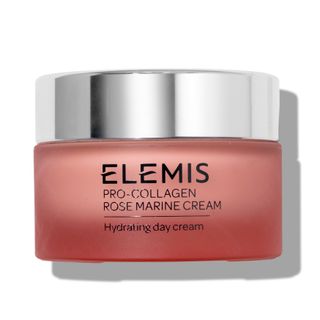
“Rejuvenate the complexion with the Elemis Pro-Collagen Rose Marine Cream, a moisturiser that works to firm, soothe and hydrate the skin.”
This product can help improve hydration of the skin with the two types of ingredients.
The first type is called “humectants”:
these ingredients help attract water.
When humectants are on the surface of the skin, they “pull in” the moisture from the outside environment, or from
within deeper layers of the skin. The following ingredients in this product do the job:
glycerin, glyceryl acrylate/acrylic acid copolymer.
This product also contains ingredients called “occlusives”. They help reduce the speed with which our skin loses moisture to the outside environment. These ingredients also help soften the upper layer of the skin, so it feels less tight and nicer to the touch. The following ingredients in this product do the job: caprylic/capric triglyceride, dimethicone.
Anti-aging2 ingredients credited for this claimLimited support
“Formulated with powerful marine and plant actives, this cream contains padina pavonica, chlorella vulgaris and gingko biloba, which work together to help reduce the appearance of fine lines and wrinkles.”
This product does not contain ingredients that are able to reduce fine lines and wrinkles or help with skin elasticity, but it can improve the look of the skin temporarily through moisturization. Well-moisturized skin might also be able to repair the sun damage better.
This ingredient ginkgo biloba leaf extract might be able to help neutralize free radicals in skin and help it fight off some of the sun damage.
Anti-oxidationNot advertised by the brand · 9 ingredients credited for this claimModerate support
This product contains antioxidants (ginkgo biloba leaf extract) that might be able to help neutralize free radicals in skin to lessen the damage it gets from the UV light (sun). There is not enough evidence to confirm their effectiveness in skin though.
Can it cause trouble?
Irritancy8 strong irritants: Rosa hybrid flower water, Parfum + 6 more — patch-test recommendedHigh risk
Comedogenic6 ingredients rated 2 or more on the 0–5 pore-clogging scale6 flagged
User reviews
Be the first — your take helps the next person decide.
Ingredients
Filter by role to see what each ingredient is doing.
Water~45–55%
Glycerin~4.4–5.4%
- Irritation risk
- Low
One of the best moisturizing ingredients. Naturally present in skin. It attracts water to the upper layer of the skin working as a humectant
More about GlycerinCaprylic/capric triglyceride~4.2–5.2%
- Irritation risk
- Medium
A good mix of fatty acids that forms a protective layer on the skin. Improves the shelf life of products. Derived from coconut and glycerin
More about Caprylic/capric triglycerideGlyceryl stearate se~2.8–3.4%
- Irritation risk
- Low
- Comedogenicity
- 2/5
Used to stabilize the product formulations and works as an emollient
More about Glyceryl stearate seIsononyl isononanoate~2.4–2.9%
- Irritation risk
- Low
Forms a protective film on the surface of the skin to prevent moisture loss. Gives a velvety feel to products while reducing tackiness
More about Isononyl isononanoateDicaprylyl carbonate~1.9–2.4%
- Irritation risk
- Low
Helps products spread more easily and works as an emollient to soften skin
More about Dicaprylyl carbonateDimethicone~1.7–2.1%
- Irritation risk
- Low
A silicone that helps to reduce water loss from the surface of the skin. Can temporarily "fill in" lines and wrinkles, absorb oil, and create a nice product finish
More about DimethiconePhenoxyethanol~0.5–1%
- Irritation risk
- Low
A preservative. It helps prevent bacterial growth in cosmetic products
More about PhenoxyethanolPolyacrylate-13~1.3–1.5%
- Irritation risk
- Low
Used to create a thicker product consistency and stabilize the product formulation
More about Polyacrylate-13Cetyl alcohol~1.1–1.3%
- Irritation risk
- Low
A non-drying alcohol that works to soften the skin and stabilize product formulations helping oil and water mix together
More about Cetyl alcoholStearic acid~0.8–1.2%
- Irritation risk
- Low
Helps oil and water mix together and works as an emollient
More about Stearic acidTocopheryl acetate~0.6–0.85%
- Irritation risk
- Medium
A more stable but less bio-available form of vitamin E compared to Tocopherol. Might help moisturize and protect the skin from free radicals, but mostly used in low concentrations to stabilize other ingredients.
More about Tocopheryl acetateCoco-caprylate~0.55–0.85%
- Irritation risk
- Medium
An emollient that softens skin and creates a nice product texture
More about Coco-caprylateRosa hybrid flower water~0.45–0.7%
- Irritation risk
- High
Xanthan gum~0.45–0.65%
- Irritation risk
- Low
Used to create a thicker product consistency
More about Xanthan gumPolyisobutene~0.45–0.7%
Bentonite~0.45–0.65%
Parfum~0.3–0.6%
- Irritation risk
- High
An aromatic blend of unspecified and possibly irritating ingredients
More about ParfumTocopherol~0.3–0.6%
- Irritation risk
- Low
Pure form of vitamin E. Can help moisturise and protect the skin from free radicals. Often used to help stabilise other ingredients or the formula itself
More about TocopherolCitric acid~0.3–0.55%
- Irritation risk
- Medium
Can work as an exfoliant but is typically used to adjust the product pH
More about Citric acidButyrospermum parkii butter~0.3–0.6%
- Irritation risk
- Low
- Comedogenicity
- 3/5
A great moisturising ingredient that softens the skin and reduces water loss from its upper layer. It also can be helpful in protecting skin from free radicals
More about Butyrospermum parkii butterChlorphenesin~0.16–0.32%
Triticum vulgare germ oil~0.3–0.55%
- Irritation risk
- Low
- Comedogenicity
- 3/5
A good emoillient. Contains vitamin E which can help neutralise free radicals, however the oil is unstable. Avoid if you have gluten or wheat sensitivity (including food allergies).
More about Triticum vulgare germ oilChlorella vulgaris extract~0.25–0.45%
- Irritation risk
- Medium
- Comedogenicity
- 3/5
A plant extract that can help to attract water to the upper layer of the skin and might have some anti-oxidant and anti-inflammatory properties
More about Chlorella vulgaris extractGlyceryl polyacrylate~0.25–0.5%
- Irritation risk
- Low
Helps to create a nice product texture and spread the product more easily on the skin
More about Glyceryl polyacrylateDaucus carota sativa root extract~0.25–0.45%
- Irritation risk
- Low
Carrot extract. Might have anti-oxidant properties and be used to add orange color
More about Daucus carota sativa root extractGlyceryl acrylate/acrylic acid copolymer~0.25–0.45%
- Irritation risk
- Medium
Helps attract water to the upper layer of the skin and provide a longer-lasting hydration. Can create a thicker product consistency
More about Glyceryl acrylate/acrylic acid copolymerDisodium edta~0.25–0.45%
Padina pavonica thallus extract~0.25–0.45%
- Irritation risk
- Low
- Comedogenicity
- 3/5
Might help to soften the upper layer of the skin. Is claimed to have anti-oxidant properties, but evidence in missing
More about Padina pavonica thallus extractSodium dehydroacetate~0.25–0.45%
Polysorbate 20~0.25–0.5%
Sorbitan isostearate~0.25–0.45%
- Irritation risk
- Low
Helps oil and water mix together
More about Sorbitan isostearateCitronellol~0.2–0.4%
Geraniol~0.2–0.4%
Ginkgo biloba leaf extract~0.2–0.4%
- Irritation risk
- High
A plant extract that might help neutralize free radicals and reduce inflammation in skin. It can be irritating
More about Ginkgo biloba leaf extractPorphyridium cruentum extract~0.25–0.4%
- Irritation risk
- Low
- Comedogenicity
- 3/5
A red algae extract. Can help attract water to the upper layer of the skin and might have an antioxidant effect
More about Porphyridium cruentum extractCollagen amino acids~0.2–0.4%
- Irritation risk
- Low
Help attract water to the upper layer of the skin, soften it and support the skin barrier function
More about Collagen amino acidsBenzyl salicylate~0.15–0.3%
Sodium benzoate~0.15–0.25%
Potassium sorbate~0.15–0.25%
Leuconostoc/radish root ferment filtrate~0.15–0.3%
- Irritation risk
- Medium
A preservative that comes from radishes fermented by a bacteria. New research suggests that the preservation properties in the ingredient come from an ammonium salt that is not present naturally in radish root but used in its cultivation. Is problematic because the exact amount of the preservative agents is difficult to determine
More about Leuconostoc/radish root ferment filtratePelargonium graveolens oil~0.15–0.25%
Rosa damascena flower oil~0.1–0.2%
- Irritation risk
- High
Used as a fragrance. Can be irritating
More about Rosa damascena flower oilRosa damascena extract~0.1–0.15%
- Irritation risk
- High
Oil of a very fragrant pink rose used as fragrance in cosmetics. Extensive research has shown it has mixed benefits. In the pro column, inhaling this flower’s scent seems to have relaxing properties and the plant’s petals contain skin-soothing and antioxidant compounds that can benefit skin. On the flipside, the numerous chemicals that create this rose’s distinctive fragrance pose a risk of causing skin aggravation.
More about Rosa damascena extractIngredient list view
Water, Glycerin, Caprylic/capric triglyceride, Glyceryl stearate se, Isononyl isononanoate, Dicaprylyl carbonate, Dimethicone, Phenoxyethanol, Polyacrylate-13, Cetyl alcohol, Stearic acid, Tocopheryl acetate, Coco-caprylate, Rosa hybrid flower water, Xanthan gum, Polyisobutene, Bentonite, Parfum, Tocopherol, Citric acid, Butyrospermum parkii butter, Chlorphenesin, Triticum vulgare germ oil, Chlorella vulgaris extract, Glyceryl polyacrylate, Daucus carota sativa root extract, Glyceryl acrylate/acrylic acid copolymer, Disodium edta, Padina pavonica thallus extract, Sodium dehydroacetate, Polysorbate 20, Sorbitan isostearate, Citronellol, Geraniol, Ginkgo biloba leaf extract, Porphyridium cruentum extract, Collagen amino acids, Benzyl salicylate, Sodium benzoate, Potassium sorbate, Leuconostoc/radish root ferment filtrate, Pelargonium graveolens oil, Rosa damascena flower oil, Rosa damascena extract
Compare prices
Retailers ranked by price — lowest first.

Sources cited in this review
Every concentration estimate and effectiveness label is anchored to one of these 10 studies and safety reviews.
- 1
- 2
- 3Final Report on the Safety Assessment of Dimethicone Copolyoljournals.sagepub.com
- 4
- 5Vitamin E in dermatologyncbi.nlm.nih.gov
- 6Vitamin E and Skin Healthlpi.oregonstate.edu

Affiliate links · As an Amazon Associate, WIMJ earns from qualifying purchases.