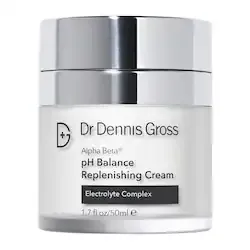
Dr Dennis Gross Alpha Beta pH Balance Replenishing Cream
Works for
1 of 2 advertised claims delivered
MoisturizingLinoleic acid, Manganese pca + 27 moreStrong evidence
“A lightweight gel cream that adapts to your skin's needs to deliver up to 24-hour hydration, balance and restore skin, and visibly calm redness.”
This product can help improve hydration of the skin with the two types of ingredients.
The first type is called “humectants”:
these ingredients help attract water.
When humectants are on the surface of the skin, they “pull in” the moisture from the outside environment, or from
within deeper layers of the skin. The following ingredients in this product do the job:
copper pca, glycerin.
This product also contains ingredients called “occlusives”. They help reduce the speed with which our skin loses moisture to the outside environment. These ingredients also help soften the upper layer of the skin, so it feels less tight and nicer to the touch. The following ingredients in this product do the job: caprylic/capric triglyceride, dimethicone.
The following ingredients in this product are especially good for supporting the skin barrier and helping with the hydration level: linoleic acid
Anti-blemishLinoleic acid, Zinc pca + 6 moreLimited evidence
“This clinically backed gel cream maintains your skin's natural pH balance to prevent sensitivity, breakouts, and dehydration.”
This product contains ingredients (glycolic acid, linoleic acid, zinc pca) that could help reduce blemishes and clogged pores in theory, but there is not enough evidence that they actually work.
Anti-agingNot advertised by the brand · Glycolic acid, Adenosine + 6 moreStrong evidence
This product can help reduce and prevent fine lines and wrinkles, improve skin elasticity and firmness because it contains adenosine, glycolic acid.
These ingredients in the product can also be helpful, even though there is less evidence for their effectiveness: centella asiatica extract.
Keep in mind that it typically takes at least 6 weeks to notice any results because the changes that are needed to improve fine lines and elasticity happen in the deeper layers of the skin. No topical anti-aging product can “erase” wrinkles or fully reverse signs of aging.
ExfoliationNot advertised by the brand · Glycolic acid, Lactic acid + 1 moreStrong evidence
This product can help exfoliate the skin. In other words, it helps break down the bonds between dead cells on the surface of the skin and speed up the skin turnover. Skin often appears softer and brighter after exfoliation, but overdoing it can result in disrupted skin barrier. The following ingredient is doing the exfoliating job in this product: glycolic acid.
Evens skin toneNot advertised by the brand · Glycolic acid, Hydrolyzed soy protein + 3 moreStrong evidence
This product can help reduce hypepigmentation and even out the skin tone because it contains the following effective ingredients: glycolic acid
Keep in mind that you would need to apply any topical skincare targetted at hypigmentation consistently for a couple of months to get a result. No topical skincare product can help get rid of hyperpigmentation (including post-acne marks and age spots) instantly.
Anti-oxidationNot advertised by the brand · Centella asiatica extract, Adenosine + 6 moreModerate evidence
This product contains antioxidants (centella asiatica extract) that might be able to help neutralize free radicals in skin to lessen the damage it gets from the UV light (sun). There is not enough evidence to confirm their effectiveness in skin though.
Can it cause trouble?
Irritancy1 strong irritant: Citrus sinensis fruit extractMedium risk
Comedogenic4 ingredients rated 2 or more on the 0–5 pore-clogging scale4 flagged


User reviews
Be the first — your take helps the next person decide.
Ingredients
Filter by role to see what each ingredient is doing.
Water~45–55%
Butylene glycol~5.4–6.6%
- Irritation risk
- Low
Used to create a nice product texture and help delivery of other ingredients. Might be somewhat helpful in attracting water to the upper layer of the skin
More about Butylene glycolC13-16 isoalkane~4.4–5.4%
- Irritation risk
- Low
Cetearyl alcohol~2.7–3.3%
- Irritation risk
- Low
- Comedogenicity
- 2/5
A non-drying alcohol. Works as an emollient. Helps water and oil mix together and creates a nice product texture
More about Cetearyl alcoholCaprylic/capric triglyceride~2.7–3.3%
- Irritation risk
- Medium
A good mix of fatty acids that forms a protective layer on the skin. Improves the shelf life of products. Derived from coconut and glycerin
More about Caprylic/capric triglycerideSodium acrylate/sodium acryloyldimethyl taurate copolymer~2–2.4%
- Irritation risk
- Low
Used to create a thicker product consistency
More about Sodium acrylate/sodium acryloyldimethyl taurate copolymerHeptyl undecylenate~1.8–2.2%
- Irritation risk
- Medium
Helps soften the upper layer of the skin, reduce water loss from the skin surface over time and create a nice product finish
More about Heptyl undecylenateGlyceryl behenate~1.4–1.7%
- Irritation risk
- Medium
Used to create a thicker product consistency and help soften the upper layer of the skin
More about Glyceryl behenateSaccharide isomerate~1.1–1.3%
- Irritation risk
- Low
Helps attract water to the upper layer of the skin
More about Saccharide isomerateMagnesium pca~0.75–1.15%
- Irritation risk
- Low
Helps attract water to the upper layer of the skin
More about Magnesium pcaManganese pca~0.6–0.9%
- Irritation risk
- Low
Helps attract water to the upper layer of the skin. Often used as a part of an ingredient complex Physiogenyl together with Sodium PCA, Magnesium PCA and Zinc PCA. The manufacturer claims that it does more than attracting water, but there is no evidence or studies supporting this claim
More about Manganese pcaPhytic acid~0.6–0.85%
- Irritation risk
- Medium
An alpha-hydroxy acid (AHA), but is mostly used to stabilize product formulations in cosmetics
More about Phytic acidSodium pca~0.55–0.85%
- Irritation risk
- Low
Naturally present in skin and helps to attract water to its upper layer
More about Sodium pcaLinoleic acid~0.65–0.95%
- Irritation risk
- Low
An excellent emollient. Helps soften the skin, restore its barrier function, and can help to calm down inflammation. It can be helpful to prevent blemishes and clogged pores
More about Linoleic acidPhospholipids~0.5–0.75%
- Irritation risk
- Low
Emollients that are naturaly present in skin. In addition, they help water and oil mix together in the product
More about PhospholipidsCopper pca~0.5–0.75%
- Irritation risk
- Low
Helps attract water to the upper layer of the skin
More about Copper pcaInonotus obliquus extract~0.45–0.65%
- Irritation risk
- Low
Lactic acid~0.4–0.6%
- Irritation risk
- Medium
An exfoliating and moisturizing alpha-hydroxy acid (AHA). Typically causes less irritation than other AHAs, for example, glycolic acid. At high concentrations (about 15%), lactic acid can help reduce lines and wrinkles. Recent studies show that lactic acid can support the "good" bacteria living on skin's surface (healthy skin microbiome)
More about Lactic acidSodium hyaluronate~0.35–0.65%
- Irritation risk
- Low
One of the best moisturizing ingredients. Attracts water into the upper layer of the skin
More about Sodium hyaluronateNiacinamide~0.3–0.6%
- Irritation risk
- Low
Is proven to be effective in reducing blemishes, evening out skin tone and helping to improve lines and wrinkles. It helps the skin to repair sun damage, calm down inflammation and keep maintain good levels of moisture. The concentration of about 2% is effective for supporting the skin barrier and evening out the skin tone. Concentration of 4-6% is better for helping with acne and balancing the sebum production
More about NiacinamideAloe barbadensis leaf juice~0.3–0.55%
- Irritation risk
- Medium
Traditionally used to treat sunburns, dermatitis and inflammation, but evidence for its effectiveness is lacking. The extract can contain humectants that help attract water into the skin
More about Aloe barbadensis leaf juiceBisabolol~0.25–0.5%
- Irritation risk
- Low
An active component of chamomile plant that historically has been used to calm down irritated skin. A recent study shows that bisabolol indeed can have some anti-inflammatory effect on skin, even though conclusive data is lacking. Bisabolol has a sweet floral scent and can be added to products for its aromatic properties
More about BisabololCentella asiatica extract~0.3–0.55%
- Irritation risk
- Medium
A plant extract that has been shown to be able to reduce inflammation in skin, support restoration of skin barrier function, as well as support collagen production. Contains active compounds called centelloids: asiaticoside, madecasosside, asiatic acid and madecassic acid. Might be helpful in preventing stretch marks. It can be itself be irritating though.
More about Centella asiatica extractPhytosterols~0.3–0.6%
- Irritation risk
- Medium
Lipids that work as an emollient and can be helpful in repairing skin barrier function
More about PhytosterolsAdenosine~0.25–0.5%
- Irritation risk
- Low
Might help improve cell turnover and reduce inflammation in skin. One study shows that the ingredients might be able to help reduce dynamic wrinkles (for example, in the corners of the eyes or on the forehead)
More about AdenosineSalicylic acid~0.25–0.45%
- Irritation risk
- High
Used for skin exfoliation. It has an anti-inflammatory and anti-bacterial effect, helps to unclog pores, prevent blemishes and speed up healing of the existing ones. Sometimes referred to as a BHA (beta-hydroxy acid)
More about Salicylic acidAloe barbadensis leaf extract~0.3–0.6%
- Irritation risk
- Medium
Traditionally used to treat sunburns, dermatitis and inflammation, but evidence for its effectiveness is lacking. The extract can contain humectants that help attract water into the skin
More about Aloe barbadensis leaf extractCaulerpa lentillifera extract~0.3–0.55%
- Irritation risk
- Low
Citrus sinensis fruit extract~0.25–0.45%
- Irritation risk
- High
Cocos nucifera fruit extract~0.3–0.55%
- Irritation risk
- Low
- Comedogenicity
- 3/5
An emollient. Found to be as effective as a moisturizer for dry skin as mineral oil. Could be comedogenic
More about Cocos nucifera fruit extractCitrullus lanatus fruit extract~0.25–0.5%
- Irritation risk
- Medium
A plant extract that can contain an antioxidant compound
More about Citrullus lanatus fruit extractMelia azadirachta leaf extract~0.25–0.5%
- Irritation risk
- High
A plant extract that has anti-bacterial properties. Can be used to preserve the product. Can be irritating
More about Melia azadirachta leaf extractMelia azadirachta flower extract~0.25–0.5%
- Irritation risk
- Medium
A plant extract that might be helpful to neutralize free radicals in skin
More about Melia azadirachta flower extractHydrolyzed soy protein~0.3–0.55%
- Irritation risk
- Low
Helps attract water to the upper layer of the skin. Might have some anti-aging, anti-oxidant, and skin lightening properties, but solid evidence is missing
More about Hydrolyzed soy proteinZinc pca~0.3–0.55%
- Irritation risk
- Low
A compound that combines zinc with a hydrating ingredient PCA. Might to be helpful against acne and clogged pores. Can help calm down inflammation in skin. Could be helpful in reducing the formation of free radicals in skin. Might help to reduce fine lines in wrinkles, but solid evidence is missing
More about Zinc pcaGlycolic acid~0.3–0.6%
- Irritation risk
- High
An alpha-hydroxy acid (AHA) that helps to remove the dead skin cells on the surface of the skin reveling a more even, smoother complexation. It is also able to stimulate collagen production with long-term use. Could help to reduce pore congestion. It can be irritating to the skin. Apply sunscreen daily if using products with glycolic acid
More about Glycolic acidGlycerin~0.35–0.65%
- Irritation risk
- Low
One of the best moisturizing ingredients. Naturally present in skin. It attracts water to the upper layer of the skin working as a humectant
More about GlycerinPentylene glycol~0.4–0.6%
- Irritation risk
- Medium
Used to preserve products, dissolve other ingredients and create a nice product texture
More about Pentylene glycolEthylhexylglycerin~0.3–0.6%
Stearyl dimethicone~0.35–0.6%
- Irritation risk
- Low
Helps soften the upper layer of the skin
More about Stearyl dimethiconeDimethicone~0.4–0.65%
- Irritation risk
- Low
A silicone that helps to reduce water loss from the surface of the skin. Can temporarily "fill in" lines and wrinkles, absorb oil, and create a nice product finish
More about DimethiconeDimethicone crosspolymer-3~0.3–0.55%
- Irritation risk
- Low
Polyglyceryl-10 laurate~0.3–0.6%
- Irritation risk
- Medium
Helps water and oil mix together
More about Polyglyceryl-10 laurateHydrogenated lecithin~0.3–0.6%
- Irritation risk
- Low
Helps to retain moisture by creating a protective barrier on the skin. Rich in fatty acids. Improves product texture and helps with the penetration of other ingredients.
More about Hydrogenated lecithinIsohexadecane~0.45–0.65%
- Irritation risk
- Low
Improves the texture of the product and helps soften the skin. Helps oil and water mix together and can be used as a cleansing agent
More about IsohexadecanePotassium cetyl phosphate~0.35–0.6%
- Irritation risk
- Medium
Helps oil and water mix together
More about Potassium cetyl phosphateIsododecane~0.3–0.5%
- Irritation risk
- Low
An emollient that helps soften the skin and can decrease moisture loss. Helps create a nice product texture
More about IsododecaneOctadecene~0.2–0.4%
- Irritation risk
- Low
Potassium chloride~0.2–0.4%
- Irritation risk
- Low
Sodium chloride~0.25–0.45%
- Irritation risk
- Low
Used to stabilize mixtures of oil and water, and create thicker, gel-like product textures
More about Sodium chlorideCalcium chloride~0.2–0.4%
- Irritation risk
- Medium
Helps create a thicker product consistency. Might be irritating
More about Calcium chlorideTocopherol~0.2–0.4%
- Irritation risk
- Low
Pure form of vitamin E. Can help moisturise and protect the skin from free radicals. Often used to help stabilise other ingredients or the formula itself
More about TocopherolCeteareth-20~0.3–0.55%
- Irritation risk
- Medium
- Comedogenicity
- 2/5
Helps oil and water mix together. Has some emollient properties
More about Ceteareth-20Sorbitan oleate~0.2–0.35%
- Irritation risk
- Medium
- Comedogenicity
- 2/5
Helps oil and water mix together
More about Sorbitan oleatePolysorbate 80~0.2–0.35%
Sodium hydroxide~0.15–0.3%
Sodium bicarbonate~0.25–0.45%
Sodium citrate~0.1–0.25%
- Irritation risk
- Medium
Helps to control the skin's pH level. Maintains the skin's natural film of amino-lactic acids and oils. Helps to preserve products
More about Sodium citrateCitric acid~0.1–0.2%
- Irritation risk
- Medium
Can work as an exfoliant but is typically used to adjust the product pH
More about Citric acidPhenoxyethanol~0.15–0.25%
- Irritation risk
- Low
A preservative. It helps prevent bacterial growth in cosmetic products
More about PhenoxyethanolBenzyl alcohol~0.1–0.2%
- Irritation risk
- High
A preservative. Can be used to mask unpleasant smell. Can be irritating
More about Benzyl alcoholSodium benzoate~0.1–0.2%
Potassium sorbate~0.1–0.2%
Ingredient list view
Water, Butylene glycol, C13-16 isoalkane, Cetearyl alcohol, Caprylic/capric triglyceride, Sodium acrylate/sodium acryloyldimethyl taurate copolymer, Heptyl undecylenate, Glyceryl behenate, Saccharide isomerate, Magnesium pca, Manganese pca, Phytic acid, Sodium pca, Linoleic acid, Phospholipids, Copper pca, Inonotus obliquus extract, Lactic acid, Sodium hyaluronate, Niacinamide, Aloe barbadensis leaf juice, Bisabolol, Centella asiatica extract, Phytosterols, Adenosine, Salicylic acid, Aloe barbadensis leaf extract, Caulerpa lentillifera extract, Citrus sinensis fruit extract, Cocos nucifera fruit extract, Citrullus lanatus fruit extract, Melia azadirachta leaf extract, Melia azadirachta flower extract, Hydrolyzed soy protein, Zinc pca, Glycolic acid, Glycerin, Pentylene glycol, Ethylhexylglycerin, Stearyl dimethicone, Dimethicone, Dimethicone crosspolymer-3, Polyglyceryl-10 laurate, Hydrogenated lecithin, Isohexadecane, Potassium cetyl phosphate, Isododecane, Octadecene, Potassium chloride, Sodium chloride, Calcium chloride, Tocopherol, Ceteareth-20, Sorbitan oleate, Polysorbate 80, Sodium hydroxide, Sodium bicarbonate, Sodium citrate, Citric acid, Phenoxyethanol, Benzyl alcohol, Sodium benzoate, Potassium sorbate
Compare prices
Retailers ranked by price — lowest first.

Worth comparing, line by line.
Match % combines shared ingredients, the first five ingredients, shared actives and hero ingredients, irritancy (lower counts in the alternative's favour), texture and body area. Only products in the same routine step are compared.
| Dr Dennis GrossAlpha Beta pH Balance Replenishing CreamYOUR PRODUCT | Paula's choiceInvisible Finish Moisture Gel | SCINICHyaluronic Acid Soothing Stick | Colleen Rothschild BeautyWeightless Moisturizer | |
|---|---|---|---|---|
| Match | — | 71% | 65% | 64% |
| Price | $59.78 | $38.81−$20.97 | $14.72−$45.06 | — |
| Shared key ingredients | — | 4 of 23 | 6 of 23 | 6 of 23 |
| Key difference | — | Oatmeal Extract | Madecassoside | Tetrahexyldecyl Ascorbate |
| Irritancy | Medium | Low | Medium | Low |
| Drying alcohol | — | — | — | — |
| View product | Shop | Shop | Shop |
Sources cited in this review
Every concentration estimate and effectiveness label is anchored to one of these 41 studies and safety reviews.
- 1Cosmetic and dermatologic use of alpha hydroxy acidsonlinelibrary.wiley.com
- 2
- 3
- 4
- 5Epidermal and dermal effects of topical lactic acidncbi.nlm.nih.gov
- 6Dual Effects of Alpha-Hydroxy Acids on the Skinpdfs.semanticscholar.org

Affiliate links · As an Amazon Associate, WIMJ earns from qualifying purchases.