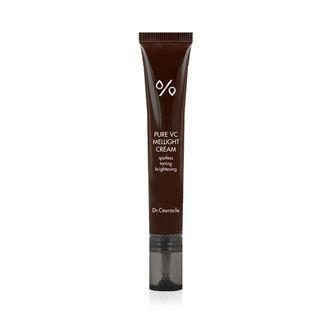
Dr. Ceuracle Pure VC Mellight Cream NEW
Works for
3 of 3 advertised claims delivered
Moisturizing24 ingredients credited for this claimStrong support
“Pure VC Mellight Cream NEW”
This product can help improve hydration of the skin with the two types of ingredients.
The first type is called “humectants”:
these ingredients help attract water.
When humectants are on the surface of the skin, they “pull in” the moisture from the outside environment, or from
within deeper layers of the skin. The following ingredients in this product do the job:
algae extract, arginine.
This product also contains ingredients called “occlusives”. They help reduce the speed with which our skin loses moisture to the outside environment. These ingredients also help soften the upper layer of the skin, so it feels less tight and nicer to the touch. The following ingredients in this product do the job: arginine, butyrospermum parkii butter.
The following ingredients in this product are especially good for supporting the skin barrier and helping with the hydration level: ceramide np
Evens skin tone4 ingredients credited for this claimStrong support
“Pure Vitamin C powder and Vitamin Tree extract with anti-pigmentation effect effectively improve complexion.”
This product can help reduce hypepigmentation and even out the skin tone because it contains the following effective ingredients: glutathione, tranexamic acid
The following ingredient (ingredients) in this product might be helpful, but there is no evidence to confirm that it actually can help even out the skin tone: glycyrrhiza glabra root extract.
Keep in mind that you would need to apply any topical skincare targetted at hypigmentation consistently for a couple of months to get a result. No topical skincare product can help get rid of hyperpigmentation (including post-acne marks and age spots) instantly.
Anti-aging6 ingredients credited for this claimModerate support
“Moisturizes and rejuvenates skin while strengthening skin barrier to protect it against free radicals and skin aging. Skin irritation test completed.”
This product contains hydroxydecyl ubiquinone. This ingredient might be able to help reduce and prevent fine lines and wrinkles, improve skin elasticity and firmness, but there is not enough evidence that it actually works.
Anti-oxidationNot advertised by the brand · 15 ingredients credited for this claimStrong support
This product contains antioxidants (glutathione, hydroxydecyl ubiquinone) that can help neutralize free radicals in skin. By doing so, they can lessen the damage the skin gets from the UV light (sun).
The following ingredients - ficus carica fruit extract also can have an antioxidant effect, but there is less evidence to confirm their effectiveness in skin.
Can it cause trouble?
Irritancy6 strong irritants: Eclipta prostrata leaf extract, Ocimum sanctum leaf extract + 4 more — patch-test recommendedHigh risk
Comedogenic5 ingredients rated 2 or more on the 0–5 pore-clogging scale5 flagged


User reviews
Be the first — your take helps the next person decide.
Ingredients
Filter by role to see what each ingredient is doing.
Hippophae rhamnoides fruit extract~22–33%
- Irritation risk
- Medium
A plant extract that might help neutralize free radicals in skin, but research on its effectiveness is lacking
More about Hippophae rhamnoides fruit extractButyrospermum parkii butter~4.4–6.6%
- Irritation risk
- Low
- Comedogenicity
- 3/5
A great moisturising ingredient that softens the skin and reduces water loss from its upper layer. It also can be helpful in protecting skin from free radicals
More about Butyrospermum parkii butterSqualane~5–7.5%
- Irritation risk
- Low
An oil naturally present in skin. Works as an emollient to soften the skin and form a protective layer on its surface without a greasy feeling.
More about SqualaneVegetable oil~4–6%
- Irritation risk
- Low
An oil from a mixture of different vegetables. Helps soften the upper layer of the skin
More about Vegetable oilDicaprylyl ether~3–4.6%
- Irritation risk
- Low
Helps soften the upper layer of the skin while creating a non-greasy feel on the skin. Helps to dissolve other ingredients
More about Dicaprylyl etherCyclohexasiloxane~2.3–3.4%
- Irritation risk
- Low
A silicone that serves as an emollient. Helps create a nice non-greasy feels
More about CyclohexasiloxanePropanediol~1.7–2.5%
- Irritation risk
- Low
Acts as a solvent for other ingredients. Speeds up the absorption of other ingredients into the skin
More about PropanediolPotassium cetyl phosphate~1.3–1.9%
- Irritation risk
- Medium
Helps oil and water mix together
More about Potassium cetyl phosphateGlycereth-26~1–1.5%
Cetearyl alcohol~0.95–1.45%
- Irritation risk
- Low
- Comedogenicity
- 2/5
A non-drying alcohol. Works as an emollient. Helps water and oil mix together and creates a nice product texture
More about Cetearyl alcoholPolyglycerin-3~0.5–1.2%
- Irritation risk
- Low
Helps to attract water to the upper layer of the skin
More about Polyglycerin-3Glyceryl stearate se~0.45–1%
- Irritation risk
- Low
- Comedogenicity
- 2/5
Used to stabilize the product formulations and works as an emollient
More about Glyceryl stearate seCaprylic/capric triglyceride~0.45–1.05%
- Irritation risk
- Medium
A good mix of fatty acids that forms a protective layer on the skin. Improves the shelf life of products. Derived from coconut and glycerin
More about Caprylic/capric triglycerideBehenyl alcohol~0.4–1%
- Irritation risk
- Low
Non-drying alcohol that helps water and oil mix together. Also serves as an emollient
More about Behenyl alcoholAlgae extract~0.4–0.95%
- Irritation risk
- Low
- Comedogenicity
- 3/5
Plant extract that helps the skin to attract water and make it more smooth for touch. Also shows promise of anti-aging properties, but research is not extensive yet
More about Algae extractEclipta prostrata leaf extract~0.35–0.8%
- Irritation risk
- High
A plant extract that is mostly used as a fragrance. Might have some anti-oxidant effect
More about Eclipta prostrata leaf extractCentella asiatica extract~0.35–0.85%
- Irritation risk
- Medium
A plant extract that has been shown to be able to reduce inflammation in skin, support restoration of skin barrier function, as well as support collagen production. Contains active compounds called centelloids: asiaticoside, madecasosside, asiatic acid and madecassic acid. Might be helpful in preventing stretch marks. It can be itself be irritating though.
More about Centella asiatica extractFicus carica fruit extract~0.2–0.8%
- Irritation risk
- Medium
A plant extract that can help neutralize free radicals. The concentrations typically used in cosmetics are too small to have an effect
More about Ficus carica fruit extractMelia azadirachta leaf extract~0.2–0.75%
- Irritation risk
- High
A plant extract that has anti-bacterial properties. Can be used to preserve the product. Can be irritating
More about Melia azadirachta leaf extractPhellodendron amurense bark extract~0.2–0.7%
- Irritation risk
- Medium
A plant extract that might have an anti-inflammatory effect
More about Phellodendron amurense bark extractMelia azadirachta flower extract~0.15–0.7%
- Irritation risk
- Medium
A plant extract that might be helpful to neutralize free radicals in skin
More about Melia azadirachta flower extractCurcuma longa root extract~0.15–0.65%
- Irritation risk
- High
A plant extract that can contain an active compound curcumin, that may have some anti-inflammatory properties when applied to the skin, but solid research is lacking and the typical concentration used in skincare products is too low. Can be an irritant
More about Curcuma longa root extractAcmella oleracea extract~0.15–0.65%
- Irritation risk
- Low
Glycyrrhiza glabra root extract~0.15–0.7%
- Irritation risk
- Medium
A plant extract that can help lighten the skin and calm down inflammation. Might be helpful in neutralizing free radicals
More about Glycyrrhiza glabra root extractOcimum sanctum leaf extract~0.15–0.65%
- Irritation risk
- High
A plant extract that is rich in a fragrance compound eugenol that is a frequent allergen and can be irritating. It might also contain anti-oxidants to help neutralize free radicals
More about Ocimum sanctum leaf extractCorallina officinalis extract~0.15–0.65%
- Irritation risk
- Low
- Comedogenicity
- 3/5
Red algae extract that helps attract water to the upper layer of the skin and might contain antioxidants
More about Corallina officinalis extractLupinus albus seed extract~0.15–0.65%
- Irritation risk
- Medium
A plant extract that helps soften the upper layer of the skin
More about Lupinus albus seed extractSodium hyaluronate~0.15–0.6%
- Irritation risk
- Low
One of the best moisturizing ingredients. Attracts water into the upper layer of the skin
More about Sodium hyaluronateLavandula angustifolia oil~0.15–0.65%
- Irritation risk
- High
An essential oil. Potential allergen and can be irritating. It has some anti-bacterial properties
More about Lavandula angustifolia oilHydrogenated lecithin~0.15–0.7%
- Irritation risk
- Low
Helps to retain moisture by creating a protective barrier on the skin. Rich in fatty acids. Improves product texture and helps with the penetration of other ingredients.
More about Hydrogenated lecithinCitrus aurantium bergamia fruit oil~0.15–0.6%
- Irritation risk
- High
A plant oil with a high content of volatile compounds that can irritate the skin and lead to allergic reactions. Can lead to photosensitivity
More about Citrus aurantium bergamia fruit oilRosmarinus officinalis leaf oil~0.15–0.65%
- Irritation risk
- High
A plant oil with high content of volatile compounds that can irritate the skin. Can be used as a fragrance. Has anti-bacterial properties and might help neutralize free radicals on the surface of the skin
More about Rosmarinus officinalis leaf oilHelianthus annuus seed oil~0.2–0.75%
- Irritation risk
- Low
A great emollient due to its high linoleic acid content. One of the most effective plant oils in helping skin hydration and repairing skin barrier function
More about Helianthus annuus seed oilChamomilla recutita flower oil~0.15–0.65%
- Irritation risk
- High
Plant oil that can have healing and anti-inflammatory properties. It contains volatile compouunds that are potential allergens and can be irritating
More about Chamomilla recutita flower oilAnthemis nobilis flower oil~0.15–0.6%
- Irritation risk
- High
An essential oil that is used as a fragrance and can be irritating. It might have some anti-oxidant effect in skin
More about Anthemis nobilis flower oilHydrogenated palm glycerides citrate~0.2–0.8%
- Irritation risk
- Low
Helps soften the upper layer of the skin
More about Hydrogenated palm glycerides citrateAcrylates crosspolymer~0.15–0.65%
Arginine~0.15–0.6%
- Irritation risk
- Low
An amino acid that is naturally present in skin and helps keep it hydrated. When used together with AHAs, it can reduce their irritating effect on the skin
More about ArginineXanthan gum~0.15–0.65%
- Irritation risk
- Low
Used to create a thicker product consistency
More about Xanthan gumTranexamic acid~0.15–0.65%
- Irritation risk
- Low
An amino acid that is effective in reducing hyperpigmentation and evening out the skin tone. It can also help in skin barrier recovery. It is used to treat melasma, especially with injections and when taken orally
More about Tranexamic acidFructooligosaccharides~0.15–0.65%
- Irritation risk
- Low
Help attract water to the upper layer of the skin
More about FructooligosaccharidesAscorbic acid~0.15–0.6%
- Irritation risk
- High
The most well-researched antioxidant that works in skin. Helps neutralize free radicals supporting collagen production, helping to even out the skin tone and preventing early signs of aging
More about Ascorbic acidHydrolyzed hyaluronic acid~0.15–0.6%
- Irritation risk
- Low
One of the best moisturizing ingredients. Attracts water into the upper layer of the skin. A version of it is naturally present in skin
More about Hydrolyzed hyaluronic acidWater~0.15–0.6%
Ceramide np~0.2–0.75%
- Irritation risk
- Low
A type of lipid similar to ceramides naturally present in skin. Helps to soften the upper layer of the skin and supports the skin barrier function to keep it hydrated. Can help to prevent inflammation in skin
More about Ceramide npGlutathione~0.1–0.5%
- Irritation risk
- Medium
A peptide that can help neutralize free radicals in skin and reduce melanin production resulting in skin lightening effect and reduction in hyperpigmentation. It can also help attract moisture to the upper layer of the skin
More about GlutathioneFullerenes~0.1–0.45%
- Irritation risk
- Low
Hydroxydecyl ubiquinone~0.1–0.45%
- Irritation risk
- Medium
An analogue of coenzyme Q10 that has a lower molecular weight, which can improve its ability to penetrate the skin. It helps neutralize free radicals in skin, improves skin hydration and might be helpful agains fine lines and wrinkles. It can be an allergen
More about Hydroxydecyl ubiquinoneTocopherol~0.1–0.45%
- Irritation risk
- Low
Pure form of vitamin E. Can help moisturise and protect the skin from free radicals. Often used to help stabilise other ingredients or the formula itself
More about Tocopherol1,2-hexanediol~0.1–0.35%
Ethylhexylglycerin~0.1–0.3%
Ingredient list view
Hippophae rhamnoides fruit extract, Butyrospermum parkii butter, Squalane, Vegetable oil, Dicaprylyl ether, Cyclohexasiloxane, Propanediol, Potassium cetyl phosphate, Glycereth-26, Cetearyl alcohol, Polyglycerin-3, Glyceryl stearate se, Caprylic/capric triglyceride, Behenyl alcohol, Unknown, Algae extract, Eclipta prostrata leaf extract, Centella asiatica extract, Ficus carica fruit extract, Melia azadirachta leaf extract, Phellodendron amurense bark extract, Melia azadirachta flower extract, Curcuma longa root extract, Acmella oleracea extract, Glycyrrhiza glabra root extract, Unknown, Ocimum sanctum leaf extract, Corallina officinalis extract, Lupinus albus seed extract, Sodium hyaluronate, Lavandula angustifolia oil, Hydrogenated lecithin, Citrus aurantium bergamia fruit oil, Rosmarinus officinalis leaf oil, Helianthus annuus seed oil, Chamomilla recutita flower oil, Anthemis nobilis flower oil, Hydrogenated palm glycerides citrate, Unknown, Acrylates crosspolymer, Arginine, Xanthan gum, Tranexamic acid, Fructooligosaccharides, Ascorbic acid, Hydrolyzed hyaluronic acid, Water, Ceramide np, Glutathione, Fullerenes, Hydroxydecyl ubiquinone, Tocopherol, 1,2-hexanediol, Ethylhexylglycerin
Compare prices
Retailers ranked by price — lowest first.

Affiliate links · prices updated regularly
Worth comparing, line by line.
Match % combines shared ingredients, the first five ingredients, shared actives and hero ingredients, irritancy (lower counts in the alternative's favour), texture and body area. Only products in the same routine step are compared.
| Dr. CeuraclePure VC Mellight Cream NEWYOUR PRODUCT | numbuzinNo.2 Cica Ceramide Repair Cream | THE RAPUEZR3 Repair Enriched Cream | PhykologyBright Tomorrow Guardian Cream | |
|---|---|---|---|---|
| Match | — | 58% | 57% | 57% |
| Price | $11.27 | $16.10+$4.83 | $82.10+$70.83 | $28.00+$16.73 |
| Shared key ingredients | — | 8 of 18 | 10 of 18 | 8 of 18 |
| Key difference | — | Niacinamide | Tripeptide-1 | Beta-Glucan |
| Irritancy | High | Medium | High | Medium |
| Drying alcohol | — | Contains drying alcohol | — | — |
| View product | Shop | Shop | Shop |


Product summary
"Dr. Ceuracle - Pure VC Mellight Cream NEW" is a well-rounded moisturizing product. The formulation is based on a combination of good humectants and emollients. Both are needed to increase the skin hydration level. Algae extract, arginine, fructooligosaccharides, hydrolyzed hyaluronic acid and polyglycerin-3 in this product (humectants) attract water molecules to the upper layer of the skin (the water comes from the outside air or from the deeper layers of the skin if the air is dry). Emollients in this formulation (ceramide np, algae extract, arginine, butyrospermum parkii butter and helianthus annuus seed oil) help to reduce the moisture loss from the skin. They also soften the skin surface and relieve the feeling of dryness and tightness.
Ingredient callouts
- This product also contains Vitamin C (Ascorbic Acid). It can be an effective active for anti-aging and evening out the skin tone, but in this moisturizer it is used for stabilizing other ingredients in the formulation. In this concentration (0.15% - 0.60%) it cannot have a noticeable benefit for the skin.
- Another benefit is that this moisturizer contain ceramides (ceramide np 0.20% - 0.75%). Ceramides are an important part of our natural skin barrier. The Ceramides used in skincare are synthetic or come from plants. They help soften the skin and can help "fill the gaps" in the skin barrier, keeping the skin hydrated and resilient for longer.
Irritation risk
This moisturizer contains a bunch of common irritants, including ingredients that do not provide any known benefit for the skin. It might not be the best choice if your skin is sensitive. We assess the overall irritancy of this moisturizer to be high. For a detailed overview of all potential irritants: click here
You can see the detailed formula review with the breakdown of all actives in the product and the full ingredient list with estimated concentrations in the tables below.
Price
The product retails for 11.27$ in the United States.
For a detailed price comparison: click here.
Sources cited in this review
Every concentration estimate and effectiveness label is anchored to one of these 46 studies and safety reviews.
- 1Abundance of active ingredients in sea-buckthorn oilncbi.nlm.nih.gov
- 2
- 3
- 4Centella asiatica in cosmetologyncbi.nlm.nih.gov
- 5
- 6

Affiliate links · As an Amazon Associate, WIMJ earns from qualifying purchases.