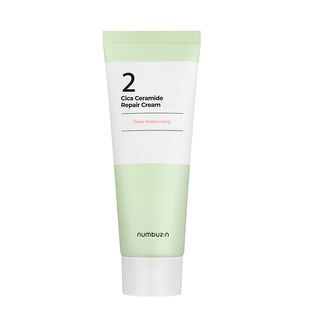
numbuzin No.2 Cica Ceramide Repair Cream
Works for
1 of 1 advertised claim delivered
Moisturizing35 ingredients credited for this claimStrong support
“No.2 Cica Ceramide Repair Cream”
This product can help improve hydration of the skin with the two types of ingredients.
The first type is called “humectants”:
these ingredients help attract water.
When humectants are on the surface of the skin, they “pull in” the moisture from the outside environment, or from
within deeper layers of the skin. The following ingredients in this product do the job:
fructooligosaccharides, glycerin.
This product also contains ingredients called “occlusives”. They help reduce the speed with which our skin loses moisture to the outside environment. These ingredients also help soften the upper layer of the skin, so it feels less tight and nicer to the touch. The following ingredients in this product do the job: butyrospermum parkii butter, caprylic/capric triglyceride.
The following ingredients in this product are especially good for supporting the skin barrier and helping with the hydration level: ceramide np, madecassoside, niacinamide, phytosphingosine
Anti-oxidationNot advertised by the brand · 9 ingredients credited for this claimStrong support
This product contains antioxidants (asiaticoside, madecassoside) that can help neutralize free radicals in skin. By doing so, they can lessen the damage the skin gets from the UV light (sun).
The following ingredients - centella asiatica extract, ficus carica fruit extract also can have an antioxidant effect, but there is less evidence to confirm their effectiveness in skin.
Anti-agingNot advertised by the brand · 6 ingredients credited for this claimStrong support
This product can help reduce and prevent fine lines and wrinkles, improve skin elasticity and firmness because it contains niacinamide.
These ingredients in the product can also be helpful, even though there is less evidence for their effectiveness: asiaticoside, centella asiatica extract, madecassoside.
Keep in mind that it typically takes at least 6 weeks to notice any results because the changes that are needed to improve fine lines and elasticity happen in the deeper layers of the skin. No topical anti-aging product can “erase” wrinkles or fully reverse signs of aging.
Evens skin toneNot advertised by the brand · 2 ingredients credited for this claimStrong support
This product can help reduce hypepigmentation and even out the skin tone because it contains the following effective ingredients: niacinamide
The following ingredient (ingredients) in this product might be helpful, but there is no evidence to confirm that it actually can help even out the skin tone: madecassoside.
Keep in mind that you would need to apply any topical skincare targetted at hypigmentation consistently for a couple of months to get a result. No topical skincare product can help get rid of hyperpigmentation (including post-acne marks and age spots) instantly.
Anti-blemishNot advertised by the brand · 4 ingredients credited for this claimStrong support
This product can help reduce breakouts and clogged pores because it contains the following ingredient: niacinamide. This ingredient is used for treating acne and can have a noticeable effect.
Can it cause trouble?
Irritancy2 strong irritants: Eclipta prostrata leaf extract, AlcoholMedium risk
Comedogenic5 ingredients rated 2 or more on the 0–5 pore-clogging scale5 flagged


User reviews
Be the first — your take helps the next person decide.
Ingredients
Filter by role to see what each ingredient is doing.
Water~45–55%
Glycerin~4.4–5.4%
- Irritation risk
- Low
One of the best moisturizing ingredients. Naturally present in skin. It attracts water to the upper layer of the skin working as a humectant
More about GlycerinButyrospermum parkii butter~4.2–5.1%
- Irritation risk
- Low
- Comedogenicity
- 3/5
A great moisturising ingredient that softens the skin and reduces water loss from its upper layer. It also can be helpful in protecting skin from free radicals
More about Butyrospermum parkii butterCetearyl alcohol~2.5–3%
- Irritation risk
- Low
- Comedogenicity
- 2/5
A non-drying alcohol. Works as an emollient. Helps water and oil mix together and creates a nice product texture
More about Cetearyl alcoholDipropylene glycol~2.2–2.7%
- Irritation risk
- Low
Helps to dissolve other ingredients in a formulation. Slows down the rate of product drying
More about Dipropylene glycolCaprylic/capric triglyceride~2–2.5%
- Irritation risk
- Medium
A good mix of fatty acids that forms a protective layer on the skin. Improves the shelf life of products. Derived from coconut and glycerin
More about Caprylic/capric triglycerideHydrogenated poly(c6-14 olefin)~1.7–2%
- Irritation risk
- Low
Helps soften the upper layer of the skin and create a nice product texture
More about Hydrogenated poly(c6-14 olefin)Methyl trimethicone~1.5–1.8%
- Irritation risk
- Low
A type of silicone that helps create a silky product finish and dissolve other ingredients
More about Methyl trimethicone1,2-hexanediol~0.75–1.15%
Niacinamide~1–1.2%
- Irritation risk
- Low
Is proven to be effective in reducing blemishes, evening out skin tone and helping to improve lines and wrinkles. It helps the skin to repair sun damage, calm down inflammation and keep maintain good levels of moisture. The concentration of about 2% is effective for supporting the skin barrier and evening out the skin tone. Concentration of 4-6% is better for helping with acne and balancing the sebum production
More about NiacinamideVegetable oil~0.75–1.15%
- Irritation risk
- Low
An oil from a mixture of different vegetables. Helps soften the upper layer of the skin
More about Vegetable oilPhenyl trimethicone~0.6–0.9%
- Irritation risk
- Low
A type of silicone that can decrease loss of moisture from the skin surface. It helps create a nice product texture
More about Phenyl trimethiconeHydrogenated polydecene~0.55–0.8%
- Irritation risk
- Low
Helps to soften the upper layer of the skin and create a nice product texture
More about Hydrogenated polydecenePalmitic acid~0.55–0.8%
- Irritation risk
- Low
An emollient that is naturally present in skin and helps soften it
More about Palmitic acidGlyceryl stearate se~0.5–0.7%
- Irritation risk
- Low
- Comedogenicity
- 2/5
Used to stabilize the product formulations and works as an emollient
More about Glyceryl stearate seCeramide np~0.5–0.75%
- Irritation risk
- Low
A type of lipid similar to ceramides naturally present in skin. Helps to soften the upper layer of the skin and supports the skin barrier function to keep it hydrated. Can help to prevent inflammation in skin
More about Ceramide npCentella asiatica extract~0.5–0.7%
- Irritation risk
- Medium
A plant extract that has been shown to be able to reduce inflammation in skin, support restoration of skin barrier function, as well as support collagen production. Contains active compounds called centelloids: asiaticoside, madecasosside, asiatic acid and madecassic acid. Might be helpful in preventing stretch marks. It can be itself be irritating though.
More about Centella asiatica extractMadecassoside~0.4–0.6%
- Irritation risk
- Medium
An antioxidant that is typically derived from plant Centella Asiatica. It can help neutralize free radicals in skin and support skin barrier function. It could, however, itself be irritating. It is often unstable in formulations
More about MadecassosideAsiaticoside~0.3–0.55%
- Irritation risk
- Medium
An active compound of Centella Asiatica plant extract. In combination with other active compounds of Centella Asiatica extract (madecasosside, asiatic acid and madecassic acid), asiaticoside has been shown to be helpful in wound-healing, restoring skin barrier function and supporting collagen production in skin. It can, however, itself be irritating
More about AsiaticosideMadecassic acid~0.3–0.55%
- Irritation risk
- Medium
An active compound of Centella Asiatica plant extract. In combination with other active compounds of Centella Asiatica extract (asiaticoside, madecasosside and asiatic acid), madecassic acid has been shown to be helpful in wound-healing, restoring skin barrier function and supporting collagen production in skin. It can, however, itself be irritating
More about Madecassic acidAsiatic acid~0.3–0.55%
- Irritation risk
- Medium
An active compound of Centella Asiatica plant extract. In combination with other active compounds of Centella Asiatica extract (asiaticoside, madecasosside and madecassic acid) asiatic acid has been shown to be helpful in wound-healing, restoring skin barrier function and supporting collagen production in skin. It can, however, itself be irritating
More about Asiatic acidFicus carica fruit extract~0.3–0.55%
- Irritation risk
- Medium
A plant extract that can help neutralize free radicals. The concentrations typically used in cosmetics are too small to have an effect
More about Ficus carica fruit extractLaminaria japonica extract~0.3–0.5%
- Irritation risk
- Low
- Comedogenicity
- 3/5
Seaweed extract that might help to attract water to the upper layer of the skin and have some anti-oxidant properties
More about Laminaria japonica extractEclipta prostrata leaf extract~0.25–0.5%
- Irritation risk
- High
A plant extract that is mostly used as a fragrance. Might have some anti-oxidant effect
More about Eclipta prostrata leaf extractAcmella oleracea extract~0.3–0.5%
- Irritation risk
- Low
Ulmus davidiana root extract~0.25–0.5%
- Irritation risk
- High
A plant root extract that helps attract water to the upper layer of the skin. It might have an anti-inflammatory effect and could help neturalize free radicals in skin
More about Ulmus davidiana root extractAmaranthus caudatus seed extract~0.25–0.5%
- Irritation risk
- Low
Hydrogenated lecithin~0.3–0.55%
- Irritation risk
- Low
Helps to retain moisture by creating a protective barrier on the skin. Rich in fatty acids. Improves product texture and helps with the penetration of other ingredients.
More about Hydrogenated lecithinSodium hyaluronate~0.25–0.5%
- Irritation risk
- Low
One of the best moisturizing ingredients. Attracts water into the upper layer of the skin
More about Sodium hyaluronateMacadamia integrifolia seed oil~0.3–0.55%
- Irritation risk
- Low
A plant oil that helps soften the upper layer of the skin
More about Macadamia integrifolia seed oilElaeis guineensis oil~0.3–0.55%
- Irritation risk
- Low
Helps soften the upper layer of the skin
More about Elaeis guineensis oilAdansonia digitata seed oil~0.3–0.55%
- Irritation risk
- Medium
Helps soften the upper layer of the skin
More about Adansonia digitata seed oilPersea gratissima oil~0.3–0.6%
- Irritation risk
- Medium
An emollient that helps soften the skin and could be helpful in repairing its barrier function
More about Persea gratissima oilStearic acid~0.45–0.65%
- Irritation risk
- Low
Helps oil and water mix together and works as an emollient
More about Stearic acidCetearyl olivate~0.3–0.55%
Sorbitan olivate~0.3–0.55%
Behenyl alcohol~0.35–0.6%
- Irritation risk
- Low
Non-drying alcohol that helps water and oil mix together. Also serves as an emollient
More about Behenyl alcoholC12-16 alcohols~0.3–0.55%
- Irritation risk
- Medium
Helps soften the upper layer of the skin and improve the product's texture
More about C12-16 alcoholsBisabolol~0.25–0.4%
- Irritation risk
- Low
An active component of chamomile plant that historically has been used to calm down irritated skin. A recent study shows that bisabolol indeed can have some anti-inflammatory effect on skin, even though conclusive data is lacking. Bisabolol has a sweet floral scent and can be added to products for its aromatic properties
More about BisabololSilica~0.4–0.65%
Microcrystalline cellulose~0.3–0.55%
Cetearyl glucoside~0.3–0.5%
- Irritation risk
- Medium
Helps water and oil in the product mix well together and improves product texture
More about Cetearyl glucosideButylene glycol~0.25–0.5%
- Irritation risk
- Low
Used to create a nice product texture and help delivery of other ingredients. Might be somewhat helpful in attracting water to the upper layer of the skin
More about Butylene glycolAmmonium acryloyldimethyltaurate/vp copolymer~0.25–0.45%
- Irritation risk
- Low
Increases thickness of a product. Texture enhancer for oil-in-water emulsions
More about Ammonium acryloyldimethyltaurate/vp copolymerGlyceryl polymethacrylate~0.3–0.5%
- Irritation risk
- Low
Used to create a nice product texture
More about Glyceryl polymethacrylateCellulose gum~0.25–0.5%
- Irritation risk
- Low
Used to create thicker product consistency and stabilize emulsions
More about Cellulose gumCholesterol~0.3–0.55%
- Irritation risk
- Low
An emollient that is naturally found in skin
More about CholesterolFructooligosaccharides~0.25–0.45%
- Irritation risk
- Low
Help attract water to the upper layer of the skin
More about FructooligosaccharidesDisodium edta~0.2–0.35%
Beta-glucan~0.2–0.35%
- Irritation risk
- Low
Helps attract water to the upper layer of the skin, calm down inflammation and irritation, restore the barrier function and support wound healing. It can be helpful in reducing fine lines and wrinkles
More about Beta-glucanMyristic acid~0.25–0.4%
- Irritation risk
- Medium
- Comedogenicity
- 3/5
Helps oil and water mix together. Could be comedogenic
More about Myristic acidHydrolyzed hyaluronic acid~0.15–0.3%
- Irritation risk
- Low
One of the best moisturizing ingredients. Attracts water into the upper layer of the skin. A version of it is naturally present in skin
More about Hydrolyzed hyaluronic acidGlucose~0.15–0.3%
- Irritation risk
- Low
Helps attract water to the upper layer of the skin. Could be helpful in restoring the skin barrier function
More about GlucoseAlcohol~0.15–0.25%
- Irritation risk
- High
Can be drying and contribute to skin irritation. Used in formulars to dissolve other ingredients, create a thinner product consistency or for its antibacterial properties
More about AlcoholPhytosphingosine~0.15–0.3%
- Irritation risk
- Low
A type of lipid that is naturally present in skin. It might help in repairing skin barrier function and has anti-bacterial effect
More about PhytosphingosineEthylhexylglycerin~0.1–0.15%
Ingredient list view
Water, Glycerin, Butyrospermum parkii butter, Cetearyl alcohol, Dipropylene glycol, Caprylic/capric triglyceride, Hydrogenated poly(c6-14 olefin), Methyl trimethicone, 1,2-hexanediol, Niacinamide, Vegetable oil, Phenyl trimethicone, Hydrogenated polydecene, Palmitic acid, Glyceryl stearate se, Ceramide np, Centella asiatica extract, Madecassoside, Asiaticoside, Madecassic acid, Asiatic acid, Ficus carica fruit extract, Laminaria japonica extract, Eclipta prostrata leaf extract, Acmella oleracea extract, Ulmus davidiana root extract, Amaranthus caudatus seed extract, Hydrogenated lecithin, Sodium hyaluronate, Macadamia integrifolia seed oil, Elaeis guineensis oil, Adansonia digitata seed oil, Persea gratissima oil, Stearic acid, Cetearyl olivate, Sorbitan olivate, Behenyl alcohol, C12-16 alcohols, Bisabolol, Silica, Microcrystalline cellulose, Cetearyl glucoside, Butylene glycol, Ammonium acryloyldimethyltaurate/vp copolymer, Glyceryl polymethacrylate, Cellulose gum, Cholesterol, Fructooligosaccharides, Disodium edta, Beta-glucan, Myristic acid, Hydrolyzed hyaluronic acid, Glucose, Alcohol, Phytosphingosine, Ethylhexylglycerin
Compare prices
Retailers ranked by price — lowest first.

Worth comparing, line by line.
Match % combines shared ingredients, the first five ingredients, shared actives and hero ingredients, irritancy (lower counts in the alternative's favour), texture and body area. Only products in the same routine step are compared.
| numbuzinNo.2 Cica Ceramide Repair CreamYOUR PRODUCT | TOSOWOONGCeramide Cream | PYUNKANG YULBlack Tea Enriched Cream | e.l.f. CosmeticsPure Skin Moisturizer | |
|---|---|---|---|---|
| Match | — | 88% | 83% | 81% |
| Price | $16.10 | $16.40 | $17.85+$1.75 | $11.81−$4.29 |
| Shared key ingredients | — | 12 of 21 | 14 of 21 | 7 of 21 |
| Key difference | — | Panthenol | Adenosine | Ceramide Eop |
| Irritancy | Medium | Medium | Medium | Low |
| Drying alcohol | Contains drying alcohol | Contains drying alcohol | — | — |
| View product | Shop | Shop | Shop |


Product summary
"numbuzin - No. 2 Cica Ceramide Repair Cream" is a well-rounded moisturizing product. The formulation is based on a combination of good humectants and emollients. Both are needed to increase the skin hydration level. Fructooligosaccharides, glycerin, hydrolyzed hyaluronic acid, sodium hyaluronate and glucose in this product (humectants) attract water molecules to the upper layer of the skin (the water comes from the outside air or from the deeper layers of the skin if the air is dry). Ceramide np, phytosphingosine, cholesterol, butyrospermum parkii butter and caprylic/capric triglyceride in this product help decrease the water evoporation from the skin, so that it stays hydrated for longer. These ingredients also soften the skin and take away the feeling of tightness and dryness.
Ingredient callouts
- Another benefit is that this moisturizer contain ceramides (phytosphingosine 0.15% - 0.30% and ceramide np 0.50% - 0.75%). Ceramides are an important part of our natural skin barrier. The Ceramides used in skincare are synthetic or come from plants. They help soften the skin and can help "fill the gaps" in the skin barrier, keeping the skin hydrated and resilient for longer.
- Actives derived from an extract of the Centella Asiatica plant (also known as Gotu Kola) - asiatic acid 0.30% - 0.55%, madecassic acid 0.30% - 0.55%, asiaticoside 0.30% - 0.55% and madecassoside 0.40% - 0.60% The Centella Asiatica Actives help strengthen and restore the skin barrier, decrease inflammation in skin and neutralize free radicals. They also can help to reduce scarring. The good news is that these actives work even in low concentrations.
Irritation risk
This formulation includes some common irritants, including ingredients that do not provide a benefit for the skin. We assess the overall irritancy of this moisturizer to be medium. For a detailed overview of all potential irritants: click here
You can see the detailed formula review with the breakdown of all actives in the product and the full ingredient list with estimated concentrations in the tables below.
Price
The product retails for 27.95A$ in Australia, from 16.10$ up to 27.00$ in the United States and for 32.71£ in the United Kingdom.
For a detailed price comparison: click here.
Sources cited in this review
Every concentration estimate and effectiveness label is anchored to one of these 44 studies and safety reviews.
- 1
- 2
- 3
- 4
- 5Safety Assessment of Polyene Group as Used in Cosmeticscir-safety.org
- 6

Affiliate links · As an Amazon Associate, WIMJ earns from qualifying purchases.