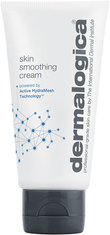
Dermalogica Skin Smoothing Cream
Works for
1 of 1 advertised claim delivered
Moisturizing25 ingredients credited for this claimStrong support
“Skin Smoothing Cream”
This product can help improve hydration of the skin with the two types of ingredients.
The first type is called “humectants”:
these ingredients help attract water.
When humectants are on the surface of the skin, they “pull in” the moisture from the outside environment, or from
within deeper layers of the skin. The following ingredients in this product do the job:
glycerin, saccharide isomerate.
This product also contains ingredients called “occlusives”. They help reduce the speed with which our skin loses moisture to the outside environment. These ingredients also help soften the upper layer of the skin, so it feels less tight and nicer to the touch. The following ingredients in this product do the job: caprylic/capric triglyceride, dimethicone.
The following ingredients in this product are especially good for supporting the skin barrier and helping with the hydration level: urea
Can it cause trouble?
Irritancy7 strong irritants: Arnica montana flower extract, Malva sylvestris flower extract + 5 more — patch-test recommendedHigh risk
Comedogenic2 ingredients rated 2 or more on the 0–5 pore-clogging scale2 flagged

User reviews
Ingredients
Filter by role to see what each ingredient is doing.
Water~45–55%
Caprylic/capric triglyceride~5.8–7.1%
- Irritation risk
- Medium
A good mix of fatty acids that forms a protective layer on the skin. Improves the shelf life of products. Derived from coconut and glycerin
More about Caprylic/capric triglycerideEthylhexyl hydroxystearate~4.3–5.2%
- Irritation risk
- Low
Helps soften the upper layer of the skin and reduce water loss from it
More about Ethylhexyl hydroxystearateStearic acid~2.9–3.5%
- Irritation risk
- Low
Helps oil and water mix together and works as an emollient
More about Stearic acidButylene glycol~2.3–2.8%
- Irritation risk
- Low
Used to create a nice product texture and help delivery of other ingredients. Might be somewhat helpful in attracting water to the upper layer of the skin
More about Butylene glycolGlycerin~2–2.4%
- Irritation risk
- Low
One of the best moisturizing ingredients. Naturally present in skin. It attracts water to the upper layer of the skin working as a humectant
More about GlycerinAloe barbadensis extract~1.6–1.9%
- Irritation risk
- Medium
Traditionally used to treat sunburns, dermatitis and inflammation, but evidence for its effectiveness is lacking. The extract can contain humectants that help attract water into the skin
More about Aloe barbadensis extractDimethicone~1.4–1.7%
- Irritation risk
- Low
A silicone that helps to reduce water loss from the surface of the skin. Can temporarily "fill in" lines and wrinkles, absorb oil, and create a nice product finish
More about DimethiconePeg-8~1–1.3%
- Irritation risk
- Medium
Used to create a nice product consistency
More about Peg-8Cetearyl alcohol~0.9–1.1%
- Irritation risk
- Low
- Comedogenicity
- 2/5
A non-drying alcohol. Works as an emollient. Helps water and oil mix together and creates a nice product texture
More about Cetearyl alcoholSodium hyaluronate~0.55–0.8%
- Irritation risk
- Low
One of the best moisturizing ingredients. Attracts water into the upper layer of the skin
More about Sodium hyaluronateVitis vinifera seed extract~0.5–0.75%
- Irritation risk
- Low
A plant extract that contains resveratrol and other anti-oxidant compounds that can help neutralize free radicals, reduce inflammation in skin and even out its tone. Can be also used to stabilize the product formulation
More about Vitis vinifera seed extractSaccharide isomerate~0.3–0.6%
- Irritation risk
- Low
Helps attract water to the upper layer of the skin
More about Saccharide isomerateCucumis sativus fruit extract~0.3–0.5%
- Irritation risk
- Medium
Might be somewhat helpful in reducing hyperpigmentation and neutralizing free radicals but its typical concentration in a product is too low for having an effect
More about Cucumis sativus fruit extractArnica montana flower extract~0.2–0.4%
- Irritation risk
- High
A plant extract that can be irritating. It can have some anti-bacterial properties, but there are no evidence of a beneficial effect for skin
More about Arnica montana flower extractHedera helix extract~0.2–0.4%
- Irritation risk
- High
A plant extract that has an anti-bacterial effect
More about Hedera helix extractMalva sylvestris flower extract~0.25–0.4%
- Irritation risk
- High
Used as a fragrance
More about Malva sylvestris flower extractParietaria officinalis extract~0.2–0.4%
- Irritation risk
- Low
Sambucus nigra flower extract~0.15–0.3%
- Irritation risk
- High
A plant extract that might help neutralize free radicals in skin
More about Sambucus nigra flower extractAscorbyl palmitate~0.15–0.3%
- Irritation risk
- Medium
Being a lipid soluble form of vitamin C, it is more stable and can penetrate the skin better than L-Ascorbic acid. It is effective in protecting the skin from free radicals, as well as evening the skin tone, but is less effective in stimulating collagen production compared to L-Ascorbic acid.
More about Ascorbyl palmitateTrehalose~0.15–0.3%
- Irritation risk
- Low
A sugar that attracts water to the upper layer of the skin
More about TrehaloseAlgin~0.15–0.3%
- Irritation risk
- Low
- Comedogenicity
- 3/5
Used to thicken product formulation. Can help attract water to the upper layer of the skin
More about AlginHydrolyzed sodium hyaluronate~0.1–0.2%
- Irritation risk
- Low
Attracts water into the upper layer of the skin
More about Hydrolyzed sodium hyaluronateSerine~0.1–0.2%
- Irritation risk
- Low
An amino-acid that helps to attract water to the upper layer of the skin. In combination with other amino-acids, might help to reduce fine lines and wrinkles
More about SerineLinoleic acid~0.25–0.45%
- Irritation risk
- Low
An excellent emollient. Helps soften the skin, restore its barrier function, and can help to calm down inflammation. It can be helpful to prevent blemishes and clogged pores
More about Linoleic acidPhospholipids~0.15–0.25%
- Irritation risk
- Low
Emollients that are naturaly present in skin. In addition, they help water and oil mix together in the product
More about PhospholipidsPhytosterols~0.15–0.3%
- Irritation risk
- Medium
Lipids that work as an emollient and can be helpful in repairing skin barrier function
More about PhytosterolsCananga odorata flower oil~0.1–0.2%
Urea~0.15–0.25%
- Irritation risk
- Low
Naturally present in skin (urea makes up about 7% of natural moisturizing factors in skin). Attracts water to the upper layer of the skin. Also has a positive effect on the skin barrier beyond the humectant action. Can enhance penetration of other ingredients. Is an exfoliating ingredient when used in high concentrations
More about UreaHydrogenated lecithin~0.15–0.25%
- Irritation risk
- Low
Helps to retain moisture by creating a protective barrier on the skin. Rich in fatty acids. Improves product texture and helps with the penetration of other ingredients.
More about Hydrogenated lecithinPullulan~0.15–0.3%
- Irritation risk
- High
Creates a thin drying film on the skin resulting in a short-term tightening effect
More about PullulanCaprylhydroxamic acid~0.15–0.25%
Citrus aurantium amara flower extract~0.15–0.25%
- Irritation risk
- High
Used as a fragrance for its citrus smell. Can be irritating
More about Citrus aurantium amara flower extractTocopheryl acetate~0.15–0.3%
- Irritation risk
- Medium
A more stable but less bio-available form of vitamin E compared to Tocopherol. Might help moisturize and protect the skin from free radicals, but mostly used in low concentrations to stabilize other ingredients.
More about Tocopheryl acetateTetrasodium glutamate diacetate~0.15–0.25%
- Irritation risk
- Low
Helps stabilize the product formulation
More about Tetrasodium glutamate diacetateHexanediol~0.15–0.3%
Glycol~0.15–0.25%
- Irritation risk
- Low
Glyceryl polyacrylate~0.15–0.3%
- Irritation risk
- Low
Helps to create a nice product texture and spread the product more easily on the skin
More about Glyceryl polyacrylateSodium citrate~0.15–0.25%
- Irritation risk
- Medium
Helps to control the skin's pH level. Maintains the skin's natural film of amino-lactic acids and oils. Helps to preserve products
More about Sodium citrateDisodium phosphate~0.15–0.3%
- Irritation risk
- Low
Helps adjust the product pH and stabilize the formulation
More about Disodium phosphatePalmitoyl hydroxypropyltrimonium amylopectin/glycerin crosspolymer~0.15–0.25%
Caprylyl glycol~0.15–0.3%
- Irritation risk
- Medium
Helps preserve products and creates a nice product texture
More about Caprylyl glycolPotassium phosphate~0.15–0.3%
Citric acid~0.15–0.25%
- Irritation risk
- Medium
Can work as an exfoliant but is typically used to adjust the product pH
More about Citric acidTocopherol~0.15–0.3%
- Irritation risk
- Low
Pure form of vitamin E. Can help moisturise and protect the skin from free radicals. Often used to help stabilise other ingredients or the formula itself
More about TocopherolMethylpropanediol~0.15–0.3%
Polysorbate 60~0.15–0.3%
Panthenol~0.15–0.25%
- Irritation risk
- Low
Helps attract water to the upper layer of the skin and can help improve skin barrier function
More about PanthenolPolyquaternium-10~0.15–0.3%
- Irritation risk
- Low
Helps soften the upper layer of the skin and create a nice product finish
More about Polyquaternium-10Cetyl alcohol~0.2–0.35%
- Irritation risk
- Low
A non-drying alcohol that works to soften the skin and stabilize product formulations helping oil and water mix together
More about Cetyl alcoholPeg-100 stearate~0.25–0.4%
- Irritation risk
- Low
Helps oil and water mix togehter and creates a nice product texture
More about Peg-100 stearateGlyceryl stearate~0.2–0.35%
- Irritation risk
- Low
An emollient that softens the skin and forms a protective layer on its surface. Helps water and oil mix together
More about Glyceryl stearateAminomethyl propanol~0.15–0.3%
Carbomer~0.15–0.3%
- Irritation risk
- Low
Helps create a thicker or gel-like product texture. It is not a surfactant but can be used in gentle cleansing formulations
More about CarbomerEthylhexylglycerin~0.15–0.3%
Sodium hydroxide~0.15–0.3%
Hydroxystearic acid~0.25–0.45%
Bht~0.1–0.2%
Benzyl benzoate~0.1–0.15%
- Irritation risk
- High
Fragrance with sweet balsamic smell. Help to preserve products and dissolve other ingredients. Could trigger allergic reactions and be irritating
More about Benzyl benzoateBenzyl salicylate~0.1–0.2%
Linalool~0.1–0.15%
Sodium benzoate~0.1–0.15%
Phenoxyethanol~0.1–0.2%
- Irritation risk
- Low
A preservative. It helps prevent bacterial growth in cosmetic products
More about PhenoxyethanolIngredient list view
Water, Caprylic/capric triglyceride, Ethylhexyl hydroxystearate, Stearic acid, Butylene glycol, Glycerin, Aloe barbadensis extract, Dimethicone, Peg-8, Cetearyl alcohol, Sodium hyaluronate, Vitis vinifera seed extract, Saccharide isomerate, Cucumis sativus fruit extract, Arnica montana flower extract, Hedera helix extract, Malva sylvestris flower extract, Parietaria officinalis extract, Sambucus nigra flower extract, Ascorbyl palmitate, Trehalose, Algin, Hydrolyzed sodium hyaluronate, Serine, Linoleic acid, Phospholipids, Phytosterols, Cananga odorata flower oil, Urea, Hydrogenated lecithin, Pullulan, Caprylhydroxamic acid, Citrus aurantium amara flower extract, Tocopheryl acetate, Tetrasodium glutamate diacetate, Hexanediol, Unknown, Glycol, Glyceryl polyacrylate, Sodium citrate, Disodium phosphate, Palmitoyl hydroxypropyltrimonium amylopectin/glycerin crosspolymer, Caprylyl glycol, Potassium phosphate, Citric acid, Tocopherol, Methylpropanediol, Polysorbate 60, Panthenol, Polyquaternium-10, Cetyl alcohol, Peg-100 stearate, Glyceryl stearate, Aminomethyl propanol, Carbomer, Ethylhexylglycerin, Sodium hydroxide, Hydroxystearic acid, Bht, Benzyl benzoate, Benzyl salicylate, Linalool, Sodium benzoate, Phenoxyethanol
Compare prices
Retailers ranked by price — lowest first.


Worth comparing, line by line.
Match % combines shared ingredients, the first five ingredients, shared actives and hero ingredients, irritancy (lower counts in the alternative's favour), texture and body area. Only products in the same routine step are compared.
| DermalogicaSkin Smoothing CreamYOUR PRODUCT | endota spaBlue Light Defence Hydro Cream | YEOUTHDay/Night Cream with Snail Extract, Hyaluronic Acid, Green Tea, Peptides | RevaleskinNight Cream | |
|---|---|---|---|---|
| Match | — | 54% | 53% | 51% |
| Price | $14.50 | $134.85+$120.35 | $24.95+$10.45 | $132.00+$117.50 |
| Shared key ingredients | — | 8 of 16 | 6 of 16 | 8 of 16 |
| Key difference | — | Fructose | Mineral Oil | Cholesterol |
| Irritancy | High | Medium | Medium | Medium |
| Drying alcohol | — | — | — | — |
| View product | Shop | Shop | Shop |


Product summary
"Dermalogica - Skin Smoothing Cream" is a well-rounded moisturizing product. As we expect from a proper moisturizer, the formula includes a combo of effective humectants and emollients. These are the two different types of ingredients that are essential for improving the skin hydration and supporting a healthy skin barrier. Urea, glycerin, saccharide isomerate, sodium hyaluronate and trehalose in this product (humectants) attract water molecules to the upper layer of the skin (the water comes from the outside air or from the deeper layers of the skin if the air is dry). Emollients in this formulation (phytosterols, caprylic/capric triglyceride, dimethicone, ethylhexyl hydroxystearate and cetearyl alcohol) help to reduce the moisture loss from the skin. They also soften the skin surface and relieve the feeling of dryness and tightness.
This product contains ingredients that could be beneficial, but their concentrations are too low in this formulation: panthenol, vitamin e and linoleic acidIrritation risk
This moisturizer contains a bunch of common irritants, including ingredients that do not provide any known benefit for the skin. It might not be the best choice if your skin is sensitive. We assess the overall irritancy of this moisturizer to be high. For a detailed overview of all potential irritants: click here
You can see the detailed formula review with the breakdown of all actives in the product and the full ingredient list with estimated concentrations in the tables below.
About the brand
According to Cruelty-Free Kitty "Dermalogica" is cruelty free, but its parent company is not.
Price
The product retails from 14.50$ up to 93.30$ in the United States, from 14.00£ up to 74.10£ in the United Kingdom, for 25.00A$ in Australia and from 24.00CA$ up to 61.00CA$ in Canada.
For a detailed price comparison: click here.
Sources cited in this review
Every concentration estimate and effectiveness label is anchored to one of these 25 studies and safety reviews.
- 1
- 2
- 3
- 4Final Report on the Safety Assessment of Dimethicone Copolyoljournals.sagepub.com
- 5Hyaluronic acid: A key molecule in skin agingncbi.nlm.nih.gov
- 6

Affiliate links · As an Amazon Associate, WIMJ earns from qualifying purchases.