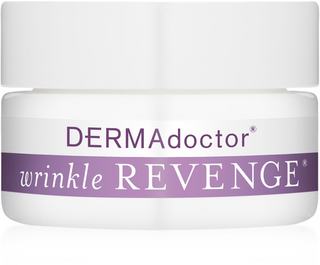
Dermadoctor Wrinkle Revenge Rescue & Protect Eye Balm
Works for
2 of 2 advertised claims delivered
Moisturizing20 ingredients credited for this claimStrong support
“Super hydrating eye balm enriched with peptides, caffeine, hyaluronic acid and antioxidants to improve the appearance of fine lines and wrinkles and helps the eye area feel refreshed, alert and youthful.”
This product can help improve hydration of the skin with the two types of ingredients.
The first type is called “humectants”:
these ingredients help attract water.
When humectants are on the surface of the skin, they “pull in” the moisture from the outside environment, or from
within deeper layers of the skin. The following ingredients in this product do the job:
cyclomethicone, glycerin.
This product also contains ingredients called “occlusives”. They help reduce the speed with which our skin loses moisture to the outside environment. These ingredients also help soften the upper layer of the skin, so it feels less tight and nicer to the touch. The following ingredients in this product do the job: caprylic/capric triglyceride, chondrus crispus extract.
The following ingredients in this product are especially good for supporting the skin barrier and helping with the hydration level: dipeptide-2, palmitoyl pentapeptide-4, palmitoyl tetrapeptide-7
Anti-aging8 ingredients credited for this claimModerate support
“Wrinkle Revenge Rescue & Protect Eye Balm”
This product contains dipeptide-2, palmitoyl pentapeptide-4, palmitoyl tetrapeptide-7, vitis vinifera seed extract. These ingredients might be able to help reduce and prevent fine lines and wrinkles, improve skin elasticity and firmness, but there is not enough evidence that it actually works.
Anti-oxidationNot advertised by the brand · 9 ingredients credited for this claimStrong support
This product contains antioxidants (superoxide dismutase, ubiquinone, vitis vinifera seed extract) that can help neutralize free radicals in skin. By doing so, they can lessen the damage the skin gets from the UV light (sun).
The following ingredients - camellia sinensis leaf extract also can have an antioxidant effect, but there is less evidence to confirm their effectiveness in skin.
Can it cause trouble?
Irritancy2 strong irritants: Nasturtium officinale extract, Retinyl palmitateMedium risk
Comedogenic4 ingredients rated 2 or more on the 0–5 pore-clogging scale4 flagged
User reviews
Be the first — your take helps the next person decide.
Ingredients
Filter by role to see what each ingredient is doing.
Water~45–55%
Caprylic/capric triglyceride~6.1–7.4%
- Irritation risk
- Medium
A good mix of fatty acids that forms a protective layer on the skin. Improves the shelf life of products. Derived from coconut and glycerin
More about Caprylic/capric triglyceridePalmitoyl pentapeptide-4~4.5–5.5%
- Irritation risk
- Low
A type of peptide. Peptides are excellent moisturizers and might be able support collagen production reducing fine lines and wrinkles
More about Palmitoyl pentapeptide-4Hesperidin methyl chalcone~3.1–3.8%
- Irritation risk
- High
Might help neutralize free radicals in skin. Is claimed to be able to improve the appearance of undereye darkness but evidence is missing. Can be an allergen and cause irritation
More about Hesperidin methyl chalconeSteareth-20~2.4–3%
Dipeptide-2~1.9–2.4%
- Irritation risk
- Low
A type of peptide. Peptides are excellent moisturizers and might be able support collagen production reducing fine lines and wrinkles
More about Dipeptide-2Palmitoyl tetrapeptide-7~1.7–2.1%
- Irritation risk
- Low
A type of peptide. Peptides are excellent moisturizers and might be able support collagen production reducing fine lines and wrinkles
More about Palmitoyl tetrapeptide-7Camellia sinensis leaf extract~1.4–1.7%
- Irritation risk
- Low
Can contain potent anti-oxidant compounds (abbreviated ECG, GCG, EGC, and EGCG) that might help protect the skin from free radicals. Can help calm down inflammation and has some anti-bacterial properties. Unfortunately, these antioxidants are unstable and lose their effectiveness very quickly in products. The concentration of the antioxidant compounds in the extract also tends to be low to be effective in topical formulation
More about Camellia sinensis leaf extractGlycerin~1.3–1.6%
- Irritation risk
- Low
One of the best moisturizing ingredients. Naturally present in skin. It attracts water to the upper layer of the skin working as a humectant
More about GlycerinMethyl gluceth-20~1–1.2%
- Irritation risk
- Low
Helps attract water to the upper layer of the skin and soften it
More about Methyl gluceth-20Cetyl alcohol~0.9–1.1%
- Irritation risk
- Low
A non-drying alcohol that works to soften the skin and stabilize product formulations helping oil and water mix together
More about Cetyl alcoholGlyceryl stearate~0.65–0.95%
- Irritation risk
- Low
An emollient that softens the skin and forms a protective layer on its surface. Helps water and oil mix together
More about Glyceryl stearateStearic acid~0.65–1%
- Irritation risk
- Low
Helps oil and water mix together and works as an emollient
More about Stearic acidPolyethylene~0.65–1%
Sodium stearoyl lactylate~0.45–0.7%
- Irritation risk
- Medium
Helps oil and water mix together
More about Sodium stearoyl lactylateCaffeine~0.45–0.65%
- Irritation risk
- Medium
Might be helpful in neutralizing free radicals. Can have a dehydration effect that might somewhat decrease the look of puffy eyes
More about CaffeineSodium hyaluronate~0.45–0.65%
- Irritation risk
- Low
One of the best moisturizing ingredients. Attracts water into the upper layer of the skin
More about Sodium hyaluronateSodium ascorbyl phosphate~0.4–0.6%
- Irritation risk
- Medium
A stable derivative of vitamin C. It is oil-soluble which means it is more likely to penetrate the skin compared to the pure form of vitamin C (which is water-soluble), but it is less bio-available and is way less effective in stimulating collagen and reducing wrinkles compared to the pure form of vitamin C (L-ascorbic acid) and its other derivatives (for example, magnesium ascorbyl phosphate). At the same time, this vitamin C derivative has been shown in studies to be effective in reducing acne, blemishes and clogged pores. It is less irritating then the pure form of vitamin C
More about Sodium ascorbyl phosphatePropylene glycol~0.3–0.6%
- Irritation risk
- High
Helps oil and water mix together and can enhance the penetration of other ingredients into the skin. It can be irritating
More about Propylene glycolMacrocystis pyrifera extract~0.3–0.55%
- Irritation risk
- Low
- Comedogenicity
- 3/5
Spirulina maxima extract~0.3–0.55%
- Irritation risk
- Low
- Comedogenicity
- 3/5
Fucus vesiculosus extract~0.3–0.5%
- Irritation risk
- Low
- Comedogenicity
- 3/5
Chondrus crispus extract~0.3–0.55%
- Irritation risk
- Low
- Comedogenicity
- 3/5
Red algae extract that helps attract water to the upper layer of the skin and create a nicer product consistency
More about Chondrus crispus extractNasturtium officinale extract~0.25–0.45%
- Irritation risk
- High
Used as a fragrance. Might have anti-oxidant properties
More about Nasturtium officinale extractCetraria islandica extract~0.35–0.6%
- Irritation risk
- Low
Vitis vinifera seed extract~0.3–0.55%
- Irritation risk
- Low
A plant extract that contains resveratrol and other anti-oxidant compounds that can help neutralize free radicals, reduce inflammation in skin and even out its tone. Can be also used to stabilize the product formulation
More about Vitis vinifera seed extractLecithin~0.3–0.55%
- Irritation risk
- Low
Used mostly for creating emulsions - helping oil and water mix together. Helps soften the upper layer of the skin
More about LecithinSuperoxide dismutase~0.25–0.5%
- Irritation risk
- Low
An antioxidant enzyme that is naturally present in skin. It can help support skin barrier function and reduce inflammation in skin. It is used in topical medications for inflammatory skin conditions including atopic dermatitis (eczema) and psoriasis. There are three types of natural Superoxide Dismutase in human skin. The compound used in topical treatments and cosmetics are mimics of typically one of these natural variants
More about Superoxide dismutaseButylene glycol~0.25–0.5%
- Irritation risk
- Low
Used to create a nice product texture and help delivery of other ingredients. Might be somewhat helpful in attracting water to the upper layer of the skin
More about Butylene glycolSaccharomyces lysate extract~0.25–0.5%
- Irritation risk
- Low
Helps attract water to the upper layer of the skin. Can have some anti-inflammatory effect
More about Saccharomyces lysate extractSqualane~0.3–0.6%
- Irritation risk
- Low
An oil naturally present in skin. Works as an emollient to soften the skin and form a protective layer on its surface without a greasy feeling.
More about SqualaneUbiquinone~0.25–0.5%
- Irritation risk
- Low
Coenzyme Q10. It helps neutralize free radicals in skin, improves skin hydration and might be helpful agains fine lines and wrinkles. It can be an allergen
More about UbiquinoneRetinyl palmitate~0.25–0.45%
- Irritation risk
- High
Three steps removed from the active form of vitamin A - retinoic acid. To have an effect in the skin, it first needs to be converted twice to become the retinoic acid. This means it is less potent than retinol, but could also be less irritating. Once converted to the retinoic acid in the skin, it helps against all signs of aging, improves skin cell turnover and helps fight blemishes and clogged pores. However, in many cosmetic formulations, it is used in a concentration that is too low to have the full effect
More about Retinyl palmitateTocopheryl acetate~0.3–0.5%
- Irritation risk
- Medium
A more stable but less bio-available form of vitamin E compared to Tocopherol. Might help moisturize and protect the skin from free radicals, but mostly used in low concentrations to stabilize other ingredients.
More about Tocopheryl acetateDimethicone~0.3–0.6%
- Irritation risk
- Low
A silicone that helps to reduce water loss from the surface of the skin. Can temporarily "fill in" lines and wrinkles, absorb oil, and create a nice product finish
More about DimethiconeCyclomethicone~0.3–0.5%
- Irritation risk
- Low
A type of silicone that leaves a nice silky finish on the skin and can help soften its upper layer
More about CyclomethiconeAcrylates/c10-30 alkyl acrylate crosspolymer~0.25–0.5%
- Irritation risk
- Medium
Maintains the texture of skincare products. Allows the product to spread evenly. Helps oil and water mix together
More about Acrylates/c10-30 alkyl acrylate crosspolymerCarbomer~0.25–0.45%
- Irritation risk
- Low
Helps create a thicker or gel-like product texture. It is not a surfactant but can be used in gentle cleansing formulations
More about CarbomerDisodium edta~0.25–0.45%
Polysorbate 20~0.25–0.5%
Ppg-2 myristyl ether propionate~0.2–0.35%
- Irritation risk
- Low
Aminomethyl propanol~0.2–0.4%
Phenoxyethanol~0.15–0.3%
- Irritation risk
- Low
A preservative. It helps prevent bacterial growth in cosmetic products
More about PhenoxyethanolMethylparaben~0.15–0.25%
Ethylparaben~0.15–0.3%
Propylparaben~0.15–0.3%
Butylparaben~0.1–0.25%
Isobutylparaben~0.1–0.2%
Ingredient list view
Water, Caprylic/capric triglyceride, Palmitoyl pentapeptide-4, Hesperidin methyl chalcone, Steareth-20, Dipeptide-2, Palmitoyl tetrapeptide-7, Camellia sinensis leaf extract, Glycerin, Methyl gluceth-20, Cetyl alcohol, Glyceryl stearate, Stearic acid, Polyethylene, Sodium stearoyl lactylate, Caffeine, Sodium hyaluronate, Sodium ascorbyl phosphate, Propylene glycol, Macrocystis pyrifera extract, Spirulina maxima extract, Fucus vesiculosus extract, Chondrus crispus extract, Nasturtium officinale extract, Cetraria islandica extract, Vitis vinifera seed extract, Unknown, Lecithin, Superoxide dismutase, Butylene glycol, Saccharomyces lysate extract, Squalane, Ubiquinone, Retinyl palmitate, Tocopheryl acetate, Dimethicone, Cyclomethicone, Acrylates/c10-30 alkyl acrylate crosspolymer, Carbomer, Disodium edta, Polysorbate 20, Ppg-2 myristyl ether propionate, Aminomethyl propanol, Phenoxyethanol, Methylparaben, Ethylparaben, Propylparaben, Butylparaben, Isobutylparaben
Compare prices
Retailers ranked by price — lowest first.


Product summary
"Dermadoctor - Wrinkle Revenge Rescue & Protect Eye Balm" is a well-rounded moisturizing product. The formulation is based on a combination of good humectants and emollients. Both are needed to increase the skin hydration level. Humectants in this product (cyclomethicone, glycerin, saccharomyces lysate extract, sodium hyaluronate and methyl gluceth-20) help to increase the water content in the upper layer of the skin. (These ingredients do so by "capturing" water molecules from the outside air or from within the deeper layers of the skin). Emollients in this formulation (palmitoyl tetrapeptide-7, cyclomethicone, caprylic/capric triglyceride, chondrus crispus extract and dimethicone) help to reduce the moisture loss from the skin. They also soften the skin surface and relieve the feeling of dryness and tightness.
Ingredient callouts
- this moisturizer includes a form of retinoids (vitamin A) - retinyl palmitate 0.25% - 0.45%, but this type of vitamin A is not very effective. It could in theory help with fine lines and wrinkles, but the effect is most likely minimal.
- We like that this moisturizer contains peptides (palmitoyl tetrapeptide-7 1.70% - 2.10%, palmitoyl pentapeptide-4 4.50% - 5.50% and dipeptide-2 1.90% - 2.40%). There are many different kind of peptides and they are naturally present in our skin. They all are a combination of amino-acids. Some of them work as natural anti-biotics, promote wound-healing and production of collagen. The science is still not settled on how effective peptides in skincare are, but it is very likely that they have a benefit. Peptides might help restore the skin barrier and fight the signs of aging. At the very least, peptides work as humectants: they attract water to the upper layer of the skin and improve its hydration.
Irritation risk
This moisturizer contains some common irritants, including those without a benefit for the skin. We assess the overall irritancy of this moisturizer to be medium. For a detailed overview of all potential irritants: click here
You can see the detailed formula review with the breakdown of all actives in the product and the full ingredient list with estimated concentrations in the tables below.
About the brand
According to Cruelty-Free Kitty "Dermadoctor" is cruelty free and so is its parent company.
Price
The product retails for 50.00$ in the United States, for 66.68A$ in Australia and for 68.00CA$ in Canada.
For a detailed price comparison: click here.
Sources cited in this review
Every concentration estimate and effectiveness label is anchored to one of these 30 studies and safety reviews.
- 1Hesperidin methyl chalcone - a new cosmetic contact allergenncbi.nlm.nih.gov
- 2
- 3
- 4Hyaluronic acid: A key molecule in skin agingncbi.nlm.nih.gov
- 5
- 6

Affiliate links · As an Amazon Associate, WIMJ earns from qualifying purchases.