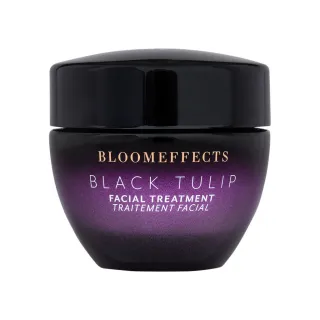
Bloomeffects Black Tulip Facial Treatment
Works for
3 of 3 advertised claims delivered
Anti-aging5 ingredients credited for this claimStrong support
“Malic and Lactic Acids combined with Pomegranate Enzymes help to brighten and even skin tone while powerful youth-preserving active ingredients Squalane, Niacinamide, Peptides and Saponaria Pumila and Orchid Stem Cells seal in moisture, plump skin and smooth fine lines and wrinkles for a restored youthful complexion.”
This product can help reduce and prevent fine lines and wrinkles, improve skin elasticity and firmness because it contains niacinamide.
These ingredients in the product can also be helpful, even though there is less evidence for their effectiveness: palmitoyl tripeptide-38.
Keep in mind that it typically takes at least 6 weeks to notice any results because the changes that are needed to improve fine lines and elasticity happen in the deeper layers of the skin. No topical anti-aging product can “erase” wrinkles or fully reverse signs of aging.
Evens skin tone4 ingredients credited for this claimStrong support
“Malic and Lactic Acids combined with Pomegranate Enzymes help to brighten and even skin tone while powerful youth-preserving active ingredients Squalane, Niacinamide, Peptides and Saponaria Pumila and Orchid Stem Cells seal in moisture, plump skin and smooth fine lines and wrinkles for a restored youthful complexion.”
This product can help reduce hypepigmentation and even out the skin tone because it contains the following effective ingredients: niacinamide
Keep in mind that you would need to apply any topical skincare targetted at hypigmentation consistently for a couple of months to get a result. No topical skincare product can help get rid of hyperpigmentation (including post-acne marks and age spots) instantly.
Moisturizing32 ingredients credited for this claimStrong support
“This botanically-enriched treatment with 31 extracts acts as a hydrating moisturizer, wipe-off mask, and luxurious night cream all-in-one to instantly revive and energize skin.”
This product can help improve hydration of the skin with the two types of ingredients.
The first type is called “humectants”:
these ingredients help attract water.
When humectants are on the surface of the skin, they “pull in” the moisture from the outside environment, or from
within deeper layers of the skin. The following ingredients in this product do the job:
avena sativa kernel flour, glycerin.
This product also contains ingredients called “occlusives”. They help reduce the speed with which our skin loses moisture to the outside environment. These ingredients also help soften the upper layer of the skin, so it feels less tight and nicer to the touch. The following ingredients in this product do the job: caprylic/capric triglyceride, helianthus annuus seed oil.
The following ingredients in this product are especially good for supporting the skin barrier and helping with the hydration level: ceramide np, niacinamide, palmitoyl tripeptide-38
Anti-oxidationNot advertised by the brand · 13 ingredients credited for this claimStrong support
This product contains antioxidants (dimethylmethoxy chromanol) that can help neutralize free radicals in skin. By doing so, they can lessen the damage the skin gets from the UV light (sun).
Anti-blemishNot advertised by the brand · 3 ingredients credited for this claimStrong support
This product can help reduce breakouts and clogged pores because it contains the following ingredient: niacinamide. This ingredient is used for treating acne and can have a noticeable effect.
Can it cause trouble?
Irritancy4 strong irritants: Hydrolyzed gardenia florida extract, Ocimum sanctum leaf extract + 2 more — patch-test recommendedHigh risk
Comedogenic2 ingredients rated 2 or more on the 0–5 pore-clogging scale2 flagged


User reviews
Be the first — your take helps the next person decide.
Ingredients
Filter by role to see what each ingredient is doing.
Water~45–55%
Squalane~4.9–5.9%
- Irritation risk
- Low
An oil naturally present in skin. Works as an emollient to soften the skin and form a protective layer on its surface without a greasy feeling.
More about SqualaneHydroxypropyl starch phosphate~3.9–4.7%
- Irritation risk
- Medium
Helps oil and water mix together and used to stabilize product formulations
More about Hydroxypropyl starch phosphatePentaerythrityl tetraisostearate~2.9–3.6%
- Irritation risk
- Medium
Used to create a thicker product consistency
More about Pentaerythrityl tetraisostearateGlycerin~2.5–3.1%
- Irritation risk
- Low
One of the best moisturizing ingredients. Naturally present in skin. It attracts water to the upper layer of the skin working as a humectant
More about GlycerinLauryl laurate~2–2.5%
- Irritation risk
- Medium
Helps soften the upper layer of the skin
More about Lauryl laurateNiacinamide~1.7–2.1%
- Irritation risk
- Low
Is proven to be effective in reducing blemishes, evening out skin tone and helping to improve lines and wrinkles. It helps the skin to repair sun damage, calm down inflammation and keep maintain good levels of moisture. The concentration of about 2% is effective for supporting the skin barrier and evening out the skin tone. Concentration of 4-6% is better for helping with acne and balancing the sebum production
More about NiacinamidePolyglyceryl-4 caprate~1.5–1.8%
Cetearyl alcohol~1.3–1.6%
- Irritation risk
- Low
- Comedogenicity
- 2/5
A non-drying alcohol. Works as an emollient. Helps water and oil mix together and creates a nice product texture
More about Cetearyl alcoholCaprylic/capric triglyceride~1.1–1.3%
- Irritation risk
- Medium
A good mix of fatty acids that forms a protective layer on the skin. Improves the shelf life of products. Derived from coconut and glycerin
More about Caprylic/capric triglycerideHydroxystearic/linolenic/oleic polyglycerides~0.9–1.1%
Coco-glucoside~0.75–1.1%
- Irritation risk
- High
Used as a cleansing agent (surfactant) in cleansers. Helps water and oil mix together in lotions. Can be irritating
More about Coco-glucosideCetyl alcohol~0.7–1.05%
- Irritation risk
- Low
A non-drying alcohol that works to soften the skin and stabilize product formulations helping oil and water mix together
More about Cetyl alcoholSodium stearoyl glutamate~0.65–0.95%
- Irritation risk
- Medium
Helps oil and water mix together
More about Sodium stearoyl glutamateLeuconostoc/radish root ferment filtrate~0.55–0.8%
- Irritation risk
- Medium
A preservative that comes from radishes fermented by a bacteria. New research suggests that the preservation properties in the ingredient come from an ammonium salt that is not present naturally in radish root but used in its cultivation. Is problematic because the exact amount of the preservative agents is difficult to determine
More about Leuconostoc/radish root ferment filtrateTulipa gesneriana flower extract~0.55–0.8%
- Irritation risk
- Low
Calanthe discolor extract~0.5–0.75%
- Irritation risk
- Low
Ceramide np~0.55–0.8%
- Irritation risk
- Low
A type of lipid similar to ceramides naturally present in skin. Helps to soften the upper layer of the skin and supports the skin barrier function to keep it hydrated. Can help to prevent inflammation in skin
More about Ceramide npPalmitoyl tripeptide-38~0.45–0.7%
- Irritation risk
- Low
A type of peptide. Peptides are excellent moisturizers and might be able support collagen production reducing fine lines and wrinkles
More about Palmitoyl tripeptide-38Sodium pca~0.45–0.65%
- Irritation risk
- Low
Naturally present in skin and helps to attract water to its upper layer
More about Sodium pcaLactic acid~0.4–0.6%
- Irritation risk
- Medium
An exfoliating and moisturizing alpha-hydroxy acid (AHA). Typically causes less irritation than other AHAs, for example, glycolic acid. At high concentrations (about 15%), lactic acid can help reduce lines and wrinkles. Recent studies show that lactic acid can support the "good" bacteria living on skin's surface (healthy skin microbiome)
More about Lactic acidMalic acid~0.4–0.65%
Sodium hyaluronate~0.35–0.65%
- Irritation risk
- Low
One of the best moisturizing ingredients. Attracts water into the upper layer of the skin
More about Sodium hyaluronatePrunus armeniaca kernel oil~0.45–0.65%
- Irritation risk
- Medium
An emollient that helps soften the skin
More about Prunus armeniaca kernel oilRubus chamaemorus seed oil~0.35–0.65%
- Irritation risk
- High
A berry extract that can have some anti-oxidant properties. It helps to preserve product formulations and improve their smell. It can be irritating
More about Rubus chamaemorus seed oilAdansonia digitata seed oil~0.4–0.65%
- Irritation risk
- Medium
Helps soften the upper layer of the skin
More about Adansonia digitata seed oilMoringa oleifera seed oil~0.4–0.65%
- Irritation risk
- Medium
A plant oil that helps soften the upper layer of the skin. Is unlikely to be helpful in restoring skin barrier function due to the low content of linoleic acid
More about Moringa oleifera seed oilEuterpe oleracea fruit oil~0.35–0.65%
- Irritation risk
- Medium
A plant oil that might help neutralize free radicals, but evidence of effectiveness in skin is lacking
More about Euterpe oleracea fruit oilJojoba oil/macadamia seed oil esters~0.35–0.65%
- Irritation risk
- Low
Helianthus annuus seed oil~0.45–0.65%
- Irritation risk
- Low
A great emollient due to its high linoleic acid content. One of the most effective plant oils in helping skin hydration and repairing skin barrier function
More about Helianthus annuus seed oilLecithin~0.45–0.65%
- Irritation risk
- Low
Used mostly for creating emulsions - helping oil and water mix together. Helps soften the upper layer of the skin
More about LecithinJojoba esters~0.45–0.65%
- Irritation risk
- Medium
An emollient made of jojoba oil. Helps soften the skin and support its barrier function
More about Jojoba estersAloe barbadensis leaf juice powder~0.35–0.65%
- Irritation risk
- Medium
Traditionally used to treat sunburns, dermatitis and inflammation, but evidence for its effectiveness is lacking. The extract can contain humectants that help attract water into the skin
More about Aloe barbadensis leaf juice powderOlea europaea fruit oil~0.4–0.6%
- Irritation risk
- Medium
An emollient that helps soften the skin but is not effective for restoring its barrier function. Might be helpful to calm down inflammation
More about Olea europaea fruit oilHelianthus annuus seed wax~0.4–0.65%
- Irritation risk
- Low
Helps soften the upper layer of the skin and support skin's barrier function while creating a thicker product consistency
More about Helianthus annuus seed waxPolyglycerin-3~0.4–0.6%
- Irritation risk
- Low
Helps to attract water to the upper layer of the skin
More about Polyglycerin-3Lactobacillus/punica granatum fruit ferment extract~0.35–0.65%
- Irritation risk
- High
An enzyme-based exfoliant
More about Lactobacillus/punica granatum fruit ferment extractAcacia decurrens flower wax~0.35–0.65%
Melia azadirachta leaf extract~0.35–0.65%
- Irritation risk
- High
A plant extract that has anti-bacterial properties. Can be used to preserve the product. Can be irritating
More about Melia azadirachta leaf extractChamomilla recutita flower extract~0.35–0.65%
- Irritation risk
- High
Plant extract that can have healing and anti-inflammatory properties. It is a potential allergen and can be irritating
More about Chamomilla recutita flower extractTocopherol~0.4–0.6%
- Irritation risk
- Low
Pure form of vitamin E. Can help moisturise and protect the skin from free radicals. Often used to help stabilise other ingredients or the formula itself
More about TocopherolMelia azadirachta flower extract~0.35–0.65%
- Irritation risk
- Medium
A plant extract that might be helpful to neutralize free radicals in skin
More about Melia azadirachta flower extractCorallina officinalis extract~0.35–0.65%
- Irritation risk
- Low
- Comedogenicity
- 3/5
Red algae extract that helps attract water to the upper layer of the skin and might contain antioxidants
More about Corallina officinalis extractGluconolactone~0.35–0.6%
- Irritation risk
- Medium
A polyhydroxy acid (PHA) that helps shed the dead cells from the skin surface revealing smoother skin. Is believed to be genter than AHAs. It helps attract water to the upper layer of the skin and can stimulate production of skin's own hyaluronic acid resulting in improved hydration levels. It has been shown to be helpful against acne and clogged pores if used consistently (e.g over a period of 12 weeks) in high enough concentration. It can help reduce fine lines and wrinkles and improve skin tone with long-term application. Can help neutralize free radicals
More about GluconolactoneCoccinia indica fruit extract~0.35–0.65%
- Irritation risk
- Medium
A plant extract that might have some anti-oxidant effect helping neutralize free radicals in skin
More about Coccinia indica fruit extractAvena sativa kernel flour~0.45–0.7%
- Irritation risk
- Low
A type of colloidal oatmeal. Can contain potent antioxidants and anti-inflammatory compounds. Is effective in supporting skin barrier
More about Avena sativa kernel flourHydrolyzed gardenia florida extract~0.35–0.65%
- Irritation risk
- High
Used as a fragrance. Might have some anti-oxidant properties
More about Hydrolyzed gardenia florida extractSolanum melongena fruit extract~0.35–0.6%
- Irritation risk
- Medium
Eggplant fruit extract. Might have some anti-oxidant effect
More about Solanum melongena fruit extractAloe barbadensis flower extract~0.4–0.65%
- Irritation risk
- High
A plant extract that might have some anti-oxidant effect
More about Aloe barbadensis flower extractSaponaria pumila callus culture extract~0.35–0.6%
- Irritation risk
- Low
Curcuma longa root extract~0.3–0.6%
- Irritation risk
- High
A plant extract that can contain an active compound curcumin, that may have some anti-inflammatory properties when applied to the skin, but solid research is lacking and the typical concentration used in skincare products is too low. Can be an irritant
More about Curcuma longa root extractOcimum sanctum leaf extract~0.35–0.65%
- Irritation risk
- High
A plant extract that is rich in a fragrance compound eugenol that is a frequent allergen and can be irritating. It might also contain anti-oxidants to help neutralize free radicals
More about Ocimum sanctum leaf extractOcimum basilicum flower/leaf extract~0.35–0.65%
- Irritation risk
- High
Used as a fragrance. Canbe irritating
More about Ocimum basilicum flower/leaf extractPhytosterols~0.45–0.65%
- Irritation risk
- Medium
Lipids that work as an emollient and can be helpful in repairing skin barrier function
More about PhytosterolsPhytosteryl macadamiate~0.45–0.65%
- Irritation risk
- Low
Helps soften the upper layer of the skin
More about Phytosteryl macadamiateTocopherol~0.4–0.6%
- Irritation risk
- Low
Pure form of vitamin E. Can help moisturise and protect the skin from free radicals. Often used to help stabilise other ingredients or the formula itself
More about TocopherolKinetin~0.35–0.65%
- Irritation risk
- Low
Hydroxypropyl cyclodextrin~0.45–0.65%
- Irritation risk
- Medium
Used to stabilize product formulations and help soften the upper layer of the skin
More about Hydroxypropyl cyclodextrinDimethylmethoxy chromanol~0.35–0.65%
- Irritation risk
- Low
Can help neutralize free radicals in skin
More about Dimethylmethoxy chromanolCalcium gluconate~0.4–0.65%
- Irritation risk
- Low
Helps attract water to the upper layer of the skin and helps to improve appearance of the product
More about Calcium gluconateSodium gluconate~0.3–0.6%
Maltodextrin~0.35–0.6%
- Irritation risk
- Low
Used to stabilize the product formulation and can help absorb oil
More about MaltodextrinIsomalt~0.3–0.6%
- Irritation risk
- Low
Helps attract water to the upper layer of the skin
More about IsomaltPolyacrylate crosspolymer-6~0.3–0.55%
- Irritation risk
- Low
Xanthan gum~0.3–0.55%
- Irritation risk
- Low
Used to create a thicker product consistency
More about Xanthan gumSodium benzoate~0.25–0.45%
Sodium methyl stearoyl taurate~0.6–0.85%
Caprylhydroxamic acid~0.2–0.35%
Sodium hydroxide~0.15–0.3%
Benzyl alcohol~0.15–0.25%
- Irritation risk
- High
A preservative. Can be used to mask unpleasant smell. Can be irritating
More about Benzyl alcoholT-butyl alcohol~0.15–0.25%
- Irritation risk
- Medium
Used to dissolve other ingredients and to improve smell of products. It could be irritating
More about T-butyl alcoholAlcohol denat.~0.1–0.2%
- Irritation risk
- High
Produces temporary toning effect. Can help dissolve other ingredients or preserve products
More about Alcohol denat.Citric acid~0.1–0.15%
- Irritation risk
- Medium
Can work as an exfoliant but is typically used to adjust the product pH
More about Citric acidIngredient list view
Water, Squalane, Hydroxypropyl starch phosphate, Pentaerythrityl tetraisostearate, Glycerin, Lauryl laurate, Niacinamide, Polyglyceryl-4 caprate, Cetearyl alcohol, Caprylic/capric triglyceride, Hydroxystearic/linolenic/oleic polyglycerides, Coco-glucoside, Cetyl alcohol, Sodium stearoyl glutamate, Leuconostoc/radish root ferment filtrate, Tulipa gesneriana flower extract, Calanthe discolor extract, Ceramide np, Palmitoyl tripeptide-38, Sodium pca, Lactic acid, Malic acid, Sodium hyaluronate, Prunus armeniaca kernel oil, Rubus chamaemorus seed oil, Adansonia digitata seed oil, Moringa oleifera seed oil, Euterpe oleracea fruit oil, Jojoba oil/macadamia seed oil esters, Helianthus annuus seed oil, Lecithin, Jojoba esters, Aloe barbadensis leaf juice powder, Olea europaea fruit oil, Helianthus annuus seed wax, Polyglycerin-3, Lactobacillus/punica granatum fruit ferment extract, Acacia decurrens flower wax, Melia azadirachta leaf extract, Chamomilla recutita flower extract, Tocopherol, Melia azadirachta flower extract, Corallina officinalis extract, Gluconolactone, Coccinia indica fruit extract, Avena sativa kernel flour, Hydrolyzed gardenia florida extract, Solanum melongena fruit extract, Aloe barbadensis flower extract, Saponaria pumila callus culture extract, Curcuma longa root extract, Ocimum sanctum leaf extract, Ocimum basilicum flower/leaf extract, Phytosterols, Phytosteryl macadamiate, Tocopherol, Kinetin, Hydroxypropyl cyclodextrin, Dimethylmethoxy chromanol, Calcium gluconate, Sodium gluconate, Maltodextrin, Isomalt, Polyacrylate crosspolymer-6, Xanthan gum, Sodium benzoate, Sodium methyl stearoyl taurate, Caprylhydroxamic acid, Sodium hydroxide, Benzyl alcohol, T-butyl alcohol, Alcohol denat., Citric acid
Compare prices
Retailers ranked by price — lowest first.

Worth comparing, line by line.
Match % combines shared ingredients, the first five ingredients, shared actives and hero ingredients, irritancy (lower counts in the alternative's favour), texture and body area. Only products in the same routine step are compared.
| BloomeffectsBlack Tulip Facial TreatmentYOUR PRODUCT | Spectacle SkincarePerformance Crème | FaceGymSupreme Restructure Cream | Glowbiotics MDGlowbiotics Probiotic Ultra Rich Brightening Cream | |
|---|---|---|---|---|
| Match | — | 82% | 79% | 78% |
| Price | $94.00 | $100.47+$6.47 | $120.00+$26.00 | $66.00−$28.00 |
| Shared key ingredients | — | 9 of 23 | 11 of 23 | 8 of 23 |
| Key difference | — | Retinal | Hexapeptide-9 | Myristoyl Nonapeptide-3 |
| Irritancy | High | Medium | Medium | Medium |
| Drying alcohol | Contains drying alcohol | — | — | Contains drying alcohol |
| View product | Shop | Shop | Shop |


Product summary
"Bloomeffects - Black Tulip Facial Treatment" is effective for: Anti-aging, Moisturizing, Evens skin tone and Anti-blemish
Ingredient callouts
- A good concentration of Niacinamide (1.70% - 2.10%). Niacinamide is a well-studied multi-tasking active. It is stable, and can work well in almost any hydrating formulation. There is solid evidence that Niacinamide can help support skin barrier, regulate oil production and reduce acne and clogged pores. It also helps to fight photodamage and improve the skin tone, reducing pigmentation marks.
- This product contains acids (gluconolactone 0.35% - 0.60% and lactic acid 0.40% - 0.60%). Their concentration is low, and they will not have a strong exfoliating effect. Instead, they work to support the skin natural acid mantle and to attract water (as humectants). PHAs (gluconolactone) especially are great for improving skin hydration. They might be even able to stimulate the production of skin's natural humectants and support the healthy skin microbiome.
- Ceramides (ceramide np 0.55% - 0.80%). Ceramides are an important part of our natural skin barrier. The Ceramides used in skincare are synthetic or come from plants. They help soften the skin and can help "fill the gaps" in the skin barrier, keeping the skin hydrated and resilient for longer.
- Peptides (palmitoyl tripeptide-38 0.45% - 0.70%). There are many different kind of Peptides and they are naturally present in our skin. They all are a combination of aminoacids. Some of them work as natural antibiotics, promote wound-healing and production of collagen. The science is still not settled on how effective Peptides are in skincare, but it is very likely that they have a benefit. They might help restore the skin barrier and fight the signs of aging. At the very least, Peptides work as humectants: they attract water to the upper layer of the skin and improve its hydration.
- Humectants (isomalt 0.30% - 0.60%, avena sativa kernel flour 0.45% - 0.70%, polyglycerin-3 0.40% - 0.60%, sodium hyaluronate 0.35% - 0.65%, sodium pca 0.45% - 0.65% and glycerin 2.50% - 3.10%). These ingredients help attract water to the upper layer of the skin and improve the skin hydration.
Price
The product retails for 94.00$ in the United States.
For a detailed price comparison: click here.
Sources cited in this review
Every concentration estimate and effectiveness label is anchored to one of these 41 studies and safety reviews.
- 1
- 2
- 3
- 4
- 5
- 6Allergen of the Year—Alkyl Glucosidepracticeupdate.com

Affiliate links · As an Amazon Associate, WIMJ earns from qualifying purchases.