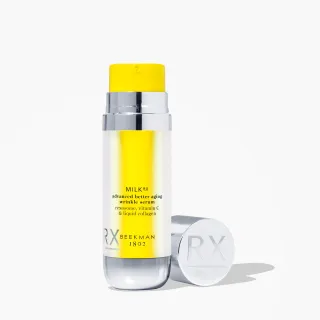
Beekman 1802 Milk RX Advanced Better Aging Wrinkle Serum

Beekman 1802 Milk RX Advanced Better Aging Wrinkle Serum

Efficacy75/100IrritancyMedium

Works for

Anti-aging
Hexapeptide-9, 3-o-ethyl ascorbic acid + 5 more
May help
What the product description says
“This breakthrough 2-in-1 formula is clinically proven to reduce fine lines and deep wrinkles—while brightening skin for a radiant, youthful glow.”
Source: Beekman

This product contains hexapeptide-9. This ingredient might be able to help reduce and prevent fine lines and wrinkles, improve skin elasticity and firmness, but there is not enough evidence that it actually works.

Hexapeptide-9Key activeEffect: MediumA type of peptide. Peptides are excellent moisturizers and might be able support collagen production reducing fine lines and wrinkles~0.15–0.3%
3-o-ethyl ascorbic acidEffect: LowA vitamin C derivative that is more stable but less potent than pure form of vitamin C. Can help neutralize free radicals and help reduce hyperpigmentation, but the required concentration is likely to be much higher than for the pure form of vitamin C, limiting the ingredient's effectiveness in products~1.6–2%
Nicotiana benthamiana hexapeptide-40 sh-polypeptide-76Effect: LowA fusion peptide that combines peptides produced by human and plant cells. It might have anti-aging effect in skin and can help the skin moisturization~0.15–0.3%
TocopherolEffect: Low, below effective dosePure form of vitamin E. Can help moisturise and protect the skin from free radicals. Often used to help stabilise other ingredients or the formula itself~0.25–0.45%
Phyllanthus emblica fruit extractEffect: Low, below effective doseA plant extract that might be helpful in neutralizing free radicals and have a skin lightening effect if used in high enough concentrations~0.25–0.4%
Ascorbyl palmitateEffect: Low, below effective doseBeing a lipid soluble form of vitamin C, it is more stable and can penetrate the skin better than L-Ascorbic acid. It is effective in protecting the skin from free radicals, as well as evening the skin tone, but is less effective in stimulating collagen production compared to L-Ascorbic acid.~0.15–0.25%
Tetrahexyldecyl ascorbateUnder-dosedBeing a lipid soluble form of vitamin C, it is more stable than ascorbic acid, but still degrades quickly and needs to be stabilized in a formulation with another ingredient. It is claimed to penetrate skin better than pure vitamin C and have the the similar benefits, but solid studies of its effectiveness are lacking. Is likely to require a higher concentration in a product than pure vitamin C to be effective. It might be able to help reduce pore clogging.~0.4–0.6%
Moisturizing
Side benefit · Ceramide ap, Ceramide as + 24 more
Works well

This product can help improve hydration of the skin with the two types of ingredients.

The first type is called “humectants”:
these ingredients help attract water. When humectants are on the surface of the skin, they “pull in” the moisture from the outside environment, or from within deeper layers of the skin. The following ingredients in this product do the job: diglycerin, glycerin.

This product also contains ingredients called “occlusives”. They help reduce the speed with which our skin loses moisture to the outside environment. These ingredients also help soften the upper layer of the skin, so it feels less tight and nicer to the touch. The following ingredients in this product do the job: caprylic/capric triglyceride, cholesterol.

The following ingredients in this product are especially good for supporting the skin barrier and helping with the hydration level: ceramide ap, ceramide as, ceramide eop, ceramide ns, hexapeptide-9

Ceramide apHero· EmollientEffect: HighA type of lipid similar to ceramides naturally present in skin. Helps to soften the upper layer of the skin and supports the skin barrier function to keep it hydrated. Can help to prevent inflammation in skin~0.25–0.5%
Ceramide asHeroEffect: HighA type of lipid similar to ceramides naturally present in skin. Helps to soften the upper layer of the skin and supports the skin barrier function to keep it hydrated. Can help to prevent inflammation in skin~0.25–0.4%
Ceramide nsHero· EmollientEffect: HighA type of lipid similar to ceramides naturally present in skin. Helps to soften the upper layer of the skin and supports the skin barrier function to keep it hydrated. Can help to prevent inflammation in skin~0.25–0.45%
Ceramide eopHero· EmollientEffect: HighA type of lipid similar to ceramides naturally present in skin. Helps to soften the upper layer of the skin and supports the skin barrier function to keep it hydrated. Can help to prevent inflammation in skin~0.15–0.25%
Hexapeptide-9Hero· HumectantEffect: HighA type of peptide. Peptides are excellent moisturizers and might be able support collagen production reducing fine lines and wrinkles~0.15–0.3%
Coco-caprylate/caprateKey active· EmollientEffect: MediumHelps to soften the upper layer of the skin without creating a greasy texture~4.2–5.1%
GlycerinKey active· HumectantEffect: HighOne of the best moisturizing ingredients. Naturally present in skin. It attracts water to the upper layer of the skin working as a humectant~2.4–3%
Caprylic/capric triglycerideKey active· Emollient, OcclusiveEffect: HighA good mix of fatty acids that forms a protective layer on the skin. Improves the shelf life of products. Derived from coconut and glycerin~1.5–1.8%
DiglycerinKey active· HumectantEffect: HighHelps attract water to the upper layer of the skin~0.8–1.2%
Polyglutamic acidKey active· HumectantEffect: HighHelps attract water to the upper layer of the skin.~0.25–0.45%
GlutathioneKey activeEffect: HighA peptide that can help neutralize free radicals in skin and reduce melanin production resulting in skin lightening effect and reduction in hyperpigmentation. It can also help attract moisture to the upper layer of the skin~0.25–0.45%
CholesterolKey active· EmollientEffect: HighAn emollient that is naturally found in skin~0.25–0.5%
Hydrolyzed soy proteinKey active· HumectantEffect: MediumHelps attract water to the upper layer of the skin. Might have some anti-aging, anti-oxidant, and skin lightening properties, but solid evidence is missing~0.25–0.4%
PhospholipidsKey activeEffect: MediumEmollients that are naturaly present in skin. In addition, they help water and oil mix together in the product~0.25–0.45%
ProlineKey activeEffect: Medium~0.25–0.45%
Rice amino acidsKey active· HumectantEffect: HighHelp attract water to the upper layer of the skin~0.2–0.4%
Milk proteinKey activeEffect: MediumHelps attract water to the upper layer of the skin~0.2–0.4%
LactoseKey active· HumectantEffect: MediumHelps attract water to the upper layer of the skin~0.2–0.4%
Nicotiana benthamiana hexapeptide-40 sh-polypeptide-76Key activeEffect: HighA fusion peptide that combines peptides produced by human and plant cells. It might have anti-aging effect in skin and can help the skin moisturization~0.15–0.3%
Glyceryl stearate citrate· EmollientEffect: LowHelps oil and water mix together while softening the upper layer of the skin~2–2.4%
Butylene glycol· HumectantEffect: LowUsed to create a nice product texture and help delivery of other ingredients. Might be somewhat helpful in attracting water to the upper layer of the skin~0.5–0.8%
Caprylyl glycol· Humectant, EmollientEffect: LowHelps preserve products and creates a nice product texture~0.4–0.65%
Glyceryl stearate· EmollientEffect: LowAn emollient that softens the skin and forms a protective layer on its surface. Helps water and oil mix together~0.3–0.5%
TocopherolEffect: Low, below effective dosePure form of vitamin E. Can help moisturise and protect the skin from free radicals. Often used to help stabilise other ingredients or the formula itself~0.25–0.45%
LecithinEffect: Low, below effective doseUsed mostly for creating emulsions - helping oil and water mix together. Helps soften the upper layer of the skin~0.25–0.5%
Bifida ferment lysateUnder-dosedConsists of remains of dead yeast bacteria cells. Helps to hydrate the skin and reduce irritation. Might has some anti-oxidant effect~0.2–0.4%
Anti-oxidation
Side benefit · 3-o-ethyl ascorbic acid, Glutathione + 8 more
Works well

This product contains antioxidants (glutathione) that can help neutralize free radicals in skin. By doing so, they can lessen the damage the skin gets from the UV light (sun).

The following ingredients - 3-o-ethyl ascorbic acid, arbutin also can have an antioxidant effect, but there is less evidence to confirm their effectiveness in skin.

3-o-ethyl ascorbic acidKey activeEffect: MediumA vitamin C derivative that is more stable but less potent than pure form of vitamin C. Can help neutralize free radicals and help reduce hyperpigmentation, but the required concentration is likely to be much higher than for the pure form of vitamin C, limiting the ingredient's effectiveness in products~1.6–2%
GlutathioneKey activeEffect: HighA peptide that can help neutralize free radicals in skin and reduce melanin production resulting in skin lightening effect and reduction in hyperpigmentation. It can also help attract moisture to the upper layer of the skin~0.25–0.45%
ArbutinKey activeEffect: MediumBeta-arbutin. Can help to reduce hyperpigmentation and has an anti-oxidant effect when used in high enough concentration. Is less effective compared to alpha-arbutin~0.2–0.4%
Hydrolyzed soy proteinEffect: LowHelps attract water to the upper layer of the skin. Might have some anti-aging, anti-oxidant, and skin lightening properties, but solid evidence is missing~0.25–0.4%
Tocopheryl acetateEffect: Low, below effective doseA more stable but less bio-available form of vitamin E compared to Tocopherol. Might help moisturize and protect the skin from free radicals, but mostly used in low concentrations to stabilize other ingredients.~0.25–0.45%
Ascorbyl palmitateEffect: Low, below effective doseBeing a lipid soluble form of vitamin C, it is more stable and can penetrate the skin better than L-Ascorbic acid. It is effective in protecting the skin from free radicals, as well as evening the skin tone, but is less effective in stimulating collagen production compared to L-Ascorbic acid.~0.15–0.25%
Tetrahexyldecyl ascorbateUnder-dosedBeing a lipid soluble form of vitamin C, it is more stable than ascorbic acid, but still degrades quickly and needs to be stabilized in a formulation with another ingredient. It is claimed to penetrate skin better than pure vitamin C and have the the similar benefits, but solid studies of its effectiveness are lacking. Is likely to require a higher concentration in a product than pure vitamin C to be effective. It might be able to help reduce pore clogging.~0.4–0.6%
TocopherolUnder-dosedPure form of vitamin E. Can help moisturise and protect the skin from free radicals. Often used to help stabilise other ingredients or the formula itself~0.25–0.45%
Phyllanthus emblica fruit extractUnder-dosedA plant extract that might be helpful in neutralizing free radicals and have a skin lightening effect if used in high enough concentrations~0.25–0.4%
Bifida ferment lysateUnder-dosedConsists of remains of dead yeast bacteria cells. Helps to hydrate the skin and reduce irritation. Might has some anti-oxidant effect~0.2–0.4%
Evens skin tone
Side benefit · 3-o-ethyl ascorbic acid, Glutathione + 5 more
Works well

This product can help reduce hypepigmentation and even out the skin tone because it contains the following effective ingredients: glutathione

The following ingredient (ingredients) in this product might be helpful, but there is no evidence to confirm that it actually can help even out the skin tone: 3-o-ethyl ascorbic acid, arbutin.

Keep in mind that you would need to apply any topical skincare targetted at hypigmentation consistently for a couple of months to get a result. No topical skincare product can help get rid of hyperpigmentation (including post-acne marks and age spots) instantly.

3-o-ethyl ascorbic acidKey activeEffect: MediumA vitamin C derivative that is more stable but less potent than pure form of vitamin C. Can help neutralize free radicals and help reduce hyperpigmentation, but the required concentration is likely to be much higher than for the pure form of vitamin C, limiting the ingredient's effectiveness in products~1.6–2%
GlutathioneKey activeEffect: HighA peptide that can help neutralize free radicals in skin and reduce melanin production resulting in skin lightening effect and reduction in hyperpigmentation. It can also help attract moisture to the upper layer of the skin~0.25–0.45%
ArbutinKey activeEffect: MediumBeta-arbutin. Can help to reduce hyperpigmentation and has an anti-oxidant effect when used in high enough concentration. Is less effective compared to alpha-arbutin~0.2–0.4%
Hydrolyzed soy proteinEffect: LowHelps attract water to the upper layer of the skin. Might have some anti-aging, anti-oxidant, and skin lightening properties, but solid evidence is missing~0.25–0.4%
Phyllanthus emblica fruit extractEffect: Low, below effective doseA plant extract that might be helpful in neutralizing free radicals and have a skin lightening effect if used in high enough concentrations~0.25–0.4%
Bifida ferment lysateEffect: Low, below effective doseConsists of remains of dead yeast bacteria cells. Helps to hydrate the skin and reduce irritation. Might has some anti-oxidant effect~0.2–0.4%
Tetrahexyldecyl ascorbateUnder-dosedBeing a lipid soluble form of vitamin C, it is more stable than ascorbic acid, but still degrades quickly and needs to be stabilized in a formulation with another ingredient. It is claimed to penetrate skin better than pure vitamin C and have the the similar benefits, but solid studies of its effectiveness are lacking. Is likely to require a higher concentration in a product than pure vitamin C to be effective. It might be able to help reduce pore clogging.~0.4–0.6%

Can it cause trouble?

Irritancy
15 flagged ingredients
Medium risk
We flagged 15 ingredients with irritancy potential. Severity depends on your sensitivity threshold; the table lists the worst offenders first.
IngredientFunctionIrritationEst. amount
3-o-ethyl ascorbic acidA vitamin C derivative that is more stable but less potent than pure form of vitamin C. Can help neutralize free radicals and help reduce hyperpigmentation, but the required concentration is likely to be much higher than for the pure form of vitamin C, limiting the ingredient's effectiveness in productsHigh~1.6–2%est.
PullulanCreates a thin drying film on the skin resulting in a short-term tightening effectHigh~0.25–0.45%est.
Caprylic/capric triglycerideA good mix of fatty acids that forms a protective layer on the skin. Improves the shelf life of products. Derived from coconut and glycerinMedium~1.5–1.8%est.
Tetrahexyldecyl ascorbateBeing a lipid soluble form of vitamin C, it is more stable than ascorbic acid, but still degrades quickly and needs to be stabilized in a formulation with another ingredient. It is claimed to penetrate skin better than pure vitamin C and have the the similar benefits, but solid studies of its effectiveness are lacking. Is likely to require a higher concentration in a product than pure vitamin C to be effective. It might be able to help reduce pore clogging.Medium~0.4–0.6%est.
Caprylyl glycolHelps preserve products and creates a nice product textureMedium~0.4–0.65%est.
1,2-hexanediolA preservativeMedium~0.35–0.65%est.
HydroxyacetophenoneUsed to increase effectiveness of preservativesMedium~0.3–0.6%est.
Sodium stearoyl glutamateHelps oil and water mix togetherMedium~0.35–0.65%est.
EthylhexylglycerinA preservativeMedium~0.25–0.45%est.
Cucumis sativus extract—Medium~0.2–0.4%est.
Phyllanthus emblica fruit extractA plant extract that might be helpful in neutralizing free radicals and have a skin lightening effect if used in high enough concentrationsMedium~0.25–0.4%est.
ArbutinBeta-arbutin. Can help to reduce hyperpigmentation and has an anti-oxidant effect when used in high enough concentration. Is less effective compared to alpha-arbutinMedium~0.2–0.4%est.
Tocopheryl acetateA more stable but less bio-available form of vitamin E compared to Tocopherol. Might help moisturize and protect the skin from free radicals, but mostly used in low concentrations to stabilize other ingredients.Medium~0.25–0.45%est.
GlutathioneA peptide that can help neutralize free radicals in skin and reduce melanin production resulting in skin lightening effect and reduction in hyperpigmentation. It can also help attract moisture to the upper layer of the skinMedium~0.25–0.45%est.
Ascorbyl palmitateBeing a lipid soluble form of vitamin C, it is more stable and can penetrate the skin better than L-Ascorbic acid. It is effective in protecting the skin from free radicals, as well as evening the skin tone, but is less effective in stimulating collagen production compared to L-Ascorbic acid.Medium~0.15–0.25%est.
Comedogenic
Clean of flagged comedogenic ingredients
None flagged

User reviews

Would you recommend?
No community reviews yet.

Be the first — your take helps the next person decide.

Ingredients

Filter by role to see what each ingredient is doing.

Water~45–55%
Formula
Irritation risk
Low

Plain old water

More about Water
Coco-caprylate/caprate~4.2–5.1%
Key active
Irritation risk
Low
Works for
Moisturizing

Helps to soften the upper layer of the skin without creating a greasy texture

More about Coco-caprylate/caprate
Cetearyl isononanoate~4.5–5.5%
Formula
Irritation risk
Low

An emollient that softens the skin and helps prevent moisture loss.

More about Cetearyl isononanoate
Propanediol~3.1–3.8%
Formula
Irritation risk
Low

Acts as a solvent for other ingredients. Speeds up the absorption of other ingredients into the skin

More about Propanediol
Glycerin~2.4–3%
Key active
Irritation risk
Low
Works for
Moisturizing

One of the best moisturizing ingredients. Naturally present in skin. It attracts water to the upper layer of the skin working as a humectant

More about Glycerin
Glyceryl stearate citrate~2–2.4%
Formula
Irritation risk
Low
Works for
CleansingMoisturizing

Helps oil and water mix together while softening the upper layer of the skin

More about Glyceryl stearate citrate
3-o-ethyl ascorbic acid~1.6–2%
Key activeIrritant · high
Irritation risk
High
Works for
Evens skin toneAnti-oxidationAnti-aging

A vitamin C derivative that is more stable but less potent than pure form of vitamin C. Can help neutralize free radicals and help reduce hyperpigmentation, but the required concentration is likely to be much higher than for the pure form of vitamin C, limiting the ingredient's effectiveness in products

More about 3-o-ethyl ascorbic acid
Caprylic/capric triglyceride~1.5–1.8%
Key activeIrritant · medium
Irritation risk
Medium
Works for
Moisturizing

A good mix of fatty acids that forms a protective layer on the skin. Improves the shelf life of products. Derived from coconut and glycerin

More about Caprylic/capric triglyceride
Polyglyceryl-3 stearate~1.1–1.4%
Formula
Irritation risk
Low
Works for
Cleansing

Helps oil and water mix together

More about Polyglyceryl-3 stearate
Diglycerin~0.8–1.2%
Key active
Irritation risk
Low
Works for
Moisturizing

Helps attract water to the upper layer of the skin

More about Diglycerin
Polyglyceryl-10 pentaisostearate~0.7–1.05%
Formula
Irritation risk
Low
Works for
Cleansing
More about Polyglyceryl-10 pentaisostearate
Butylene glycol~0.5–0.8%
Formula
Irritation risk
Low
Works for
Moisturizing

Used to create a nice product texture and help delivery of other ingredients. Might be somewhat helpful in attracting water to the upper layer of the skin

More about Butylene glycol
C9-12 alkane~0.45–0.7%
Formula
Irritation risk
Low

Helps dissolve other ingredients in a formulation

More about C9-12 alkane
Hydrogenated lecithin~0.45–0.65%
Formula
Irritation risk
Low
Works for
Cleansing

Helps to retain moisture by creating a protective barrier on the skin. Rich in fatty acids. Improves product texture and helps with the penetration of other ingredients.

More about Hydrogenated lecithin
Tetrahexyldecyl ascorbate~0.4–0.6%
Under-dosedIrritant · medium
Irritation risk
Medium
Works for
Anti-oxidationEvens skin toneAnti-aging

Being a lipid soluble form of vitamin C, it is more stable than ascorbic acid, but still degrades quickly and needs to be stabilized in a formulation with another ingredient. It is claimed to penetrate skin better than pure vitamin C and have the the similar benefits, but solid studies of its effectiveness are lacking. Is likely to require a higher concentration in a product than pure vitamin C to be effective. It might be able to help reduce pore clogging.

More about Tetrahexyldecyl ascorbate
Caprylyl glycol~0.4–0.65%
Irritant · medium
Irritation risk
Medium
Works for
Moisturizing

Helps preserve products and creates a nice product texture

More about Caprylyl glycol
1,2-hexanediol~0.35–0.65%
Irritant · medium
Irritation risk
Medium

A preservative

More about 1,2-hexanediol
Hydroxyacetophenone~0.3–0.6%
Irritant · medium
Irritation risk
Medium

Used to increase effectiveness of preservatives

More about Hydroxyacetophenone
Sodium stearoyl glutamate~0.35–0.65%
Irritant · medium
Irritation risk
Medium
Works for
Cleansing

Helps oil and water mix together

More about Sodium stearoyl glutamate
Xanthan gum~0.3–0.5%
Formula
Irritation risk
Low
Works for
Cleansing

Used to create a thicker product consistency

More about Xanthan gum
Carbomer~0.25–0.5%
Formula
Irritation risk
Low
Works for
Cleansing

Helps create a thicker or gel-like product texture. It is not a surfactant but can be used in gentle cleansing formulations

More about Carbomer
Ethylhexylglycerin~0.25–0.45%
Irritant · medium
Irritation risk
Medium

A preservative

More about Ethylhexylglycerin
Sodium hydroxide~0.25–0.45%
Formula
Irritation risk
Low

Used to adjust the product's pH

More about Sodium hydroxide
Cucumis sativus extract~0.2–0.4%
Irritant · medium
Phospholipids~0.25–0.45%
Key active
Irritation risk
Low
Works for
Moisturizing

Emollients that are naturaly present in skin. In addition, they help water and oil mix together in the product

More about Phospholipids
Polyglutamic acid~0.25–0.45%
Key active
Irritation risk
Low
Works for
Moisturizing

Helps attract water to the upper layer of the skin.

More about Polyglutamic acid
Iron oxides~0.2–0.4%
Formula
Irritation risk
Low
Works for
Sun protection

An umbrella term for the following three colorants: CI 77491, CI 77492, CI 77499. They might be able to offer some protection against visible light, but the degree of the protection is not clear

More about Iron oxides
Sclerotium gum~0.2–0.4%
Formula
Irritation risk
Low

Used to create gel-like formulas and stabilize emulsions

More about Sclerotium gum
Lecithin~0.25–0.5%
Formula
Irritation risk
Low
Works for
CleansingMoisturizing

Used mostly for creating emulsions - helping oil and water mix together. Helps soften the upper layer of the skin

More about Lecithin
Maltodextrin~0.25–0.45%
Formula
Irritation risk
Low
Works for
Mattifying

Used to stabilize the product formulation and can help absorb oil

More about Maltodextrin
Phyllanthus emblica fruit extract~0.25–0.4%
Under-dosedIrritant · medium
Irritation risk
Medium
Works for
Anti-oxidationAnti-agingEvens skin tone

A plant extract that might be helpful in neutralizing free radicals and have a skin lightening effect if used in high enough concentrations

More about Phyllanthus emblica fruit extract
Pullulan~0.25–0.45%
Irritant · high
Irritation risk
High
Works for
Mattifying

Creates a thin drying film on the skin resulting in a short-term tightening effect

More about Pullulan
2,3-butanediol~0.2–0.4%
Formula
Irritation risk
Low
More about 2,3-butanediol
Silica~0.35–0.6%
Formula
Irritation risk
Low

Used to absorb oil and can temporarily mattify skin

More about Silica
Arbutin~0.2–0.4%
Key activeIrritant · medium
Irritation risk
Medium
Works for
Evens skin toneAnti-oxidation

Beta-arbutin. Can help to reduce hyperpigmentation and has an anti-oxidant effect when used in high enough concentration. Is less effective compared to alpha-arbutin

More about Arbutin
Hydrolyzed soy protein~0.25–0.4%
Key active
Irritation risk
Low
Works for
MoisturizingAnti-inflammatoryEvens skin toneAnti-oxidation

Helps attract water to the upper layer of the skin. Might have some anti-aging, anti-oxidant, and skin lightening properties, but solid evidence is missing

More about Hydrolyzed soy protein
Tocopherol~0.25–0.45%
Under-dosed
Irritation risk
Low
Works for
Anti-oxidationAnti-agingAnti-inflammatoryMoisturizing

Pure form of vitamin E. Can help moisturise and protect the skin from free radicals. Often used to help stabilise other ingredients or the formula itself

More about Tocopherol
Rice amino acids~0.2–0.4%
Key active
Irritation risk
Low
Works for
Moisturizing

Help attract water to the upper layer of the skin

More about Rice amino acids
Linseed acid~0.35–0.65%
Formula
Irritation risk
Low
Works for
Cleansing
More about Linseed acid
Tocopheryl acetate~0.25–0.45%
Irritant · medium
Irritation risk
Medium
Works for
Anti-oxidation

A more stable but less bio-available form of vitamin E compared to Tocopherol. Might help moisturize and protect the skin from free radicals, but mostly used in low concentrations to stabilize other ingredients.

More about Tocopheryl acetate
Glyceryl stearate~0.3–0.5%
Formula
Irritation risk
Low
Works for
CleansingMoisturizing

An emollient that softens the skin and forms a protective layer on its surface. Helps water and oil mix together

More about Glyceryl stearate
Lactose~0.2–0.4%
Key active
Irritation risk
Low
Works for
Moisturizing

Helps attract water to the upper layer of the skin

More about Lactose
Milk protein~0.2–0.4%
Key active
Irritation risk
Low
Works for
Moisturizing

Helps attract water to the upper layer of the skin

More about Milk protein
Bifida ferment lysate~0.2–0.4%
Under-dosed
Irritation risk
Low
Works for
MoisturizingAnti-oxidationEvens skin tone

Consists of remains of dead yeast bacteria cells. Helps to hydrate the skin and reduce irritation. Might has some anti-oxidant effect

More about Bifida ferment lysate
Glutathione~0.25–0.45%
Key activeIrritant · medium
Irritation risk
Medium
Works for
Evens skin toneMoisturizingAnti-oxidation

A peptide that can help neutralize free radicals in skin and reduce melanin production resulting in skin lightening effect and reduction in hyperpigmentation. It can also help attract moisture to the upper layer of the skin

More about Glutathione
Proline~0.25–0.45%
Key active
Irritation risk
Low
Works for
Moisturizing
More about Proline
Sodium carbonate~0.25–0.45%
Formula
Irritation risk
Low

Helps regulate product's pH

More about Sodium carbonate
Caprae lac~0.2–0.4%
Formula
Irritation risk
Low
More about Caprae lac
Ceramide ns~0.25–0.45%
Hero · Moisturizing
Irritation risk
Low
Works for
MoisturizingAnti-inflammatory

A type of lipid similar to ceramides naturally present in skin. Helps to soften the upper layer of the skin and supports the skin barrier function to keep it hydrated. Can help to prevent inflammation in skin

More about Ceramide ns
Ceramide as~0.25–0.4%
Hero · Moisturizing
Irritation risk
Low
Works for
MoisturizingReduces irritationAnti-inflammatory

A type of lipid similar to ceramides naturally present in skin. Helps to soften the upper layer of the skin and supports the skin barrier function to keep it hydrated. Can help to prevent inflammation in skin

More about Ceramide as
Ceramide ap~0.25–0.5%
Hero · Moisturizing
Irritation risk
Low
Works for
MoisturizingReduces irritationAnti-inflammatory

A type of lipid similar to ceramides naturally present in skin. Helps to soften the upper layer of the skin and supports the skin barrier function to keep it hydrated. Can help to prevent inflammation in skin

More about Ceramide ap
Cholesterol~0.25–0.5%
Key active
Irritation risk
Low
Works for
MoisturizingCleansing

An emollient that is naturally found in skin

More about Cholesterol
Hydrolyzed adansonia digitata seed extract~0.2–0.4%
Formula
Sodium benzoate~0.15–0.3%
Formula
Irritation risk
Low

A preservative

More about Sodium benzoate
Nephelium lappaceum peel extract~0.15–0.3%
Formula
Ascorbyl palmitate~0.15–0.25%
Irritant · medium
Irritation risk
Medium
Works for
Anti-oxidationAnti-aging

Being a lipid soluble form of vitamin C, it is more stable and can penetrate the skin better than L-Ascorbic acid. It is effective in protecting the skin from free radicals, as well as evening the skin tone, but is less effective in stimulating collagen production compared to L-Ascorbic acid.

More about Ascorbyl palmitate
Hexapeptide-9~0.15–0.3%
Hero · Moisturizing
Irritation risk
Low
Works for
MoisturizingAnti-aging

A type of peptide. Peptides are excellent moisturizers and might be able support collagen production reducing fine lines and wrinkles

More about Hexapeptide-9
Nicotiana benthamiana hexapeptide-40 sh-polypeptide-76~0.15–0.3%
Key active
Irritation risk
Low
Works for
MoisturizingAnti-aging

A fusion peptide that combines peptides produced by human and plant cells. It might have anti-aging effect in skin and can help the skin moisturization

More about Nicotiana benthamiana hexapeptide-40 sh-polypeptide-76
Ceramide eop~0.15–0.25%
Hero · Moisturizing
Irritation risk
Low
Works for
MoisturizingReduces irritationAnti-inflammatory

A type of lipid similar to ceramides naturally present in skin. Helps to soften the upper layer of the skin and supports the skin barrier function to keep it hydrated. Can help to prevent inflammation in skin

More about Ceramide eop
Ingredient list view

Water, Coco-caprylate/caprate, Cetearyl isononanoate, Propanediol, Glycerin, Glyceryl stearate citrate, 3-o-ethyl ascorbic acid, Caprylic/capric triglyceride, Polyglyceryl-3 stearate, Diglycerin, Polyglyceryl-10 pentaisostearate, Butylene glycol, C9-12 alkane, Hydrogenated lecithin, Tetrahexyldecyl ascorbate, Caprylyl glycol, 1,2-hexanediol, Hydroxyacetophenone, Sodium stearoyl glutamate, Xanthan gum, Carbomer, Ethylhexylglycerin, Sodium hydroxide, Cucumis sativus extract, Phospholipids, Polyglutamic acid, Iron oxides, Sclerotium gum, Lecithin, Maltodextrin, Phyllanthus emblica fruit extract, Pullulan, 2,3-butanediol, Silica, Arbutin, Hydrolyzed soy protein, Tocopherol, Rice amino acids, Linseed acid, Tocopheryl acetate, Glyceryl stearate, Lactose, Milk protein, Bifida ferment lysate, Glutathione, Proline, Sodium carbonate, Caprae lac, Ceramide ns, Ceramide as, Ceramide ap, Cholesterol, Hydrolyzed adansonia digitata seed extract, Sodium benzoate, Nephelium lappaceum peel extract, Ascorbyl palmitate, Hexapeptide-9, Nicotiana benthamiana hexapeptide-40 sh-polypeptide-76, Ceramide eop

Compare prices

Retailers ranked by price — lowest first.

Amazon USPrice as of 11/13 12:07 GMT
$68.00
Buy
Beekman
$72.00
Buy

Affiliate links · As an Amazon Associate, WIMJ earns from qualifying purchases.

Worth comparing, line by line.

Match % combines shared ingredients, the first five ingredients, shared actives and hero ingredients, irritancy (lower counts in the alternative's favour), texture and body area. Only products in the same routine step are compared.

Side-by-side comparison of this product against its closest alternatives
Beekman 1802Milk RX Advanced Better Aging Wrinkle SerumYOUR PRODUCTTransparent LabCeramide Repair Serum - Transparent LabBubble SkincareDay Dream Tone and Texture SerumhellobubbleDay Dream Serum
Match—53%52%52%
Price$72.00$29.35−$42.65$14.13−$57.87$29.18−$42.82
Shared key ingredients—8 of 186 of 186 of 18
Key difference—MadecassosideNiacinamideNiacinamide
Irritancy Medium Medium Low Low
Drying alcohol————
View product Shop Shop Shop

More alternatives: RNW DER. CONCENTRATE Ceramide PlusEqqualberry NAD+ Peptide Boosting Serum

Cheaper alternatives? See how this stacks up against similar formulas.
We compare ingredient profiles across our catalog — pick the closest match for your budget.
Open dupe finder

Sources cited in this review

Every concentration estimate and effectiveness label is anchored to one of these 26 studies and safety reviews.

  1. 1
  2. 2
  3. 3
  4. 4
  5. 5
  6. 6
Beekman 1802 Milk RX Advanced Better Aging Wrinkle Serum
Beekman 1802Milk RX Advanced Better Aging Wrinkle Serum

Affiliate links · As an Amazon Associate, WIMJ earns from qualifying purchases.

As an Amazon Associate, WIMJ earns from qualifying purchases.