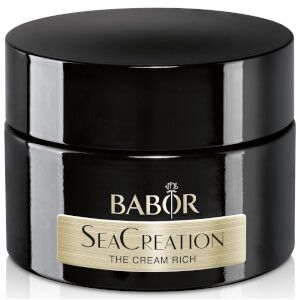
BABOR SeaCreation The Rich Cream

BABOR SeaCreation The Rich Cream

Efficacy75/100IrritancyHigh
Edit

Works for

1 of 1 advertised claim delivered

Anti-aging
Butyrospermum parkii butter, Thermus thermophillus ferment + 5 more
Moderate evidence
What the product description says
“SeaCreation helps protect against premature skin aging, helps promote anti-aging skin functions and assists in reducing the look of existing signs of aging.”
Source: Dermstore

This product contains glutathione. This ingredient help neutralize free radicals in skin. By doing so, they might be able to prevent early signs of aging (like fine lines and wrinkles), at least to some extent. These ingredients will not be able to "reverse" signs of aging.

Butyrospermum parkii butterEffect: LowA great moisturising ingredient that softens the skin and reduces water loss from its upper layer. It also can be helpful in protecting skin from free radicals~1.5–1.8%
Thermus thermophillus fermentEffect: LowMight be helpful in neutralising free radicals in skin and have some hydration properties~1.1–1.4%
SericinEffect: Low~0.2–0.4%
Prunus amygdalus dulcis oilEffect: LowAn emollient that softens the skin~0.25–0.5%
Ascorbic acidUnder-dosedEffect: HighThe most well-researched antioxidant that works in skin. Helps neutralize free radicals supporting collagen production, helping to even out the skin tone and preventing early signs of aging~0.05–0.15%
TocopherolEffect: Low, below effective dosePure form of vitamin E. Can help moisturise and protect the skin from free radicals. Often used to help stabilise other ingredients or the formula itself~0.15–0.3%
Ascorbyl palmitateEffect: Low, below effective doseBeing a lipid soluble form of vitamin C, it is more stable and can penetrate the skin better than L-Ascorbic acid. It is effective in protecting the skin from free radicals, as well as evening the skin tone, but is less effective in stimulating collagen production compared to L-Ascorbic acid.~0.2–0.4%
Anti-oxidation
Not advertised by the brand · Glutathione, Butyrospermum parkii butter + 8 more
Strong evidence

This product contains antioxidants (glutathione) that can help neutralize free radicals in skin. By doing so, they can lessen the damage the skin gets from the UV light (sun).

GlutathioneKey activeEffect: HighA peptide that can help neutralize free radicals in skin and reduce melanin production resulting in skin lightening effect and reduction in hyperpigmentation. It can also help attract moisture to the upper layer of the skin~0.2–0.4%
Butyrospermum parkii butterEffect: LowA great moisturising ingredient that softens the skin and reduces water loss from its upper layer. It also can be helpful in protecting skin from free radicals~1.5–1.8%
Thermus thermophillus fermentEffect: LowMight be helpful in neutralising free radicals in skin and have some hydration properties~1.1–1.4%
SericinEffect: Low~0.2–0.4%
Prunus amygdalus dulcis oilEffect: LowAn emollient that softens the skin~0.25–0.5%
TocopherolUnder-dosedEffect: HighPure form of vitamin E. Can help moisturise and protect the skin from free radicals. Often used to help stabilise other ingredients or the formula itself~0.15–0.3%
Ascorbic acidUnder-dosedEffect: HighThe most well-researched antioxidant that works in skin. Helps neutralize free radicals supporting collagen production, helping to even out the skin tone and preventing early signs of aging~0.05–0.15%
Tocopheryl acetateEffect: Low, below effective doseA more stable but less bio-available form of vitamin E compared to Tocopherol. Might help moisturize and protect the skin from free radicals, but mostly used in low concentrations to stabilize other ingredients.~0.5–0.75%
BisabololEffect: Low, below effective doseAn active component of chamomile plant that historically has been used to calm down irritated skin. A recent study shows that bisabolol indeed can have some anti-inflammatory effect on skin, even though conclusive data is lacking. Bisabolol has a sweet floral scent and can be added to products for its aromatic properties~0.2–0.35%
Ascorbyl palmitateEffect: Low, below effective doseBeing a lipid soluble form of vitamin C, it is more stable and can penetrate the skin better than L-Ascorbic acid. It is effective in protecting the skin from free radicals, as well as evening the skin tone, but is less effective in stimulating collagen production compared to L-Ascorbic acid.~0.2–0.4%
Moisturizing
Not advertised by the brand · Panthenol, Simmondsia chinensis seed oil + 18 more
Strong evidence

This product can help improve hydration of the skin with the two types of ingredients.

The first type is called “humectants”:
these ingredients help attract water. When humectants are on the surface of the skin, they “pull in” the moisture from the outside environment, or from within deeper layers of the skin. The following ingredients in this product do the job: glycerin, pantolactone.

This product also contains ingredients called “occlusives”. They help reduce the speed with which our skin loses moisture to the outside environment. These ingredients also help soften the upper layer of the skin, so it feels less tight and nicer to the touch. The following ingredients in this product do the job: butyrospermum parkii butter, cera alba.

The following ingredients in this product are especially good for supporting the skin barrier and helping with the hydration level: panthenol

Simmondsia chinensis seed oilKey active· Emollient, OcclusiveEffect: HighSoftens the upper layer of skin and helps restore the healthy skin barrier. Has shown to help calm down inflammation in skin. It is a stable oil, meaning that it retains its properties even when exposed to air.~1.7–2%
Thermus thermophillus fermentKey active· HumectantEffect: HighMight be helpful in neutralising free radicals in skin and have some hydration properties~1.1–1.4%
Cera albaKey active· Emollient, OcclusiveEffect: HighForms a protective barrier that holds water and keeps dry skin hydrated. Keeps an emulsion from separating into its oil and liquid components, and increases the thickness of a product. Can be an allergen~0.5–0.7%
Butyrospermum parkii butterKey active· Emollient, OcclusiveEffect: HighA great moisturising ingredient that softens the skin and reduces water loss from its upper layer. It also can be helpful in protecting skin from free radicals~1.5–1.8%
Cera microcristallinaKey active· Emollient, OcclusiveEffect: HighHelps to soften the upper layer of the skin, reduce water loss from its surface and create a thicker product consistency~2.3–2.9%
GlutathioneKey activeEffect: HighA peptide that can help neutralize free radicals in skin and reduce melanin production resulting in skin lightening effect and reduction in hyperpigmentation. It can also help attract moisture to the upper layer of the skin~0.2–0.4%
GlycerinKey active· HumectantEffect: HighOne of the best moisturizing ingredients. Naturally present in skin. It attracts water to the upper layer of the skin working as a humectant~3–3.6%
Glycine soja oilKey active· EmollientEffect: HighA good emollient that helps soften the skin and helps repair its barrier function. It can clog pores if used in high concentrations.~0.3–0.55%
PanthenolHero· HumectantEffect: HighHelps attract water to the upper layer of the skin and can help improve skin barrier function~0.4–0.6%
PantolactoneKey active· HumectantEffect: HighHelps attract water to the upper layer of the skin~0.2–0.4%
Prunus amygdalus dulcis oilKey active· EmollientEffect: MediumAn emollient that softens the skin~0.25–0.5%
SericinKey activeEffect: Medium~0.2–0.4%
Plankton extractKey activeEffect: MediumCan help attract water to the upper layer of the skin~0.2–0.4%
Cetyl palmitateKey active· EmollientEffect: MediumAn emollient that helps soften the skin and is used to improve product texture and stability~0.7–1.05%
Decyl oleateKey active· EmollientEffect: MediumHelps soften the upper layer of the skin~1.9–2.3%
Hydrolyzed conchiolin proteinEffect: Low~0.2–0.4%
Isohexadecane· EmollientEffect: LowImproves the texture of the product and helps soften the skin. Helps oil and water mix together and can be used as a cleansing agent~7.3–8.9%
Butylene glycol· HumectantEffect: LowUsed to create a nice product texture and help delivery of other ingredients. Might be somewhat helpful in attracting water to the upper layer of the skin~0.35–0.65%
Caprylic/capric triglycerideUnder-dosedEffect: HighA good mix of fatty acids that forms a protective layer on the skin. Improves the shelf life of products. Derived from coconut and glycerin~0.3–0.5%
TocopherolEffect: Low, below effective dosePure form of vitamin E. Can help moisturise and protect the skin from free radicals. Often used to help stabilise other ingredients or the formula itself~0.15–0.3%
Evens skin tone
Not advertised by the brand · Glutathione, Salicylic acid + 1 more
Strong evidence

This product can help reduce hypepigmentation and even out the skin tone because it contains the following effective ingredients: glutathione

Keep in mind that you would need to apply any topical skincare targetted at hypigmentation consistently for a couple of months to get a result. No topical skincare product can help get rid of hyperpigmentation (including post-acne marks and age spots) instantly.

GlutathioneKey activeEffect: HighA peptide that can help neutralize free radicals in skin and reduce melanin production resulting in skin lightening effect and reduction in hyperpigmentation. It can also help attract moisture to the upper layer of the skin~0.2–0.4%
Ascorbic acidUnder-dosedEffect: HighThe most well-researched antioxidant that works in skin. Helps neutralize free radicals supporting collagen production, helping to even out the skin tone and preventing early signs of aging~0.05–0.15%
Salicylic acidEffect: Low, below effective doseUsed for skin exfoliation. It has an anti-inflammatory and anti-bacterial effect, helps to unclog pores, prevent blemishes and speed up healing of the existing ones. Sometimes referred to as a BHA (beta-hydroxy acid)~0.2–0.4%

Can it cause trouble?

Irritancy
11 strong irritants: Parfum, Limonene + 9 more — patch-test recommended
High risk
We flagged 30 ingredients with irritancy potential. Severity depends on your sensitivity threshold; the table lists the worst offenders first.
IngredientFunctionIrritationEst. amount
ParfumAn aromatic blend of unspecified and possibly irritating ingredientsHigh~0.25–0.45%est.
LimoneneA common frangrance that can easily irritate skin, especially if exposed to air, light or heatHigh~0.25–0.45%est.
LinaloolA fragrance. Can be irritatingHigh~0.2–0.4%est.
AlcoholCan be drying and contribute to skin irritation. Used in formulars to dissolve other ingredients, create a thinner product consistency or for its antibacterial propertiesHigh~0.25–0.4%est.
Benzyl alcoholA preservative. Can be used to mask unpleasant smell. Can be irritatingHigh~0.2–0.35%est.
Hexyl cinnamalA fragrance with jasmine smell. A likely irritantHigh~0.2–0.4%est.
CitronellolA fragrance. Can be irritatingHigh~0.2–0.4%est.
Salicylic acidUsed for skin exfoliation. It has an anti-inflammatory and anti-bacterial effect, helps to unclog pores, prevent blemishes and speed up healing of the existing ones. Sometimes referred to as a BHA (beta-hydroxy acid)High~0.2–0.4%est.
CitralA fragrance with a lemon scent. A likely irritantHigh~0.2–0.35%est.
Alpha-isomethyl iononeA fragrance. Potential allergen and can be irritatingHigh~0.15–0.3%est.
GeraniolA fragrance. Can be irritatingHigh~0.15–0.3%est.
Benzyl salicylateA fragrance. Is a likely irritantHigh~0.15–0.25%est.
HydroxycitronellalA fragrance. A likely allergen and can be irritatingHigh~0.15–0.25%est.
Ascorbic acidThe most well-researched antioxidant that works in skin. Helps neutralize free radicals supporting collagen production, helping to even out the skin tone and preventing early signs of agingHigh~0.05–0.15%est.
Polyglyceryl-3 polyricinoleateHelps oil and water mix togetherMedium~3.7–4.5%est.
Simmondsia chinensis seed oilSoftens the upper layer of skin and helps restore the healthy skin barrier. Has shown to help calm down inflammation in skin. It is a stable oil, meaning that it retains its properties even when exposed to air.Medium~1.7–2%est.
Thermus thermophillus fermentMight be helpful in neutralising free radicals in skin and have some hydration propertiesMedium~1.1–1.4%est.
Tocopheryl acetateA more stable but less bio-available form of vitamin E compared to Tocopherol. Might help moisturize and protect the skin from free radicals, but mostly used in low concentrations to stabilize other ingredients.Medium~0.5–0.75%est.
Cera albaForms a protective barrier that holds water and keeps dry skin hydrated. Keeps an emulsion from separating into its oil and liquid components, and increases the thickness of a product. Can be an allergenMedium~0.5–0.7%est.
Glycine soja oilA good emollient that helps soften the skin and helps repair its barrier function. It can clog pores if used in high concentrations.Medium~0.3–0.55%est.
EthylhexylglycerinA preservativeMedium~0.25–0.4%est.
Caprylic/capric triglycerideA good mix of fatty acids that forms a protective layer on the skin. Improves the shelf life of products. Derived from coconut and glycerinMedium~0.3–0.5%est.
Sericin—Medium~0.2–0.4%est.
Potassium sorbateA preservativeMedium~0.25–0.45%est.
Hydrolyzed conchiolin protein—Medium~0.2–0.4%est.
Plankton extractCan help attract water to the upper layer of the skinMedium~0.2–0.4%est.
Citric acidCan work as an exfoliant but is typically used to adjust the product pHMedium~0.2–0.4%est.
GlutathioneA peptide that can help neutralize free radicals in skin and reduce melanin production resulting in skin lightening effect and reduction in hyperpigmentation. It can also help attract moisture to the upper layer of the skinMedium~0.2–0.4%est.
Ascorbyl palmitateBeing a lipid soluble form of vitamin C, it is more stable and can penetrate the skin better than L-Ascorbic acid. It is effective in protecting the skin from free radicals, as well as evening the skin tone, but is less effective in stimulating collagen production compared to L-Ascorbic acid.Medium~0.2–0.4%est.
Sorbic acidA preservativeMedium~0.1–0.2%est.
Comedogenic
6 ingredients rated 2 or more on the 0–5 pore-clogging scale
6 flagged
These ingredients have a comedogenic rating of 2 or more on a 0–5 scale; the table shows each one's rating. In leave-on products they can clog pores in acne-prone skin.
IngredientFunctionRatingEst. amount
Butyrospermum parkii butterA great moisturising ingredient that softens the skin and reduces water loss from its upper layer. It also can be helpful in protecting skin from free radicals3/5~1.5–1.8%est.
Macrocystis pyrifera extract—3/5~0.2–0.4%est.
Fucus vesiculosus extract—3/5~0.25–0.4%est.
Plankton extractCan help attract water to the upper layer of the skin3/5~0.2–0.4%est.
Decyl oleateHelps soften the upper layer of the skin2/5~1.9–2.3%est.
Glycine soja oilA good emollient that helps soften the skin and helps repair its barrier function. It can clog pores if used in high concentrations.2/5~0.3–0.55%est.
Edit

User reviews

Would you recommend?
No community reviews yet.

Be the first — your take helps the next person decide.

Write a review · ~30s

Ingredients

Filter by role to see what each ingredient is doing.

Water~45–55%
Formula
Irritation risk
Low

Plain old water

More about Water
Isohexadecane~7.3–8.9%
Formula
Irritation risk
Low
Works for
CleansingMoisturizing

Improves the texture of the product and helps soften the skin. Helps oil and water mix together and can be used as a cleansing agent

More about Isohexadecane
Polyglyceryl-3 polyricinoleate~3.7–4.5%
Irritant · medium
Irritation risk
Medium
Works for
Cleansing

Helps oil and water mix together

More about Polyglyceryl-3 polyricinoleate
Glycerin~3–3.6%
Key active
Irritation risk
Low
Works for
Moisturizing

One of the best moisturizing ingredients. Naturally present in skin. It attracts water to the upper layer of the skin working as a humectant

More about Glycerin
Cera microcristallina~2.3–2.9%
Key active
Irritation risk
Low
Works for
Moisturizing

Helps to soften the upper layer of the skin, reduce water loss from its surface and create a thicker product consistency

More about Cera microcristallina
Decyl oleate~1.9–2.3%
Key activeComedogenic 2/5
Irritation risk
Low
Comedogenicity
2/5
Works for
Moisturizing

Helps soften the upper layer of the skin

More about Decyl oleate
Simmondsia chinensis seed oil~1.7–2%
Key activeIrritant · medium
Irritation risk
Medium
Works for
Moisturizing

Softens the upper layer of skin and helps restore the healthy skin barrier. Has shown to help calm down inflammation in skin. It is a stable oil, meaning that it retains its properties even when exposed to air.

More about Simmondsia chinensis seed oil
Butyrospermum parkii butter~1.5–1.8%
Key activeComedogenic 3/5
Irritation risk
Low
Comedogenicity
3/5
Works for
MoisturizingAnti-oxidationAnti-aging

A great moisturising ingredient that softens the skin and reduces water loss from its upper layer. It also can be helpful in protecting skin from free radicals

More about Butyrospermum parkii butter
Thermus thermophillus ferment~1.1–1.4%
Key activeIrritant · medium
Irritation risk
Medium
Works for
MoisturizingAnti-agingAnti-oxidation

Might be helpful in neutralising free radicals in skin and have some hydration properties

More about Thermus thermophillus ferment
Magnesium sulfate~1–1.2%
Formula
Irritation risk
Low

Used to create a thicker product consistency

More about Magnesium sulfate
Cetyl palmitate~0.7–1.05%
Key active
Irritation risk
Low
Works for
Moisturizing

An emollient that helps soften the skin and is used to improve product texture and stability

More about Cetyl palmitate
Silica dimethyl silylate~0.6–0.9%
Formula
Irritation risk
Low

Used to create a thicker product consistency

More about Silica dimethyl silylate
Tocopheryl acetate~0.5–0.75%
Irritant · medium
Irritation risk
Medium
Works for
Anti-oxidation

A more stable but less bio-available form of vitamin E compared to Tocopherol. Might help moisturize and protect the skin from free radicals, but mostly used in low concentrations to stabilize other ingredients.

More about Tocopheryl acetate
Methylsilanol mannuronate~0.45–0.65%
Formula
Panthenol~0.4–0.6%
Hero · Moisturizing
Irritation risk
Low
Works for
Reduces rednessMoisturizingReduces irritation

Helps attract water to the upper layer of the skin and can help improve skin barrier function

More about Panthenol
Phenoxyethanol~0.45–0.65%
Formula
Irritation risk
Low

A preservative. It helps prevent bacterial growth in cosmetic products

More about Phenoxyethanol
Butylene glycol~0.35–0.65%
Formula
Irritation risk
Low
Works for
Moisturizing

Used to create a nice product texture and help delivery of other ingredients. Might be somewhat helpful in attracting water to the upper layer of the skin

More about Butylene glycol
Cera alba~0.5–0.7%
Key activeIrritant · medium
Irritation risk
Medium
Works for
CleansingMoisturizing

Forms a protective barrier that holds water and keeps dry skin hydrated. Keeps an emulsion from separating into its oil and liquid components, and increases the thickness of a product. Can be an allergen

More about Cera alba
Pseudoalteromonas ferment extract~0.3–0.55%
Formula
Glycine soja oil~0.3–0.55%
Key activeComedogenic 2/5Irritant · medium
Irritation risk
Medium
Comedogenicity
2/5
Works for
Moisturizing

A good emollient that helps soften the skin and helps repair its barrier function. It can clog pores if used in high concentrations.

More about Glycine soja oil
Parfum~0.25–0.45%
Irritant · high
Irritation risk
High

An aromatic blend of unspecified and possibly irritating ingredients

More about Parfum
Limonene~0.25–0.45%
Irritant · high
Irritation risk
High

A common frangrance that can easily irritate skin, especially if exposed to air, light or heat

More about Limonene
Linalool~0.2–0.4%
Irritant · high
Irritation risk
High

A fragrance. Can be irritating

More about Linalool
Ethylhexylglycerin~0.25–0.4%
Irritant · medium
Irritation risk
Medium

A preservative

More about Ethylhexylglycerin
Prunus amygdalus dulcis oil~0.25–0.5%
Key active
Irritation risk
Low
Works for
MoisturizingAnti-oxidationAnti-aging

An emollient that softens the skin

More about Prunus amygdalus dulcis oil
Macrocystis pyrifera extract~0.2–0.4%
Comedogenic 3/5
Irritation risk
Low
Comedogenicity
3/5
More about Macrocystis pyrifera extract
Alcohol~0.25–0.4%
Irritant · high
Irritation risk
High
Works for
Antibacterial

Can be drying and contribute to skin irritation. Used in formulars to dissolve other ingredients, create a thinner product consistency or for its antibacterial properties

More about Alcohol
Bisabolol~0.2–0.35%
Formula
Irritation risk
Low
Works for
Anti-inflammatoryReduces irritationAnti-oxidation

An active component of chamomile plant that historically has been used to calm down irritated skin. A recent study shows that bisabolol indeed can have some anti-inflammatory effect on skin, even though conclusive data is lacking. Bisabolol has a sweet floral scent and can be added to products for its aromatic properties

More about Bisabolol
Fucus vesiculosus extract~0.25–0.4%
Comedogenic 3/5
Irritation risk
Low
Comedogenicity
3/5
More about Fucus vesiculosus extract
Caprylic/capric triglyceride~0.3–0.5%
Under-dosedIrritant · medium
Irritation risk
Medium
Works for
Moisturizing

A good mix of fatty acids that forms a protective layer on the skin. Improves the shelf life of products. Derived from coconut and glycerin

More about Caprylic/capric triglyceride
Sericin~0.2–0.4%
Key activeIrritant · medium
Irritation risk
Medium
Works for
MoisturizingAnti-oxidationAnti-aging
More about Sericin
Glycolipids~0.2–0.4%
Formula
Irritation risk
Low
More about Glycolipids
Potassium sorbate~0.25–0.45%
Irritant · medium
Irritation risk
Medium

A preservative

More about Potassium sorbate
Benzyl alcohol~0.2–0.35%
Irritant · high
Irritation risk
High

A preservative. Can be used to mask unpleasant smell. Can be irritating

More about Benzyl alcohol
Sclerotium gum~0.2–0.4%
Formula
Irritation risk
Low

Used to create gel-like formulas and stabilize emulsions

More about Sclerotium gum
Hexyl cinnamal~0.2–0.4%
Irritant · high
Irritation risk
High

A fragrance with jasmine smell. A likely irritant

More about Hexyl cinnamal
Citronellol~0.2–0.4%
Irritant · high
Irritation risk
High

A fragrance. Can be irritating

More about Citronellol
Sodium benzoate~0.2–0.4%
Formula
Irritation risk
Low

A preservative

More about Sodium benzoate
Hydrolyzed conchiolin protein~0.2–0.4%
Irritant · medium
Irritation risk
Medium
Works for
Moisturizing
More about Hydrolyzed conchiolin protein
Salicylic acid~0.2–0.4%
Irritant · high
Irritation risk
High
Works for
Anti-blemishExfoliationAnti-inflammatoryAntibacterialEvens skin tone

Used for skin exfoliation. It has an anti-inflammatory and anti-bacterial effect, helps to unclog pores, prevent blemishes and speed up healing of the existing ones. Sometimes referred to as a BHA (beta-hydroxy acid)

More about Salicylic acid
Plankton extract~0.2–0.4%
Key activeComedogenic 3/5Irritant · medium
Irritation risk
Medium
Comedogenicity
3/5
Works for
Moisturizing

Can help attract water to the upper layer of the skin

More about Plankton extract
Citric acid~0.2–0.4%
Irritant · medium
Irritation risk
Medium

Can work as an exfoliant but is typically used to adjust the product pH

More about Citric acid
Pantolactone~0.2–0.4%
Key active
Irritation risk
Low
Works for
Moisturizing

Helps attract water to the upper layer of the skin

More about Pantolactone
Glutathione~0.2–0.4%
Key activeIrritant · medium
Irritation risk
Medium
Works for
MoisturizingAnti-oxidationEvens skin tone

A peptide that can help neutralize free radicals in skin and reduce melanin production resulting in skin lightening effect and reduction in hyperpigmentation. It can also help attract moisture to the upper layer of the skin

More about Glutathione
Ascorbyl palmitate~0.2–0.4%
Irritant · medium
Irritation risk
Medium
Works for
Anti-oxidationAnti-aging

Being a lipid soluble form of vitamin C, it is more stable and can penetrate the skin better than L-Ascorbic acid. It is effective in protecting the skin from free radicals, as well as evening the skin tone, but is less effective in stimulating collagen production compared to L-Ascorbic acid.

More about Ascorbyl palmitate
Citral~0.2–0.35%
Irritant · high
Irritation risk
High

A fragrance with a lemon scent. A likely irritant

More about Citral
Alpha-isomethyl ionone~0.15–0.3%
Irritant · high
Irritation risk
High

A fragrance. Potential allergen and can be irritating

More about Alpha-isomethyl ionone
Geraniol~0.15–0.3%
Irritant · high
Irritation risk
High

A fragrance. Can be irritating

More about Geraniol
Benzyl salicylate~0.15–0.25%
Irritant · high
Irritation risk
High

A fragrance. Is a likely irritant

More about Benzyl salicylate
Sodium hydroxide~0.15–0.3%
Formula
Irritation risk
Low

Used to adjust the product's pH

More about Sodium hydroxide
Tocopherol~0.15–0.3%
Under-dosed
Irritation risk
Low
Works for
Anti-oxidationMoisturizingAnti-inflammatoryAnti-aging

Pure form of vitamin E. Can help moisturise and protect the skin from free radicals. Often used to help stabilise other ingredients or the formula itself

More about Tocopherol
Prunus amygdalus dulcis fruit extract~0.15–0.25%
Formula
Hydroxycitronellal~0.15–0.25%
Irritant · high
Irritation risk
High

A fragrance. A likely allergen and can be irritating

More about Hydroxycitronellal
Galactaric acid~0.1–0.25%
Formula
Ascorbic acid~0.05–0.15%
Under-dosedIrritant · high
Irritation risk
High
Works for
Anti-oxidationEvens skin toneAnti-aging

The most well-researched antioxidant that works in skin. Helps neutralize free radicals supporting collagen production, helping to even out the skin tone and preventing early signs of aging

More about Ascorbic acid
Sorbic acid~0.1–0.2%
Irritant · medium
Irritation risk
Medium

A preservative

More about Sorbic acid
Ingredient list view

Water, Isohexadecane, Polyglyceryl-3 polyricinoleate, Glycerin, Cera microcristallina, Decyl oleate, Simmondsia chinensis seed oil, Butyrospermum parkii butter, Thermus thermophillus ferment, Magnesium sulfate, Cetyl palmitate, Silica dimethyl silylate, Tocopheryl acetate, Methylsilanol mannuronate, Panthenol, Phenoxyethanol, Butylene glycol, Cera alba, Pseudoalteromonas ferment extract, Glycine soja oil, Parfum, Limonene, Linalool, Ethylhexylglycerin, Prunus amygdalus dulcis oil, Macrocystis pyrifera extract, Alcohol, Bisabolol, Fucus vesiculosus extract, Caprylic/capric triglyceride, Sericin, Glycolipids, Potassium sorbate, Benzyl alcohol, Sclerotium gum, Hexyl cinnamal, Citronellol, Sodium benzoate, Hydrolyzed conchiolin protein, Salicylic acid, Plankton extract, Citric acid, Pantolactone, Glutathione, Ascorbyl palmitate, Citral, Alpha-isomethyl ionone, Geraniol, Benzyl salicylate, Sodium hydroxide, Tocopherol, Prunus amygdalus dulcis fruit extract, Hydroxycitronellal, Galactaric acid, Ascorbic acid, Sorbic acid

Compare prices

Retailers ranked by price — lowest first.

Dermstore
$325.00
Buy

Affiliate links · prices updated regularly

Worth comparing, line by line.

Match % combines shared ingredients, the first five ingredients, shared actives and hero ingredients, irritancy (lower counts in the alternative's favour), texture and body area. Only products in the same routine step are compared.

Side-by-side comparison of this product against its closest alternatives
BABORSeaCreation The Rich CreamYOUR PRODUCTMedipharma CosmeticsHaut in Balance Pigment/Age Spot Reducing Treatment CreamThe Jojoba CompanyIntense Overnight Renewal CreamOodeeNova Illuminating Moisturiser
Match—89%87%86%
Price$325.00$27.50−$297.50$46.75−$278.25—
Shared key ingredients—6 of 134 of 134 of 13
Key difference—Lactic AcidCamellia Sinensis Leaf ExtractNiacinamide
Irritancy High Medium Low Medium
Drying alcohol Contains drying alcohol Contains drying alcohol ——
View product Shop Shop Shop
Cheaper alternatives? See how this stacks up against similar formulas.
We compare ingredient profiles across our catalog — pick the closest match for your budget.
Open dupe finder

Product summary

Based on the ingredients included, "BABOR - SeaCreation The Rich Cream" works well for moisturizing the skin. As we expect from a proper moisturizer, the formula includes a combo of effective humectants and emollients. These are the two different types of ingredients that are essential for improving the skin hydration and supporting a healthy skin barrier. Humectants in this product (panthenol, glycerin, pantolactone, thermus thermophillus ferment and butylene glycol) help to increase the water content in the upper layer of the skin. (These ingredients do so by "capturing" water molecules from the outside air or from within the deeper layers of the skin). Emollients in this formulation (glycine soja oil, butyrospermum parkii butter, cera alba, cera microcristallina and simmondsia chinensis seed oil) help to reduce the moisture loss from the skin. They also soften the skin surface and relieve the feeling of dryness and tightness.

Ingredient callouts

  • This product also contains vitamin C (Ascorbic Acid). It can be an effective active for anti-aging and evening out the skin tone, but in this moisturizer it is used for stabilizing other ingredients in the formulation. In this concentration (0.05% - 0.15%) it cannot have a noticeable benefit for the skin.

Irritation risk

There are quite a few common irritants in this product, including ingredients without particular skin benefits. We would not recommend it for sensitive skin. We assess the overall irritancy of this moisturizer to be high. For a detailed overview of all potential irritants: click here

You can see the detailed formula review with the breakdown of all actives in the product and the full ingredient list with estimated concentrations in the tables below.

Price

The product retails for 575.00$ in the United States, for 1008.00A$ in Australia and for 687.50CA$ in Canada.

For a detailed price comparison: click here.

Sources cited in this review

Every concentration estimate and effectiveness label is anchored to one of these 18 studies and safety reviews.

  1. 1
  2. 2
  3. 3
  4. 4
  5. 5
  6. 6
BABOR SeaCreation The Rich Cream
BABORSeaCreation The Rich Cream

Affiliate links · As an Amazon Associate, WIMJ earns from qualifying purchases.

As an Amazon Associate, WIMJ earns from qualifying purchases.