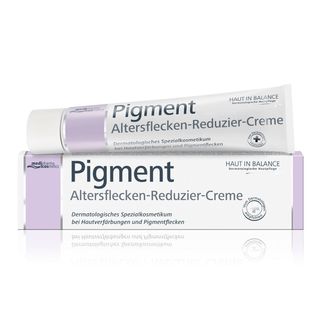
Medipharma Cosmetics Haut in Balance Pigment/Age Spot Reducing Treatment Cream
Works for
1 of 3 advertised claims delivered
MoisturizingPanthenol, Butyrospermum parkii butter + 12 moreStrong evidence
“Haut in Balance Pigment/Age Spot Reducing Treatment Cream”
This product can help improve hydration of the skin with the two types of ingredients.
The first type is called “humectants”:
these ingredients help attract water.
When humectants are on the surface of the skin, they “pull in” the moisture from the outside environment, or from
within deeper layers of the skin. The following ingredients in this product do the job:
galactoarabinan, glycerin.
This product also contains ingredients called “occlusives”. They help reduce the speed with which our skin loses moisture to the outside environment. These ingredients also help soften the upper layer of the skin, so it feels less tight and nicer to the touch. The following ingredients in this product do the job: butyrospermum parkii butter, caprylic/capric triglyceride.
The following ingredients in this product are especially good for supporting the skin barrier and helping with the hydration level: panthenol
Anti-agingButyrospermum parkii butter, Tocopherol + 1 moreLimited evidence
“Spot Treatment for Unwanted Pigment Haut in Balance Pigment Age Spot Reducing Treatment Cream is an intense treatment for age spots and unwanted pigmentation.”
This product does not contain ingredients that are able to reduce fine lines and wrinkles or help with skin elasticity, but it can improve the look of the skin temporarily through moisturization. Well-moisturized skin might also be able to repair the sun damage better.This ingredient - butyrospermum parkii butter - could be helpful for preventing or repairing signs of aging in theory, but there is no evidence that it actually works.
Evens skin toneSalicylic acid, Lactic acidLimited evidence
“Spot Treatment for Unwanted Pigment Haut in Balance Pigment Age Spot Reducing Treatment Cream is an intense treatment for age spots and unwanted pigmentation.”
This product might help improve the skin tone through exfoliation. In other words, it helps to speed up the shedding of cells from the upper layer of the skin, and this might help reduce hyperpigmentation.
Anti-blemishNot advertised by the brand · Salicylic acidStrong evidence
This product can help reduce breakouts and clogged pores because it contains the following ingredient: salicylic acid. This ingredient is used for treating acne and can have a noticeable effect.
ExfoliationNot advertised by the brand · Salicylic acid, Lactic acidStrong evidence
This product can help exfoliate the skin. In other words, it helps break down the bonds between dead cells on the surface of the skin and speed up the skin turnover. Skin often appears softer and brighter after exfoliation, but overdoing it can result in disrupted skin barrier. The following ingredient is doing the exfoliating job in this product: salicylic acid.
Can it cause trouble?
Irritancy2 strong irritants: Parfum, AlcoholMedium risk
Comedogenic2 ingredients rated 2 or more on the 0–5 pore-clogging scale2 flagged


User reviews
Be the first — your take helps the next person decide.
Ingredients
Filter by role to see what each ingredient is doing.
Water~40–60%
Cetearyl alcohol~5.5–8.3%
- Irritation risk
- Low
- Comedogenicity
- 2/5
A non-drying alcohol. Works as an emollient. Helps water and oil mix together and creates a nice product texture
More about Cetearyl alcoholGlycerin~3.5–5.2%
- Irritation risk
- Low
One of the best moisturizing ingredients. Naturally present in skin. It attracts water to the upper layer of the skin working as a humectant
More about GlycerinOlea europaea fruit oil~2.7–4.1%
- Irritation risk
- Medium
An emollient that helps soften the skin but is not effective for restoring its barrier function. Might be helpful to calm down inflammation
More about Olea europaea fruit oilButyrospermum parkii butter~2.1–3.2%
- Irritation risk
- Low
- Comedogenicity
- 3/5
A great moisturising ingredient that softens the skin and reduces water loss from its upper layer. It also can be helpful in protecting skin from free radicals
More about Butyrospermum parkii butterCaprylic/capric triglyceride~1.8–2.7%
- Irritation risk
- Medium
A good mix of fatty acids that forms a protective layer on the skin. Improves the shelf life of products. Derived from coconut and glycerin
More about Caprylic/capric triglycerideMethylpropanediol~1.4–2.2%
Cera alba~1.6–2.3%
- Irritation risk
- Medium
Forms a protective barrier that holds water and keeps dry skin hydrated. Keeps an emulsion from separating into its oil and liquid components, and increases the thickness of a product. Can be an allergen
More about Cera albaGlyceryl stearate citrate~1–1.5%
- Irritation risk
- Low
Helps oil and water mix together while softening the upper layer of the skin
More about Glyceryl stearate citrateLactic acid~0.6–1.35%
- Irritation risk
- Medium
An exfoliating and moisturizing alpha-hydroxy acid (AHA). Typically causes less irritation than other AHAs, for example, glycolic acid. At high concentrations (about 15%), lactic acid can help reduce lines and wrinkles. Recent studies show that lactic acid can support the "good" bacteria living on skin's surface (healthy skin microbiome)
More about Lactic acidSalicylic acid~0.45–1%
- Irritation risk
- High
Used for skin exfoliation. It has an anti-inflammatory and anti-bacterial effect, helps to unclog pores, prevent blemishes and speed up healing of the existing ones. Sometimes referred to as a BHA (beta-hydroxy acid)
More about Salicylic acidPanthenol~0.4–0.9%
- Irritation risk
- Low
Helps attract water to the upper layer of the skin and can help improve skin barrier function
More about PanthenolGalactoarabinan~0.35–0.85%
- Irritation risk
- Medium
Helps attract water to the upper layer of the skin
More about GalactoarabinanLecithin~0.35–0.8%
- Irritation risk
- Low
Used mostly for creating emulsions - helping oil and water mix together. Helps soften the upper layer of the skin
More about LecithinTocopherol~0.3–0.7%
- Irritation risk
- Low
Pure form of vitamin E. Can help moisturise and protect the skin from free radicals. Often used to help stabilise other ingredients or the formula itself
More about TocopherolHelianthus annuus seed oil~0.3–0.7%
- Irritation risk
- Low
A great emollient due to its high linoleic acid content. One of the most effective plant oils in helping skin hydration and repairing skin barrier function
More about Helianthus annuus seed oilLepidium sativum sprout extract~0.2–0.75%
- Irritation risk
- Low
Soy isoflavones~0.15–0.65%
- Irritation risk
- Low
Parfum~0.1–0.45%
- Irritation risk
- High
An aromatic blend of unspecified and possibly irritating ingredients
More about ParfumAlcohol~0.1–0.45%
- Irritation risk
- High
Can be drying and contribute to skin irritation. Used in formulars to dissolve other ingredients, create a thinner product consistency or for its antibacterial properties
More about AlcoholHeliotropine~0.1–0.35%
- Irritation risk
- Low
Xanthan gum~0.1–0.4%
- Irritation risk
- Low
Used to create a thicker product consistency
More about Xanthan gumPhenylpropanol~0.1–0.3%
- Irritation risk
- High
Helps mask the smell of other ingredients and helps preserve the product formulation
More about PhenylpropanolSucrose stearate~0.1–0.4%
Caprylyl glycol~0.1–0.35%
- Irritation risk
- Medium
Helps preserve products and creates a nice product texture
More about Caprylyl glycolSodium hydroxide~0.05–0.2%
Citric acid~0.01–0.1%
- Irritation risk
- Medium
Can work as an exfoliant but is typically used to adjust the product pH
More about Citric acidCi 77891~0.01–0.1%
- Irritation risk
- Low
Ingredient list view
Water, Cetearyl alcohol, Glycerin, Olea europaea fruit oil, Butyrospermum parkii butter, Caprylic/capric triglyceride, Methylpropanediol, Cera alba, Glyceryl stearate citrate, Lactic acid, Salicylic acid, Panthenol, Galactoarabinan, Lecithin, Tocopherol, Helianthus annuus seed oil, Lepidium sativum sprout extract, Soy isoflavones, Parfum, Alcohol, Heliotropine, Xanthan gum, Phenylpropanol, Sucrose stearate, Caprylyl glycol, Sodium hydroxide, Citric acid, Ci 77891
Compare prices
Retailers ranked by price — lowest first.
.png)
Affiliate links · prices updated regularly
Worth comparing, line by line.
Match % combines shared ingredients, the first five ingredients, shared actives and hero ingredients, irritancy (lower counts in the alternative's favour), texture and body area. Only products in the same routine step are compared.
| Medipharma CosmeticsHaut in Balance Pigment/Age Spot Reducing Treatment CreamYOUR PRODUCT | The Jojoba CompanyIntense Overnight Renewal Cream | OodeeNova Illuminating Moisturiser | BeautycounterCountermatch Recovery Sleeping Cream | |
|---|---|---|---|---|
| Match | — | 84% | 79% | 76% |
| Price | $27.50 | $45.45+$17.95 | — | $62.00+$34.50 |
| Shared key ingredients | — | 4 of 10 | 4 of 10 | 6 of 10 |
| Key difference | — | Camellia Sinensis Leaf Extract | Niacinamide | Betaine |
| Irritancy | Medium | Low | Medium | Low |
| Drying alcohol | Contains drying alcohol | — | — | — |
| View product | Shop | Shop | Shop |


Product summary
"Medipharma Cosmetics - Haut in Balance Pigment/Age Spot Reducing Treatment Cream" is a well-rounded moisturizing product. This moisturizer uses a good combo of humectants and emollients. These both types of ingredients are essentials for improving the skin hydration and keeping the skin barrier healthy. Humectants in this product (panthenol, galactoarabinan, glycerin and caprylyl glycol) help to increase the water content in the upper layer of the skin. (These ingredients do so by "capturing" water molecules from the outside air or from within the deeper layers of the skin). Butyrospermum parkii butter, caprylic/capric triglyceride, cera alba, helianthus annuus seed oil and cetearyl alcohol in this product help decrease the water evoporation from the skin, so that it stays hydrated for longer. These ingredients also soften the skin and take away the feeling of tightness and dryness.
Ingredient callouts
- This product contains acids (lactic acid 0.60% - 1.35%). Their concentration is low, and they will not have a strong exfoliating effect. Instead, they work to support the skin natural acid mantle and to attract water (as humectants). Lactic acid is particularly good in attracting water to the upper layer of the skin and improving the skin barrier.
- Salicylic acid (0.45% - 1.00%) in this product will have an exfoliating effect and help smooth the skin. We, however, do not recommend using a moisturizer with Salicylic Acid daily to avoid over-exfoliating.
- Panthenol (pro-vitamin B5) at about 0.40% - 0.90% concentration. In this concentration, Panthenol works effectively to improve the skin barrier and reduce inflammation.
Irritation risk
There are some common irritants in this product, including ingredients that do not have benefits for the skin. We assess the overall irritancy of this moisturizer to be medium. For a detailed overview of all potential irritants: click here
You can see the detailed formula review with the breakdown of all actives in the product and the full ingredient list with estimated concentrations in the tables below.
Price
The product retails for 27.50$ in the United States.
For a detailed price comparison: click here.
Sources cited in this review
Every concentration estimate and effectiveness label is anchored to one of these 17 studies and safety reviews.
- 1
- 2Use of “natural” oils for moisturization: Review of olive, coconut, and sunflower seed oilonlinelibrary.wiley.com
- 3
- 4Epidermal and dermal effects of topical lactic acidncbi.nlm.nih.gov
- 5Dual Effects of Alpha-Hydroxy Acids on the Skinpdfs.semanticscholar.org
- 6Salicylic acid as a peeling agent: a comprehensive reviewncbi.nlm.nih.gov

Affiliate links · As an Amazon Associate, WIMJ earns from qualifying purchases.