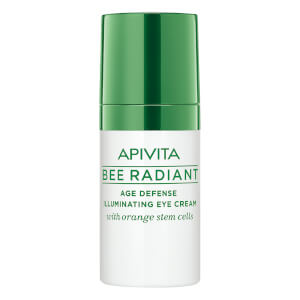
APIVITA Bee Radiant Age Defense Illuminating Eye Cream
Works for
1 of 3 advertised claims delivered
MoisturizingIsosorbide dicaprylate, Panthenol + 19 moreStrong evidence
“Part of the brand’s Bee Radiant range, the cream is enriched with the brand’s signature Greek Wild Rosehip aqueous infusion, offering antioxidant, anti-inflammatory and moisturising attributes.”
This product can help improve hydration of the skin with the two types of ingredients.
The first type is called “humectants”:
these ingredients help attract water.
When humectants are on the surface of the skin, they “pull in” the moisture from the outside environment, or from
within deeper layers of the skin. The following ingredients in this product do the job:
glycerin, sodium hyaluronate.
This product also contains ingredients called “occlusives”. They help reduce the speed with which our skin loses moisture to the outside environment. These ingredients also help soften the upper layer of the skin, so it feels less tight and nicer to the touch. The following ingredients in this product do the job: butyrospermum parkii butter, helianthus annuus seed oil.
The following ingredients in this product are especially good for supporting the skin barrier and helping with the hydration level: isosorbide dicaprylate, panthenol
Evens skin toneAlbizia julibrissin bark extract, Ascorbyl tetraisopalmitateLimited evidence
“a natural blend of minerals enhances tone”
This product contains ingredients (albizia julibrissin bark extract) that could help reduce hyperpigmentation (for example, post-acne marks or age spots) in theory, but there is not enough evidence that they actually work.
Anti-agingButyrospermum parkii butter, Tocopherol + 1 moreLimited evidence
“Combat fine lines, wrinkles and signs of ageing with the Age Defense Illuminating Eye Cream from APIVITA; a rich-textured cream that revives skin’s radiance by combining anti-ageing action with the the smoothing of skin’s micro-relief.”
This product does not contain ingredients that are able to reduce fine lines and wrinkles or help with skin elasticity, but it can improve the look of the skin temporarily through moisturization. Well-moisturized skin might also be able to repair the sun damage better.This ingredient - butyrospermum parkii butter - could be helpful for preventing or repairing signs of aging in theory, but there is no evidence that it actually works.
Can it cause trouble?
Irritancy2 strong irritants: Citrus aurantium dulcis callus culture extract, Rosa damascena flower oilMedium risk
Comedogenic2 ingredients rated 2 or more on the 0–5 pore-clogging scale2 flagged


User reviews
Be the first — your take helps the next person decide.
Ingredients
Filter by role to see what each ingredient is doing.
Water~45–55%
Glycerin~4.4–5.4%
- Irritation risk
- Low
One of the best moisturizing ingredients. Naturally present in skin. It attracts water to the upper layer of the skin working as a humectant
More about GlycerinTriheptanoin~4.2–5.1%
- Irritation risk
- Low
A synthetic triglyceride. Helps soften the upper layer of the skin
More about TriheptanoinOlus oil~3.3–4%
- Irritation risk
- Low
An oil from a mixture of different vegetables. Helps soften the upper layer of the skin
More about Olus oilAlbizia julibrissin bark extract~2.7–3.3%
- Irritation risk
- High
A plant extract that might help to neutralize free radicals in skin. Is claimed to help reduce hyperpigmentation but evidence is missing
More about Albizia julibrissin bark extractIsosorbide dicaprylate~2.2–2.7%
- Irritation risk
- Low
Helps soften the upper layer of the skin. Early studies suggest that it can help strengthen the skin barrier
More about Isosorbide dicaprylateButyrospermum parkii butter~1.9–2.3%
- Irritation risk
- Low
- Comedogenicity
- 3/5
A great moisturising ingredient that softens the skin and reduces water loss from its upper layer. It also can be helpful in protecting skin from free radicals
More about Butyrospermum parkii butterPalmitic/stearic triglyceride~1.6–2%
- Irritation risk
- Low
Water~1.4–1.7%
Capryloyl glycerin/sebacic acid copolymer~1.1–1.4%
- Irritation risk
- Low
Helps soften the upper layer of the skin
More about Capryloyl glycerin/sebacic acid copolymerCi 77891~0.95–1.15%
- Irritation risk
- Low
Diheptyl succinate~0.7–1%
- Irritation risk
- Low
Helps to soften the upper layer of the skin and creates a nice product finish on the skin
More about Diheptyl succinateGlyceryl stearate citrate~0.6–0.85%
- Irritation risk
- Low
Helps oil and water mix together while softening the upper layer of the skin
More about Glyceryl stearate citrateSodium stearoyl glutamate~0.5–0.8%
- Irritation risk
- Medium
Helps oil and water mix together
More about Sodium stearoyl glutamateCetearyl alcohol~0.55–0.8%
- Irritation risk
- Low
- Comedogenicity
- 2/5
A non-drying alcohol. Works as an emollient. Helps water and oil mix together and creates a nice product texture
More about Cetearyl alcoholCitrus aurantium dulcis callus culture extract~0.5–0.7%
- Irritation risk
- High
Propolis extract~0.5–0.7%
- Irritation risk
- High
A complex substance produced by honey bees. Can have anti-bacterial and some anti-oxidant effect. Is an allergen and can be irritating
More about Propolis extractPunica granatum seed oil~0.5–0.75%
- Irritation risk
- Low
Helps soften the upper layer of the skin
More about Punica granatum seed oilMel extract~0.45–0.7%
- Irritation risk
- Low
Helianthus annuus seed oil~0.45–0.7%
- Irritation risk
- Low
A great emollient due to its high linoleic acid content. One of the most effective plant oils in helping skin hydration and repairing skin barrier function
More about Helianthus annuus seed oilRosa damascena flower oil~0.3–0.6%
- Irritation risk
- High
Used as a fragrance. Can be irritating
More about Rosa damascena flower oilSodium hyaluronate~0.3–0.6%
- Irritation risk
- Low
One of the best moisturizing ingredients. Attracts water into the upper layer of the skin
More about Sodium hyaluronateOlea europaea fruit oil~0.3–0.6%
- Irritation risk
- Medium
An emollient that helps soften the skin but is not effective for restoring its barrier function. Might be helpful to calm down inflammation
More about Olea europaea fruit oilHydroxypropyl cyclodextrin~0.35–0.6%
- Irritation risk
- Medium
Used to stabilize product formulations and help soften the upper layer of the skin
More about Hydroxypropyl cyclodextrinHydrogenated lecithin~0.3–0.55%
- Irritation risk
- Low
Helps to retain moisture by creating a protective barrier on the skin. Rich in fatty acids. Improves product texture and helps with the penetration of other ingredients.
More about Hydrogenated lecithinCetyl palmitate~0.25–0.45%
- Irritation risk
- Low
An emollient that helps soften the skin and is used to improve product texture and stability
More about Cetyl palmitateXanthan gum~0.2–0.4%
- Irritation risk
- Low
Used to create a thicker product consistency
More about Xanthan gumSorbitan palmitate~0.25–0.45%
- Irritation risk
- Medium
Helps water and oil mix together and stabilize the product formulation
More about Sorbitan palmitateAscorbyl tetraisopalmitate~0.2–0.4%
- Irritation risk
- Medium
A vitamin C derivative. Studies show that is might be effective in reducing hyperpigmentation, but there are no studies confirming that it is effectively converted into the bioavailable form of Vitamin C in skin. It is not clear how this derivative compares in effectiveness to the topical application of bioavailable form of vitamin C (L-ascorbic acid)
More about Ascorbyl tetraisopalmitateTocopheryl acetate~0.2–0.35%
- Irritation risk
- Medium
A more stable but less bio-available form of vitamin E compared to Tocopherol. Might help moisturize and protect the skin from free radicals, but mostly used in low concentrations to stabilize other ingredients.
More about Tocopheryl acetatePanthenol~0.15–0.3%
- Irritation risk
- Low
Helps attract water to the upper layer of the skin and can help improve skin barrier function
More about PanthenolMica~0.15–0.3%
- Irritation risk
- Low
Creates an illusion of smoother and more radiant skin tone. Adds shimmer to the skin by reflecting light
More about MicaMethylpropanediol~0.15–0.3%
Citronellyl methylcrotonate~0.15–0.3%
- Irritation risk
- Low
Ethylhexylglycerin~0.15–0.3%
Caprylhydroxamic acid~0.15–0.25%
Cetyl hydroxyethylcellulose~0.15–0.25%
- Irritation risk
- Low
Used to create a thicker product consistency and stabilize formulations
More about Cetyl hydroxyethylcelluloseDisodium edta~0.1–0.2%
Sodium pca~0.1–0.15%
- Irritation risk
- Low
Naturally present in skin and helps to attract water to its upper layer
More about Sodium pcaTocopherol~0.05–0.15%
- Irritation risk
- Low
Pure form of vitamin E. Can help moisturise and protect the skin from free radicals. Often used to help stabilise other ingredients or the formula itself
More about TocopherolCi 77491~0.05–0.15%
- Irritation risk
- Low
A red colorant made of iron oxide. Typically is not irritating
More about Ci 77491Ingredient list view
Water, Glycerin, Triheptanoin, Olus oil, Albizia julibrissin bark extract, Isosorbide dicaprylate, Butyrospermum parkii butter, Palmitic/stearic triglyceride, Water, Capryloyl glycerin/sebacic acid copolymer, Ci 77891, Diheptyl succinate, Glyceryl stearate citrate, Sodium stearoyl glutamate, Cetearyl alcohol, Citrus aurantium dulcis callus culture extract, Propolis extract, Punica granatum seed oil, Mel extract, Helianthus annuus seed oil, Rosa damascena flower oil, Sodium hyaluronate, Olea europaea fruit oil, Hydroxypropyl cyclodextrin, Hydrogenated lecithin, Cetyl palmitate, Xanthan gum, Sorbitan palmitate, Ascorbyl tetraisopalmitate, Tocopheryl acetate, Panthenol, Mica, Methylpropanediol, Citronellyl methylcrotonate, Ethylhexylglycerin, Caprylhydroxamic acid, Cetyl hydroxyethylcellulose, Disodium edta, Sodium pca, Tocopherol, Ci 77491
Compare prices
Retailers ranked by price — lowest first.
Affiliate links · prices updated regularly · As an Amazon Associate, WIMJ earns from qualifying purchases.
Worth comparing, line by line.
Match % combines shared ingredients, the first five ingredients, shared actives and hero ingredients, irritancy (lower counts in the alternative's favour), texture and body area. Only products in the same routine step are compared.
| APIVITABee Radiant Age Defense Illuminating Eye CreamYOUR PRODUCT | MALIN + GOETZRevitalizing Eye Cream | 305careMorning Muse Eye Cream | |
|---|---|---|---|
| Match | — | 56% | 53% |
| Price | — | $90.90 | — |
| Shared key ingredients | — | 6 of 8 | 5 of 8 |
| Key difference | — | Anhydroxylitol | Dipeptide-2 |
| Irritancy | Medium | Medium | Low |
| Drying alcohol | — | — | — |
| View product | Shop | Shop |
Product summary
"APIVITA - Bee Radiant Age Defense Illuminating Eye Cream" is a well-rounded moisturizing product. As we expect from a proper moisturizer, the formula includes a combo of effective humectants and emollients. These are the two different types of ingredients that are essential for improving the skin hydration and supporting a healthy skin barrier. Panthenol, glycerin, sodium hyaluronate, sodium pca and honey extract in this product (humectants) attract water molecules to the upper layer of the skin (the water comes from the outside air or from the deeper layers of the skin if the air is dry). Isosorbide dicaprylate, butyrospermum parkii butter, helianthus annuus seed oil, cetearyl alcohol and cetyl palmitate in this product help decrease the water evoporation from the skin, so that it stays hydrated for longer. These ingredients also soften the skin and take away the feeling of tightness and dryness.
Irritation risk
There are some common irritants in this product, including ingredients that do not have benefits for the skin. We assess the overall irritancy of this moisturizer to be medium. For a detailed overview of all potential irritants: click here
You can see the detailed formula review with the breakdown of all actives in the product and the full ingredient list with estimated concentrations in the tables below.
Price
The product retails for 36.16£ in the United Kingdom.
For a detailed price comparison: click here.
Sources cited in this review
Every concentration estimate and effectiveness label is anchored to one of these 20 studies and safety reviews.
- 1
- 2Phytopharmacological properties of Albizia species: A reviewresearchgate.net
- 3
- 4
- 5
- 6

Affiliate links · As an Amazon Associate, WIMJ earns from qualifying purchases.