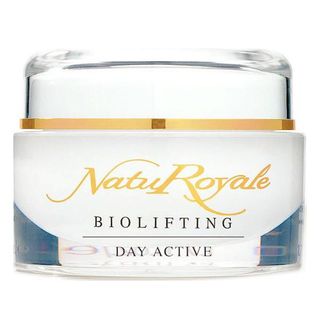
Annemarie Borlind NatuRoyale Bio Lifting Cream

Annemarie Borlind NatuRoyale Bio Lifting Cream

Efficacy75/100IrritancyHigh
Edit

Works for

2 of 2 advertised claims delivered

Moisturizing
21 ingredients credited for this claim
Good support
What the product description says
“Natu Royale Bio Lifting Cream”
From product name

This product can help improve hydration of the skin with the two types of ingredients.

The first type is called “humectants”:
these ingredients help attract water. When humectants are on the surface of the skin, they “pull in” the moisture from the outside environment, or from within deeper layers of the skin. The following ingredients in this product do the job: glycerin, hyaluronic acid.

This product also contains ingredients called “occlusives”. They help reduce the speed with which our skin loses moisture to the outside environment. These ingredients also help soften the upper layer of the skin, so it feels less tight and nicer to the touch. The following ingredients in this product do the job: beeswax, caprylic/capric triglyceride.

Panthenyl ethyl etherKey activeEffect: HighHelps attract water to the upper layer of the skin and can help improve skin barrier function~0.25–0.5%
Simmondsia chinensis seed oilKey active· Emollient, OcclusiveEffect: HighSoftens the upper layer of skin and helps restore the healthy skin barrier. Has shown to help calm down inflammation in skin. It is a stable oil, meaning that it retains its properties even when exposed to air.~1.3–1.6%
Sodium pcaKey active· HumectantEffect: HighNaturally present in skin and helps to attract water to its upper layer~0.25–0.45%
Hyaluronic acidKey active· HumectantEffect: HighOne of the best moisturizing ingredients. Attracts water into the upper layer of the skin. Naturally present in skin. Typically has large molecule size unless advertised otherwise on the product label. Helps support skin's barrier function and may help to reduce inflammation~0.25–0.45%
BeeswaxKey active· Emollient, OcclusiveEffect: HighForms a protective barrier that holds water and keeps dry skin hydrated. Keeps an emulsion from separating into its oil and liquid components, and increases the thickness of a product. Can be an allergen~2.1–2.5%
Caprylic/capric triglycerideKey active· Emollient, OcclusiveEffect: HighA good mix of fatty acids that forms a protective layer on the skin. Improves the shelf life of products. Derived from coconut and glycerin~1.5–1.9%
Cera albaKey active· Emollient, OcclusiveEffect: HighForms a protective barrier that holds water and keeps dry skin hydrated. Keeps an emulsion from separating into its oil and liquid components, and increases the thickness of a product. Can be an allergen~2.7–3.3%
GlycerinKey active· HumectantEffect: HighOne of the best moisturizing ingredients. Naturally present in skin. It attracts water to the upper layer of the skin working as a humectant~1.8–2.1%
Glycine soja oilKey active· EmollientEffect: HighA good emollient that helps soften the skin and helps repair its barrier function. It can clog pores if used in high concentrations.~0.25–0.5%
Helianthus annuus extractKey active· EmollientEffect: HighHelps soften the upper layer of the skin~0.15–0.25%
Helianthus annuus seed oilKey active· Emollient, OcclusiveEffect: HighA great emollient due to its high linoleic acid content. One of the most effective plant oils in helping skin hydration and repairing skin barrier function~0.2–0.35%
SqualaneKey active· Emollient, OcclusiveEffect: HighAn oil naturally present in skin. Works as an emollient to soften the skin and form a protective layer on its surface without a greasy feeling.~4.3–5.2%
Tremella fuciformis sporocarp extractKey active· HumectantEffect: HighMushroom extract that helps attract water to the upper layer of the skin~0.25–0.5%
Macadamia ternifolia seed oilKey active· EmollientEffect: MediumPlant oil from nuts that helps soften the upper layer of the skin. Contains a high concentration of oleic acid that can weaken skin's barrier function and increase water-loss while enhancing penetration of other ingredients~1–1.2%
Caprylyl caprylate/caprateKey active· EmollientEffect: MediumHelps soften the upper layer of the skin~4.5–5.5%
Cetyl palmitateKey active· EmollientEffect: MediumAn emollient that helps soften the skin and is used to improve product texture and stability~0.55–0.85%
Sorbitol· HumectantEffect: LowHelps attract water to the upper layer of the skin and improves the product texture~0.7–1.05%
Aloe barbadensis leaf juice powderEffect: LowTraditionally used to treat sunburns, dermatitis and inflammation, but evidence for its effectiveness is lacking. The extract can contain humectants that help attract water into the skin~0.25–0.45%
Prunus armeniaca kernel oilUnder-dosedEffect: HighAn emollient that helps soften the skin~0.5–0.75%
LecithinEffect: Low, below effective doseUsed mostly for creating emulsions - helping oil and water mix together. Helps soften the upper layer of the skin~0.35–0.65%
TocopherolEffect: Low, below effective dosePure form of vitamin E. Can help moisturise and protect the skin from free radicals. Often used to help stabilise other ingredients or the formula itself~0.25–0.45%
Anti-aging
5 ingredients credited for this claim
Moderate support
What the product description says
“Biolifting complex with white truffle supplies skin with moisture and activates the cell regeneration process. It prevents new wrinkles and lines.”
Source: SmallFlower

This product contains lycopene. This ingredient help neutralize free radicals in skin. By doing so, they might be able to prevent early signs of aging (like fine lines and wrinkles), at least to some extent. These ingredients will not be able to "reverse" signs of aging.

Hyaluronic acidEffect: LowOne of the best moisturizing ingredients. Attracts water into the upper layer of the skin. Naturally present in skin. Typically has large molecule size unless advertised otherwise on the product label. Helps support skin's barrier function and may help to reduce inflammation~0.25–0.45%
Retinyl palmitateUnder-dosedEffect: MediumThree steps removed from the active form of vitamin A - retinoic acid. To have an effect in the skin, it first needs to be converted twice to become the retinoic acid. This means it is less potent than retinol, but could also be less irritating. Once converted to the retinoic acid in the skin, it helps against all signs of aging, improves skin cell turnover and helps fight blemishes and clogged pores. However, in many cosmetic formulations, it is used in a concentration that is too low to have the full effect~0.25–0.45%
Magnesium ascorbyl phosphateEffect: Low, below effective doseA derivative of vitamin C that is more stable, but less bioavailable than the pure form of vitamin C. It does not penetrate the skin well, but has been shown to convert to pure vitamin C once in skin. It can be helpful in stimulating collagen production and lightening the skin tone, but the required concentration is likely to be very high~0.25–0.45%
TocopherolEffect: Low, below effective dosePure form of vitamin E. Can help moisturise and protect the skin from free radicals. Often used to help stabilise other ingredients or the formula itself~0.25–0.45%
Ascorbyl palmitateEffect: Low, below effective doseBeing a lipid soluble form of vitamin C, it is more stable and can penetrate the skin better than L-Ascorbic acid. It is effective in protecting the skin from free radicals, as well as evening the skin tone, but is less effective in stimulating collagen production compared to L-Ascorbic acid.~0.2–0.35%
Anti-oxidation
Not advertised by the brand · 9 ingredients credited for this claim
Strong support

This product contains antioxidants (lycopene) that can help neutralize free radicals in skin. By doing so, they can lessen the damage the skin gets from the UV light (sun).

LycopeneKey activeEffect: HighHelps neutralize free radicals in skin combating sun damage. Adds a red color to the product~0.2–0.4%
Tremella fuciformis sporocarp extractEffect: LowMushroom extract that helps attract water to the upper layer of the skin~0.25–0.5%
Pancratium maritimum extractEffect: LowA plant extract that might help neutralize free radicals in skin. It might help reduce hyperpigmentation~0.2–0.35%
TocopherolUnder-dosedEffect: HighPure form of vitamin E. Can help moisturise and protect the skin from free radicals. Often used to help stabilise other ingredients or the formula itself~0.25–0.45%
Rosmarinus officinalis leaf extractEffect: Low, below effective doseCan be helpful in reducing inflammation in skin, including inflamed acne. It can be irritating~0.15–0.25%
Tocopheryl acetateEffect: Low, below effective doseA more stable but less bio-available form of vitamin E compared to Tocopherol. Might help moisturize and protect the skin from free radicals, but mostly used in low concentrations to stabilize other ingredients.~0.3–0.55%
Magnesium ascorbyl phosphateEffect: Low, below effective doseA derivative of vitamin C that is more stable, but less bioavailable than the pure form of vitamin C. It does not penetrate the skin well, but has been shown to convert to pure vitamin C once in skin. It can be helpful in stimulating collagen production and lightening the skin tone, but the required concentration is likely to be very high~0.25–0.45%
Ascorbyl palmitateEffect: Low, below effective doseBeing a lipid soluble form of vitamin C, it is more stable and can penetrate the skin better than L-Ascorbic acid. It is effective in protecting the skin from free radicals, as well as evening the skin tone, but is less effective in stimulating collagen production compared to L-Ascorbic acid.~0.2–0.35%
Prunus armeniaca kernel oilEffect: Low, below effective doseAn emollient that helps soften the skin~0.5–0.75%
Evens skin tone
Not advertised by the brand · 3 ingredients credited for this claim
Moderate support

The following ingredient (ingredients) in this product might be helpful, but there is no evidence to confirm that it actually works: pancratium maritimum extract.

Pancratium maritimum extractKey activeEffect: MediumA plant extract that might help neutralize free radicals in skin. It might help reduce hyperpigmentation~0.2–0.35%
Retinyl palmitateUnder-dosedEffect: MediumThree steps removed from the active form of vitamin A - retinoic acid. To have an effect in the skin, it first needs to be converted twice to become the retinoic acid. This means it is less potent than retinol, but could also be less irritating. Once converted to the retinoic acid in the skin, it helps against all signs of aging, improves skin cell turnover and helps fight blemishes and clogged pores. However, in many cosmetic formulations, it is used in a concentration that is too low to have the full effect~0.25–0.45%
Magnesium ascorbyl phosphateEffect: Low, below effective doseA derivative of vitamin C that is more stable, but less bioavailable than the pure form of vitamin C. It does not penetrate the skin well, but has been shown to convert to pure vitamin C once in skin. It can be helpful in stimulating collagen production and lightening the skin tone, but the required concentration is likely to be very high~0.25–0.45%

Can it cause trouble?

Irritancy
12 strong irritants: Aroma, Parfum + 10 more — patch-test recommended
High risk
We flagged 29 ingredients with irritancy potential. Severity depends on your sensitivity threshold; the table lists the worst offenders first.
IngredientFunctionIrritationEst. amount
AromaAn unspecified blend of fragrant irritating ingredientsHigh~0.45–0.65%est.
ParfumAn aromatic blend of unspecified and possibly irritating ingredientsHigh~0.35–0.6%est.
Benzyl alcoholA preservative. Can be used to mask unpleasant smell. Can be irritatingHigh~0.3–0.55%est.
Retinyl palmitateThree steps removed from the active form of vitamin A - retinoic acid. To have an effect in the skin, it first needs to be converted twice to become the retinoic acid. This means it is less potent than retinol, but could also be less irritating. Once converted to the retinoic acid in the skin, it helps against all signs of aging, improves skin cell turnover and helps fight blemishes and clogged pores. However, in many cosmetic formulations, it is used in a concentration that is too low to have the full effectHigh~0.25–0.45%est.
LinaloolA fragrance. Can be irritatingHigh~0.25–0.45%est.
Benzyl salicylateA fragrance. Is a likely irritantHigh~0.25–0.45%est.
Hexyl cinnamalA fragrance with jasmine smell. A likely irritantHigh~0.25–0.45%est.
CitronellolA fragrance. Can be irritatingHigh~0.2–0.4%est.
LimoneneA common frangrance that can easily irritate skin, especially if exposed to air, light or heatHigh~0.25–0.4%est.
GeraniolA fragrance. Can be irritatingHigh~0.2–0.4%est.
Pancratium maritimum extractA plant extract that might help neutralize free radicals in skin. It might help reduce hyperpigmentationHigh~0.2–0.35%est.
Benzyl benzoateFragrance with sweet balsamic smell. Help to preserve products and dissolve other ingredients. Could trigger allergic reactions and be irritatingHigh~0.15–0.3%est.
Rosmarinus officinalis leaf extractCan be helpful in reducing inflammation in skin, including inflamed acne. It can be irritatingHigh~0.15–0.25%est.
Rosmarinus officinalis extract—High~0.15–0.3%est.
Cera albaForms a protective barrier that holds water and keeps dry skin hydrated. Keeps an emulsion from separating into its oil and liquid components, and increases the thickness of a product. Can be an allergenMedium~2.7–3.3%est.
Caprylic/capric triglycerideA good mix of fatty acids that forms a protective layer on the skin. Improves the shelf life of products. Derived from coconut and glycerinMedium~1.5–1.9%est.
Simmondsia chinensis seed oilSoftens the upper layer of skin and helps restore the healthy skin barrier. Has shown to help calm down inflammation in skin. It is a stable oil, meaning that it retains its properties even when exposed to air.Medium~1.3–1.6%est.
Macadamia ternifolia seed oilPlant oil from nuts that helps soften the upper layer of the skin. Contains a high concentration of oleic acid that can weaken skin's barrier function and increase water-loss while enhancing penetration of other ingredientsMedium~1–1.2%est.
Polyglyceryl-3 polyricinoleateHelps oil and water mix togetherMedium~0.5–0.75%est.
Sorbitan oleateHelps oil and water mix togetherMedium~0.45–0.7%est.
Prunus armeniaca kernel oilAn emollient that helps soften the skinMedium~0.5–0.75%est.
Tocopheryl acetateA more stable but less bio-available form of vitamin E compared to Tocopherol. Might help moisturize and protect the skin from free radicals, but mostly used in low concentrations to stabilize other ingredients.Medium~0.3–0.55%est.
Potassium sorbateA preservativeMedium~0.25–0.5%est.
Magnesium ascorbyl phosphateA derivative of vitamin C that is more stable, but less bioavailable than the pure form of vitamin C. It does not penetrate the skin well, but has been shown to convert to pure vitamin C once in skin. It can be helpful in stimulating collagen production and lightening the skin tone, but the required concentration is likely to be very highMedium~0.25–0.45%est.
Glycine soja oilA good emollient that helps soften the skin and helps repair its barrier function. It can clog pores if used in high concentrations.Medium~0.25–0.5%est.
Caprylhydroxamic acidA preservativeMedium~0.25–0.45%est.
Aloe barbadensis leaf juice powderTraditionally used to treat sunburns, dermatitis and inflammation, but evidence for its effectiveness is lacking. The extract can contain humectants that help attract water into the skinMedium~0.25–0.45%est.
LycopeneHelps neutralize free radicals in skin combating sun damage. Adds a red color to the productMedium~0.2–0.4%est.
Ascorbyl palmitateBeing a lipid soluble form of vitamin C, it is more stable and can penetrate the skin better than L-Ascorbic acid. It is effective in protecting the skin from free radicals, as well as evening the skin tone, but is less effective in stimulating collagen production compared to L-Ascorbic acid.Medium~0.2–0.35%est.
Comedogenic
2 ingredients rated 2 or more on the 0–5 pore-clogging scale
2 flagged
These ingredients have a comedogenic rating of 2 or more on a 0–5 scale; the table shows each one's rating. In leave-on products they can clog pores in acne-prone skin.
IngredientFunctionRatingEst. amount
Sorbitan oleateHelps oil and water mix together2/5~0.45–0.7%est.
Glycine soja oilA good emollient that helps soften the skin and helps repair its barrier function. It can clog pores if used in high concentrations.2/5~0.25–0.5%est.
Edit
Cheaper Alternatives
Similar formulations, better price
No cheaper similar product found.

User reviews

Would you recommend?
No community reviews yet.

Be the first — your take helps the next person decide.

Write a review · ~30s

Ingredients

Filter by role to see what each ingredient is doing.

Water~45–55%
Formula
Irritation risk
Low

Plain old water

More about Water
Caprylyl caprylate/caprate~4.5–5.5%
Key active
Irritation risk
Low
Works for
Moisturizing

Helps soften the upper layer of the skin

More about Caprylyl caprylate/caprate
Squalane~4.3–5.2%
Key active
Irritation risk
Low
Works for
Moisturizing

An oil naturally present in skin. Works as an emollient to soften the skin and form a protective layer on its surface without a greasy feeling.

More about Squalane
Decyl cocoate~3.2–3.9%
Formula
Irritation risk
Low
More about Decyl cocoate
Cera alba~2.7–3.3%
Key activeIrritant · medium
Irritation risk
Medium
Works for
MoisturizingCleansing

Forms a protective barrier that holds water and keeps dry skin hydrated. Keeps an emulsion from separating into its oil and liquid components, and increases the thickness of a product. Can be an allergen

More about Cera alba
Beeswax~2.1–2.5%
Key active
Irritation risk
Low
Works for
Moisturizing

Forms a protective barrier that holds water and keeps dry skin hydrated. Keeps an emulsion from separating into its oil and liquid components, and increases the thickness of a product. Can be an allergen

More about Beeswax
Glycerin~1.8–2.1%
Key active
Irritation risk
Low
Works for
Moisturizing

One of the best moisturizing ingredients. Naturally present in skin. It attracts water to the upper layer of the skin working as a humectant

More about Glycerin
Caprylic/capric triglyceride~1.5–1.9%
Key activeIrritant · medium
Irritation risk
Medium
Works for
Moisturizing

A good mix of fatty acids that forms a protective layer on the skin. Improves the shelf life of products. Derived from coconut and glycerin

More about Caprylic/capric triglyceride
Simmondsia chinensis seed oil~1.3–1.6%
Key activeIrritant · medium
Irritation risk
Medium
Works for
Moisturizing

Softens the upper layer of skin and helps restore the healthy skin barrier. Has shown to help calm down inflammation in skin. It is a stable oil, meaning that it retains its properties even when exposed to air.

More about Simmondsia chinensis seed oil
Macadamia ternifolia seed oil~1–1.2%
Key activeIrritant · medium
Irritation risk
Medium
Works for
Moisturizing

Plant oil from nuts that helps soften the upper layer of the skin. Contains a high concentration of oleic acid that can weaken skin's barrier function and increase water-loss while enhancing penetration of other ingredients

More about Macadamia ternifolia seed oil
Sorbitol~0.7–1.05%
Formula
Irritation risk
Low
Works for
Moisturizing

Helps attract water to the upper layer of the skin and improves the product texture

More about Sorbitol
Distarch phosphate~0.6–0.9%
Formula
Cetyl palmitate~0.55–0.85%
Key active
Irritation risk
Low
Works for
Moisturizing

An emollient that helps soften the skin and is used to improve product texture and stability

More about Cetyl palmitate
Polyglyceryl-3 polyricinoleate~0.5–0.75%
Irritant · medium
Irritation risk
Medium
Works for
Cleansing

Helps oil and water mix together

More about Polyglyceryl-3 polyricinoleate
Sorbitan oleate~0.45–0.7%
Comedogenic 2/5Irritant · medium
Irritation risk
Medium
Comedogenicity
2/5
Works for
Cleansing

Helps oil and water mix together

More about Sorbitan oleate
Prunus armeniaca kernel oil~0.5–0.75%
Under-dosedIrritant · medium
Irritation risk
Medium
Works for
MoisturizingAnti-oxidation

An emollient that helps soften the skin

More about Prunus armeniaca kernel oil
Aroma~0.45–0.65%
Irritant · high
Irritation risk
High

An unspecified blend of fragrant irritating ingredients

More about Aroma
Parfum~0.35–0.6%
Irritant · high
Irritation risk
High

An aromatic blend of unspecified and possibly irritating ingredients

More about Parfum
Benzyl alcohol~0.3–0.55%
Irritant · high
Irritation risk
High

A preservative. Can be used to mask unpleasant smell. Can be irritating

More about Benzyl alcohol
Lecithin~0.35–0.65%
Formula
Irritation risk
Low
Works for
CleansingMoisturizing

Used mostly for creating emulsions - helping oil and water mix together. Helps soften the upper layer of the skin

More about Lecithin
Aluminum/magnesium hydroxide stearate~0.3–0.55%
Formula
Tocopheryl acetate~0.3–0.55%
Irritant · medium
Irritation risk
Medium
Works for
Anti-oxidation

A more stable but less bio-available form of vitamin E compared to Tocopherol. Might help moisturize and protect the skin from free radicals, but mostly used in low concentrations to stabilize other ingredients.

More about Tocopheryl acetate
Magnesium sulfate~0.25–0.5%
Formula
Irritation risk
Low

Used to create a thicker product consistency

More about Magnesium sulfate
Retinyl palmitate~0.25–0.45%
Under-dosedIrritant · high
Irritation risk
High
Works for
Anti-agingEvens skin toneAnti-blemishExfoliation

Three steps removed from the active form of vitamin A - retinoic acid. To have an effect in the skin, it first needs to be converted twice to become the retinoic acid. This means it is less potent than retinol, but could also be less irritating. Once converted to the retinoic acid in the skin, it helps against all signs of aging, improves skin cell turnover and helps fight blemishes and clogged pores. However, in many cosmetic formulations, it is used in a concentration that is too low to have the full effect

More about Retinyl palmitate
Panthenyl ethyl ether~0.25–0.5%
Key active
Irritation risk
Low
Works for
Moisturizing

Helps attract water to the upper layer of the skin and can help improve skin barrier function

More about Panthenyl ethyl ether
Potassium sorbate~0.25–0.5%
Irritant · medium
Irritation risk
Medium

A preservative

More about Potassium sorbate
Magnesium ascorbyl phosphate~0.25–0.45%
Irritant · medium
Irritation risk
Medium
Works for
Anti-agingEvens skin toneAnti-oxidation

A derivative of vitamin C that is more stable, but less bioavailable than the pure form of vitamin C. It does not penetrate the skin well, but has been shown to convert to pure vitamin C once in skin. It can be helpful in stimulating collagen production and lightening the skin tone, but the required concentration is likely to be very high

More about Magnesium ascorbyl phosphate
Glycine soja oil~0.25–0.5%
Key activeComedogenic 2/5Irritant · medium
Irritation risk
Medium
Comedogenicity
2/5
Works for
Moisturizing

A good emollient that helps soften the skin and helps repair its barrier function. It can clog pores if used in high concentrations.

More about Glycine soja oil
Glycine soja extract~0.25–0.45%
Formula
Caprylhydroxamic acid~0.25–0.45%
Irritant · medium
Irritation risk
Medium

A preservative

More about Caprylhydroxamic acid
Sodium pca~0.25–0.45%
Key active
Irritation risk
Low
Works for
Moisturizing

Naturally present in skin and helps to attract water to its upper layer

More about Sodium pca
Aloe barbadensis leaf juice powder~0.25–0.45%
Irritant · medium
Irritation risk
Medium
Works for
Moisturizing

Traditionally used to treat sunburns, dermatitis and inflammation, but evidence for its effectiveness is lacking. The extract can contain humectants that help attract water into the skin

More about Aloe barbadensis leaf juice powder
Acmella oleracea extract~0.25–0.5%
Formula
Linalool~0.25–0.45%
Irritant · high
Irritation risk
High

A fragrance. Can be irritating

More about Linalool
Tremella fuciformis sporocarp extract~0.25–0.5%
Key active
Irritation risk
Low
Works for
MoisturizingAnti-oxidation

Mushroom extract that helps attract water to the upper layer of the skin

More about Tremella fuciformis sporocarp extract
Hyaluronic acid~0.25–0.45%
Key active
Irritation risk
Low
Works for
MoisturizingAnti-inflammatoryAnti-aging

One of the best moisturizing ingredients. Attracts water into the upper layer of the skin. Naturally present in skin. Typically has large molecule size unless advertised otherwise on the product label. Helps support skin's barrier function and may help to reduce inflammation

More about Hyaluronic acid
Benzyl salicylate~0.25–0.45%
Irritant · high
Irritation risk
High

A fragrance. Is a likely irritant

More about Benzyl salicylate
Hexyl cinnamal~0.25–0.45%
Irritant · high
Irritation risk
High

A fragrance with jasmine smell. A likely irritant

More about Hexyl cinnamal
Citronellol~0.2–0.4%
Irritant · high
Irritation risk
High

A fragrance. Can be irritating

More about Citronellol
Limonene~0.25–0.4%
Irritant · high
Irritation risk
High

A common frangrance that can easily irritate skin, especially if exposed to air, light or heat

More about Limonene
Geraniol~0.2–0.4%
Irritant · high
Irritation risk
High

A fragrance. Can be irritating

More about Geraniol
Tocopherol~0.25–0.45%
Under-dosed
Irritation risk
Low
Works for
Anti-oxidationAnti-inflammatoryAnti-agingMoisturizing

Pure form of vitamin E. Can help moisturise and protect the skin from free radicals. Often used to help stabilise other ingredients or the formula itself

More about Tocopherol
Tuber magnatum extract~0.2–0.4%
Formula
Lycopene~0.2–0.4%
Key activeIrritant · medium
Irritation risk
Medium
Works for
Anti-oxidation

Helps neutralize free radicals in skin combating sun damage. Adds a red color to the product

More about Lycopene
Pancratium maritimum extract~0.2–0.35%
Key activeIrritant · high
Irritation risk
High
Works for
Evens skin toneAnti-oxidation

A plant extract that might help neutralize free radicals in skin. It might help reduce hyperpigmentation

More about Pancratium maritimum extract
Ascorbyl palmitate~0.2–0.35%
Irritant · medium
Irritation risk
Medium
Works for
Anti-agingAnti-oxidation

Being a lipid soluble form of vitamin C, it is more stable and can penetrate the skin better than L-Ascorbic acid. It is effective in protecting the skin from free radicals, as well as evening the skin tone, but is less effective in stimulating collagen production compared to L-Ascorbic acid.

More about Ascorbyl palmitate
Benzyl benzoate~0.15–0.3%
Irritant · high
Irritation risk
High

Fragrance with sweet balsamic smell. Help to preserve products and dissolve other ingredients. Could trigger allergic reactions and be irritating

More about Benzyl benzoate
Rosmarinus officinalis leaf extract~0.15–0.25%
Irritant · high
Irritation risk
High
Works for
Anti-blemishAntibacterialAnti-oxidation

Can be helpful in reducing inflammation in skin, including inflamed acne. It can be irritating

More about Rosmarinus officinalis leaf extract
Rosmarinus officinalis extract~0.15–0.3%
Irritant · high
Helianthus annuus seed oil~0.2–0.35%
Key active
Irritation risk
Low
Works for
Moisturizing

A great emollient due to its high linoleic acid content. One of the most effective plant oils in helping skin hydration and repairing skin barrier function

More about Helianthus annuus seed oil
Helianthus annuus extract~0.15–0.25%
Key active
Irritation risk
Low
Works for
Moisturizing

Helps soften the upper layer of the skin

More about Helianthus annuus extract
Hydrogenated palm glycerides citrate~0.15–0.3%
Formula
Irritation risk
Low

Helps soften the upper layer of the skin

More about Hydrogenated palm glycerides citrate
Ingredient list view

Water, Caprylyl caprylate/caprate, Squalane, Decyl cocoate, Cera alba, Beeswax, Glycerin, Caprylic/capric triglyceride, Simmondsia chinensis seed oil, Macadamia ternifolia seed oil, Sorbitol, Distarch phosphate, Cetyl palmitate, Polyglyceryl-3 polyricinoleate, Sorbitan oleate, Prunus armeniaca kernel oil, Aroma, Parfum, Benzyl alcohol, Lecithin, Aluminum/magnesium hydroxide stearate, Tocopheryl acetate, Magnesium sulfate, Retinyl palmitate, Panthenyl ethyl ether, Potassium sorbate, Magnesium ascorbyl phosphate, Glycine soja oil, Glycine soja extract, Caprylhydroxamic acid, Sodium pca, Aloe barbadensis leaf juice powder, Acmella oleracea extract, Linalool, Tremella fuciformis sporocarp extract, Hyaluronic acid, Benzyl salicylate, Hexyl cinnamal, Citronellol, Limonene, Geraniol, Tocopherol, Tuber magnatum extract, Lycopene, Pancratium maritimum extract, Ascorbyl palmitate, Benzyl benzoate, Rosmarinus officinalis leaf extract, Rosmarinus officinalis extract, Helianthus annuus seed oil, Helianthus annuus extract, Hydrogenated palm glycerides citrate

Compare prices

Retailers ranked by price — lowest first.

No pricing data available yet for this product.
Cheaper alternatives? See how this stacks up against similar formulas.
We compare ingredient profiles across our catalog — pick the closest match for your budget.
Open dupe finder

Sources cited in this review

Every concentration estimate and effectiveness label is anchored to one of these 24 studies and safety reviews.

  1. 1
  2. 2
  3. 3
  4. 4
  5. 5
  6. 6
Annemarie Borlind NatuRoyale Bio Lifting Cream
Annemarie BorlindNatuRoyale Bio Lifting Cream

Affiliate links · As an Amazon Associate, WIMJ earns from qualifying purchases.

As an Amazon Associate, WIMJ earns from qualifying purchases.