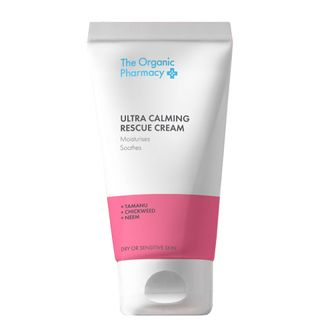
The Organic Pharmacy Face Ultra Calming Rescue Cream
Works for
1 of 1 advertised claim delivered
Moisturizing10 ingredients credited for this claimGood support
“The creamy texture cushions the skin with moisture while key botanicals such as tamanu, chickweed and neem work to support a calmer-looking complexion.”
This product can help improve hydration of the skin with the two types of ingredients.
The first type is called “humectants”:
these ingredients help attract water.
When humectants are on the surface of the skin, they “pull in” the moisture from the outside environment, or from
within deeper layers of the skin. The following ingredients in this product do the job:
glycerin, sodium lactate.
This product also contains ingredients called “occlusives”. They help reduce the speed with which our skin loses moisture to the outside environment. These ingredients also help soften the upper layer of the skin, so it feels less tight and nicer to the touch. The following ingredients in this product do the job: caprylic/capric triglyceride, cera alba.
Can it cause trouble?
Irritancy1 strong irritant: Sorbitan sesquioleateMedium risk
ComedogenicClean of flagged comedogenic ingredientsNone flagged
User reviews
Be the first — your take helps the next person decide.
Ingredients
Filter by role to see what each ingredient is doing.
Water~40–60%
Squalane~5.3–7.9%
- Irritation risk
- Low
An oil naturally present in skin. Works as an emollient to soften the skin and form a protective layer on its surface without a greasy feeling.
More about SqualaneGlycerin~3.8–5.7%
- Irritation risk
- Low
One of the best moisturizing ingredients. Naturally present in skin. It attracts water to the upper layer of the skin working as a humectant
More about GlycerinCera alba~2.8–4.2%
- Irritation risk
- Medium
Forms a protective barrier that holds water and keeps dry skin hydrated. Keeps an emulsion from separating into its oil and liquid components, and increases the thickness of a product. Can be an allergen
More about Cera albaCetearyl ethylhexanoate~2.2–3.3%
- Irritation risk
- Low
An emollient that helps soften the skin
More about Cetearyl ethylhexanoateCaprylic/capric triglyceride~1.9–2.8%
- Irritation risk
- Medium
A good mix of fatty acids that forms a protective layer on the skin. Improves the shelf life of products. Derived from coconut and glycerin
More about Caprylic/capric triglyceridePolyglyceryl-3 polyricinoleate~1.5–2.3%
- Irritation risk
- Medium
Helps oil and water mix together
More about Polyglyceryl-3 polyricinoleateSorbitan sesquioleate~1.3–2%
- Irritation risk
- High
Used to help oil and water mix together. Can be irritating
More about Sorbitan sesquioleateSodium lactate~1.1–1.6%
- Irritation risk
- Medium
Helps attract water to the upper layer of the skin. Is often used to adjust the pH level of the product
More about Sodium lactateSucrose polystearate~0.95–1.4%
- Irritation risk
- Medium
Helps oil and water mix together
More about Sucrose polystearateBenzyl alcohol~0.5–1%
- Irritation risk
- High
A preservative. Can be used to mask unpleasant smell. Can be irritating
More about Benzyl alcoholHelianthus annuus seed oil~0.5–1.2%
- Irritation risk
- Low
A great emollient due to its high linoleic acid content. One of the most effective plant oils in helping skin hydration and repairing skin barrier function
More about Helianthus annuus seed oilMelia azadirachta seed oil~0.5–1.15%
- Irritation risk
- Low
Helps soften the upper layer of the skin and can support skin barrier function due to the high linoleic acid content
More about Melia azadirachta seed oilAnthemis nobilis flower oil~0.35–0.85%
- Irritation risk
- High
An essential oil that is used as a fragrance and can be irritating. It might have some anti-oxidant effect in skin
More about Anthemis nobilis flower oilCalophyllum inophyllum seed oil~0.35–0.8%
- Irritation risk
- Low
Stellaria media extract~0.2–0.75%
- Irritation risk
- Low
Aloe barbadensis leaf juice~0.15–0.65%
- Irritation risk
- Medium
Traditionally used to treat sunburns, dermatitis and inflammation, but evidence for its effectiveness is lacking. The extract can contain humectants that help attract water into the skin
More about Aloe barbadensis leaf juicePolyglyceryl-3 ricinoleate~0.15–0.55%
Tocopherol~0.1–0.4%
- Irritation risk
- Low
Pure form of vitamin E. Can help moisturise and protect the skin from free radicals. Often used to help stabilise other ingredients or the formula itself
More about TocopherolMagnesium sulfate~0.1–0.4%
Salicylic acid~0.05–0.3%
- Irritation risk
- High
Used for skin exfoliation. It has an anti-inflammatory and anti-bacterial effect, helps to unclog pores, prevent blemishes and speed up healing of the existing ones. Sometimes referred to as a BHA (beta-hydroxy acid)
More about Salicylic acidSorbic acid~0.05–0.25%
Pinene~0.05–0.2%
- Irritation risk
- Low
Ingredient list view
Water, Squalane, Glycerin, Cera alba, Cetearyl ethylhexanoate, Caprylic/capric triglyceride, Polyglyceryl-3 polyricinoleate, Sorbitan sesquioleate, Sodium lactate, Sucrose polystearate, Benzyl alcohol, Helianthus annuus seed oil, Melia azadirachta seed oil, Anthemis nobilis flower oil, Calophyllum inophyllum seed oil, Stellaria media extract, Aloe barbadensis leaf juice, Polyglyceryl-3 ricinoleate, Tocopherol, Magnesium sulfate, Salicylic acid, Sorbic acid, Pinene
Compare prices
Retailers ranked by price — lowest first.

Affiliate links · prices updated regularly
Sources cited in this review
Every concentration estimate and effectiveness label is anchored to one of these 17 studies and safety reviews.
- 1
- 2
- 3
- 4
- 5
- 6Effect of topically applied lipids on surfactant-irritated skinonlinelibrary.wiley.com

Affiliate links · As an Amazon Associate, WIMJ earns from qualifying purchases.