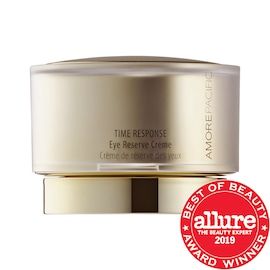
AMOREPACIFIC TIME RESPONSE Eye Reserve Crème
Works for
3 of 3 advertised claims delivered
Anti-aging10 ingredients credited for this claimStrong support
“Loss of Firmness and Elasticity, Dryness, and Dullness and Uneven TextureFormulation.”
This product can help reduce and prevent fine lines and wrinkles, improve skin elasticity and firmness because it contains adenosine.
These ingredients in the product can also be helpful, even though there is less evidence for their effectiveness: epigallocatechin gallate.
Keep in mind that it typically takes at least 6 weeks to notice any results because the changes that are needed to improve fine lines and elasticity happen in the deeper layers of the skin. No topical anti-aging product can “erase” wrinkles or fully reverse signs of aging.
Moisturizing31 ingredients credited for this claimGood support
“Loss of Firmness and Elasticity, Dryness, and Dullness and Uneven TextureFormulation.”
This product can help improve hydration of the skin with the two types of ingredients.
The first type is called “humectants”:
these ingredients help attract water.
When humectants are on the surface of the skin, they “pull in” the moisture from the outside environment, or from
within deeper layers of the skin. The following ingredients in this product do the job:
betaine, glycerin.
This product also contains ingredients called “occlusives”. They help reduce the speed with which our skin loses moisture to the outside environment. These ingredients also help soften the upper layer of the skin, so it feels less tight and nicer to the touch. The following ingredients in this product do the job: butyrospermum parkii butter, helianthus annuus seed oil.
Evens skin tone5 ingredients credited for this claimModerate support
“Loss of Firmness and Elasticity, Dryness, and Dullness and Uneven TextureFormulation.”
The following ingredient (ingredients) in this product might be helpful, but there is no evidence to confirm that it actually works: epigallocatechin gallate, glycine soja seed extract.
Anti-oxidationNot advertised by the brand · 12 ingredients credited for this claimModerate support
This product contains antioxidants (epigallocatechin gallate) that might be able to help neutralize free radicals in skin to lessen the damage it gets from the UV light (sun). There is not enough evidence to confirm their effectiveness in skin though.
Can it cause trouble?
Irritancy1 strong irritant: ParfumMedium risk
Comedogenic3 ingredients rated 2 or more on the 0–5 pore-clogging scale3 flagged


User reviews
Be the first — your take helps the next person decide.
Ingredients
Filter by role to see what each ingredient is doing.
Camellia sinensis leaf water~22–33%
- Irritation risk
- Low
Green tea leaf water. Might have some minimal anti-oxidant effect
More about Camellia sinensis leaf waterButylene glycol~4.3–6.4%
- Irritation risk
- Low
Used to create a nice product texture and help delivery of other ingredients. Might be somewhat helpful in attracting water to the upper layer of the skin
More about Butylene glycolWater~4.1–6.2%
Glycerin~2.8–4.1%
- Irritation risk
- Low
One of the best moisturizing ingredients. Naturally present in skin. It attracts water to the upper layer of the skin working as a humectant
More about GlycerinHydrogenated poly(c6-14 olefin)~2.2–3.4%
- Irritation risk
- Low
Helps soften the upper layer of the skin and create a nice product texture
More about Hydrogenated poly(c6-14 olefin)Butyrospermum parkii butter~1.8–2.8%
- Irritation risk
- Low
- Comedogenicity
- 3/5
A great moisturising ingredient that softens the skin and reduces water loss from its upper layer. It also can be helpful in protecting skin from free radicals
More about Butyrospermum parkii butterPentaerythrityl tetraethylhexanoate~1.5–2.3%
- Irritation risk
- Low
Used to create a nice product consistency while softening the upper layer of the skin
More about Pentaerythrityl tetraethylhexanoateHydrogenated olive oil lauryl esters~1.3–1.9%
- Irritation risk
- Low
Jojoba esters~1.1–1.6%
- Irritation risk
- Medium
An emollient made of jojoba oil. Helps soften the skin and support its barrier function
More about Jojoba estersMethyl trimethicone~0.85–1.25%
- Irritation risk
- Low
A type of silicone that helps create a silky product finish and dissolve other ingredients
More about Methyl trimethiconeCaprylic/capric triglyceride~0.6–1.4%
- Irritation risk
- Medium
A good mix of fatty acids that forms a protective layer on the skin. Improves the shelf life of products. Derived from coconut and glycerin
More about Caprylic/capric triglycerideDiisostearyl malate~0.55–1.25%
- Irritation risk
- Medium
Helps to soften the upper layer of the skin
More about Diisostearyl malateCetyl ethylhexanoate~0.5–1.2%
- Irritation risk
- Medium
An emollient that helps soften the skin and creates a thicker product texture
More about Cetyl ethylhexanoateBehenyl alcohol~0.5–1.15%
- Irritation risk
- Low
Non-drying alcohol that helps water and oil mix together. Also serves as an emollient
More about Behenyl alcoholHelianthus annuus seed oil~0.45–1.1%
- Irritation risk
- Low
A great emollient due to its high linoleic acid content. One of the most effective plant oils in helping skin hydration and repairing skin barrier function
More about Helianthus annuus seed oilPropanediol~0.4–0.95%
- Irritation risk
- Low
Acts as a solvent for other ingredients. Speeds up the absorption of other ingredients into the skin
More about PropanediolHydrogenated lecithin~0.4–0.9%
- Irritation risk
- Low
Helps to retain moisture by creating a protective barrier on the skin. Rich in fatty acids. Improves product texture and helps with the penetration of other ingredients.
More about Hydrogenated lecithinPeg-40 stearate~0.4–0.9%
Camellia sinensis seed oil~0.35–0.85%
- Irritation risk
- Low
A plant oil that helps to soften the upper layer of the skin and can help restore the skin barrier. Might have some anti-oxidant effect
More about Camellia sinensis seed oilArachidyl alcohol~0.35–0.85%
- Irritation risk
- Low
Used to soften the upper layer of the skin and create a thicker product consistency
More about Arachidyl alcoholBetaine~0.2–0.75%
- Irritation risk
- Low
Helps attract water to the upper layer of the skin and improves the product texture
More about BetaineNiacinamide~0.2–0.8%
- Irritation risk
- Low
Is proven to be effective in reducing blemishes, evening out skin tone and helping to improve lines and wrinkles. It helps the skin to repair sun damage, calm down inflammation and keep maintain good levels of moisture. The concentration of about 2% is effective for supporting the skin barrier and evening out the skin tone. Concentration of 4-6% is better for helping with acne and balancing the sebum production
More about NiacinamidePolyglyceryl-10 stearate~0.2–0.75%
- Irritation risk
- Medium
Helps water and oil mix together and softens the upper layer of the skin
More about Polyglyceryl-10 stearateHexanediol~0.2–0.75%
Hydroxyethyl acrylate/sodium acryloyldimethyl taurate copolymer~0.2–0.75%
- Irritation risk
- Medium
A gelling agent that thickens the product consistency and leaves the skin with a velvety finish
More about Hydroxyethyl acrylate/sodium acryloyldimethyl taurate copolymerGlyceryl stearate~0.35–0.8%
- Irritation risk
- Low
An emollient that softens the skin and forms a protective layer on its surface. Helps water and oil mix together
More about Glyceryl stearateCetearyl alcohol~0.35–0.8%
- Irritation risk
- Low
- Comedogenicity
- 2/5
A non-drying alcohol. Works as an emollient. Helps water and oil mix together and creates a nice product texture
More about Cetearyl alcoholMica~0.35–0.75%
- Irritation risk
- Low
Creates an illusion of smoother and more radiant skin tone. Adds shimmer to the skin by reflecting light
More about MicaArachidyl glucoside~0.3–0.7%
Parfum~0.2–0.75%
- Irritation risk
- High
An aromatic blend of unspecified and possibly irritating ingredients
More about ParfumTitanium dioxide~0.35–0.75%
- Irritation risk
- Low
Works as a UV filter when used in high concentrations. It is photostable and is effective mostly against the UVB light, with some protection in the UVA range. In small concentrations, used for its ability to improve the color of cosmetic products. Is usually well tolerated by the skin
More about Titanium dioxideCi 77891~0.2–0.75%
- Irritation risk
- Low
Dipotassium glycyrrhizate~0.3–0.7%
- Irritation risk
- Low
A salt derived from licorice. Works as an emollient to soften the upper layer of the skin and can help calm down inflammation. Might be helpful for skin lightening
More about Dipotassium glycyrrhizateCaffeine~0.3–0.7%
- Irritation risk
- Medium
Might be helpful in neutralizing free radicals. Can have a dehydration effect that might somewhat decrease the look of puffy eyes
More about CaffeineGlyceryl caprylate~0.4–0.9%
- Irritation risk
- Low
An emollient that can also help water and oil mix together, as well as prevent bacteria growth in products
More about Glyceryl caprylateDipalmitoyl hydroxyproline~0.3–0.7%
- Irritation risk
- Low
Is claimed to stimulate collagen and elastin production, as well as work as an anti-oxidant. There is however not enough evidence for its effectiveness
More about Dipalmitoyl hydroxyprolineAcrylates/c10-30 alkyl acrylate crosspolymer~0.4–0.9%
- Irritation risk
- Medium
Maintains the texture of skincare products. Allows the product to spread evenly. Helps oil and water mix together
More about Acrylates/c10-30 alkyl acrylate crosspolymerDisodium edta~0.3–0.75%
Ethylhexylglycerin~0.3–0.75%
Adenosine~0.3–0.75%
- Irritation risk
- Low
Might help improve cell turnover and reduce inflammation in skin. One study shows that the ingredients might be able to help reduce dynamic wrinkles (for example, in the corners of the eyes or on the forehead)
More about AdenosineBeta-glucan~0.3–0.7%
- Irritation risk
- Low
Helps attract water to the upper layer of the skin, calm down inflammation and irritation, restore the barrier function and support wound healing. It can be helpful in reducing fine lines and wrinkles
More about Beta-glucanTromethamine~0.3–0.7%
Sorbitan isostearate~0.3–0.75%
- Irritation risk
- Low
Helps oil and water mix together
More about Sorbitan isostearatePolysorbate 60~0.35–0.75%
Palmitic acid~0.35–0.85%
- Irritation risk
- Low
An emollient that is naturally present in skin and helps soften it
More about Palmitic acidNatto gum~0.3–0.7%
- Irritation risk
- Low
Glycine soja seed extract~0.2–0.75%
- Irritation risk
- Medium
An emollient that helps soften the skin. Might be somewhat helpful in evening the skin tone.
More about Glycine soja seed extractTheobroma cacao extract~0.15–0.65%
- Irritation risk
- Low
- Comedogenicity
- 3/5
Dextrin~0.15–0.65%
- Irritation risk
- Low
A sugar that is used to stabilize the product formulation. Can help attract water to the upper layer of the skin
More about DextrinCamellia sinensis leaf extract~0.15–0.65%
- Irritation risk
- Low
Can contain potent anti-oxidant compounds (abbreviated ECG, GCG, EGC, and EGCG) that might help protect the skin from free radicals. Can help calm down inflammation and has some anti-bacterial properties. Unfortunately, these antioxidants are unstable and lose their effectiveness very quickly in products. The concentration of the antioxidant compounds in the extract also tends to be low to be effective in topical formulation
More about Camellia sinensis leaf extractGlucose~0.15–0.6%
- Irritation risk
- Low
Helps attract water to the upper layer of the skin. Could be helpful in restoring the skin barrier function
More about GlucoseTocopherol~0.15–0.55%
- Irritation risk
- Low
Pure form of vitamin E. Can help moisturise and protect the skin from free radicals. Often used to help stabilise other ingredients or the formula itself
More about TocopherolPoloxamer 235~0.15–0.6%
Ethoxydiglycol~0.1–0.45%
Epigallocatechin gallate~0.1–0.45%
- Irritation risk
- Low
A polyphenol found in tea. This particular compound abbreviated EGCG is the most powerful antioxidant among those extracted from tea (usually green tea). Unfortunately, EGCG is unstable, requires a low pH (below 4) to prevent quick degradation, and does not penetrate the skin very well. This is why the full anti-oxidant effect of EGCG is typically not realized when it is added to topical skincare
More about Epigallocatechin gallateTocophersolan~0.1–0.4%
- Irritation risk
- Low
Poloxamer 338~0.1–0.4%
Phenoxyethanol~0.1–0.4%
- Irritation risk
- Low
A preservative. It helps prevent bacterial growth in cosmetic products
More about PhenoxyethanolPanax ginseng root extract~0.15–0.55%
- Irritation risk
- High
A plant extract that might have some anti-inflammatory properties, but solid evidence is lacking. It can be irritating
More about Panax ginseng root extractMagnolia obovata bark extract~0.1–0.3%
- Irritation risk
- Low
Caprylyl glycol~0.1–0.5%
- Irritation risk
- Medium
Helps preserve products and creates a nice product texture
More about Caprylyl glycolIngredient list view
Camellia sinensis leaf water, Butylene glycol, Water, Glycerin, Hydrogenated poly(c6-14 olefin), Butyrospermum parkii butter, Pentaerythrityl tetraethylhexanoate, Hydrogenated olive oil lauryl esters, Jojoba esters, Methyl trimethicone, Caprylic/capric triglyceride, Diisostearyl malate, Cetyl ethylhexanoate, Behenyl alcohol, Helianthus annuus seed oil, Propanediol, Hydrogenated lecithin, Peg-40 stearate, Camellia sinensis seed oil, Arachidyl alcohol, Betaine, Niacinamide, Polyglyceryl-10 stearate, Hexanediol, Hydroxyethyl acrylate/sodium acryloyldimethyl taurate copolymer, Glyceryl stearate, Cetearyl alcohol, Mica, Arachidyl glucoside, Parfum, Titanium dioxide, Ci 77891, Dipotassium glycyrrhizate, Caffeine, Glyceryl caprylate, Dipalmitoyl hydroxyproline, Acrylates/c10-30 alkyl acrylate crosspolymer, Disodium edta, Ethylhexylglycerin, Adenosine, Beta-glucan, Tromethamine, Sorbitan isostearate, Polysorbate 60, Palmitic acid, Natto gum, Glycine soja seed extract, Theobroma cacao extract, Dextrin, Camellia sinensis leaf extract, Glucose, Tocopherol, Poloxamer 235, Ethoxydiglycol, Epigallocatechin gallate, Tocophersolan, Poloxamer 338, Phenoxyethanol, Panax ginseng root extract, Magnolia obovata bark extract, Caprylyl glycol
Compare prices
Retailers ranked by price — lowest first.
Worth comparing, line by line.
Match % combines shared ingredients, the first five ingredients, shared actives and hero ingredients, irritancy (lower counts in the alternative's favour), texture and body area. Only products in the same routine step are compared.
| AMOREPACIFICTIME RESPONSE Eye Reserve CrèmeYOUR PRODUCT | COSRXAdvanced Snail Peptide Eye Cream | Beyou CosmeticsCaffeine Eye Cream | MizonCollagen Power Firming Eye Cream | |
|---|---|---|---|---|
| Match | — | 86% | 86% | 85% |
| Price | $260.00 | $20.88−$239.12 | $18.99−$241.01 | $13.33−$246.67 |
| Shared key ingredients | — | 5 of 15 | 5 of 15 | 6 of 15 |
| Key difference | — | Copper Tripeptide-1 | Panthenol | Copper Tripeptide-1 |
| Irritancy | Medium | Low | Low | Medium |
| Drying alcohol | — | — | — | — |
| View product | Shop | Shop | Shop |


Sources cited in this review
Every concentration estimate and effectiveness label is anchored to one of these 30 studies and safety reviews.
- 1
- 2Safety Assessment of Pentaerythrityl Tetraesters as Used in Cosmeticsjournals.sagepub.com
- 3
- 4
- 5Effect of topically applied lipids on surfactant-irritated skinonlinelibrary.wiley.com
- 6

Affiliate links · As an Amazon Associate, WIMJ earns from qualifying purchases.