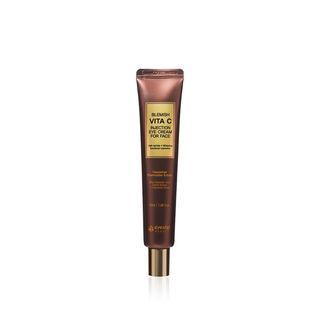
Eyenlip Injection Eye Cream For Face - 2 Types
Works for
2 of 2 advertised claims delivered
Anti-aging8 ingredients credited for this claimStrong support
“Niacin Vita B This eye cream helps improve wrinkles with adenoside and calms the skin around eye areas with centella asiatica extract.”
This product can help reduce and prevent fine lines and wrinkles, improve skin elasticity and firmness because it contains adenosine.
Keep in mind that it typically takes at least 6 weeks to notice any results because the changes that are needed to improve fine lines and elasticity happen in the deeper layers of the skin. No topical anti-aging product can “erase” wrinkles or fully reverse signs of aging.
Moisturizing28 ingredients credited for this claimGood support
“Helps whiten the skin with 4% of niacinamide and keeps the skin moisturized with 7 kinds of hyaluronic acids.”
This product can help improve hydration of the skin with the two types of ingredients.
The first type is called “humectants”:
these ingredients help attract water.
When humectants are on the surface of the skin, they “pull in” the moisture from the outside environment, or from
within deeper layers of the skin. The following ingredients in this product do the job:
arginine, betaine.
This product also contains ingredients called “occlusives”. They help reduce the speed with which our skin loses moisture to the outside environment. These ingredients also help soften the upper layer of the skin, so it feels less tight and nicer to the touch. The following ingredients in this product do the job: arginine, beeswax.
Can it cause trouble?
Irritancy2 strong irritants: Parfum, Carica papaya fruit extractMedium risk
Comedogenic2 ingredients rated 2 or more on the 0–5 pore-clogging scale2 flagged


User reviews
Be the first — your take helps the next person decide.
Ingredients
Filter by role to see what each ingredient is doing.
Water~45–55%
Glycerin~4.9–5.9%
- Irritation risk
- Low
One of the best moisturizing ingredients. Naturally present in skin. It attracts water to the upper layer of the skin working as a humectant
More about GlycerinCaprylic/capric triglyceride~4.1–5%
- Irritation risk
- Medium
A good mix of fatty acids that forms a protective layer on the skin. Improves the shelf life of products. Derived from coconut and glycerin
More about Caprylic/capric triglycerideButylene glycol~3–3.6%
- Irritation risk
- Low
Used to create a nice product texture and help delivery of other ingredients. Might be somewhat helpful in attracting water to the upper layer of the skin
More about Butylene glycolButylene glycol dicaprylate/dicaprate~2.3–2.8%
- Irritation risk
- Low
Helps soften the upper layer of the skin
More about Butylene glycol dicaprylate/dicapratePropanediol~1.8–2.2%
- Irritation risk
- Low
Acts as a solvent for other ingredients. Speeds up the absorption of other ingredients into the skin
More about PropanediolBeeswax~1.6–2%
- Irritation risk
- Low
Forms a protective barrier that holds water and keeps dry skin hydrated. Keeps an emulsion from separating into its oil and liquid components, and increases the thickness of a product. Can be an allergen
More about BeeswaxCetyl alcohol~1.4–1.8%
- Irritation risk
- Low
A non-drying alcohol that works to soften the skin and stabilize product formulations helping oil and water mix together
More about Cetyl alcoholBetaine~1.1–1.3%
- Irritation risk
- Low
Helps attract water to the upper layer of the skin and improves the product texture
More about BetainePhenyl trimethicone~0.95–1.15%
- Irritation risk
- Low
A type of silicone that can decrease loss of moisture from the skin surface. It helps create a nice product texture
More about Phenyl trimethiconeSorbitan stearate~0.65–1%
Dipropylene glycol~0.5–0.75%
- Irritation risk
- Low
Helps to dissolve other ingredients in a formulation. Slows down the rate of product drying
More about Dipropylene glycolArginine~0.45–0.65%
- Irritation risk
- Low
An amino acid that is naturally present in skin and helps keep it hydrated. When used together with AHAs, it can reduce their irritating effect on the skin
More about ArginineMethylpropanediol~0.4–0.6%
Hydroxyacetophenone~0.35–0.6%
Cetearyl olivate~0.35–0.6%
Stearyl alcohol~0.4–0.6%
- Irritation risk
- Low
An emollient that helps soften the skin
More about Stearyl alcoholSorbitan olivate~0.3–0.55%
Ammonium acryloyldimethyltaurate/vp copolymer~0.25–0.5%
- Irritation risk
- Low
Increases thickness of a product. Texture enhancer for oil-in-water emulsions
More about Ammonium acryloyldimethyltaurate/vp copolymerAllantoin~0.2–0.35%
- Irritation risk
- Low
Helps calm down inflammation in skin and can help reduce itching. Helps to repair the skin barrier and keep skin hydrated
More about AllantoinMyristyl alcohol~0.25–0.45%
- Irritation risk
- High
Helps to stabilize the product formulation while softening the upper layer of the skin. Can be irritating
More about Myristyl alcoholAdenosine~0.2–0.35%
- Irritation risk
- Low
Might help improve cell turnover and reduce inflammation in skin. One study shows that the ingredients might be able to help reduce dynamic wrinkles (for example, in the corners of the eyes or on the forehead)
More about AdenosineLauryl alcohol~0.2–0.4%
Dipotassium glycyrrhizate~0.15–0.3%
- Irritation risk
- Low
A salt derived from licorice. Works as an emollient to soften the upper layer of the skin and can help calm down inflammation. Might be helpful for skin lightening
More about Dipotassium glycyrrhizateCitrofortunella microcarpa fruit extract~0.15–0.3%
- Irritation risk
- Low
Xanthan gum~0.2–0.35%
- Irritation risk
- Low
Used to create a thicker product consistency
More about Xanthan gumCarbomer~0.2–0.35%
- Irritation risk
- Low
Helps create a thicker or gel-like product texture. It is not a surfactant but can be used in gentle cleansing formulations
More about CarbomerCaprylyl glycol~0.2–0.4%
- Irritation risk
- Medium
Helps preserve products and creates a nice product texture
More about Caprylyl glycol1,2-hexanediol~0.2–0.35%
Parfum~0.15–0.3%
- Irritation risk
- High
An aromatic blend of unspecified and possibly irritating ingredients
More about ParfumHydroxypropyltrimonium hyaluronate~0.2–0.4%
- Irritation risk
- Low
Potassium hyaluronate~0.2–0.35%
- Irritation risk
- Low
Oryza sativa bran extract~0.2–0.35%
Capsicum annuum fruit extract~0.2–0.35%
- Irritation risk
- Medium
Pepper extract. Might be able to help neutralize free radicals
More about Capsicum annuum fruit extractHelianthus annuus seed oil~0.2–0.4%
- Irritation risk
- Low
A great emollient due to its high linoleic acid content. One of the most effective plant oils in helping skin hydration and repairing skin barrier function
More about Helianthus annuus seed oilNiacinamide~0.2–0.35%
- Irritation risk
- Low
Is proven to be effective in reducing blemishes, evening out skin tone and helping to improve lines and wrinkles. It helps the skin to repair sun damage, calm down inflammation and keep maintain good levels of moisture. The concentration of about 2% is effective for supporting the skin barrier and evening out the skin tone. Concentration of 4-6% is better for helping with acne and balancing the sebum production
More about NiacinamideCentella asiatica extract~0.2–0.4%
- Irritation risk
- Medium
A plant extract that has been shown to be able to reduce inflammation in skin, support restoration of skin barrier function, as well as support collagen production. Contains active compounds called centelloids: asiaticoside, madecasosside, asiatic acid and madecassic acid. Might be helpful in preventing stretch marks. It can be itself be irritating though.
More about Centella asiatica extractHippophae rhamnoides extract~0.2–0.35%
- Irritation risk
- Low
Daucus carota sativa root extract~0.2–0.35%
- Irritation risk
- Low
Carrot extract. Might have anti-oxidant properties and be used to add orange color
More about Daucus carota sativa root extract3-o-ethyl ascorbic acid~0.2–0.35%
- Irritation risk
- High
A vitamin C derivative that is more stable but less potent than pure form of vitamin C. Can help neutralize free radicals and help reduce hyperpigmentation, but the required concentration is likely to be much higher than for the pure form of vitamin C, limiting the ingredient's effectiveness in products
More about 3-o-ethyl ascorbic acidSodium hyaluronate~0.2–0.35%
- Irritation risk
- Low
One of the best moisturizing ingredients. Attracts water into the upper layer of the skin
More about Sodium hyaluronateSolanum tuberosum pulp extract~0.2–0.35%
- Irritation risk
- Low
Sodium acetylated hyaluronate~0.2–0.35%
- Irritation risk
- Low
A type of hyaluronic acid that works as an excellent moisturizer by attracting water into the upper layer of the skin. Is typically feels less sticky on the skin compared to the usual hyaluronic acid
More about Sodium acetylated hyaluronateHydrolyzed hyaluronic acid~0.15–0.3%
- Irritation risk
- Low
One of the best moisturizing ingredients. Attracts water into the upper layer of the skin. A version of it is naturally present in skin
More about Hydrolyzed hyaluronic acidHyaluronic acid~0.2–0.35%
- Irritation risk
- Low
One of the best moisturizing ingredients. Attracts water into the upper layer of the skin. Naturally present in skin. Typically has large molecule size unless advertised otherwise on the product label. Helps support skin's barrier function and may help to reduce inflammation
More about Hyaluronic acidAloe barbadensis leaf juice~0.2–0.35%
- Irritation risk
- Medium
Traditionally used to treat sunburns, dermatitis and inflammation, but evidence for its effectiveness is lacking. The extract can contain humectants that help attract water into the skin
More about Aloe barbadensis leaf juiceTocopheryl acetate~0.2–0.35%
- Irritation risk
- Medium
A more stable but less bio-available form of vitamin E compared to Tocopherol. Might help moisturize and protect the skin from free radicals, but mostly used in low concentrations to stabilize other ingredients.
More about Tocopheryl acetateHoney extract~0.2–0.35%
- Irritation risk
- Medium
Helps attract water to the upper layer of the skin
More about Honey extractSimmondsia chinensis seed oil~0.25–0.45%
- Irritation risk
- Medium
Softens the upper layer of skin and helps restore the healthy skin barrier. Has shown to help calm down inflammation in skin. It is a stable oil, meaning that it retains its properties even when exposed to air.
More about Simmondsia chinensis seed oilAscorbic acid~0.15–0.3%
- Irritation risk
- High
The most well-researched antioxidant that works in skin. Helps neutralize free radicals supporting collagen production, helping to even out the skin tone and preventing early signs of aging
More about Ascorbic acidNiacinamide~0.15–0.3%
- Irritation risk
- Low
Is proven to be effective in reducing blemishes, evening out skin tone and helping to improve lines and wrinkles. It helps the skin to repair sun damage, calm down inflammation and keep maintain good levels of moisture. The concentration of about 2% is effective for supporting the skin barrier and evening out the skin tone. Concentration of 4-6% is better for helping with acne and balancing the sebum production
More about NiacinamideButyrospermum parkii butter~0.2–0.4%
- Irritation risk
- Low
- Comedogenicity
- 3/5
A great moisturising ingredient that softens the skin and reduces water loss from its upper layer. It also can be helpful in protecting skin from free radicals
More about Butyrospermum parkii butterCarica papaya fruit extract~0.15–0.25%
- Irritation risk
- High
Argania spinosa kernel oil~0.2–0.35%
- Irritation risk
- Medium
An emollient that helps soften the upper layer of the skin. Might have some weak anti-oxidant properties
More about Argania spinosa kernel oilCetearyl alcohol~0.2–0.35%
- Irritation risk
- Low
- Comedogenicity
- 2/5
A non-drying alcohol. Works as an emollient. Helps water and oil mix together and creates a nice product texture
More about Cetearyl alcoholSolanum lycopersicum fruit extract~0.1–0.2%
- Irritation risk
- Low
Sodium hyaluronate crosspolymer~0.1–0.15%
- Irritation risk
- Medium
Attracts water into the upper layer of the skin
More about Sodium hyaluronate crosspolymerIngredient list view
Water, Glycerin, Caprylic/capric triglyceride, Butylene glycol, Butylene glycol dicaprylate/dicaprate, Propanediol, Beeswax, Cetyl alcohol, Betaine, Phenyl trimethicone, Sorbitan stearate, Dipropylene glycol, Arginine, Methylpropanediol, Hydroxyacetophenone, Cetearyl olivate, Stearyl alcohol, Sorbitan olivate, Ammonium acryloyldimethyltaurate/vp copolymer, Allantoin, Myristyl alcohol, Adenosine, Lauryl alcohol, Dipotassium glycyrrhizate, Citrofortunella microcarpa fruit extract, Xanthan gum, Carbomer, Caprylyl glycol, 1,2-hexanediol, Parfum, Hydroxypropyltrimonium hyaluronate, Potassium hyaluronate, Oryza sativa bran extract, Capsicum annuum fruit extract, Helianthus annuus seed oil, Niacinamide, Unknown, Centella asiatica extract, Hippophae rhamnoides extract, Daucus carota sativa root extract, 3-o-ethyl ascorbic acid, Sodium hyaluronate, Solanum tuberosum pulp extract, Sodium acetylated hyaluronate, Hydrolyzed hyaluronic acid, Hyaluronic acid, Aloe barbadensis leaf juice, Tocopheryl acetate, Honey extract, Simmondsia chinensis seed oil, Unknown, Ascorbic acid, Niacinamide, Butyrospermum parkii butter, Carica papaya fruit extract, Argania spinosa kernel oil, Cetearyl alcohol, Solanum lycopersicum fruit extract, Sodium hyaluronate crosspolymer
Compare prices
Retailers ranked by price — lowest first.

Affiliate links · prices updated regularly
Worth comparing, line by line.
Match % combines shared ingredients, the first five ingredients, shared actives and hero ingredients, irritancy (lower counts in the alternative's favour), texture and body area. Only products in the same routine step are compared.
| EyenlipInjection Eye Cream For Face - 2 TypesYOUR PRODUCT | 12 GRABSOlibetaine Rich Hyaluron Moist Cream | NERISHSoy Ceramide Barrier Cream | preangeVit B5 Emulsion | |
|---|---|---|---|---|
| Match | — | 82% | 82% | 82% |
| Price | $11.79 | $19.80+$8.01 | $16.11+$4.32 | $21.15+$9.36 |
| Shared key ingredients | — | 13 of 21 | 11 of 21 | 12 of 21 |
| Key difference | — | Panthenol | Ceramide Np | Panthenol |
| Irritancy | Medium | Low | Medium | Low |
| Drying alcohol | — | — | — | — |
| View product | Shop | Shop | Shop |


Product summary
Based on the ingredients included, "Eyenlip - Injection Eye Cream For Face - 2 Types" works well for moisturizing the skin. This moisturizer uses a good combo of humectants and emollients. These both types of ingredients are essentials for improving the skin hydration and keeping the skin barrier healthy. Arginine, betaine, glycerin, butylene glycol and caprylyl glycol in this product (humectants) attract water molecules to the upper layer of the skin (the water comes from the outside air or from the deeper layers of the skin if the air is dry). Emollients in this formulation (arginine, beeswax, caprylic/capric triglyceride, phenyl trimethicone and butylene glycol dicaprylate/dicaprate) help to reduce the moisture loss from the skin. They also soften the skin surface and relieve the feeling of dryness and tightness.
Ingredient callouts
- We particularly like that there is a good concentration of Niacinamide (4.10% - 5.00%) in this moisturizer. Niacinamide is a well-studied multi-tasking active. It is a great ingredient to have in a moisturizer. It is stable, and can work well in almost any hydrating formulation. There is solid evidence that Niacinamide can help support skin barrier, regulate oil production and reduce acne and clogged pores. It also helps to fight photodamage and help improve the skin tone, reducing pigmentation marks.
- This product also contains Vitamin C (Ascorbic Acid). It can be an effective active for anti-aging and evening out the skin tone, but in this moisturizer it is used for stabilizing other ingredients in the formulation. In this concentration (0.15% - 0.30%) it cannot have a noticeable benefit for the skin.
- Adenosine 0.20% - 0.40%. It is a chemical present inside our skin cells. A clinical trial confirmed that topical application of Adenosine in a low concentration can reduce dynamic wrinkles (these are the wrinkles that appear with age in a places where our mimic is the most active, for example, in the corners of the eyes or on the forehead).
Irritation risk
There are some common irritants in this product, including ingredients that do not have benefits for the skin. We assess the overall irritancy of this moisturizer to be medium. For a detailed overview of all potential irritants: click here
You can see the detailed formula review with the breakdown of all actives in the product and the full ingredient list with estimated concentrations in the tables below.
Price
The product retails for 11.10$ in the United States.
For a detailed price comparison: click here.
Sources cited in this review
Every concentration estimate and effectiveness label is anchored to one of these 29 studies and safety reviews.
- 1
- 2
- 3Cosmetic allergy from myristyl alcoholncbi.nlm.nih.gov
- 4
- 5Patch testing with myristyl alcoholresearchgate.net
- 6

Affiliate links · As an Amazon Associate, WIMJ earns from qualifying purchases.