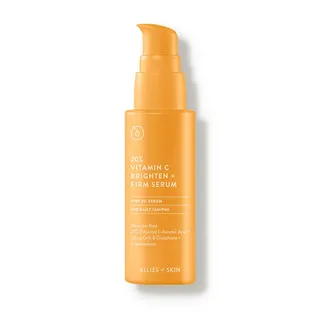
Allies of Skin 20% Vitamin C Brighten + Firm Serum

Allies of Skin 20% Vitamin C Brighten + Firm Serum

Efficacy91/100IrritancyHigh

Works for

Moisturizing
Ceramide np, Palmitoyl tripeptide-5 + 31 more
Works well
What the product description says
“balm-like quality”
Source: Candour Beauty

This product can help improve hydration of the skin with the two types of ingredients.

The first type is called “humectants”:
these ingredients help attract water. When humectants are on the surface of the skin, they “pull in” the moisture from the outside environment, or from within deeper layers of the skin. The following ingredients in this product do the job: dextran, glycerin.

This product also contains ingredients called “occlusives”. They help reduce the speed with which our skin loses moisture to the outside environment. These ingredients also help soften the upper layer of the skin, so it feels less tight and nicer to the touch. The following ingredients in this product do the job: helianthus annuus seed oil, carthamus tinctorius seed oil.

The following ingredients in this product are especially good for supporting the skin barrier and helping with the hydration level: ceramide np, palmitoyl tripeptide-5, palmitoyl tripeptide-8

Ceramide npHero· EmollientEffect: HighA type of lipid similar to ceramides naturally present in skin. Helps to soften the upper layer of the skin and supports the skin barrier function to keep it hydrated. Can help to prevent inflammation in skin~0.3–0.6%
Palmitoyl tripeptide-5HeroEffect: HighA type of peptide. Peptides are excellent moisturizers and might be able support collagen production reducing fine lines and wrinkles~0.3–0.5%
Palmitoyl tripeptide-8HeroEffect: High~0.3–0.5%
Carthamus tinctorius seed oilKey active· EmollientEffect: HighAn emollient that helps soften the skin and might help calm down inflammation~1.6–1.9%
Helianthus annuus seed oilKey active· Emollient, OcclusiveEffect: HighA great emollient due to its high linoleic acid content. One of the most effective plant oils in helping skin hydration and repairing skin barrier function~1.2–1.4%
Hydrolyzed jojoba estersKey activeEffect: HighHelps soften the upper layer of the skin~0.6–0.9%
Hydrolyzed silkKey active· HumectantEffect: MediumCan help attract water to the upper layer of the skin~0.45–0.65%
Sodium hyaluronateKey active· HumectantEffect: HighOne of the best moisturizing ingredients. Attracts water into the upper layer of the skin~0.3–0.55%
DextranKey active· HumectantEffect: HighHelps attract water to the most upper layer of the skin. Derived from sugar~0.3–0.55%
GlutathioneKey activeEffect: HighA peptide that can help neutralize free radicals in skin and reduce melanin production resulting in skin lightening effect and reduction in hyperpigmentation. It can also help attract moisture to the upper layer of the skin~0.3–0.55%
GlycerinKey active· HumectantEffect: HighOne of the best moisturizing ingredients. Naturally present in skin. It attracts water to the upper layer of the skin working as a humectant~0.3–0.55%
Helianthus annuus seed waxKey active· EmollientEffect: HighHelps soften the upper layer of the skin and support skin's barrier function while creating a thicker product consistency~0.3–0.5%
Hyaluronic acidKey active· HumectantEffect: HighOne of the best moisturizing ingredients. Attracts water into the upper layer of the skin. Naturally present in skin. Typically has large molecule size unless advertised otherwise on the product label. Helps support skin's barrier function and may help to reduce inflammation~0.3–0.55%
SphingolipidsKey active· EmollientEffect: HighSphingolipids are a group of lipids with a common chemical structure. Some of them are naturally present in skin and can be converted to ceramides~0.3–0.55%
C12-15 alkyl benzoateKey active· EmollientEffect: MediumEnhances the product texture and makes it more spreadable. Helps reduce water loss from the outer layer of skin. Extands the shelf life by preventing bacteria growth~0.3–0.5%
Moringa oleifera seed extractKey activeEffect: MediumHelps soften the upper layer of the skin and might have some antioxidant effect~0.3–0.5%
HoneyKey active· HumectantEffect: MediumHelps attract water to the skin and might have some anti-bacterial properties. Can be an allergen~0.3–0.5%
PhospholipidsKey activeEffect: MediumEmollients that are naturaly present in skin. In addition, they help water and oil mix together in the product~0.3–0.55%
Lactobacillus fermentKey active· HumectantEffect: HighA fermentation product created by bacteria Lactobacillus. The fermented product has anti-bacterial properties and might be helpful in calming down inflammation, but studies are lacking. Helps attract water to the upper layer of the skin. Can be used as a preservative~0.25–0.45%
Moringa oleifera seed oil· EmollientEffect: LowA plant oil that helps soften the upper layer of the skin. Is unlikely to be helpful in restoring skin barrier function due to the low content of linoleic acid~0.55–0.8%
Isohexadecane· EmollientEffect: LowImproves the texture of the product and helps soften the skin. Helps oil and water mix together and can be used as a cleansing agent~0.4–0.6%
Dicaprylyl ether· EmollientEffect: LowHelps soften the upper layer of the skin while creating a non-greasy feel on the skin. Helps to dissolve other ingredients~0.3–0.5%
Caprylyl glycol· Humectant, EmollientEffect: LowHelps preserve products and creates a nice product texture~0.3–0.6%
Calcium gluconate· HumectantEffect: LowHelps attract water to the upper layer of the skin and helps to improve appearance of the product~0.3–0.5%
Butylene glycol· HumectantEffect: LowUsed to create a nice product texture and help delivery of other ingredients. Might be somewhat helpful in attracting water to the upper layer of the skin~0.25–0.45%
Camellia sinensis leaf extractEffect: Low, below effective doseCan contain potent anti-oxidant compounds (abbreviated ECG, GCG, EGC, and EGCG) that might help protect the skin from free radicals. Can help calm down inflammation and has some anti-bacterial properties. Unfortunately, these antioxidants are unstable and lose their effectiveness very quickly in products. The concentration of the antioxidant compounds in the extract also tends to be low to be effective in topical formulation~0.45–0.65%
LecithinEffect: Low, below effective doseUsed mostly for creating emulsions - helping oil and water mix together. Helps soften the upper layer of the skin~0.35–0.6%
TocopherolEffect: Low, below effective dosePure form of vitamin E. Can help moisturise and protect the skin from free radicals. Often used to help stabilise other ingredients or the formula itself~0.3–0.55%
Isononyl isononanoateEffect: Low, below effective doseForms a protective film on the surface of the skin to prevent moisture loss. Gives a velvety feel to products while reducing tackiness~0.3–0.5%
Lactic acidUnder-dosedAn exfoliating and moisturizing alpha-hydroxy acid (AHA). Typically causes less irritation than other AHAs, for example, glycolic acid. At high concentrations (about 15%), lactic acid can help reduce lines and wrinkles. Recent studies show that lactic acid can support the "good" bacteria living on skin's surface (healthy skin microbiome)~0.65–0.95%
Caprylic/capric triglycerideUnder-dosedA good mix of fatty acids that forms a protective layer on the skin. Improves the shelf life of products. Derived from coconut and glycerin~0.3–0.55%
NiacinamideUnder-dosedIs proven to be effective in reducing blemishes, evening out skin tone and helping to improve lines and wrinkles. It helps the skin to repair sun damage, calm down inflammation and keep maintain good levels of moisture. The concentration of about 2% is effective for supporting the skin barrier and evening out the skin tone. Concentration of 4-6% is better for helping with acne and balancing the sebum production~0.25–0.5%
GluconolactoneUnder-dosedA polyhydroxy acid (PHA) that helps shed the dead cells from the skin surface revealing smoother skin. Is believed to be genter than AHAs. It helps attract water to the upper layer of the skin and can stimulate production of skin's own hyaluronic acid resulting in improved hydration levels. It has been shown to be helpful against acne and clogged pores if used consistently (e.g over a period of 12 weeks) in high enough concentration. It can help reduce fine lines and wrinkles and improve skin tone with long-term application. Can help neutralize free radicals~0.25–0.45%
Evens skin tone
Glutathione, Tetrahydrobisdemethoxydiferuloylmethane + 8 more
Works well
What the product description says
“brighten”
Source: Candour Beauty

This product can help reduce hypepigmentation and even out the skin tone because it contains the following effective ingredients: glutathione

The following ingredient (ingredients) in this product might be helpful, but there is no evidence to confirm that it actually can help even out the skin tone: tetrahydrobisdemethoxydiferuloylmethane, tetrahydrodemethoxydiferuloylmethane, tetrahydrodiferuloylmethane.

Keep in mind that you would need to apply any topical skincare targetted at hypigmentation consistently for a couple of months to get a result. No topical skincare product can help get rid of hyperpigmentation (including post-acne marks and age spots) instantly.

GlutathioneKey activeEffect: HighA peptide that can help neutralize free radicals in skin and reduce melanin production resulting in skin lightening effect and reduction in hyperpigmentation. It can also help attract moisture to the upper layer of the skin~0.3–0.55%
TetrahydrobisdemethoxydiferuloylmethaneEffect: LowAn anti-oxidant derived from curcumin (naturally present in tumeric). It might be helpful in neutralizing free radicals in skin and possibly help even out the skin tone. Can be irritating~0.3–0.55%
TetrahydrodiferuloylmethaneEffect: LowAn anti-oxidant derived from curcumin (naturally present in tumeric). Is a part of the tetrahydrocurcuminoids complex (THC). The complex might be helpful in neutralizing free radicals in skin and possibly help even out the skin tone. Can be irritating~0.3–0.55%
TetrahydrodemethoxydiferuloylmethaneEffect: LowAn anti-oxidant derived from curcumin (naturally present in tumeric). Is a part of the tetrahydrocurcuminoids complex (THC). The complex might be helpful in neutralizing free radicals in skin and possibly help even out the skin tone. Can be irritating~0.3–0.55%
Camellia sinensis leaf extractEffect: Low, below effective doseCan contain potent anti-oxidant compounds (abbreviated ECG, GCG, EGC, and EGCG) that might help protect the skin from free radicals. Can help calm down inflammation and has some anti-bacterial properties. Unfortunately, these antioxidants are unstable and lose their effectiveness very quickly in products. The concentration of the antioxidant compounds in the extract also tends to be low to be effective in topical formulation~0.45–0.65%
Lactic acidUnder-dosedAn exfoliating and moisturizing alpha-hydroxy acid (AHA). Typically causes less irritation than other AHAs, for example, glycolic acid. At high concentrations (about 15%), lactic acid can help reduce lines and wrinkles. Recent studies show that lactic acid can support the "good" bacteria living on skin's surface (healthy skin microbiome)~0.65–0.95%
Tetrahexyldecyl ascorbateUnder-dosedBeing a lipid soluble form of vitamin C, it is more stable than ascorbic acid, but still degrades quickly and needs to be stabilized in a formulation with another ingredient. It is claimed to penetrate skin better than pure vitamin C and have the the similar benefits, but solid studies of its effectiveness are lacking. Is likely to require a higher concentration in a product than pure vitamin C to be effective. It might be able to help reduce pore clogging.~0.3–0.55%
NiacinamideUnder-dosedIs proven to be effective in reducing blemishes, evening out skin tone and helping to improve lines and wrinkles. It helps the skin to repair sun damage, calm down inflammation and keep maintain good levels of moisture. The concentration of about 2% is effective for supporting the skin barrier and evening out the skin tone. Concentration of 4-6% is better for helping with acne and balancing the sebum production~0.25–0.5%
GluconolactoneUnder-dosedA polyhydroxy acid (PHA) that helps shed the dead cells from the skin surface revealing smoother skin. Is believed to be genter than AHAs. It helps attract water to the upper layer of the skin and can stimulate production of skin's own hyaluronic acid resulting in improved hydration levels. It has been shown to be helpful against acne and clogged pores if used consistently (e.g over a period of 12 weeks) in high enough concentration. It can help reduce fine lines and wrinkles and improve skin tone with long-term application. Can help neutralize free radicals~0.25–0.45%
3-o-ethyl ascorbic acidUnder-dosedA vitamin C derivative that is more stable but less potent than pure form of vitamin C. Can help neutralize free radicals and help reduce hyperpigmentation, but the required concentration is likely to be much higher than for the pure form of vitamin C, limiting the ingredient's effectiveness in products~0.25–0.45%
Anti-aging
Astaxanthin, Palmitoyl tripeptide-5 + 12 more
May help
What the product description says
“Firm Serum”
Source: Candour Beauty

This product contains astaxanthin, palmitoyl tripeptide-5, palmitoyl tripeptide-8. These ingredients might be able to help reduce and prevent fine lines and wrinkles, improve skin elasticity and firmness, but there is not enough evidence that it actually works.

AstaxanthinKey activeEffect: MediumHelps neutralize free radicals in skin and might help to calm down inflammation~0.3–0.5%
Palmitoyl tripeptide-5Key activeEffect: MediumA type of peptide. Peptides are excellent moisturizers and might be able support collagen production reducing fine lines and wrinkles~0.3–0.5%
Palmitoyl tripeptide-8Key activeEffect: Medium~0.3–0.5%
Hyaluronic acidEffect: LowOne of the best moisturizing ingredients. Attracts water into the upper layer of the skin. Naturally present in skin. Typically has large molecule size unless advertised otherwise on the product label. Helps support skin's barrier function and may help to reduce inflammation~0.3–0.55%
TetrahydrodiferuloylmethaneEffect: LowAn anti-oxidant derived from curcumin (naturally present in tumeric). Is a part of the tetrahydrocurcuminoids complex (THC). The complex might be helpful in neutralizing free radicals in skin and possibly help even out the skin tone. Can be irritating~0.3–0.55%
TetrahydrobisdemethoxydiferuloylmethaneEffect: LowAn anti-oxidant derived from curcumin (naturally present in tumeric). It might be helpful in neutralizing free radicals in skin and possibly help even out the skin tone. Can be irritating~0.3–0.55%
TetrahydrodemethoxydiferuloylmethaneEffect: LowAn anti-oxidant derived from curcumin (naturally present in tumeric). Is a part of the tetrahydrocurcuminoids complex (THC). The complex might be helpful in neutralizing free radicals in skin and possibly help even out the skin tone. Can be irritating~0.3–0.55%
Camellia sinensis leaf extractEffect: Low, below effective doseCan contain potent anti-oxidant compounds (abbreviated ECG, GCG, EGC, and EGCG) that might help protect the skin from free radicals. Can help calm down inflammation and has some anti-bacterial properties. Unfortunately, these antioxidants are unstable and lose their effectiveness very quickly in products. The concentration of the antioxidant compounds in the extract also tends to be low to be effective in topical formulation~0.45–0.65%
TocopherolEffect: Low, below effective dosePure form of vitamin E. Can help moisturise and protect the skin from free radicals. Often used to help stabilise other ingredients or the formula itself~0.3–0.55%
3-o-ethyl ascorbic acidEffect: Low, below effective doseA vitamin C derivative that is more stable but less potent than pure form of vitamin C. Can help neutralize free radicals and help reduce hyperpigmentation, but the required concentration is likely to be much higher than for the pure form of vitamin C, limiting the ingredient's effectiveness in products~0.25–0.45%
Lactic acidUnder-dosedAn exfoliating and moisturizing alpha-hydroxy acid (AHA). Typically causes less irritation than other AHAs, for example, glycolic acid. At high concentrations (about 15%), lactic acid can help reduce lines and wrinkles. Recent studies show that lactic acid can support the "good" bacteria living on skin's surface (healthy skin microbiome)~0.65–0.95%
Tetrahexyldecyl ascorbateUnder-dosedBeing a lipid soluble form of vitamin C, it is more stable than ascorbic acid, but still degrades quickly and needs to be stabilized in a formulation with another ingredient. It is claimed to penetrate skin better than pure vitamin C and have the the similar benefits, but solid studies of its effectiveness are lacking. Is likely to require a higher concentration in a product than pure vitamin C to be effective. It might be able to help reduce pore clogging.~0.3–0.55%
GluconolactoneUnder-dosedA polyhydroxy acid (PHA) that helps shed the dead cells from the skin surface revealing smoother skin. Is believed to be genter than AHAs. It helps attract water to the upper layer of the skin and can stimulate production of skin's own hyaluronic acid resulting in improved hydration levels. It has been shown to be helpful against acne and clogged pores if used consistently (e.g over a period of 12 weeks) in high enough concentration. It can help reduce fine lines and wrinkles and improve skin tone with long-term application. Can help neutralize free radicals~0.25–0.45%
NiacinamideUnder-dosedIs proven to be effective in reducing blemishes, evening out skin tone and helping to improve lines and wrinkles. It helps the skin to repair sun damage, calm down inflammation and keep maintain good levels of moisture. The concentration of about 2% is effective for supporting the skin barrier and evening out the skin tone. Concentration of 4-6% is better for helping with acne and balancing the sebum production~0.25–0.5%
Anti-oxidation
Side benefit · Camellia oleifera leaf extract, Astaxanthin + 19 more
Works well

This product contains antioxidants (astaxanthin, camellia oleifera leaf extract, dimethylmethoxy chromanol, glutathione) that can help neutralize free radicals in skin. By doing so, they can lessen the damage the skin gets from the UV light (sun).

The following ingredients - rubus idaeus seed oil, tetrahydrobisdemethoxydiferuloylmethane, tetrahydrodemethoxydiferuloylmethane, tetrahydrodiferuloylmethane also can have an antioxidant effect, but there is less evidence to confirm their effectiveness in skin.

Camellia oleifera leaf extractKey activeEffect: HighA plant extract that can help neutralize free radicals and reduce inflammation, even though it is not usually used in sufficient concentration in cosmetics~0.35–0.6%
AstaxanthinKey activeEffect: HighHelps neutralize free radicals in skin and might help to calm down inflammation~0.3–0.5%
GlutathioneKey activeEffect: HighA peptide that can help neutralize free radicals in skin and reduce melanin production resulting in skin lightening effect and reduction in hyperpigmentation. It can also help attract moisture to the upper layer of the skin~0.3–0.55%
TetrahydrodemethoxydiferuloylmethaneKey activeEffect: MediumAn anti-oxidant derived from curcumin (naturally present in tumeric). Is a part of the tetrahydrocurcuminoids complex (THC). The complex might be helpful in neutralizing free radicals in skin and possibly help even out the skin tone. Can be irritating~0.3–0.55%
TetrahydrobisdemethoxydiferuloylmethaneKey activeEffect: MediumAn anti-oxidant derived from curcumin (naturally present in tumeric). It might be helpful in neutralizing free radicals in skin and possibly help even out the skin tone. Can be irritating~0.3–0.55%
Rubus idaeus seed oilKey activeEffect: MediumA plant oil that might be able to help neutralize free radicals in skin~0.3–0.6%
TetrahydrodiferuloylmethaneKey activeEffect: MediumAn anti-oxidant derived from curcumin (naturally present in tumeric). Is a part of the tetrahydrocurcuminoids complex (THC). The complex might be helpful in neutralizing free radicals in skin and possibly help even out the skin tone. Can be irritating~0.3–0.55%
Dimethylmethoxy chromanolKey activeEffect: HighCan help neutralize free radicals in skin~0.25–0.45%
Carthamus tinctorius seed oilEffect: LowAn emollient that helps soften the skin and might help calm down inflammation~1.6–1.9%
Moringa oleifera seed extractEffect: LowHelps soften the upper layer of the skin and might have some antioxidant effect~0.3–0.5%
Plantago lanceolata leaf extractEffect: LowA plant extract that might have anti-oxidant properties~0.3–0.55%
Euterpe oleracea fruit oilEffect: LowA plant oil that might help neutralize free radicals, but evidence of effectiveness in skin is lacking~0.3–0.5%
Lactobacillus fermentEffect: LowA fermentation product created by bacteria Lactobacillus. The fermented product has anti-bacterial properties and might be helpful in calming down inflammation, but studies are lacking. Helps attract water to the upper layer of the skin. Can be used as a preservative~0.25–0.45%
CaffeineEffect: LowMight be helpful in neutralizing free radicals. Can have a dehydration effect that might somewhat decrease the look of puffy eyes~0.25–0.45%
BisabololEffect: Low, below effective doseAn active component of chamomile plant that historically has been used to calm down irritated skin. A recent study shows that bisabolol indeed can have some anti-inflammatory effect on skin, even though conclusive data is lacking. Bisabolol has a sweet floral scent and can be added to products for its aromatic properties~0.25–0.5%
Camellia sinensis leaf extractUnder-dosedCan contain potent anti-oxidant compounds (abbreviated ECG, GCG, EGC, and EGCG) that might help protect the skin from free radicals. Can help calm down inflammation and has some anti-bacterial properties. Unfortunately, these antioxidants are unstable and lose their effectiveness very quickly in products. The concentration of the antioxidant compounds in the extract also tends to be low to be effective in topical formulation~0.45–0.65%
Tetrahexyldecyl ascorbateUnder-dosedBeing a lipid soluble form of vitamin C, it is more stable than ascorbic acid, but still degrades quickly and needs to be stabilized in a formulation with another ingredient. It is claimed to penetrate skin better than pure vitamin C and have the the similar benefits, but solid studies of its effectiveness are lacking. Is likely to require a higher concentration in a product than pure vitamin C to be effective. It might be able to help reduce pore clogging.~0.3–0.55%
ErgothioneineUnder-dosedCan help neutralize free radicals in skin. Preliminary studies show that it can be more effective than coenzyme Q10 but studies on effective concentration for topical applications are lacking~0.3–0.55%
TocopherolUnder-dosedPure form of vitamin E. Can help moisturise and protect the skin from free radicals. Often used to help stabilise other ingredients or the formula itself~0.3–0.55%
3-o-ethyl ascorbic acidUnder-dosedA vitamin C derivative that is more stable but less potent than pure form of vitamin C. Can help neutralize free radicals and help reduce hyperpigmentation, but the required concentration is likely to be much higher than for the pure form of vitamin C, limiting the ingredient's effectiveness in products~0.25–0.45%
GluconolactoneUnder-dosedA polyhydroxy acid (PHA) that helps shed the dead cells from the skin surface revealing smoother skin. Is believed to be genter than AHAs. It helps attract water to the upper layer of the skin and can stimulate production of skin's own hyaluronic acid resulting in improved hydration levels. It has been shown to be helpful against acne and clogged pores if used consistently (e.g over a period of 12 weeks) in high enough concentration. It can help reduce fine lines and wrinkles and improve skin tone with long-term application. Can help neutralize free radicals~0.25–0.45%

Can it cause trouble?

Irritancy
1 strong irritant: Citrus aurantium dulcis callus culture extract — patch-test recommended
High risk
We flagged 36 ingredients with irritancy potential. Severity depends on your sensitivity threshold; the table lists the worst offenders first.
IngredientFunctionIrritationEst. amount
Sodium c14-16 olefin sulfonateHelps oil and water mix together and used as a cleansing agent. Can be irritating and is better avoided for sensitive skinHigh~5.4–6.6%est.
3-o-ethyl ascorbic acidA vitamin C derivative that is more stable but less potent than pure form of vitamin C. Can help neutralize free radicals and help reduce hyperpigmentation, but the required concentration is likely to be much higher than for the pure form of vitamin C, limiting the ingredient's effectiveness in productsHigh~0.45–0.7%est.
Phenethyl alcoholA fragrance. Can be irritatingHigh~0.25–0.5%est.
TetrahydrodiferuloylmethaneAn anti-oxidant derived from curcumin (naturally present in tumeric). Is a part of the tetrahydrocurcuminoids complex (THC). The complex might be helpful in neutralizing free radicals in skin and possibly help even out the skin tone. Can be irritatingHigh~0.3–0.55%est.
TetrahydrodemethoxydiferuloylmethaneAn anti-oxidant derived from curcumin (naturally present in tumeric). Is a part of the tetrahydrocurcuminoids complex (THC). The complex might be helpful in neutralizing free radicals in skin and possibly help even out the skin tone. Can be irritatingHigh~0.3–0.55%est.
TetrahydrobisdemethoxydiferuloylmethaneAn anti-oxidant derived from curcumin (naturally present in tumeric). It might be helpful in neutralizing free radicals in skin and possibly help even out the skin tone. Can be irritatingHigh~0.3–0.55%est.
Cocamidopropyl hydroxysultaineUsed as a cleansing agent. Helps water and oil mix togetherMedium~2.9–3.5%est.
Sodium cocoamphoacetateHelps oil and water mix together and works as a cleansing agent. Creates foamMedium~1.9–2.4%est.
Leuconostoc/radish root ferment filtrateA preservative that comes from radishes fermented by a bacteria. New research suggests that the preservation properties in the ingredient come from an ammonium salt that is not present naturally in radish root but used in its cultivation. Is problematic because the exact amount of the preservative agents is difficult to determineMedium~0.9–1.1%est.
Lactic acidAn exfoliating and moisturizing alpha-hydroxy acid (AHA). Typically causes less irritation than other AHAs, for example, glycolic acid. At high concentrations (about 15%), lactic acid can help reduce lines and wrinkles. Recent studies show that lactic acid can support the "good" bacteria living on skin's surface (healthy skin microbiome)Medium~0.65–0.95%est.
Moringa oleifera seed oilA plant oil that helps soften the upper layer of the skin. Is unlikely to be helpful in restoring skin barrier function due to the low content of linoleic acidMedium~0.55–0.8%est.
Hydrolyzed silkCan help attract water to the upper layer of the skinMedium~0.45–0.65%est.
AstaxanthinHelps neutralize free radicals in skin and might help to calm down inflammationMedium~0.25–0.5%est.
Citric acidCan work as an exfoliant but is typically used to adjust the product pHMedium~0.25–0.45%est.
Lauryl glucosideHelps oil and water mix togetherMedium~0.35–0.6%est.
Sodium cocoyl glutamateHelps oil and water mix togetherMedium~0.35–0.65%est.
Sodium lauryl glucose carboxylateHelps water and oil mix together and works as a cleansing agentMedium~0.35–0.6%est.
Caprylyl glycolHelps preserve products and creates a nice product textureMedium~0.3–0.5%est.
O-cymen-5-olA preservativeMedium~0.05–0.1%est.
Tetrasodium edtaHelps to stabilize the product formulationMedium~0.25–0.45%est.
EthoxydiglycolHelps to improve the product consistencyMedium~0.25–0.45%est.
GlutathioneA peptide that can help neutralize free radicals in skin and reduce melanin production resulting in skin lightening effect and reduction in hyperpigmentation. It can also help attract moisture to the upper layer of the skinMedium~0.25–0.5%est.
GluconolactoneA polyhydroxy acid (PHA) that helps shed the dead cells from the skin surface revealing smoother skin. Is believed to be genter than AHAs. It helps attract water to the upper layer of the skin and can stimulate production of skin's own hyaluronic acid resulting in improved hydration levels. It has been shown to be helpful against acne and clogged pores if used consistently (e.g over a period of 12 weeks) in high enough concentration. It can help reduce fine lines and wrinkles and improve skin tone with long-term application. Can help neutralize free radicalsMedium~0.25–0.45%est.
Caprylic/capric triglycerideA good mix of fatty acids that forms a protective layer on the skin. Improves the shelf life of products. Derived from coconut and glycerinMedium~0.3–0.55%est.
CaffeineMight be helpful in neutralizing free radicals. Can have a dehydration effect that might somewhat decrease the look of puffy eyesMedium~0.25–0.45%est.
Polysorbate 60Helps oil and water mix togetherMedium~0.3–0.5%est.
Tetrahexyldecyl ascorbateBeing a lipid soluble form of vitamin C, it is more stable than ascorbic acid, but still degrades quickly and needs to be stabilized in a formulation with another ingredient. It is claimed to penetrate skin better than pure vitamin C and have the the similar benefits, but solid studies of its effectiveness are lacking. Is likely to require a higher concentration in a product than pure vitamin C to be effective. It might be able to help reduce pore clogging.Medium~0.3–0.55%est.
Plantago lanceolata leaf extractA plant extract that might have anti-oxidant propertiesMedium~0.3–0.55%est.
Moringa oleifera seed extractHelps soften the upper layer of the skin and might have some antioxidant effectMedium~0.3–0.5%est.
Euterpe oleracea fruit oilA plant oil that might help neutralize free radicals, but evidence of effectiveness in skin is lackingMedium~0.3–0.5%est.
Rubus idaeus seed oilA plant oil that might be able to help neutralize free radicals in skinMedium~0.3–0.6%est.
EthylhexylglycerinA preservativeMedium~0.25–0.5%est.
Acetyl tributyl citrateUsed to create a thicker product consistencyMedium~0.2–0.35%est.
Sorbitan oleateHelps oil and water mix togetherMedium~0.2–0.35%est.
Potassium sorbateA preservativeMedium~0.1–0.2%est.
Comedogenic
1 ingredient rated 2 or more on the 0–5 pore-clogging scale
1 flagged
These ingredients have a comedogenic rating of 2 or more on a 0–5 scale; the table shows each one's rating. In leave-on products they can clog pores in acne-prone skin.
IngredientFunctionRatingEst. amount
Sorbitan oleateHelps oil and water mix together2/5~0.2–0.35%est.

User reviews

Would you recommend?
No community reviews yet.

Be the first — your take helps the next person decide.

Ingredients

Filter by role to see what each ingredient is doing.

Water~45–55%
Formula
Irritation risk
Low

Plain old water

More about Water
Polyacrylate-1 crosspolymer~3.7–4.6%
Formula
Sodium c14-16 olefin sulfonate~5.4–6.6%
Irritant · high
Irritation risk
High
Works for
Cleansing

Helps oil and water mix together and used as a cleansing agent. Can be irritating and is better avoided for sensitive skin

More about Sodium c14-16 olefin sulfonate
Glycerin~2.9–3.6%
Key active
Irritation risk
Low
Works for
Moisturizing

One of the best moisturizing ingredients. Naturally present in skin. It attracts water to the upper layer of the skin working as a humectant

More about Glycerin
Cocamidopropyl hydroxysultaine~2.9–3.5%
Irritant · medium
Irritation risk
Medium
Works for
Cleansing

Used as a cleansing agent. Helps water and oil mix together

More about Cocamidopropyl hydroxysultaine
Sodium cocoamphoacetate~1.9–2.4%
Irritant · medium
Irritation risk
Medium
Works for
Cleansing

Helps oil and water mix together and works as a cleansing agent. Creates foam

More about Sodium cocoamphoacetate
Carthamus tinctorius seed oil~1.6–1.9%
Key active
Irritation risk
Low
Works for
MoisturizingAnti-oxidation

An emollient that helps soften the skin and might help calm down inflammation

More about Carthamus tinctorius seed oil
Propanediol~1.4–1.7%
Formula
Irritation risk
Low

Acts as a solvent for other ingredients. Speeds up the absorption of other ingredients into the skin

More about Propanediol
Helianthus annuus seed oil~1.2–1.4%
Key active
Irritation risk
Low
Works for
Moisturizing

A great emollient due to its high linoleic acid content. One of the most effective plant oils in helping skin hydration and repairing skin barrier function

More about Helianthus annuus seed oil
Leuconostoc/radish root ferment filtrate~0.9–1.1%
Irritant · medium
Irritation risk
Medium

A preservative that comes from radishes fermented by a bacteria. New research suggests that the preservation properties in the ingredient come from an ammonium salt that is not present naturally in radish root but used in its cultivation. Is problematic because the exact amount of the preservative agents is difficult to determine

More about Leuconostoc/radish root ferment filtrate
Lactic acid~0.65–0.95%
Under-dosedIrritant · medium
Irritation risk
Medium
Works for
ExfoliationEvens skin toneMoisturizingAnti-aging

An exfoliating and moisturizing alpha-hydroxy acid (AHA). Typically causes less irritation than other AHAs, for example, glycolic acid. At high concentrations (about 15%), lactic acid can help reduce lines and wrinkles. Recent studies show that lactic acid can support the "good" bacteria living on skin's surface (healthy skin microbiome)

More about Lactic acid
Hydrolyzed jojoba esters~0.6–0.9%
Key active
Irritation risk
Low
Works for
Moisturizing

Helps soften the upper layer of the skin

More about Hydrolyzed jojoba esters
Moringa oleifera seed oil~0.55–0.8%
Irritant · medium
Irritation risk
Medium
Works for
Moisturizing

A plant oil that helps soften the upper layer of the skin. Is unlikely to be helpful in restoring skin barrier function due to the low content of linoleic acid

More about Moringa oleifera seed oil
3-o-ethyl ascorbic acid~0.45–0.7%
Under-dosedIrritant · high
Irritation risk
High
Works for
Anti-oxidationEvens skin toneAnti-aging

A vitamin C derivative that is more stable but less potent than pure form of vitamin C. Can help neutralize free radicals and help reduce hyperpigmentation, but the required concentration is likely to be much higher than for the pure form of vitamin C, limiting the ingredient's effectiveness in products

More about 3-o-ethyl ascorbic acid
Cocodimonium hydroxypropyl silk amino acids~0.4–0.65%
Formula
Hydrolyzed silk~0.45–0.65%
Key activeIrritant · medium
Irritation risk
Medium
Works for
Moisturizing

Can help attract water to the upper layer of the skin

More about Hydrolyzed silk
Camellia sinensis leaf extract~0.45–0.65%
Under-dosed
Irritation risk
Low
Works for
Anti-oxidationAntibacterialAnti-agingAnti-blemishMoisturizingEvens skin tone

Can contain potent anti-oxidant compounds (abbreviated ECG, GCG, EGC, and EGCG) that might help protect the skin from free radicals. Can help calm down inflammation and has some anti-bacterial properties. Unfortunately, these antioxidants are unstable and lose their effectiveness very quickly in products. The concentration of the antioxidant compounds in the extract also tends to be low to be effective in topical formulation

More about Camellia sinensis leaf extract
Camellia oleifera leaf extract~0.35–0.6%
Key active
Irritation risk
Low
Works for
Anti-oxidationAnti-inflammatory

A plant extract that can help neutralize free radicals and reduce inflammation, even though it is not usually used in sufficient concentration in cosmetics

More about Camellia oleifera leaf extract
Sodium hyaluronate~0.3–0.6%
Key active
Irritation risk
Low
Works for
Moisturizing

One of the best moisturizing ingredients. Attracts water into the upper layer of the skin

More about Sodium hyaluronate
Lecithin~0.35–0.6%
Formula
Irritation risk
Low
Works for
CleansingMoisturizing

Used mostly for creating emulsions - helping oil and water mix together. Helps soften the upper layer of the skin

More about Lecithin
Astaxanthin~0.25–0.5%
Key activeIrritant · medium
Irritation risk
Medium
Works for
Anti-oxidationAnti-agingAnti-inflammatory

Helps neutralize free radicals in skin and might help to calm down inflammation

More about Astaxanthin
Xanthan gum~0.3–0.5%
Formula
Irritation risk
Low
Works for
Cleansing

Used to create a thicker product consistency

More about Xanthan gum
Citric acid~0.25–0.45%
Irritant · medium
Irritation risk
Medium

Can work as an exfoliant but is typically used to adjust the product pH

More about Citric acid
Lauryl glucoside~0.35–0.6%
Irritant · medium
Irritation risk
Medium
Works for
Cleansing

Helps oil and water mix together

More about Lauryl glucoside
Sodium cocoyl glutamate~0.35–0.65%
Irritant · medium
Irritation risk
Medium
Works for
Cleansing

Helps oil and water mix together

More about Sodium cocoyl glutamate
Sodium lauryl glucose carboxylate~0.35–0.6%
Irritant · medium
Irritation risk
Medium
Works for
Cleansing

Helps water and oil mix together and works as a cleansing agent

More about Sodium lauryl glucose carboxylate
Caprylyl glycol~0.3–0.5%
Irritant · medium
Irritation risk
Medium
Works for
Moisturizing

Helps preserve products and creates a nice product texture

More about Caprylyl glycol
O-cymen-5-ol~0.05–0.1%
Irritant · medium
Irritation risk
Medium

A preservative

More about O-cymen-5-ol
Polysorbate 20~0.3–0.5%
Formula
Irritation risk
Low
Works for
Cleansing

Helps oil and water mix together

More about Polysorbate 20
Tetrasodium edta~0.25–0.45%
Irritant · medium
Irritation risk
Medium

Helps to stabilize the product formulation

More about Tetrasodium edta
Phenethyl alcohol~0.25–0.5%
Irritant · high
Irritation risk
High

A fragrance. Can be irritating

More about Phenethyl alcohol
Propanediol~0.25–0.5%
Formula
Irritation risk
Low

Acts as a solvent for other ingredients. Speeds up the absorption of other ingredients into the skin

More about Propanediol
Glycerin~0.3–0.55%
Key active
Irritation risk
Low
Works for
Moisturizing

One of the best moisturizing ingredients. Naturally present in skin. It attracts water to the upper layer of the skin working as a humectant

More about Glycerin
3-o-ethyl ascorbic acid~0.25–0.45%
Under-dosedIrritant · high
Irritation risk
High
Works for
Evens skin toneAnti-oxidationAnti-aging

A vitamin C derivative that is more stable but less potent than pure form of vitamin C. Can help neutralize free radicals and help reduce hyperpigmentation, but the required concentration is likely to be much higher than for the pure form of vitamin C, limiting the ingredient's effectiveness in products

More about 3-o-ethyl ascorbic acid
Benzimidazole diamond amidoethyl urea carbamoyl propyl polymethylsilsesquioxane~0.25–0.5%
Formula
Dimethyl isosorbide~0.25–0.5%
Formula
Irritation risk
Low

Used to dissolve other ingredients in a product and can enhance their ability to penetrate the skin

More about Dimethyl isosorbide
Helianthus annuus seed wax~0.3–0.5%
Key active
Irritation risk
Low
Works for
Moisturizing

Helps soften the upper layer of the skin and support skin's barrier function while creating a thicker product consistency

More about Helianthus annuus seed wax
Polyglyceryl-10 tristearate~0.25–0.45%
Formula
Ethoxydiglycol~0.25–0.45%
Irritant · medium
Irritation risk
Medium

Helps to improve the product consistency

More about Ethoxydiglycol
Dicaprylyl ether~0.3–0.5%
Formula
Irritation risk
Low
Works for
Moisturizing

Helps soften the upper layer of the skin while creating a non-greasy feel on the skin. Helps to dissolve other ingredients

More about Dicaprylyl ether
Water~0.25–0.45%
Formula
Irritation risk
Low

Plain old water

More about Water
Caprylyl glycol~0.3–0.5%
Irritant · medium
Irritation risk
Medium
Works for
Moisturizing

Helps preserve products and creates a nice product texture

More about Caprylyl glycol
Citrus aurantium dulcis callus culture extract~0.25–0.45%
Irritant · high
Glutathione~0.25–0.5%
Key activeIrritant · medium
Irritation risk
Medium
Works for
Anti-oxidationMoisturizingEvens skin tone

A peptide that can help neutralize free radicals in skin and reduce melanin production resulting in skin lightening effect and reduction in hyperpigmentation. It can also help attract moisture to the upper layer of the skin

More about Glutathione
Acetyl cysteine~0.25–0.45%
Formula
Dimethylmethoxy chromanol~0.25–0.45%
Key active
Irritation risk
Low
Works for
Anti-oxidation

Can help neutralize free radicals in skin

More about Dimethylmethoxy chromanol
Ergothioneine~0.25–0.45%
Under-dosed
Irritation risk
Low
Works for
Anti-oxidation

Can help neutralize free radicals in skin. Preliminary studies show that it can be more effective than coenzyme Q10 but studies on effective concentration for topical applications are lacking

More about Ergothioneine
Tocopherol~0.25–0.5%
Under-dosed
Irritation risk
Low
Works for
Anti-oxidationAnti-inflammatoryAnti-agingMoisturizing

Pure form of vitamin E. Can help moisturise and protect the skin from free radicals. Often used to help stabilise other ingredients or the formula itself

More about Tocopherol
Gluconolactone~0.25–0.45%
Under-dosedIrritant · medium
Irritation risk
Medium
Works for
Evens skin toneExfoliationMoisturizingAnti-agingAnti-blemishAnti-oxidation

A polyhydroxy acid (PHA) that helps shed the dead cells from the skin surface revealing smoother skin. Is believed to be genter than AHAs. It helps attract water to the upper layer of the skin and can stimulate production of skin's own hyaluronic acid resulting in improved hydration levels. It has been shown to be helpful against acne and clogged pores if used consistently (e.g over a period of 12 weeks) in high enough concentration. It can help reduce fine lines and wrinkles and improve skin tone with long-term application. Can help neutralize free radicals

More about Gluconolactone
Leuconostoc/radish root ferment filtrate~0.25–0.5%
Irritant · medium
Irritation risk
Medium

A preservative that comes from radishes fermented by a bacteria. New research suggests that the preservation properties in the ingredient come from an ammonium salt that is not present naturally in radish root but used in its cultivation. Is problematic because the exact amount of the preservative agents is difficult to determine

More about Leuconostoc/radish root ferment filtrate
Xanthan gum~0.25–0.5%
Formula
Irritation risk
Low
Works for
Cleansing

Used to create a thicker product consistency

More about Xanthan gum
Silica~0.4–0.6%
Formula
Irritation risk
Low

Used to absorb oil and can temporarily mattify skin

More about Silica
Sodium benzoate~0.25–0.45%
Formula
Irritation risk
Low

A preservative

More about Sodium benzoate
Calcium gluconate~0.3–0.5%
Formula
Irritation risk
Low
Works for
Moisturizing

Helps attract water to the upper layer of the skin and helps to improve appearance of the product

More about Calcium gluconate
Phenoxyethanol~0.25–0.5%
Formula
Irritation risk
Low

A preservative. It helps prevent bacterial growth in cosmetic products

More about Phenoxyethanol
Water~0.25–0.45%
Formula
Irritation risk
Low

Plain old water

More about Water
Glycerin~0.3–0.55%
Key active
Irritation risk
Low
Works for
Moisturizing

One of the best moisturizing ingredients. Naturally present in skin. It attracts water to the upper layer of the skin working as a humectant

More about Glycerin
Caprylic/capric triglyceride~0.3–0.55%
Under-dosedIrritant · medium
Irritation risk
Medium
Works for
Moisturizing

A good mix of fatty acids that forms a protective layer on the skin. Improves the shelf life of products. Derived from coconut and glycerin

More about Caprylic/capric triglyceride
Isononyl isononanoate~0.3–0.5%
Formula
Irritation risk
Low
Works for
Moisturizing

Forms a protective film on the surface of the skin to prevent moisture loss. Gives a velvety feel to products while reducing tackiness

More about Isononyl isononanoate
Caffeine~0.25–0.45%
Irritant · medium
Irritation risk
Medium
Works for
De-puffingAnti-oxidation

Might be helpful in neutralizing free radicals. Can have a dehydration effect that might somewhat decrease the look of puffy eyes

More about Caffeine
C12-15 alkyl benzoate~0.3–0.5%
Key active
Irritation risk
Low
Works for
Moisturizing

Enhances the product texture and makes it more spreadable. Helps reduce water loss from the outer layer of skin. Extands the shelf life by preventing bacteria growth

More about C12-15 alkyl benzoate
Niacinamide~0.25–0.5%
Under-dosed
Irritation risk
Low
Works for
MoisturizingEvens skin toneAnti-blemishAnti-agingReduces irritationReduces rednessAnti-inflammatoryAntibacterial

Is proven to be effective in reducing blemishes, evening out skin tone and helping to improve lines and wrinkles. It helps the skin to repair sun damage, calm down inflammation and keep maintain good levels of moisture. The concentration of about 2% is effective for supporting the skin barrier and evening out the skin tone. Concentration of 4-6% is better for helping with acne and balancing the sebum production

More about Niacinamide
Lactobacillus ferment~0.25–0.45%
Key active
Irritation risk
Low
Works for
MoisturizingAnti-inflammatoryAnti-oxidationReduces irritation

A fermentation product created by bacteria Lactobacillus. The fermented product has anti-bacterial properties and might be helpful in calming down inflammation, but studies are lacking. Helps attract water to the upper layer of the skin. Can be used as a preservative

More about Lactobacillus ferment
Cetearyl olivate~0.25–0.5%
Formula
Irritation risk
Low
Works for
Cleansing

Helps oil and water mix together

More about Cetearyl olivate
Butylene glycol~0.25–0.45%
Formula
Irritation risk
Low
Works for
Moisturizing

Used to create a nice product texture and help delivery of other ingredients. Might be somewhat helpful in attracting water to the upper layer of the skin

More about Butylene glycol
Polysorbate 60~0.3–0.5%
Irritant · medium
Irritation risk
Medium
Works for
Cleansing

Helps oil and water mix together

More about Polysorbate 60
Tetrahexyldecyl ascorbate~0.3–0.55%
Under-dosedIrritant · medium
Irritation risk
Medium
Works for
Anti-oxidationEvens skin toneAnti-aging

Being a lipid soluble form of vitamin C, it is more stable than ascorbic acid, but still degrades quickly and needs to be stabilized in a formulation with another ingredient. It is claimed to penetrate skin better than pure vitamin C and have the the similar benefits, but solid studies of its effectiveness are lacking. Is likely to require a higher concentration in a product than pure vitamin C to be effective. It might be able to help reduce pore clogging.

More about Tetrahexyldecyl ascorbate
Marrubium vulgare extract~0.25–0.5%
Formula
Plantago lanceolata leaf extract~0.3–0.55%
Irritant · medium
Irritation risk
Medium
Works for
Anti-oxidationAnti-inflammatory

A plant extract that might have anti-oxidant properties

More about Plantago lanceolata leaf extract
Palmitoyl tripeptide-5~0.3–0.5%
Hero · Moisturizing
Irritation risk
Low
Works for
MoisturizingAnti-aging

A type of peptide. Peptides are excellent moisturizers and might be able support collagen production reducing fine lines and wrinkles

More about Palmitoyl tripeptide-5
Acetyl tetrapeptide-40~0.3–0.5%
Formula
Palmitoyl tripeptide-8~0.3–0.5%
Hero · Moisturizing
Irritation risk
Low
Works for
MoisturizingAnti-aging
More about Palmitoyl tripeptide-8
Hydrolyzed verbascum thapsus flower~0.3–0.55%
Formula
Moringa oleifera seed extract~0.3–0.5%
Key activeIrritant · medium
Irritation risk
Medium
Works for
MoisturizingAnti-oxidation

Helps soften the upper layer of the skin and might have some antioxidant effect

More about Moringa oleifera seed extract
Teprenone~0.25–0.5%
Formula
Irritation risk
Low
More about Teprenone
Phospholipids~0.3–0.55%
Key active
Irritation risk
Low
Works for
Moisturizing

Emollients that are naturaly present in skin. In addition, they help water and oil mix together in the product

More about Phospholipids
Hyaluronic acid~0.3–0.55%
Key active
Irritation risk
Low
Works for
MoisturizingAnti-inflammatoryAnti-aging

One of the best moisturizing ingredients. Attracts water into the upper layer of the skin. Naturally present in skin. Typically has large molecule size unless advertised otherwise on the product label. Helps support skin's barrier function and may help to reduce inflammation

More about Hyaluronic acid
Syringa vulgaris leaf cell culture extract~0.25–0.5%
Formula
Sodium hyaluronate~0.3–0.55%
Key active
Irritation risk
Low
Works for
Moisturizing

One of the best moisturizing ingredients. Attracts water into the upper layer of the skin

More about Sodium hyaluronate
Sphingolipids~0.3–0.55%
Key active
Irritation risk
Low
Works for
Moisturizing

Sphingolipids are a group of lipids with a common chemical structure. Some of them are naturally present in skin and can be converted to ceramides

More about Sphingolipids
Astaxanthin~0.3–0.5%
Key activeIrritant · medium
Irritation risk
Medium
Works for
Anti-oxidationAnti-inflammatoryAnti-aging

Helps neutralize free radicals in skin and might help to calm down inflammation

More about Astaxanthin
Bisabolol~0.25–0.5%
Formula
Irritation risk
Low
Works for
Anti-inflammatoryReduces irritationAnti-oxidation

An active component of chamomile plant that historically has been used to calm down irritated skin. A recent study shows that bisabolol indeed can have some anti-inflammatory effect on skin, even though conclusive data is lacking. Bisabolol has a sweet floral scent and can be added to products for its aromatic properties

More about Bisabolol
Euterpe oleracea fruit oil~0.3–0.5%
Irritant · medium
Irritation risk
Medium
Works for
Anti-oxidation

A plant oil that might help neutralize free radicals, but evidence of effectiveness in skin is lacking

More about Euterpe oleracea fruit oil
Rubus idaeus seed oil~0.3–0.6%
Key activeIrritant · medium
Irritation risk
Medium
Works for
Anti-oxidation

A plant oil that might be able to help neutralize free radicals in skin

More about Rubus idaeus seed oil
Honey~0.3–0.5%
Key active
Irritation risk
Low
Works for
MoisturizingAntibacterial

Helps attract water to the skin and might have some anti-bacterial properties. Can be an allergen

More about Honey
Dimethyl isosorbide~0.3–0.55%
Formula
Irritation risk
Low

Used to dissolve other ingredients in a product and can enhance their ability to penetrate the skin

More about Dimethyl isosorbide
Ceramide np~0.3–0.6%
Hero · Moisturizing
Irritation risk
Low
Works for
MoisturizingReduces irritationAnti-inflammatory

A type of lipid similar to ceramides naturally present in skin. Helps to soften the upper layer of the skin and supports the skin barrier function to keep it hydrated. Can help to prevent inflammation in skin

More about Ceramide np
Tocopherol~0.3–0.55%
Under-dosed
Irritation risk
Low
Works for
Anti-oxidationAnti-agingAnti-inflammatoryMoisturizing

Pure form of vitamin E. Can help moisturise and protect the skin from free radicals. Often used to help stabilise other ingredients or the formula itself

More about Tocopherol
Glutathione~0.3–0.55%
Key activeIrritant · medium
Irritation risk
Medium
Works for
Anti-oxidationMoisturizingEvens skin tone

A peptide that can help neutralize free radicals in skin and reduce melanin production resulting in skin lightening effect and reduction in hyperpigmentation. It can also help attract moisture to the upper layer of the skin

More about Glutathione
Tetrahydrodiferuloylmethane~0.3–0.55%
Key activeIrritant · high
Irritation risk
High
Works for
Anti-oxidationEvens skin toneAnti-aging

An anti-oxidant derived from curcumin (naturally present in tumeric). Is a part of the tetrahydrocurcuminoids complex (THC). The complex might be helpful in neutralizing free radicals in skin and possibly help even out the skin tone. Can be irritating

More about Tetrahydrodiferuloylmethane
Tetrahydrodemethoxydiferuloylmethane~0.3–0.55%
Key activeIrritant · high
Irritation risk
High
Works for
Anti-oxidationEvens skin toneAnti-aging

An anti-oxidant derived from curcumin (naturally present in tumeric). Is a part of the tetrahydrocurcuminoids complex (THC). The complex might be helpful in neutralizing free radicals in skin and possibly help even out the skin tone. Can be irritating

More about Tetrahydrodemethoxydiferuloylmethane
Tetrahydrobisdemethoxydiferuloylmethane~0.3–0.55%
Key activeIrritant · high
Irritation risk
High
Works for
Anti-oxidationEvens skin toneAnti-aging

An anti-oxidant derived from curcumin (naturally present in tumeric). It might be helpful in neutralizing free radicals in skin and possibly help even out the skin tone. Can be irritating

More about Tetrahydrobisdemethoxydiferuloylmethane
Ergothioneine~0.3–0.55%
Under-dosed
Irritation risk
Low
Works for
Anti-oxidation

Can help neutralize free radicals in skin. Preliminary studies show that it can be more effective than coenzyme Q10 but studies on effective concentration for topical applications are lacking

More about Ergothioneine
Xanthan gum~0.3–0.55%
Formula
Irritation risk
Low
Works for
Cleansing

Used to create a thicker product consistency

More about Xanthan gum
Caprylyl glycol~0.3–0.6%
Irritant · medium
Irritation risk
Medium
Works for
Moisturizing

Helps preserve products and creates a nice product texture

More about Caprylyl glycol
Carbomer~0.3–0.55%
Formula
Irritation risk
Low
Works for
Cleansing

Helps create a thicker or gel-like product texture. It is not a surfactant but can be used in gentle cleansing formulations

More about Carbomer
Sorbitan olivate~0.3–0.55%
Formula
Irritation risk
Low
Works for
Cleansing

Helps oil and water mix together

More about Sorbitan olivate
Benzimidazole diamond amidoethyl urea carbamoyl propyl polymethylsilsesquioxane~0.3–0.55%
Formula
Mica~0.3–0.6%
Formula
Irritation risk
Low

Creates an illusion of smoother and more radiant skin tone. Adds shimmer to the skin by reflecting light

More about Mica
Dextran~0.3–0.55%
Key active
Irritation risk
Low
Works for
Moisturizing

Helps attract water to the most upper layer of the skin. Derived from sugar

More about Dextran
Citric acid~0.3–0.5%
Irritant · medium
Irritation risk
Medium

Can work as an exfoliant but is typically used to adjust the product pH

More about Citric acid
Sodium hydroxide~0.3–0.55%
Formula
Irritation risk
Low

Used to adjust the product's pH

More about Sodium hydroxide
Acrylamide/sodium acryloyldimethyltaurate copolymer~0.3–0.55%
Formula
Irritation risk
Low

Helps water and oil mix together and create gel-like textures

More about Acrylamide/sodium acryloyldimethyltaurate copolymer
Titanium dioxide~0.45–0.65%
Formula
Irritation risk
Low
Works for
Sun protection

Works as a UV filter when used in high concentrations. It is photostable and is effective mostly against the UVB light, with some protection in the UVA range. In small concentrations, used for its ability to improve the color of cosmetic products. Is usually well tolerated by the skin

More about Titanium dioxide
Ethylhexylglycerin~0.25–0.5%
Irritant · medium
Irritation risk
Medium

A preservative

More about Ethylhexylglycerin
Isohexadecane~0.4–0.6%
Formula
Irritation risk
Low
Works for
CleansingMoisturizing

Improves the texture of the product and helps soften the skin. Helps oil and water mix together and can be used as a cleansing agent

More about Isohexadecane
Maltodextrin~0.25–0.5%
Formula
Irritation risk
Low
Works for
Mattifying

Used to stabilize the product formulation and can help absorb oil

More about Maltodextrin
Polysorbate 80~0.25–0.5%
Formula
Irritation risk
Low
Works for
Cleansing

Helps water and oil mix together

More about Polysorbate 80
Acetyl tributyl citrate~0.2–0.35%
Irritant · medium
Irritation risk
Medium

Used to create a thicker product consistency

More about Acetyl tributyl citrate
Tetrasodium edta~0.2–0.35%
Irritant · medium
Irritation risk
Medium

Helps to stabilize the product formulation

More about Tetrasodium edta
Sorbitan oleate~0.2–0.35%
Comedogenic 2/5Irritant · medium
Irritation risk
Medium
Comedogenicity
2/5
Works for
Cleansing

Helps oil and water mix together

More about Sorbitan oleate
Sodium benzoate~0.1–0.2%
Formula
Irritation risk
Low

A preservative

More about Sodium benzoate
Potassium sorbate~0.1–0.2%
Irritant · medium
Irritation risk
Medium

A preservative

More about Potassium sorbate
Sodium glycolate~0.15–0.25%
Formula
Polysorbate 20~0.15–0.25%
Formula
Irritation risk
Low
Works for
Cleansing

Helps oil and water mix together

More about Polysorbate 20
Phenoxyethanol~0.1–0.2%
Formula
Irritation risk
Low

A preservative. It helps prevent bacterial growth in cosmetic products

More about Phenoxyethanol
O-cymen-5-ol~0.05–0.1%
Irritant · medium
Irritation risk
Medium

A preservative

More about O-cymen-5-ol
Ingredient list view

Water, Polyacrylate-1 crosspolymer, Sodium c14-16 olefin sulfonate, Glycerin, Cocamidopropyl hydroxysultaine, Sodium cocoamphoacetate, Carthamus tinctorius seed oil, Propanediol, Helianthus annuus seed oil, Leuconostoc/radish root ferment filtrate, Lactic acid, Hydrolyzed jojoba esters, Moringa oleifera seed oil, 3-o-ethyl ascorbic acid, Cocodimonium hydroxypropyl silk amino acids, Hydrolyzed silk, Camellia sinensis leaf extract, Camellia oleifera leaf extract, Sodium hyaluronate, Lecithin, Astaxanthin, Xanthan gum, Citric acid, Lauryl glucoside, Sodium cocoyl glutamate, Sodium lauryl glucose carboxylate, Caprylyl glycol, O-cymen-5-ol, Polysorbate 20, Tetrasodium edta, Phenethyl alcohol, Propanediol, Glycerin, 3-o-ethyl ascorbic acid, Benzimidazole diamond amidoethyl urea carbamoyl propyl polymethylsilsesquioxane, Dimethyl isosorbide, Helianthus annuus seed wax, Polyglyceryl-10 tristearate, Ethoxydiglycol, Dicaprylyl ether, Water, Caprylyl glycol, Citrus aurantium dulcis callus culture extract, Glutathione, Acetyl cysteine, Dimethylmethoxy chromanol, Ergothioneine, Tocopherol, Gluconolactone, Leuconostoc/radish root ferment filtrate, Xanthan gum, Silica, Sodium benzoate, Calcium gluconate, Phenoxyethanol, Water, Glycerin, Caprylic/capric triglyceride, Isononyl isononanoate, Caffeine, C12-15 alkyl benzoate, Niacinamide, Lactobacillus ferment, Cetearyl olivate, Butylene glycol, Polysorbate 60, Tetrahexyldecyl ascorbate, Marrubium vulgare extract, Plantago lanceolata leaf extract, Palmitoyl tripeptide-5, Acetyl tetrapeptide-40, Palmitoyl tripeptide-8, Hydrolyzed verbascum thapsus flower, Moringa oleifera seed extract, Teprenone, Phospholipids, Hyaluronic acid, Syringa vulgaris leaf cell culture extract, Sodium hyaluronate, Sphingolipids, Astaxanthin, Bisabolol, Euterpe oleracea fruit oil, Rubus idaeus seed oil, Honey, Dimethyl isosorbide, Ceramide np, Tocopherol, Glutathione, Tetrahydrodiferuloylmethane, Tetrahydrodemethoxydiferuloylmethane, Tetrahydrobisdemethoxydiferuloylmethane, Ergothioneine, Xanthan gum, Caprylyl glycol, Carbomer, Sorbitan olivate, Benzimidazole diamond amidoethyl urea carbamoyl propyl polymethylsilsesquioxane, Mica, Dextran, Citric acid, Sodium hydroxide, Acrylamide/sodium acryloyldimethyltaurate copolymer, Titanium dioxide, Ethylhexylglycerin, Isohexadecane, Maltodextrin, Polysorbate 80, Acetyl tributyl citrate, Tetrasodium edta, Sorbitan oleate, Sodium benzoate, Potassium sorbate, Sodium glycolate, Polysorbate 20, Phenoxyethanol, O-cymen-5-ol

Compare prices

Retailers ranked by price — lowest first.

Candour Beauty30 ml
$82.00
Buy
Candour Beauty30 ml
$85.00
Buy
SpaceNK US
$88.00
Buy
Amazon USPrice as of 11/10 00:28 GMT
$99.88
Buy
Dermstore1 fl. oz
$101.00
Buy

Affiliate links · As an Amazon Associate, WIMJ earns from qualifying purchases.

Worth comparing, line by line.

Match % combines shared ingredients, the first five ingredients, shared actives and hero ingredients, irritancy (lower counts in the alternative's favour), texture and body area. Only products in the same routine step are compared.

Side-by-side comparison of this product against its closest alternatives
Allies of Skin20% Vitamin C Brighten + Firm SerumYOUR PRODUCTJin Jung sungOmega Vegan Vita SerumYouth To The PeopleSuperfood Firm + Brighten SerumThe Purest SolutionsYouth Radiant Renewal Retinol Serum
Match—73%72%72%
Price$88.00$31.40−$56.60—$6.63−$81.37
Shared key ingredients—8 of 325 of 327 of 32
Key difference—Vitamin CTetrahexyldecyl AscorbateRetinol
Irritancy High Medium Medium Medium
Drying alcohol——— Contains drying alcohol
View product Shop Shop Shop

More alternatives: Cyrène Skincare Diamond Retinal 1Lumene Nordic Ageless [AJATON] Radiant Youth Pressed Serum

Cheaper alternatives? See how this stacks up against similar formulas.
We compare ingredient profiles across our catalog — pick the closest match for your budget.
Open dupe finder

Sources cited in this review

Every concentration estimate and effectiveness label is anchored to one of these 61 studies and safety reviews.

  1. 1
  2. 2
  3. 3
  4. 4
  5. 5
  6. 6
Allies of Skin 20% Vitamin C Brighten + Firm Serum
Allies of Skin20% Vitamin C Brighten + Firm Serum

Affiliate links · As an Amazon Associate, WIMJ earns from qualifying purchases.

As an Amazon Associate, WIMJ earns from qualifying purchases.