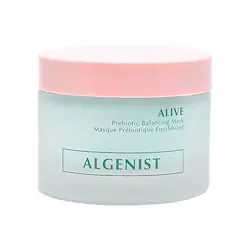
Algenist Masque équilibrant aux prébiotiques ALIVE
Works for
Anti-agingLactococcus ferment lysate, Magnesium aluminum silicate + 2 moreNot delivered
“Clinically proven to visibly minimize appearance of fine lines and wrinkles, and boost benefits of other active ingredients.”
This product does not contain ingredients that are able to reduce fine lines and wrinkles or help with skin elasticity, but it can improve the look of the skin temporarily through moisturization. Well-moisturized skin might also be able to repair the sun damage better.These ingredients - lactococcus ferment lysate, magnesium aluminum silicate - could be helpful for preventing or repairing signs of aging in theory, but there is no evidence that it actually works.
MoisturizingSide benefit · Glycerin, Lactococcus ferment lysate + 12 moreWorks
This product can help improve hydration of the skin with the two types of ingredients.
The first type is called “humectants”:
these ingredients help attract water.
When humectants are on the surface of the skin, they “pull in” the moisture from the outside environment, or from
within deeper layers of the skin. The following ingredients in this product do the job:
glycerin, sucrose.
This product also contains ingredients called “occlusives”. They help reduce the speed with which our skin loses moisture to the outside environment. These ingredients also help soften the upper layer of the skin, so it feels less tight and nicer to the touch. The following ingredients in this product do the job: phytosteryl/octyldodecyl lauroyl glutamate, glyceryl stearate.
Can it cause trouble?
Irritancy18 flagged ingredientsMedium risk
Comedogenic4 ingredients rated 2 or more on the 0–5 pore-clogging scale4 flagged
User reviews
Be the first — your take helps the next person decide.
Ingredients
Filter by role to see what each ingredient is doing.
Glycerin~22–33%
- Irritation risk
- Low
One of the best moisturizing ingredients. Naturally present in skin. It attracts water to the upper layer of the skin working as a humectant
More about GlycerinWater~11–16%
Sodium cocoyl glycinate~4.5–6.7%
- Irritation risk
- Medium
Helps oil and water mix together
More about Sodium cocoyl glycinatePropanediol~3.1–4.6%
- Irritation risk
- Low
Acts as a solvent for other ingredients. Speeds up the absorption of other ingredients into the skin
More about PropanediolKaolin~2.5–3.7%
- Irritation risk
- Low
A type of clay that consists mainly of aluminum silicate. Helps absorb oil and creates a thicker product consistency. Can be used to add a white color
More about KaolinLactococcus ferment lysate~1.7–2.6%
- Irritation risk
- Low
Consists of remains of dead bacteria cells. Is likely helpful in attracting water to the upper layer of the skin. Might be helpful in reducing inflammation and neutralizing free radicals in skin
More about Lactococcus ferment lysateBentonite~1.6–2.4%
Magnesium aluminum silicate~1.4–2%
- Irritation risk
- Low
Might be helpful in restoring skin barrier function and, when combined with zinc carbonate and malonic acid, reducing fine lines and wrinkles by stimulating elastin production. Also helps stabilize the product formulation
More about Magnesium aluminum silicateMaltooligosyl glucoside~1.2–1.8%
- Irritation risk
- Low
Helps water and oil mix together and can help attract water to the upper layer of the skin
More about Maltooligosyl glucosideMyristic acid~1–1.5%
- Irritation risk
- Medium
- Comedogenicity
- 3/5
Helps oil and water mix together. Could be comedogenic
More about Myristic acidLactic acid~0.6–1.35%
- Irritation risk
- Medium
An exfoliating and moisturizing alpha-hydroxy acid (AHA). Typically causes less irritation than other AHAs, for example, glycolic acid. At high concentrations (about 15%), lactic acid can help reduce lines and wrinkles. Recent studies show that lactic acid can support the "good" bacteria living on skin's surface (healthy skin microbiome)
More about Lactic acidGlyceryl stearate~0.55–1.35%
- Irritation risk
- Low
An emollient that softens the skin and forms a protective layer on its surface. Helps water and oil mix together
More about Glyceryl stearateAlgae oligosaccharides~0.5–1.1%
- Irritation risk
- Low
Chlorella vulgaris extract~0.45–1.05%
- Irritation risk
- Medium
- Comedogenicity
- 3/5
A plant extract that can help to attract water to the upper layer of the skin and might have some anti-oxidant and anti-inflammatory properties
More about Chlorella vulgaris extractAlteromonas ferment extract~0.45–1%
- Irritation risk
- Low
A marine extract that helps attract water to the upper layer of the skin. It is claimed to have anti-inflammatory properties but research is lacking
More about Alteromonas ferment extractCorallina officinalis extract~0.45–1%
- Irritation risk
- Low
- Comedogenicity
- 3/5
Red algae extract that helps attract water to the upper layer of the skin and might contain antioxidants
More about Corallina officinalis extractCurcuma longa root extract~0.4–0.95%
- Irritation risk
- High
A plant extract that can contain an active compound curcumin, that may have some anti-inflammatory properties when applied to the skin, but solid research is lacking and the typical concentration used in skincare products is too low. Can be an irritant
More about Curcuma longa root extractMelia azadirachta leaf extract~0.4–0.95%
- Irritation risk
- High
A plant extract that has anti-bacterial properties. Can be used to preserve the product. Can be irritating
More about Melia azadirachta leaf extractMelia azadirachta flower extract~0.4–0.9%
- Irritation risk
- Medium
A plant extract that might be helpful to neutralize free radicals in skin
More about Melia azadirachta flower extractOcimum basilicum flower/leaf extract~0.35–0.85%
- Irritation risk
- High
Used as a fragrance. Canbe irritating
More about Ocimum basilicum flower/leaf extractOcimum sanctum leaf extract~0.35–0.8%
- Irritation risk
- High
A plant extract that is rich in a fragrance compound eugenol that is a frequent allergen and can be irritating. It might also contain anti-oxidants to help neutralize free radicals
More about Ocimum sanctum leaf extractTocopherol~0.35–0.8%
- Irritation risk
- Low
Pure form of vitamin E. Can help moisturise and protect the skin from free radicals. Often used to help stabilise other ingredients or the formula itself
More about TocopherolHydrogenated starch hydrolysate~0.35–0.75%
- Irritation risk
- Low
Helps to attract water to the upper layer of the skin. Can add sweet taste to lip products
More about Hydrogenated starch hydrolysateCocamidopropyl betaine~1–1.5%
- Irritation risk
- High
Helps water and oil mix together. Used as a cleansing ingredient. Could be an allergen
More about Cocamidopropyl betaineSodium methyl oleoyl taurate~0.55–1.3%
- Irritation risk
- Medium
Helps oil and water mix together
More about Sodium methyl oleoyl taurateButylene glycol~0.35–0.75%
- Irritation risk
- Low
Used to create a nice product texture and help delivery of other ingredients. Might be somewhat helpful in attracting water to the upper layer of the skin
More about Butylene glycolCoco-glucoside~0.4–0.9%
- Irritation risk
- High
Used as a cleansing agent (surfactant) in cleansers. Helps water and oil mix together in lotions. Can be irritating
More about Coco-glucosideLauryl glucoside~0.35–0.85%
Styrene/acrylates copolymer~0.4–0.9%
- Irritation risk
- Low
Used to create an even product consistency. Can help boost efficiency of sunscreen filters
More about Styrene/acrylates copolymerPhytosteryl/octyldodecyl lauroyl glutamate~0.3–0.75%
- Irritation risk
- Low
A mix of amino acids and plant-based lipids. Helps to soften the upper layer of the skin and reduce water loss over time
More about Phytosteryl/octyldodecyl lauroyl glutamateEthylhexylglycerin~0.2–0.75%
Lauric acid~0.35–0.8%
- Irritation risk
- Medium
- Comedogenicity
- 3/5
Helps water and oil mix together. Has anti-bacterial properties that might be helpful in preventing blemishes
More about Lauric acidPalmitic acid~0.3–0.75%
- Irritation risk
- Low
An emollient that is naturally present in skin and helps soften it
More about Palmitic acidCellulose gum~0.35–0.8%
- Irritation risk
- Low
Used to create thicker product consistency and stabilize emulsions
More about Cellulose gumSucrose~0.2–0.7%
- Irritation risk
- Low
Can help attract water to the upper layer of the skin. In crystal form, it can work as a gentle exfoliant, gentler than the salt scrub. Helps stabilize the emulsion
More about SucroseSodium chloride~0.3–0.7%
- Irritation risk
- Low
Used to stabilize mixtures of oil and water, and create thicker, gel-like product textures
More about Sodium chlorideMica~0.3–0.75%
- Irritation risk
- Low
Creates an illusion of smoother and more radiant skin tone. Adds shimmer to the skin by reflecting light
More about MicaSodium benzoate~0.25–0.5%
Phenoxyethanol~0.15–0.55%
- Irritation risk
- Low
A preservative. It helps prevent bacterial growth in cosmetic products
More about PhenoxyethanolTitanium dioxide~0.2–0.75%
- Irritation risk
- Low
Works as a UV filter when used in high concentrations. It is photostable and is effective mostly against the UVB light, with some protection in the UVA range. In small concentrations, used for its ability to improve the color of cosmetic products. Is usually well tolerated by the skin
More about Titanium dioxideIron oxides~0.1–0.35%
- Irritation risk
- Low
An umbrella term for the following three colorants: CI 77491, CI 77492, CI 77499. They might be able to offer some protection against visible light, but the degree of the protection is not clear
More about Iron oxidesCi 77491~0.1–0.4%
- Irritation risk
- Low
A red colorant made of iron oxide. Typically is not irritating
More about Ci 77491Ci 77742~0.1–0.4%
Chromium hydroxide green~0.05–0.3%
Ci 77289~0.05–0.3%
Ingredient list view
Glycerin, Water, Sodium cocoyl glycinate, Propanediol, Kaolin, Lactococcus ferment lysate, Bentonite, Magnesium aluminum silicate, Maltooligosyl glucoside, Myristic acid, Lactic acid, Glyceryl stearate, Algae oligosaccharides, Chlorella vulgaris extract, Alteromonas ferment extract, Corallina officinalis extract, Curcuma longa root extract, Melia azadirachta leaf extract, Melia azadirachta flower extract, Ocimum basilicum flower/leaf extract, Ocimum sanctum leaf extract, Tocopherol, Hydrogenated starch hydrolysate, Cocamidopropyl betaine, Sodium methyl oleoyl taurate, Butylene glycol, Coco-glucoside, Lauryl glucoside, Styrene/acrylates copolymer, Phytosteryl/octyldodecyl lauroyl glutamate, Ethylhexylglycerin, Lauric acid, Palmitic acid, Cellulose gum, Sucrose, Sodium chloride, Mica, Sodium benzoate, Phenoxyethanol, Titanium dioxide, Iron oxides, Ci 77491, Ci 77742, Chromium hydroxide green, Ci 77289
Compare prices
Retailers ranked by price — lowest first.

Worth comparing, line by line.
Match % combines shared ingredients, the first five ingredients, shared actives and hero ingredients, irritancy (lower counts in the alternative's favour), texture and body area. Only products in the same routine step are compared.
| AlgenistMasque équilibrant aux prébiotiques ALIVEYOUR PRODUCT | Earth TherapeuticsCalming Pink Clay Facial Sheet Mask | MarinneMilk Peel Sleeping Mask | BIHAKU JOSHIWhite Mask | |
|---|---|---|---|---|
| Match | — | 46% | 46% | 43% |
| Price | $50.00 | $9.00−$41.00 | $18.00−$32.00 | $12.70−$37.30 |
| Shared key ingredients | — | 3 of 11 | 2 of 11 | 2 of 11 |
| Key difference | — | Madecassoside | Sodium Pca | Ascorbyl Glucoside |
| Irritancy | Medium | Medium | Low | Medium |
| Drying alcohol | — | Contains drying alcohol | — | — |
| View product | Shop | Shop | Shop |


More alternatives: Dr Dennis Gross Vitamin C Lactic Biocellulose Brightening Treatment MaskNassifMD Dermaceuticals Overnight Illuminating Masque with Elasta-Derm C
Sources cited in this review
Every concentration estimate and effectiveness label is anchored to one of these 15 studies and safety reviews.
- 1
- 2
- 3
- 4
- 5Epidermal and dermal effects of topical lactic acidncbi.nlm.nih.gov
- 6Dual Effects of Alpha-Hydroxy Acids on the Skinpdfs.semanticscholar.org

Affiliate links · As an Amazon Associate, WIMJ earns from qualifying purchases.