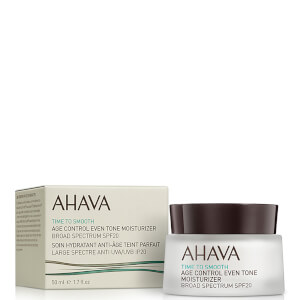
Ahava Age Control Even Tone Moisturizer SPF20

Ahava Age Control Even Tone Moisturizer SPF20

SPF 20Efficacy68/100IrritancyHigh·1 UV filter
Edit

Works for

3 of 4 advertised claims delivered

Sun protection
SPF 20 · 1 UV filter · Partial spectrum
Weak protectionSPF under 30
SPF 20Partial spectrumChemical filtersNo white cast

This product does not offer good protection against UVA rays.

This product can be considered "reef safe" because it does not contain the UV filters (oxybenzone and octinoxate) that can be harmful to coral reefs when present in the water in high concentrations.

UV spectrum
UVB290–320 nmUVA II320–340 nmUVA I340–400 nm
Butyloctyl Salicylate
FilterCoverageWhat it doesEst. amount
Butyloctyl SalicylateUVBA synthetic ester of salicylic acid that is used to help disperse pigments and boost effectiveness of sunscreen ingredients. It is able to absorb UV light (working as an organic, or chemical filter), but is not approved as a sunscreen ingredient on its own~0.5–1.15%
~ marks concentrations estimated from label position and typical use levels
Reef-safe
No oxybenzone or octinoxate — the two filters banned in Hawaii, Florida Keys and Aruba.
Moisturizing
24 ingredients credited for this claim
Good support
What the product description says
“Age Control Even Tone Moisturizer SPF20”
Source: Lookfantastic

This product can help improve hydration of the skin with the two types of ingredients.

The first type is called “humectants”:
these ingredients help attract water. When humectants are on the surface of the skin, they “pull in” the moisture from the outside environment, or from within deeper layers of the skin. The following ingredients in this product do the job: glycerin, polyglycerin-3.

This product also contains ingredients called “occlusives”. They help reduce the speed with which our skin loses moisture to the outside environment. These ingredients also help soften the upper layer of the skin, so it feels less tight and nicer to the touch. The following ingredients in this product do the job: caprylic/capric triglyceride, dimethicone.

DimethiconeKey active· Emollient, OcclusiveEffect: HighA silicone that helps to reduce water loss from the surface of the skin. Can temporarily "fill in" lines and wrinkles, absorb oil, and create a nice product finish~0.3–0.75%
GlycerinKey active· HumectantEffect: HighOne of the best moisturizing ingredients. Naturally present in skin. It attracts water to the upper layer of the skin working as a humectant~0.15–0.6%
Sodium lactateKey active· HumectantEffect: HighHelps attract water to the upper layer of the skin. Is often used to adjust the pH level of the product~0.05–0.2%
Helianthus annuus seed oilKey active· Emollient, OcclusiveEffect: HighA great emollient due to its high linoleic acid content. One of the most effective plant oils in helping skin hydration and repairing skin barrier function~0.15–0.65%
Helianthus annuus sprout extractKey activeEffect: HighHelps soften the upper layer of the skin and can help support the skin barrier~0.15–0.5%
Zinc pcaKey active· HumectantEffect: HighA compound that combines zinc with a hydrating ingredient PCA. Might to be helpful against acne and clogged pores. Can help calm down inflammation in skin. Could be helpful in reducing the formation of free radicals in skin. Might help to reduce fine lines in wrinkles, but solid evidence is missing~0.01–0.05%
Polyglycerin-3Key active· HumectantEffect: HighHelps to attract water to the upper layer of the skin~0.1–0.4%
Oenothera biennis oilKey active· EmollientEffect: HighHelps soften the upper layer of the skin and can support skin barrier function~0.15–0.65%
Caprylic/capric triglycerideKey active· Emollient, OcclusiveEffect: HighA good mix of fatty acids that forms a protective layer on the skin. Improves the shelf life of products. Derived from coconut and glycerin~0.45–1%
Octyldodecyl neopentanoateKey active· EmollientEffect: HighAn emollient that helps soften the skin. Often used to stabilize other ingredients, for example, sunscreen~0.15–0.65%
Porphyra umbilicalis extractKey activeEffect: MediumAn algae extract that can help attract water to the upper layer of the skin. Might have an anti-oxidant effect in skin but evidence is lacking~0.05–0.3%
Dunaliella salina extractKey activeEffect: MediumA green micro-algae extract that might help neutralize free radicals in skin, but solid evidence is lacking. It helps to soften the upper layer of the skin~0.15–0.55%
C12-15 alkyl benzoateKey active· EmollientEffect: MediumEnhances the product texture and makes it more spreadable. Helps reduce water loss from the outer layer of skin. Extands the shelf life by preventing bacteria growth~0.55–1.25%
Cetearyl alcoholKey active· EmollientEffect: MediumA non-drying alcohol. Works as an emollient. Helps water and oil mix together and creates a nice product texture~0.45–1.05%
Pentylene glycol· EmollientEffect: LowUsed to preserve products, dissolve other ingredients and create a nice product texture~0.15–0.65%
Propylene glycol· HumectantEffect: LowHelps oil and water mix together and can enhance the penetration of other ingredients into the skin. It can be irritating~0.05–0.2%
Aloe barbadensis leaf juice· HumectantEffect: LowTraditionally used to treat sunburns, dermatitis and inflammation, but evidence for its effectiveness is lacking. The extract can contain humectants that help attract water into the skin~23–34%
Butylene glycol· HumectantEffect: LowUsed to create a nice product texture and help delivery of other ingredients. Might be somewhat helpful in attracting water to the upper layer of the skin~0.8–1.2%
Glyceryl stearate· EmollientEffect: LowAn emollient that softens the skin and forms a protective layer on its surface. Helps water and oil mix together~0.15–0.7%
Hydrogenated palm glycerides· EmollientEffect: LowAn emollient that softens the skin~0.2–0.75%
Hydrogenated polydecene· EmollientEffect: LowHelps to soften the upper layer of the skin and create a nice product texture~0.15–0.6%
Camellia sinensis leaf extractEffect: LowCan contain potent anti-oxidant compounds (abbreviated ECG, GCG, EGC, and EGCG) that might help protect the skin from free radicals. Can help calm down inflammation and has some anti-bacterial properties. Unfortunately, these antioxidants are unstable and lose their effectiveness very quickly in products. The concentration of the antioxidant compounds in the extract also tends to be low to be effective in topical formulation~0.4–0.95%
NiacinamideUnder-dosedEffect: HighIs proven to be effective in reducing blemishes, evening out skin tone and helping to improve lines and wrinkles. It helps the skin to repair sun damage, calm down inflammation and keep maintain good levels of moisture. The concentration of about 2% is effective for supporting the skin barrier and evening out the skin tone. Concentration of 4-6% is better for helping with acne and balancing the sebum production~0.15–0.5%
Cucumis sativus fruit extractEffect: Low, below effective doseMight be somewhat helpful in reducing hyperpigmentation and neutralizing free radicals but its typical concentration in a product is too low for having an effect~0.15–0.7%
Evens skin tone
5 ingredients credited for this claim
Moderate support
What the product description says
“Improve skin tone and texture with AHAVA Age Control Even Tone Moisturiser SPF 20 ; a skin-brightening, multi-beneficial formula developed to address ageing concerns.”
Source: Lookfantastic

The following ingredient (ingredients) in this product might be helpful, but there is no evidence to confirm that it actually works: ascorbyl glucoside.

The biggest effect for evening out skin tone in this product comes from sun protection. Sun damage is the main factor causing age spots, darkening of post-acne marks and other discolorations. This is why sun protection is the best strategy for maintaining an even skin tone. We, however, do not recommend using this product as a sunscreen because the protection it offers is not strong enough).

Ascorbyl glucosideKey activeEffect: MediumA vitamin C derivative that is more stable but less potent than pure form of vitamin C. Has a potential to boost collagen production, nutralise free radicals and reduce hyperpigmentation, but the required concentration is likely to be much higher than for the pure form of vitamin C, limiting the ingredient's effectiveness in products~1.4–2.1%
Camellia sinensis leaf extractEffect: LowCan contain potent anti-oxidant compounds (abbreviated ECG, GCG, EGC, and EGCG) that might help protect the skin from free radicals. Can help calm down inflammation and has some anti-bacterial properties. Unfortunately, these antioxidants are unstable and lose their effectiveness very quickly in products. The concentration of the antioxidant compounds in the extract also tends to be low to be effective in topical formulation~0.4–0.95%
NiacinamideUnder-dosedEffect: HighIs proven to be effective in reducing blemishes, evening out skin tone and helping to improve lines and wrinkles. It helps the skin to repair sun damage, calm down inflammation and keep maintain good levels of moisture. The concentration of about 2% is effective for supporting the skin barrier and evening out the skin tone. Concentration of 4-6% is better for helping with acne and balancing the sebum production~0.15–0.5%
Ascorbic acidUnder-dosedEffect: HighThe most well-researched antioxidant that works in skin. Helps neutralize free radicals supporting collagen production, helping to even out the skin tone and preventing early signs of aging~2.2–3.3%
Salicylic acidEffect: Low, below effective doseUsed for skin exfoliation. It has an anti-inflammatory and anti-bacterial effect, helps to unclog pores, prevent blemishes and speed up healing of the existing ones. Sometimes referred to as a BHA (beta-hydroxy acid)~0.05–0.2%
Anti-aging
6 ingredients credited for this claim
Moderate support
What the product description says
“Fortified with the brand's innovative VF Brightening™ Accelerator Complex, the lightweight, quick-absorbing cream minimises the appearance of fine lines, wrinkles and dark spots for a smoother, more refined complexion.”
Source: Lookfantastic

This product contains ascorbyl glucoside. This ingredient might be able to help reduce and prevent fine lines and wrinkles, improve skin elasticity and firmness, but there is not enough evidence that it actually works. The biggest anti-aging effect in this product comes from sun protection. Sun damage is the main factor causing early signs of skin aging. We, however, do not recommend using this product as a sunscreen because the protection it offers is not strong enough).

Ascorbyl glucosideKey activeEffect: MediumA vitamin C derivative that is more stable but less potent than pure form of vitamin C. Has a potential to boost collagen production, nutralise free radicals and reduce hyperpigmentation, but the required concentration is likely to be much higher than for the pure form of vitamin C, limiting the ingredient's effectiveness in products~1.4–2.1%
Zinc pcaEffect: LowA compound that combines zinc with a hydrating ingredient PCA. Might to be helpful against acne and clogged pores. Can help calm down inflammation in skin. Could be helpful in reducing the formation of free radicals in skin. Might help to reduce fine lines in wrinkles, but solid evidence is missing~0.01–0.05%
Camellia sinensis leaf extractEffect: LowCan contain potent anti-oxidant compounds (abbreviated ECG, GCG, EGC, and EGCG) that might help protect the skin from free radicals. Can help calm down inflammation and has some anti-bacterial properties. Unfortunately, these antioxidants are unstable and lose their effectiveness very quickly in products. The concentration of the antioxidant compounds in the extract also tends to be low to be effective in topical formulation~0.4–0.95%
Aloe barbadensis leaf juiceEffect: LowTraditionally used to treat sunburns, dermatitis and inflammation, but evidence for its effectiveness is lacking. The extract can contain humectants that help attract water into the skin~23–34%
NiacinamideUnder-dosedEffect: HighIs proven to be effective in reducing blemishes, evening out skin tone and helping to improve lines and wrinkles. It helps the skin to repair sun damage, calm down inflammation and keep maintain good levels of moisture. The concentration of about 2% is effective for supporting the skin barrier and evening out the skin tone. Concentration of 4-6% is better for helping with acne and balancing the sebum production~0.15–0.5%
Ascorbic acidUnder-dosedEffect: HighThe most well-researched antioxidant that works in skin. Helps neutralize free radicals supporting collagen production, helping to even out the skin tone and preventing early signs of aging~2.2–3.3%
Anti-oxidation
Not advertised by the brand · 13 ingredients credited for this claim
Moderate support

This product contains antioxidants (ascorbyl glucoside, camellia sinensis leaf extract, scutellaria baicalensis extract) that might be able to help neutralize free radicals in skin to lessen the damage it gets from the UV light (sun). There is not enough evidence to confirm their effectiveness in skin though.

Camellia sinensis leaf extractKey activeEffect: MediumCan contain potent anti-oxidant compounds (abbreviated ECG, GCG, EGC, and EGCG) that might help protect the skin from free radicals. Can help calm down inflammation and has some anti-bacterial properties. Unfortunately, these antioxidants are unstable and lose their effectiveness very quickly in products. The concentration of the antioxidant compounds in the extract also tends to be low to be effective in topical formulation~0.4–0.95%
Scutellaria baicalensis extractKey activeEffect: MediumA plant extract that might contain a compound baicalin that could be helpful in neutralizing free radicals and reducing inflammation in skin. The baicalin concentration in skincare typically too low. Can be used for its fragrant properties~0.05–0.25%
Ascorbyl glucosideKey activeEffect: MediumA vitamin C derivative that is more stable but less potent than pure form of vitamin C. Has a potential to boost collagen production, nutralise free radicals and reduce hyperpigmentation, but the required concentration is likely to be much higher than for the pure form of vitamin C, limiting the ingredient's effectiveness in products~1.4–2.1%
Dunaliella salina extractEffect: LowA green micro-algae extract that might help neutralize free radicals in skin, but solid evidence is lacking. It helps to soften the upper layer of the skin~0.15–0.55%
Zinc pcaEffect: LowA compound that combines zinc with a hydrating ingredient PCA. Might to be helpful against acne and clogged pores. Can help calm down inflammation in skin. Could be helpful in reducing the formation of free radicals in skin. Might help to reduce fine lines in wrinkles, but solid evidence is missing~0.01–0.05%
Oenothera biennis oilEffect: LowHelps soften the upper layer of the skin and can support skin barrier function~0.15–0.65%
Porphyra umbilicalis extractEffect: LowAn algae extract that can help attract water to the upper layer of the skin. Might have an anti-oxidant effect in skin but evidence is lacking~0.05–0.3%
Calendula officinalis flower extractEffect: LowA plant extract that has some anti-oxidant and anti-bacterial properties. Can be irritating~0.4–0.95%
Citrus reticulata peel extractEffect: LowA likely irritant. Might have some anti-oxidant activity, but is mostly used as a fragrance in cosmetic products~0.3–0.7%
Disodium lauriminodipropionate tocopheryl phosphatesUnder-dosedEffect: HighA form of Vitamin E. In concentrations 1-3%, it can help neutralize free radicals in skin and support photodamage repair~0.2–0.7%
Ascorbic acidUnder-dosedEffect: HighThe most well-researched antioxidant that works in skin. Helps neutralize free radicals supporting collagen production, helping to even out the skin tone and preventing early signs of aging~2.2–3.3%
Tocopheryl acetateEffect: Low, below effective doseA more stable but less bio-available form of vitamin E compared to Tocopherol. Might help moisturize and protect the skin from free radicals, but mostly used in low concentrations to stabilize other ingredients.~0.05–0.2%
Cucumis sativus fruit extractEffect: Low, below effective doseMight be somewhat helpful in reducing hyperpigmentation and neutralizing free radicals but its typical concentration in a product is too low for having an effect~0.15–0.7%

Can it cause trouble?

Irritancy
4 strong irritants: Calendula officinalis flower extract, Citrus reticulata peel extract + 2 more — patch-test recommended
High risk
We flagged 26 ingredients with irritancy potential. Severity depends on your sensitivity threshold; the table lists the worst offenders first.
IngredientFunctionIrritationEst. amount
Ascorbic acidThe most well-researched antioxidant that works in skin. Helps neutralize free radicals supporting collagen production, helping to even out the skin tone and preventing early signs of agingHigh~2.2–3.3%est.
Calendula officinalis flower extractA plant extract that has some anti-oxidant and anti-bacterial properties. Can be irritatingHigh~0.4–0.95%est.
Citrus reticulata peel extractA likely irritant. Might have some anti-oxidant activity, but is mostly used as a fragrance in cosmetic productsHigh~0.3–0.7%est.
Melissa officinalis leaf extractA plant extract that is added for its fragrance. Can be irritatingHigh~0.15–0.5%est.
ParfumAn aromatic blend of unspecified and possibly irritating ingredientsHigh~0.1–0.45%est.
Propylene glycolHelps oil and water mix together and can enhance the penetration of other ingredients into the skin. It can be irritatingHigh~0.05–0.2%est.
Salicylic acidUsed for skin exfoliation. It has an anti-inflammatory and anti-bacterial effect, helps to unclog pores, prevent blemishes and speed up healing of the existing ones. Sometimes referred to as a BHA (beta-hydroxy acid)High~0.05–0.2%est.
Scutellaria baicalensis extractA plant extract that might contain a compound baicalin that could be helpful in neutralizing free radicals and reducing inflammation in skin. The baicalin concentration in skincare typically too low. Can be used for its fragrant propertiesHigh~0.05–0.25%est.
Aloe barbadensis leaf juiceTraditionally used to treat sunburns, dermatitis and inflammation, but evidence for its effectiveness is lacking. The extract can contain humectants that help attract water into the skinMedium~23–34%est.
Aminomethyl propanediolHelps adjust the product pH and can be used to mask the odor of other ingredientsMedium~3.9–5.8%est.
Ascorbyl glucosideA vitamin C derivative that is more stable but less potent than pure form of vitamin C. Has a potential to boost collagen production, nutralise free radicals and reduce hyperpigmentation, but the required concentration is likely to be much higher than for the pure form of vitamin C, limiting the ingredient's effectiveness in productsMedium~1.4–2.1%est.
Benzotriazolyl dodecyl p-cresolUsed to stabilize the product formulation protecting it from sun lightMedium~0.9–1.3%est.
Butyloctyl salicylateA synthetic ester of salicylic acid that is used to help disperse pigments and boost effectiveness of sunscreen ingredients. It is able to absorb UV light (working as an organic, or chemical filter), but is not approved as a sunscreen ingredient on its ownMedium~0.5–1.15%est.
Caprylic/capric triglycerideA good mix of fatty acids that forms a protective layer on the skin. Improves the shelf life of products. Derived from coconut and glycerinMedium~0.45–1%est.
Citric acidCan work as an exfoliant but is typically used to adjust the product pHMedium~0.3–0.75%est.
Cucumis sativus fruit extractMight be somewhat helpful in reducing hyperpigmentation and neutralizing free radicals but its typical concentration in a product is too low for having an effectMedium~0.15–0.7%est.
Disodium edtaStabilizes the product formulationMedium~0.15–0.65%est.
EthylhexylglycerinA preservativeMedium~0.15–0.5%est.
MethylpropanediolHelps dissolve other ingredients in a formulationMedium~0.15–0.5%est.
Oenothera biennis oilHelps soften the upper layer of the skin and can support skin barrier functionMedium~0.15–0.65%est.
Pentylene glycolUsed to preserve products, dissolve other ingredients and create a nice product textureMedium~0.15–0.65%est.
Polyglyceryl-3 polyricinoleateHelps oil and water mix togetherMedium~0.1–0.35%est.
Potassium cetyl phosphateHelps oil and water mix togetherMedium~0.05–0.3%est.
Sodium citrateHelps to control the skin's pH level. Maintains the skin's natural film of amino-lactic acids and oils. Helps to preserve productsMedium~0.05–0.25%est.
Sodium lactateHelps attract water to the upper layer of the skin. Is often used to adjust the pH level of the productMedium~0.05–0.2%est.
Tocopheryl acetateA more stable but less bio-available form of vitamin E compared to Tocopherol. Might help moisturize and protect the skin from free radicals, but mostly used in low concentrations to stabilize other ingredients.Medium~0.05–0.2%est.
Comedogenic
2 ingredients rated 2 or more on the 0–5 pore-clogging scale
2 flagged
These ingredients have a comedogenic rating of 2 or more on a 0–5 scale; the table shows each one's rating. In leave-on products they can clog pores in acne-prone skin.
IngredientFunctionRatingEst. amount
Porphyra umbilicalis extractAn algae extract that can help attract water to the upper layer of the skin. Might have an anti-oxidant effect in skin but evidence is lacking3/5~0.05–0.3%est.
Cetearyl alcoholA non-drying alcohol. Works as an emollient. Helps water and oil mix together and creates a nice product texture2/5~0.45–1.05%est.
Edit

User reviews

Would you recommend?
No community reviews yet.

Be the first — your take helps the next person decide.

Write a review · ~30s

Ingredients

Filter by role to see what each ingredient is doing.

Aloe barbadensis leaf juice~23–34%
Irritant · medium
Irritation risk
Medium
Works for
MoisturizingAntibacterialAnti-inflammatoryReduces rednessReduces irritationAnti-blemishAnti-aging

Traditionally used to treat sunburns, dermatitis and inflammation, but evidence for its effectiveness is lacking. The extract can contain humectants that help attract water into the skin

More about Aloe barbadensis leaf juice
Aminomethyl propanediol~3.9–5.8%
Irritant · medium
Irritation risk
Medium

Helps adjust the product pH and can be used to mask the odor of other ingredients

More about Aminomethyl propanediol
Water~3.7–5.6%
Formula
Irritation risk
Low

Plain old water

More about Water
Water~2.9–4.4%
Formula
Irritation risk
Low

Plain old water

More about Water
Ascorbic acid~2.2–3.3%
Under-dosedIrritant · high
Irritation risk
High
Works for
Anti-agingEvens skin toneAnti-oxidation

The most well-researched antioxidant that works in skin. Helps neutralize free radicals supporting collagen production, helping to even out the skin tone and preventing early signs of aging

More about Ascorbic acid
Ascorbyl glucoside~1.4–2.1%
Key activeIrritant · medium
Irritation risk
Medium
Works for
Evens skin toneAnti-agingAnti-oxidation

A vitamin C derivative that is more stable but less potent than pure form of vitamin C. Has a potential to boost collagen production, nutralise free radicals and reduce hyperpigmentation, but the required concentration is likely to be much higher than for the pure form of vitamin C, limiting the ingredient's effectiveness in products

More about Ascorbyl glucoside
Benzotriazolyl dodecyl p-cresol~0.9–1.3%
Irritant · medium
Irritation risk
Medium

Used to stabilize the product formulation protecting it from sun light

More about Benzotriazolyl dodecyl p-cresol
Butylene glycol~0.8–1.2%
Formula
Irritation risk
Low
Works for
Moisturizing

Used to create a nice product texture and help delivery of other ingredients. Might be somewhat helpful in attracting water to the upper layer of the skin

More about Butylene glycol
Butyloctyl salicylate~0.5–1.15%
UV filterKey activeIrritant · medium
Irritation risk
Medium
Works for
Sun protection

A synthetic ester of salicylic acid that is used to help disperse pigments and boost effectiveness of sunscreen ingredients. It is able to absorb UV light (working as an organic, or chemical filter), but is not approved as a sunscreen ingredient on its own

More about Butyloctyl salicylate
C12-15 alkyl benzoate~0.55–1.25%
Key active
Irritation risk
Low
Works for
Moisturizing

Enhances the product texture and makes it more spreadable. Helps reduce water loss from the outer layer of skin. Extands the shelf life by preventing bacteria growth

More about C12-15 alkyl benzoate
Calendula officinalis flower extract~0.4–0.95%
Irritant · high
Irritation risk
High
Works for
Anti-oxidation

A plant extract that has some anti-oxidant and anti-bacterial properties. Can be irritating

More about Calendula officinalis flower extract
Camellia sinensis leaf extract~0.4–0.95%
Key active
Irritation risk
Low
Works for
Anti-oxidationAntibacterialAnti-agingAnti-blemishEvens skin toneMoisturizing

Can contain potent anti-oxidant compounds (abbreviated ECG, GCG, EGC, and EGCG) that might help protect the skin from free radicals. Can help calm down inflammation and has some anti-bacterial properties. Unfortunately, these antioxidants are unstable and lose their effectiveness very quickly in products. The concentration of the antioxidant compounds in the extract also tends to be low to be effective in topical formulation

More about Camellia sinensis leaf extract
Caprylic/capric triglyceride~0.45–1%
Key activeIrritant · medium
Irritation risk
Medium
Works for
Moisturizing

A good mix of fatty acids that forms a protective layer on the skin. Improves the shelf life of products. Derived from coconut and glycerin

More about Caprylic/capric triglyceride
Cetearyl alcohol~0.45–1.05%
Key activeComedogenic 2/5
Irritation risk
Low
Comedogenicity
2/5
Works for
CleansingMoisturizing

A non-drying alcohol. Works as an emollient. Helps water and oil mix together and creates a nice product texture

More about Cetearyl alcohol
Citric acid~0.3–0.75%
Irritant · medium
Irritation risk
Medium

Can work as an exfoliant but is typically used to adjust the product pH

More about Citric acid
Citrus reticulata peel extract~0.3–0.7%
Irritant · high
Irritation risk
High
Works for
Anti-oxidation

A likely irritant. Might have some anti-oxidant activity, but is mostly used as a fragrance in cosmetic products

More about Citrus reticulata peel extract
Commiphora abyssinica resin extract~0.2–0.75%
Formula
Cucumis sativus fruit extract~0.15–0.7%
Irritant · medium
Irritation risk
Medium
Works for
MoisturizingAnti-oxidation

Might be somewhat helpful in reducing hyperpigmentation and neutralizing free radicals but its typical concentration in a product is too low for having an effect

More about Cucumis sativus fruit extract
Dimethicone~0.3–0.75%
Key active
Irritation risk
Low
Works for
MoisturizingMattifying

A silicone that helps to reduce water loss from the surface of the skin. Can temporarily "fill in" lines and wrinkles, absorb oil, and create a nice product finish

More about Dimethicone
Disodium edta~0.15–0.65%
Irritant · medium
Irritation risk
Medium

Stabilizes the product formulation

More about Disodium edta
Disodium lauriminodipropionate tocopheryl phosphates~0.2–0.7%
Under-dosed
Irritation risk
Low
Works for
Anti-oxidationCleansing

A form of Vitamin E. In concentrations 1-3%, it can help neutralize free radicals in skin and support photodamage repair

More about Disodium lauriminodipropionate tocopheryl phosphates
Dunaliella salina extract~0.15–0.55%
Key active
Irritation risk
Low
Works for
MoisturizingAnti-oxidation

A green micro-algae extract that might help neutralize free radicals in skin, but solid evidence is lacking. It helps to soften the upper layer of the skin

More about Dunaliella salina extract
Ethylhexylglycerin~0.15–0.5%
Irritant · medium
Irritation risk
Medium

A preservative

More about Ethylhexylglycerin
Glycerin~0.15–0.6%
Key active
Irritation risk
Low
Works for
Moisturizing

One of the best moisturizing ingredients. Naturally present in skin. It attracts water to the upper layer of the skin working as a humectant

More about Glycerin
Glyceryl stearate~0.15–0.7%
Formula
Irritation risk
Low
Works for
CleansingMoisturizing

An emollient that softens the skin and forms a protective layer on its surface. Helps water and oil mix together

More about Glyceryl stearate
Helianthus annuus seed oil~0.15–0.65%
Key active
Irritation risk
Low
Works for
Moisturizing

A great emollient due to its high linoleic acid content. One of the most effective plant oils in helping skin hydration and repairing skin barrier function

More about Helianthus annuus seed oil
Hydrogenated olive oil cetyl esters~0.15–0.7%
Formula
Irritation risk
Low

Help stabilize the product formulation

More about Hydrogenated olive oil cetyl esters
Hydrogenated palm glycerides~0.2–0.75%
Formula
Irritation risk
Low
Works for
CleansingMoisturizing

An emollient that softens the skin

More about Hydrogenated palm glycerides
Hydrogenated polydecene~0.15–0.6%
Formula
Irritation risk
Low
Works for
Moisturizing

Helps to soften the upper layer of the skin and create a nice product texture

More about Hydrogenated polydecene
Hydroxyapatite~0.2–0.75%
Formula
Irritation risk
Low
More about Hydroxyapatite
Sea water~0.1–0.5%
Formula
Irritation risk
Low

Dissolves other ingredients. It does not have additional skin benefits compared to plain water

More about Sea water
Melissa officinalis leaf extract~0.15–0.5%
Irritant · high
Irritation risk
High

A plant extract that is added for its fragrance. Can be irritating

More about Melissa officinalis leaf extract
Methylpropanediol~0.15–0.5%
Irritant · medium
Irritation risk
Medium

Helps dissolve other ingredients in a formulation

More about Methylpropanediol
Myricetin~0.15–0.5%
Formula
Irritation risk
Low
More about Myricetin
Niacinamide~0.15–0.5%
Under-dosed
Irritation risk
Low
Works for
Anti-agingAnti-blemishEvens skin toneMoisturizingReduces irritationAnti-inflammatoryAntibacterialReduces redness

Is proven to be effective in reducing blemishes, evening out skin tone and helping to improve lines and wrinkles. It helps the skin to repair sun damage, calm down inflammation and keep maintain good levels of moisture. The concentration of about 2% is effective for supporting the skin barrier and evening out the skin tone. Concentration of 4-6% is better for helping with acne and balancing the sebum production

More about Niacinamide
Octyldodecyl neopentanoate~0.15–0.65%
Key active
Irritation risk
Low
Works for
Moisturizing

An emollient that helps soften the skin. Often used to stabilize other ingredients, for example, sunscreen

More about Octyldodecyl neopentanoate
Oenothera biennis oil~0.15–0.65%
Key activeIrritant · medium
Irritation risk
Medium
Works for
MoisturizingAnti-oxidationAnti-blemishAnti-inflammatory

Helps soften the upper layer of the skin and can support skin barrier function

More about Oenothera biennis oil
Opuntia ficus-indica fruit extract~0.15–0.5%
Formula
Helianthus annuus sprout extract~0.15–0.5%
Key active
Irritation risk
Low
Works for
Moisturizing

Helps soften the upper layer of the skin and can help support the skin barrier

More about Helianthus annuus sprout extract
Parfum~0.1–0.45%
Irritant · high
Irritation risk
High

An aromatic blend of unspecified and possibly irritating ingredients

More about Parfum
Peg-100 stearate~0.15–0.65%
Formula
Irritation risk
Low
Works for
Cleansing

Helps oil and water mix togehter and creates a nice product texture

More about Peg-100 stearate
Pentaerythrityl tetra-di-t-butyl hydroxyhydrocinnamate~0.15–0.55%
Formula
Irritation risk
Low

Used to increase stability of product formulations

More about Pentaerythrityl tetra-di-t-butyl hydroxyhydrocinnamate
Pseudoalteromonas ferment extract~0.1–0.45%
Formula
Pentylene glycol~0.15–0.65%
Irritant · medium
Irritation risk
Medium
Works for
Moisturizing

Used to preserve products, dissolve other ingredients and create a nice product texture

More about Pentylene glycol
Phenoxyethanol~0.15–0.5%
Formula
Irritation risk
Low

A preservative. It helps prevent bacterial growth in cosmetic products

More about Phenoxyethanol
Phoenix dactylifera seed extract~0.1–0.45%
Formula
Polyglycerin-3~0.1–0.4%
Key active
Irritation risk
Low
Works for
Moisturizing

Helps to attract water to the upper layer of the skin

More about Polyglycerin-3
Polyglyceryl-3 polyricinoleate~0.1–0.35%
Irritant · medium
Irritation risk
Medium
Works for
Cleansing

Helps oil and water mix together

More about Polyglyceryl-3 polyricinoleate
Porphyra umbilicalis extract~0.05–0.3%
Key activeComedogenic 3/5
Irritation risk
Low
Comedogenicity
3/5
Works for
MoisturizingAnti-oxidation

An algae extract that can help attract water to the upper layer of the skin. Might have an anti-oxidant effect in skin but evidence is lacking

More about Porphyra umbilicalis extract
Potassium cetyl phosphate~0.05–0.3%
Irritant · medium
Irritation risk
Medium
Works for
Cleansing

Helps oil and water mix together

More about Potassium cetyl phosphate
Propylene glycol~0.05–0.2%
Irritant · high
Irritation risk
High
Works for
Moisturizing

Helps oil and water mix together and can enhance the penetration of other ingredients into the skin. It can be irritating

More about Propylene glycol
Salicylic acid~0.05–0.2%
Irritant · high
Irritation risk
High
Works for
Anti-inflammatoryAnti-blemishExfoliationAntibacterialEvens skin tone

Used for skin exfoliation. It has an anti-inflammatory and anti-bacterial effect, helps to unclog pores, prevent blemishes and speed up healing of the existing ones. Sometimes referred to as a BHA (beta-hydroxy acid)

More about Salicylic acid
Scutellaria baicalensis extract~0.05–0.25%
Key activeIrritant · high
Irritation risk
High
Works for
Anti-oxidation

A plant extract that might contain a compound baicalin that could be helpful in neutralizing free radicals and reducing inflammation in skin. The baicalin concentration in skincare typically too low. Can be used for its fragrant properties

More about Scutellaria baicalensis extract
Sodium citrate~0.05–0.25%
Irritant · medium
Irritation risk
Medium

Helps to control the skin's pH level. Maintains the skin's natural film of amino-lactic acids and oils. Helps to preserve products

More about Sodium citrate
Sodium lactate~0.05–0.2%
Key activeIrritant · medium
Irritation risk
Medium
Works for
Moisturizing

Helps attract water to the upper layer of the skin. Is often used to adjust the pH level of the product

More about Sodium lactate
Stearyl alcohol~0.15–0.55%
Formula
Irritation risk
Low
Works for
Cleansing

An emollient that helps soften the skin

More about Stearyl alcohol
Styrene/acrylates copolymer~0.15–0.5%
Formula
Irritation risk
Low

Used to create an even product consistency. Can help boost efficiency of sunscreen filters

More about Styrene/acrylates copolymer
Tocopheryl acetate~0.05–0.2%
Irritant · medium
Irritation risk
Medium
Works for
Anti-oxidation

A more stable but less bio-available form of vitamin E compared to Tocopherol. Might help moisturize and protect the skin from free radicals, but mostly used in low concentrations to stabilize other ingredients.

More about Tocopheryl acetate
Tris(tetramethylhydroxypiperidinol) citrate~0.05–0.1%
Formula
Undecylcrylene dimethicone~0.1–0.35%
Formula
Xanthan gum~0.01–0.05%
Formula
Irritation risk
Low
Works for
Cleansing

Used to create a thicker product consistency

More about Xanthan gum
Zinc pca~0.01–0.05%
Key active
Irritation risk
Low
Works for
Anti-inflammatoryMoisturizingAnti-blemishAnti-agingAnti-oxidation

A compound that combines zinc with a hydrating ingredient PCA. Might to be helpful against acne and clogged pores. Can help calm down inflammation in skin. Could be helpful in reducing the formation of free radicals in skin. Might help to reduce fine lines in wrinkles, but solid evidence is missing

More about Zinc pca
Zizyphus jujuba fruit extract~0.01–0.05%
Formula
Ingredient list view

Aloe barbadensis leaf juice, Aminomethyl propanediol, Water, Water, Ascorbic acid, Ascorbyl glucoside, Benzotriazolyl dodecyl p-cresol, Butylene glycol, Butyloctyl salicylate, C12-15 alkyl benzoate, Calendula officinalis flower extract, Camellia sinensis leaf extract, Caprylic/capric triglyceride, Cetearyl alcohol, Citric acid, Citrus reticulata peel extract, Commiphora abyssinica resin extract, Cucumis sativus fruit extract, Dimethicone, Disodium edta, Disodium lauriminodipropionate tocopheryl phosphates, Dunaliella salina extract, Ethylhexylglycerin, Glycerin, Glyceryl stearate, Helianthus annuus seed oil, Hydrogenated olive oil cetyl esters, Hydrogenated palm glycerides, Hydrogenated polydecene, Hydroxyapatite, Sea water, Melissa officinalis leaf extract, Methylpropanediol, Myricetin, Niacinamide, Octyldodecyl neopentanoate, Oenothera biennis oil, Opuntia ficus-indica fruit extract, Helianthus annuus sprout extract, Parfum, Peg-100 stearate, Pentaerythrityl tetra-di-t-butyl hydroxyhydrocinnamate, Pseudoalteromonas ferment extract, Pentylene glycol, Phenoxyethanol, Phoenix dactylifera seed extract, Polyglycerin-3, Polyglyceryl-3 polyricinoleate, Porphyra umbilicalis extract, Potassium cetyl phosphate, Propylene glycol, Salicylic acid, Scutellaria baicalensis extract, Sodium citrate, Sodium lactate, Stearyl alcohol, Styrene/acrylates copolymer, Tocopheryl acetate, Tris(tetramethylhydroxypiperidinol) citrate, Undecylcrylene dimethicone, Xanthan gum, Zinc pca, Zizyphus jujuba fruit extract

Compare prices

Retailers ranked by price — lowest first.

Lookfantastic Australia
≈ $57.63
Buy
Recreate Yourself
≈ $57.63
Buy
Lookfantastic Australia
≈ $61.12
Buy
Lookfantastic
≈ $70.72
Buy
Lookfantastic
≈ $70.72
Buy
Mankind
≈ $70.72
Buy

Affiliate links · prices updated regularly

Worth comparing, line by line.

Match % combines shared ingredients, the first five ingredients, shared actives and hero ingredients, irritancy (lower counts in the alternative's favour), texture and body area. Only products in the same routine step are compared.

Side-by-side comparison of this product against its closest alternatives
AhavaAge Control Even Tone Moisturizer SPF20YOUR PRODUCTRéViveSensitif Soothing Day Cream SPF 30 Broad Spectrum Sunscreen PA +++The SaemEco Earth Light Sun CreamRelevant SkinOne & Done Everyday Cream with SPF 40
Match—59%58%58%
Price$52.99$225.00+$172.01$15.30−$37.69—
Shared key ingredients—6 of 175 of 175 of 17
Key difference—Oligopeptide-24AdenosineBisabolol
Irritancy High Medium Medium Low
SPFSPF 20SPF 30SPF 50SPF 40
Drying alcohol————
View product Shop Shop Shop
Cheaper alternatives? See how this stacks up against similar formulas.
We compare ingredient profiles across our catalog — pick the closest match for your budget.
Open dupe finder

Sources cited in this review

Every concentration estimate and effectiveness label is anchored to one of these 34 studies and safety reviews.

  1. 1
  2. 2
  3. 3
  4. 4
  5. 5
  6. 6
Ahava Age Control Even Tone Moisturizer SPF20
AhavaAge Control Even Tone Moisturizer SPF20

Affiliate links · As an Amazon Associate, WIMJ earns from qualifying purchases.

As an Amazon Associate, WIMJ earns from qualifying purchases.