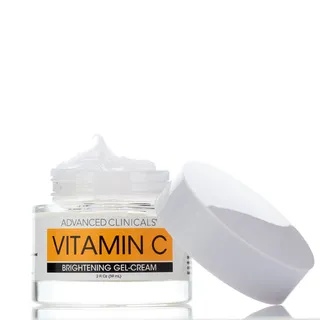
ADVANCED CLINICALS Vitamin C Face Cream

ADVANCED CLINICALS Vitamin C Face Cream

Efficacy100/100IrritancyHigh

Works for

Moisturizing
Niacinamide, Glycerin + 13 more
Works well
What the product description says
“This Vitamin C Face Gel-Cream, infused with Ferulic Acid, Niacinamide, and Squalane, helps brighten dull, uneven-looking skin while delivering weightless hydration.”
Source: Advanced Clinicals

This product can help improve hydration of the skin with the two types of ingredients.

The first type is called “humectants”:
these ingredients help attract water. When humectants are on the surface of the skin, they “pull in” the moisture from the outside environment, or from within deeper layers of the skin. The following ingredients in this product do the job: glucosamine hcl, glycerin.

This product also contains ingredients called “occlusives”. They help reduce the speed with which our skin loses moisture to the outside environment. These ingredients also help soften the upper layer of the skin, so it feels less tight and nicer to the touch. The following ingredients in this product do the job: dimethicone, squalane.

The following ingredients in this product are especially good for supporting the skin barrier and helping with the hydration level: niacinamide

NiacinamideHeroEffect: HighIs proven to be effective in reducing blemishes, evening out skin tone and helping to improve lines and wrinkles. It helps the skin to repair sun damage, calm down inflammation and keep maintain good levels of moisture. The concentration of about 2% is effective for supporting the skin barrier and evening out the skin tone. Concentration of 4-6% is better for helping with acne and balancing the sebum production~1.2–1.4%
GlycerinKey active· HumectantEffect: HighOne of the best moisturizing ingredients. Naturally present in skin. It attracts water to the upper layer of the skin working as a humectant~3.8–4.7%
Pyrus malus fruit extractKey activeEffect: MediumCan have some moisturizing properties due to its sugar content~3.1–3.7%
DimethiconeKey active· Emollient, OcclusiveEffect: HighA silicone that helps to reduce water loss from the surface of the skin. Can temporarily "fill in" lines and wrinkles, absorb oil, and create a nice product finish~2.4–3%
Limnanthes alba seed oilKey active· EmollientEffect: HighThis oil's cmposition is closest to rapeseed oil. It is a very stable oil and serves as an emoillient~1.7–2%
SqualaneKey active· Emollient, OcclusiveEffect: HighAn oil naturally present in skin. Works as an emollient to soften the skin and form a protective layer on its surface without a greasy feeling.~1.5–1.8%
Sodium hyaluronateKey active· HumectantEffect: HighOne of the best moisturizing ingredients. Attracts water into the upper layer of the skin~0.5–0.7%
Glucosamine hclKey active· HumectantEffect: HighMight be able to stimulate production of skin's natural moisturizing compounds such as hyaluronic acid. Could be helpful for evening the skin tone.~0.5–0.75%
Helianthus annuus extractKey active· EmollientEffect: HighHelps soften the upper layer of the skin~0.3–0.6%
Lactobacillus fermentKey active· HumectantEffect: HighA fermentation product created by bacteria Lactobacillus. The fermented product has anti-bacterial properties and might be helpful in calming down inflammation, but studies are lacking. Helps attract water to the upper layer of the skin. Can be used as a preservative~0.1–0.25%
Aloe barbadensis leaf juice powderEffect: LowTraditionally used to treat sunburns, dermatitis and inflammation, but evidence for its effectiveness is lacking. The extract can contain humectants that help attract water into the skin~0.7–1.05%
Camellia sinensis leaf extractEffect: LowCan contain potent anti-oxidant compounds (abbreviated ECG, GCG, EGC, and EGCG) that might help protect the skin from free radicals. Can help calm down inflammation and has some anti-bacterial properties. Unfortunately, these antioxidants are unstable and lose their effectiveness very quickly in products. The concentration of the antioxidant compounds in the extract also tends to be low to be effective in topical formulation~0.35–0.6%
Caprylyl glycol· Humectant, EmollientEffect: LowHelps preserve products and creates a nice product texture~0.3–0.5%
Butylene glycol· HumectantEffect: LowUsed to create a nice product texture and help delivery of other ingredients. Might be somewhat helpful in attracting water to the upper layer of the skin~0.05–0.15%
TocopherolEffect: Low, below effective dosePure form of vitamin E. Can help moisturise and protect the skin from free radicals. Often used to help stabilise other ingredients or the formula itself~0.3–0.55%
Evens skin tone
Niacinamide, Ferulic acid + 3 more
Works well
What the product description says
“This Vitamin C Face Gel-Cream, infused with Ferulic Acid, Niacinamide, and Squalane, helps brighten dull, uneven-looking skin while delivering weightless hydration.”
Source: Advanced Clinicals

This product can help reduce hypepigmentation and even out the skin tone because it contains the following effective ingredients: niacinamide

The following ingredient (ingredients) in this product might be helpful, but there is no evidence to confirm that it actually can help even out the skin tone: ferulic acid, glucosamine hcl.

Keep in mind that you would need to apply any topical skincare targetted at hypigmentation consistently for a couple of months to get a result. No topical skincare product can help get rid of hyperpigmentation (including post-acne marks and age spots) instantly.

NiacinamideKey activeEffect: HighIs proven to be effective in reducing blemishes, evening out skin tone and helping to improve lines and wrinkles. It helps the skin to repair sun damage, calm down inflammation and keep maintain good levels of moisture. The concentration of about 2% is effective for supporting the skin barrier and evening out the skin tone. Concentration of 4-6% is better for helping with acne and balancing the sebum production~1.2–1.4%
Ferulic acidKey activeEffect: MediumA potent anti-oxidant that has been shown to be effective in neutralizing free radicals in skin. There seem to have a synergetic effect of ferulic acid, vitamin E and C, meaning that when the ingredients are used together, they enhance each other's ability protect the skin against free radicals. Ferulic acid also helps to stabilize other ingredients - including vitamins C and E. It can help to even out the skin tone. Ferulic acid is approved for use as a sunscreen ingredient in Japan in concentrations up to 10%~0.55–0.8%
Glucosamine hclKey activeEffect: MediumMight be able to stimulate production of skin's natural moisturizing compounds such as hyaluronic acid. Could be helpful for evening the skin tone.~0.5–0.75%
Camellia sinensis leaf extractEffect: LowCan contain potent anti-oxidant compounds (abbreviated ECG, GCG, EGC, and EGCG) that might help protect the skin from free radicals. Can help calm down inflammation and has some anti-bacterial properties. Unfortunately, these antioxidants are unstable and lose their effectiveness very quickly in products. The concentration of the antioxidant compounds in the extract also tends to be low to be effective in topical formulation~0.35–0.6%
Tetrahexyldecyl ascorbateUnder-dosedBeing a lipid soluble form of vitamin C, it is more stable than ascorbic acid, but still degrades quickly and needs to be stabilized in a formulation with another ingredient. It is claimed to penetrate skin better than pure vitamin C and have the the similar benefits, but solid studies of its effectiveness are lacking. Is likely to require a higher concentration in a product than pure vitamin C to be effective. It might be able to help reduce pore clogging.~0.6–0.9%
Anti-oxidation
Side benefit · Ferulic acid, Camellia sinensis leaf extract + 9 more
Works well

This product contains antioxidants (ferulic acid) that can help neutralize free radicals in skin. By doing so, they can lessen the damage the skin gets from the UV light (sun).

The following ingredients - camellia sinensis leaf extract also can have an antioxidant effect, but there is less evidence to confirm their effectiveness in skin.

Ferulic acidKey activeEffect: HighA potent anti-oxidant that has been shown to be effective in neutralizing free radicals in skin. There seem to have a synergetic effect of ferulic acid, vitamin E and C, meaning that when the ingredients are used together, they enhance each other's ability protect the skin against free radicals. Ferulic acid also helps to stabilize other ingredients - including vitamins C and E. It can help to even out the skin tone. Ferulic acid is approved for use as a sunscreen ingredient in Japan in concentrations up to 10%~0.55–0.8%
Camellia sinensis leaf extractKey activeEffect: MediumCan contain potent anti-oxidant compounds (abbreviated ECG, GCG, EGC, and EGCG) that might help protect the skin from free radicals. Can help calm down inflammation and has some anti-bacterial properties. Unfortunately, these antioxidants are unstable and lose their effectiveness very quickly in products. The concentration of the antioxidant compounds in the extract also tends to be low to be effective in topical formulation~0.35–0.6%
Pyrus malus fruit extractEffect: LowCan have some moisturizing properties due to its sugar content~3.1–3.7%
Limnanthes alba seed oilEffect: LowThis oil's cmposition is closest to rapeseed oil. It is a very stable oil and serves as an emoillient~1.7–2%
Terminalia ferdinandiana fruit extractEffect: LowA plant extract that might have some anti-oxidant effect in skin, but evidence is lacking~0.95–1.15%
Glucosamine hclEffect: LowMight be able to stimulate production of skin's natural moisturizing compounds such as hyaluronic acid. Could be helpful for evening the skin tone.~0.5–0.75%
Lactobacillus fermentEffect: LowA fermentation product created by bacteria Lactobacillus. The fermented product has anti-bacterial properties and might be helpful in calming down inflammation, but studies are lacking. Helps attract water to the upper layer of the skin. Can be used as a preservative~0.1–0.25%
Panax ginseng root extractEffect: Low, below effective doseA plant extract that might have some anti-inflammatory properties, but solid evidence is lacking. It can be irritating~0.35–0.65%
Rosmarinus officinalis leaf extractEffect: Low, below effective doseCan be helpful in reducing inflammation in skin, including inflamed acne. It can be irritating~0.25–0.45%
Tetrahexyldecyl ascorbateUnder-dosedBeing a lipid soluble form of vitamin C, it is more stable than ascorbic acid, but still degrades quickly and needs to be stabilized in a formulation with another ingredient. It is claimed to penetrate skin better than pure vitamin C and have the the similar benefits, but solid studies of its effectiveness are lacking. Is likely to require a higher concentration in a product than pure vitamin C to be effective. It might be able to help reduce pore clogging.~0.6–0.9%
TocopherolUnder-dosedPure form of vitamin E. Can help moisturise and protect the skin from free radicals. Often used to help stabilise other ingredients or the formula itself~0.3–0.55%
Anti-aging
Side benefit the brand mentions · Niacinamide, Ferulic acid + 5 more
Works well
What the product description says
“This formula diminishes the look of sun damaged skin, dark spots, hyperpigmentation, and wrinkles.”
Source: Advanced Clinicals

This product can help reduce and prevent fine lines and wrinkles, improve skin elasticity and firmness because it contains niacinamide.

These ingredients in the product can also be helpful, even though there is less evidence for their effectiveness: ferulic acid.

Keep in mind that it typically takes at least 6 weeks to notice any results because the changes that are needed to improve fine lines and elasticity happen in the deeper layers of the skin. No topical anti-aging product can “erase” wrinkles or fully reverse signs of aging.

NiacinamideKey activeEffect: HighIs proven to be effective in reducing blemishes, evening out skin tone and helping to improve lines and wrinkles. It helps the skin to repair sun damage, calm down inflammation and keep maintain good levels of moisture. The concentration of about 2% is effective for supporting the skin barrier and evening out the skin tone. Concentration of 4-6% is better for helping with acne and balancing the sebum production~1.2–1.4%
Ferulic acidKey activeEffect: MediumA potent anti-oxidant that has been shown to be effective in neutralizing free radicals in skin. There seem to have a synergetic effect of ferulic acid, vitamin E and C, meaning that when the ingredients are used together, they enhance each other's ability protect the skin against free radicals. Ferulic acid also helps to stabilize other ingredients - including vitamins C and E. It can help to even out the skin tone. Ferulic acid is approved for use as a sunscreen ingredient in Japan in concentrations up to 10%~0.55–0.8%
Limnanthes alba seed oilEffect: LowThis oil's cmposition is closest to rapeseed oil. It is a very stable oil and serves as an emoillient~1.7–2%
Glucosamine hclEffect: LowMight be able to stimulate production of skin's natural moisturizing compounds such as hyaluronic acid. Could be helpful for evening the skin tone.~0.5–0.75%
Camellia sinensis leaf extractEffect: LowCan contain potent anti-oxidant compounds (abbreviated ECG, GCG, EGC, and EGCG) that might help protect the skin from free radicals. Can help calm down inflammation and has some anti-bacterial properties. Unfortunately, these antioxidants are unstable and lose their effectiveness very quickly in products. The concentration of the antioxidant compounds in the extract also tends to be low to be effective in topical formulation~0.35–0.6%
TocopherolEffect: Low, below effective dosePure form of vitamin E. Can help moisturise and protect the skin from free radicals. Often used to help stabilise other ingredients or the formula itself~0.3–0.55%
Tetrahexyldecyl ascorbateUnder-dosedBeing a lipid soluble form of vitamin C, it is more stable than ascorbic acid, but still degrades quickly and needs to be stabilized in a formulation with another ingredient. It is claimed to penetrate skin better than pure vitamin C and have the the similar benefits, but solid studies of its effectiveness are lacking. Is likely to require a higher concentration in a product than pure vitamin C to be effective. It might be able to help reduce pore clogging.~0.6–0.9%
Anti-blemish
Side benefit · Niacinamide, Camellia sinensis leaf extract + 1 more
Works well

This product can help reduce breakouts and clogged pores because it contains the following ingredient: niacinamide. This ingredient is used for treating acne and can have a noticeable effect.

NiacinamideHeroEffect: HighIs proven to be effective in reducing blemishes, evening out skin tone and helping to improve lines and wrinkles. It helps the skin to repair sun damage, calm down inflammation and keep maintain good levels of moisture. The concentration of about 2% is effective for supporting the skin barrier and evening out the skin tone. Concentration of 4-6% is better for helping with acne and balancing the sebum production~1.2–1.4%
Camellia sinensis leaf extractEffect: LowCan contain potent anti-oxidant compounds (abbreviated ECG, GCG, EGC, and EGCG) that might help protect the skin from free radicals. Can help calm down inflammation and has some anti-bacterial properties. Unfortunately, these antioxidants are unstable and lose their effectiveness very quickly in products. The concentration of the antioxidant compounds in the extract also tends to be low to be effective in topical formulation~0.35–0.6%
Rosmarinus officinalis leaf extractUnder-dosedCan be helpful in reducing inflammation in skin, including inflamed acne. It can be irritating~0.25–0.45%

Can it cause trouble?

Irritancy
3 strong irritants: Citrus paradisi peel oil, Rosmarinus officinalis leaf extract + 1 more — patch-test recommended
High risk
We flagged 14 ingredients with irritancy potential. Severity depends on your sensitivity threshold; the table lists the worst offenders first.
IngredientFunctionIrritationEst. amount
Citrus paradisi peel oilUsed as a fragrance. Can be irritatingHigh~0.3–0.55%est.
Panax ginseng root extractA plant extract that might have some anti-inflammatory properties, but solid evidence is lacking. It can be irritatingHigh~0.35–0.65%est.
Rosmarinus officinalis leaf extractCan be helpful in reducing inflammation in skin, including inflamed acne. It can be irritatingHigh~0.25–0.45%est.
LimoneneA common frangrance that can easily irritate skin, especially if exposed to air, light or heatHigh~0.05–0.1%est.
Pyrus malus fruit extractCan have some moisturizing properties due to its sugar contentMedium~3.1–3.7%est.
Terminalia ferdinandiana fruit extractA plant extract that might have some anti-oxidant effect in skin, but evidence is lackingMedium~0.95–1.15%est.
Aloe barbadensis leaf juice powderTraditionally used to treat sunburns, dermatitis and inflammation, but evidence for its effectiveness is lacking. The extract can contain humectants that help attract water into the skinMedium~0.7–1.05%est.
Tetrahexyldecyl ascorbateBeing a lipid soluble form of vitamin C, it is more stable than ascorbic acid, but still degrades quickly and needs to be stabilized in a formulation with another ingredient. It is claimed to penetrate skin better than pure vitamin C and have the the similar benefits, but solid studies of its effectiveness are lacking. Is likely to require a higher concentration in a product than pure vitamin C to be effective. It might be able to help reduce pore clogging.Medium~0.6–0.9%est.
Citric acidCan work as an exfoliant but is typically used to adjust the product pHMedium~0.3–0.55%est.
Sodium metabisulfiteA preservativeMedium~0.1–0.2%est.
Caprylyl glycolHelps preserve products and creates a nice product textureMedium~0.3–0.5%est.
EthylhexylglycerinA preservativeMedium~0.25–0.4%est.
Hexylene glycolHelps create a more spreadable product textureMedium~0.2–0.35%est.
Polysorbate 60Helps oil and water mix togetherMedium~0.2–0.35%est.
Comedogenic
Clean of flagged comedogenic ingredients
None flagged
Did this help you decide?

User reviews

Would you recommend?
No community reviews yet.

Be the first — your take helps the next person decide.

Ingredients

Filter by role to see what each ingredient is doing.

Water~45–55%
Formula
Irritation risk
Low

Plain old water

More about Water
Propanediol~5.3–6.4%
Formula
Irritation risk
Low

Acts as a solvent for other ingredients. Speeds up the absorption of other ingredients into the skin

More about Propanediol
Glycerin~3.8–4.7%
Key active
Irritation risk
Low
Works for
Moisturizing

One of the best moisturizing ingredients. Naturally present in skin. It attracts water to the upper layer of the skin working as a humectant

More about Glycerin
Pyrus malus fruit extract~3.1–3.7%
Key activeIrritant · medium
Irritation risk
Medium
Works for
MoisturizingAnti-oxidation

Can have some moisturizing properties due to its sugar content

More about Pyrus malus fruit extract
Dimethicone~2.4–3%
Key active
Irritation risk
Low
Works for
MoisturizingMattifying

A silicone that helps to reduce water loss from the surface of the skin. Can temporarily "fill in" lines and wrinkles, absorb oil, and create a nice product finish

More about Dimethicone
Ammonium acryloyldimethyltaurate/vp copolymer~1.9–2.4%
Formula
Irritation risk
Low

Increases thickness of a product. Texture enhancer for oil-in-water emulsions

More about Ammonium acryloyldimethyltaurate/vp copolymer
Limnanthes alba seed oil~1.7–2%
Key active
Irritation risk
Low
Works for
MoisturizingAnti-agingAnti-oxidation

This oil's cmposition is closest to rapeseed oil. It is a very stable oil and serves as an emoillient

More about Limnanthes alba seed oil
Squalane~1.5–1.8%
Key active
Irritation risk
Low
Works for
Moisturizing

An oil naturally present in skin. Works as an emollient to soften the skin and form a protective layer on its surface without a greasy feeling.

More about Squalane
Niacinamide~1.2–1.4%
Hero · Moisturizing, Anti-blemish
Irritation risk
Low
Works for
Anti-agingEvens skin toneMoisturizingAnti-blemishReduces irritationAnti-inflammatoryReduces rednessAntibacterial

Is proven to be effective in reducing blemishes, evening out skin tone and helping to improve lines and wrinkles. It helps the skin to repair sun damage, calm down inflammation and keep maintain good levels of moisture. The concentration of about 2% is effective for supporting the skin barrier and evening out the skin tone. Concentration of 4-6% is better for helping with acne and balancing the sebum production

More about Niacinamide
Terminalia ferdinandiana fruit extract~0.95–1.15%
Irritant · medium
Irritation risk
Medium
Works for
Anti-oxidation

A plant extract that might have some anti-oxidant effect in skin, but evidence is lacking

More about Terminalia ferdinandiana fruit extract
Aloe barbadensis leaf juice powder~0.7–1.05%
Irritant · medium
Irritation risk
Medium
Works for
Moisturizing

Traditionally used to treat sunburns, dermatitis and inflammation, but evidence for its effectiveness is lacking. The extract can contain humectants that help attract water into the skin

More about Aloe barbadensis leaf juice powder
Tetrahexyldecyl ascorbate~0.6–0.9%
Under-dosedIrritant · medium
Irritation risk
Medium
Works for
Anti-agingEvens skin toneAnti-oxidation

Being a lipid soluble form of vitamin C, it is more stable than ascorbic acid, but still degrades quickly and needs to be stabilized in a formulation with another ingredient. It is claimed to penetrate skin better than pure vitamin C and have the the similar benefits, but solid studies of its effectiveness are lacking. Is likely to require a higher concentration in a product than pure vitamin C to be effective. It might be able to help reduce pore clogging.

More about Tetrahexyldecyl ascorbate
Ferulic acid~0.55–0.8%
Key active
Irritation risk
Low
Works for
Anti-oxidationAnti-agingEvens skin toneAnti-inflammatory

A potent anti-oxidant that has been shown to be effective in neutralizing free radicals in skin. There seem to have a synergetic effect of ferulic acid, vitamin E and C, meaning that when the ingredients are used together, they enhance each other's ability protect the skin against free radicals. Ferulic acid also helps to stabilize other ingredients - including vitamins C and E. It can help to even out the skin tone. Ferulic acid is approved for use as a sunscreen ingredient in Japan in concentrations up to 10%

More about Ferulic acid
Glucosamine hcl~0.5–0.75%
Key active
Irritation risk
Low
Works for
MoisturizingAntibacterialEvens skin toneAnti-agingAnti-oxidation

Might be able to stimulate production of skin's natural moisturizing compounds such as hyaluronic acid. Could be helpful for evening the skin tone.

More about Glucosamine hcl
Sodium hyaluronate~0.5–0.7%
Key active
Irritation risk
Low
Works for
Moisturizing

One of the best moisturizing ingredients. Attracts water into the upper layer of the skin

More about Sodium hyaluronate
Caulerpa lentillifera extract~0.5–0.75%
Formula
Hydroxyethylcellulose~0.5–0.75%
Formula
Irritation risk
Low

Used to thicken product formulations and create gel-like textures

More about Hydroxyethylcellulose
Phenoxyethanol~0.45–0.65%
Formula
Irritation risk
Low

A preservative. It helps prevent bacterial growth in cosmetic products

More about Phenoxyethanol
Polysorbate 20~0.45–0.65%
Formula
Irritation risk
Low
Works for
Cleansing

Helps oil and water mix together

More about Polysorbate 20
Tetrasodium glutamate diacetate~0.35–0.65%
Formula
Irritation risk
Low

Helps stabilize the product formulation

More about Tetrasodium glutamate diacetate
Oryza sativa bran extract~0.3–0.6%
Formula
Irritation risk
Low

Used to thicken the product consistency

More about Oryza sativa bran extract
Citrus paradisi peel oil~0.3–0.55%
Irritant · high
Irritation risk
High

Used as a fragrance. Can be irritating

More about Citrus paradisi peel oil
Citric acid~0.3–0.55%
Irritant · medium
Irritation risk
Medium

Can work as an exfoliant but is typically used to adjust the product pH

More about Citric acid
Camellia sinensis leaf extract~0.35–0.6%
Key active
Irritation risk
Low
Works for
AntibacterialAnti-oxidationAnti-agingAnti-blemishEvens skin toneMoisturizing

Can contain potent anti-oxidant compounds (abbreviated ECG, GCG, EGC, and EGCG) that might help protect the skin from free radicals. Can help calm down inflammation and has some anti-bacterial properties. Unfortunately, these antioxidants are unstable and lose their effectiveness very quickly in products. The concentration of the antioxidant compounds in the extract also tends to be low to be effective in topical formulation

More about Camellia sinensis leaf extract
Panax ginseng root extract~0.35–0.65%
Irritant · high
Irritation risk
High
Works for
Anti-inflammatoryAnti-oxidation

A plant extract that might have some anti-inflammatory properties, but solid evidence is lacking. It can be irritating

More about Panax ginseng root extract
Sodium metabisulfite~0.1–0.2%
Irritant · medium
Irritation risk
Medium

A preservative

More about Sodium metabisulfite
Helianthus annuus extract~0.3–0.6%
Key active
Irritation risk
Low
Works for
Moisturizing

Helps soften the upper layer of the skin

More about Helianthus annuus extract
Tocopherol~0.3–0.55%
Under-dosed
Irritation risk
Low
Works for
Anti-oxidationAnti-agingAnti-inflammatoryMoisturizing

Pure form of vitamin E. Can help moisturise and protect the skin from free radicals. Often used to help stabilise other ingredients or the formula itself

More about Tocopherol
Rosmarinus officinalis leaf extract~0.25–0.45%
Under-dosedIrritant · high
Irritation risk
High
Works for
Anti-blemishAntibacterialAnti-oxidation

Can be helpful in reducing inflammation in skin, including inflamed acne. It can be irritating

More about Rosmarinus officinalis leaf extract
Caprylyl glycol~0.3–0.5%
Irritant · medium
Irritation risk
Medium
Works for
Moisturizing

Helps preserve products and creates a nice product texture

More about Caprylyl glycol
Ethylhexylglycerin~0.25–0.4%
Irritant · medium
Irritation risk
Medium

A preservative

More about Ethylhexylglycerin
Hexylene glycol~0.2–0.35%
Irritant · medium
Irritation risk
Medium
Works for
Cleansing

Helps create a more spreadable product texture

More about Hexylene glycol
Polysorbate 60~0.2–0.35%
Irritant · medium
Irritation risk
Medium
Works for
Cleansing

Helps oil and water mix together

More about Polysorbate 60
Disodium phosphate~0.15–0.25%
Formula
Irritation risk
Low

Helps adjust the product pH and stabilize the formulation

More about Disodium phosphate
Lactobacillus ferment~0.1–0.25%
Key active
Irritation risk
Low
Works for
MoisturizingAnti-oxidationAnti-inflammatoryReduces irritation

A fermentation product created by bacteria Lactobacillus. The fermented product has anti-bacterial properties and might be helpful in calming down inflammation, but studies are lacking. Helps attract water to the upper layer of the skin. Can be used as a preservative

More about Lactobacillus ferment
Sodium phosphate~0.1–0.2%
Formula
Irritation risk
Low

Helps stabilize the product formulation

More about Sodium phosphate
Butylene glycol~0.05–0.15%
Formula
Irritation risk
Low
Works for
Moisturizing

Used to create a nice product texture and help delivery of other ingredients. Might be somewhat helpful in attracting water to the upper layer of the skin

More about Butylene glycol
Limonene~0.05–0.1%
Irritant · high
Irritation risk
High

A common frangrance that can easily irritate skin, especially if exposed to air, light or heat

More about Limonene
Ingredient list view

Water, Propanediol, Glycerin, Pyrus malus fruit extract, Dimethicone, Ammonium acryloyldimethyltaurate/vp copolymer, Limnanthes alba seed oil, Squalane, Niacinamide, Terminalia ferdinandiana fruit extract, Aloe barbadensis leaf juice powder, Tetrahexyldecyl ascorbate, Ferulic acid, Glucosamine hcl, Sodium hyaluronate, Caulerpa lentillifera extract, Hydroxyethylcellulose, Phenoxyethanol, Polysorbate 20, Tetrasodium glutamate diacetate, Oryza sativa bran extract, Citrus paradisi peel oil, Citric acid, Camellia sinensis leaf extract, Panax ginseng root extract, Sodium metabisulfite, Helianthus annuus extract, Tocopherol, Rosmarinus officinalis leaf extract, Caprylyl glycol, Ethylhexylglycerin, Hexylene glycol, Polysorbate 60, Disodium phosphate, Lactobacillus ferment, Sodium phosphate, Butylene glycol, Limonene

Compare prices

Retailers ranked by price — lowest first.

Amazon USPrice as of 11/22 06:19 GMT
$8.99
Buy
Advanced Clinicals
$12.99
Buy
Amazon USPrice as of 11/21 12:44 GMT
$13.99
Buy

Affiliate links · As an Amazon Associate, WIMJ earns from qualifying purchases.

Worth comparing, line by line.

Match % combines shared ingredients, the first five ingredients, shared actives and hero ingredients, irritancy (lower counts in the alternative's favour), texture and body area. Only products in the same routine step are compared.

Side-by-side comparison of this product against its closest alternatives
ADVANCED CLINICALSVitamin C Face CreamYOUR PRODUCTinnisfreeBrightening CreamMedicubeTXA + Niacinamide Capsule CreamNIP+FABVitamin C Fix Hybrid Gel Cream 5%
Match—83%82%80%
Price$8.99$20.06+$11.07$13.93+$4.94$14.11+$5.12
Shared key ingredients—6 of 144 of 145 of 14
Key difference—GluconolactoneAlpha-ArbutinAscorbyl Glucoside
Irritancy High Medium Medium High
Drying alcohol————
View product Shop Shop Shop

More alternatives: Skincare by Dr V TRIO Blemish PM Gel MoisturiserRéVive Hydrogel Moisturizer / Hyaluronic Acid Water Cream

Cheaper alternatives? See how this stacks up against similar formulas.
We compare ingredient profiles across our catalog — pick the closest match for your budget.
Open dupe finder

Sources cited in this review

Every concentration estimate and effectiveness label is anchored to one of these 25 studies and safety reviews.

  1. 1
  2. 2
  3. 3
  4. 4
  5. 5
  6. 6
ADVANCED CLINICALS Vitamin C Face Cream
ADVANCED CLINICALSVitamin C Face Cream

Affiliate links · As an Amazon Associate, WIMJ earns from qualifying purchases.

As an Amazon Associate, WIMJ earns from qualifying purchases.