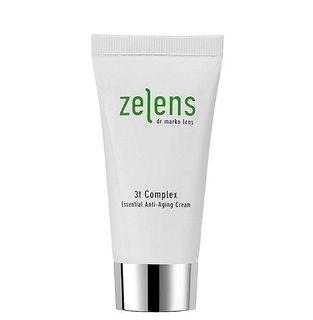
Zelens Deluxe 3t Complex Essential Anti-Aging Cream
Works for
2 of 2 advertised claims delivered
Anti-aging4 ingredients credited for this claimModerate support
“Deluxe 3t Complex Essential Anti-Aging Cream”
This product contains ursolic acid. This ingredient might be able to help reduce and prevent fine lines and wrinkles, improve skin elasticity and firmness, but there is not enough evidence that it actually works.
Moisturizing25 ingredients credited for this claimGood support
“Deluxe 3t Complex Essential Anti-Aging Cream”
This product can help improve hydration of the skin with the two types of ingredients.
The first type is called “humectants”:
these ingredients help attract water.
When humectants are on the surface of the skin, they “pull in” the moisture from the outside environment, or from
within deeper layers of the skin. The following ingredients in this product do the job:
glycerin, hyaluronic acid.
This product also contains ingredients called “occlusives”. They help reduce the speed with which our skin loses moisture to the outside environment. These ingredients also help soften the upper layer of the skin, so it feels less tight and nicer to the touch. The following ingredients in this product do the job: dimethicone, helianthus annuus seed oil.
Anti-oxidationNot advertised by the brand · 15 ingredients credited for this claimModerate support
This product contains antioxidants (ginkgo biloba leaf extract, malpighia punicifolia fruit extract, ursolic acid) that might be able to help neutralize free radicals in skin to lessen the damage it gets from the UV light (sun). There is not enough evidence to confirm their effectiveness in skin though.
Can it cause trouble?
Irritancy7 strong irritants: Rosa damascena extract, Parfum + 5 more — patch-test recommendedHigh risk
Comedogenic9 ingredients rated 2 or more on the 0–5 pore-clogging scale9 flagged
User reviews
Be the first — your take helps the next person decide.
Ingredients
Filter by role to see what each ingredient is doing.
Ursolic acid~28–41%
- Irritation risk
- Low
Rosa damascena extract~6.9–10.3%
- Irritation risk
- High
Oil of a very fragrant pink rose used as fragrance in cosmetics. Extensive research has shown it has mixed benefits. In the pro column, inhaling this flower’s scent seems to have relaxing properties and the plant’s petals contain skin-soothing and antioxidant compounds that can benefit skin. On the flipside, the numerous chemicals that create this rose’s distinctive fragrance pose a risk of causing skin aggravation.
More about Rosa damascena extractAlgae~4.3–6.4%
- Irritation risk
- Low
Ursolic acid~2.6–3.9%
- Irritation risk
- Low
Water~2.2–3.3%
Isononyl isononanoate~2–3%
- Irritation risk
- Low
Forms a protective film on the surface of the skin to prevent moisture loss. Gives a velvety feel to products while reducing tackiness
More about Isononyl isononanoateGlycerin~1.6–2.4%
- Irritation risk
- Low
One of the best moisturizing ingredients. Naturally present in skin. It attracts water to the upper layer of the skin working as a humectant
More about GlycerinPropanediol~1.3–1.9%
- Irritation risk
- Low
Acts as a solvent for other ingredients. Speeds up the absorption of other ingredients into the skin
More about PropanediolButylene glycol~1–1.5%
- Irritation risk
- Low
Used to create a nice product texture and help delivery of other ingredients. Might be somewhat helpful in attracting water to the upper layer of the skin
More about Butylene glycolCaprylic/capric triglyceride~0.85–1.25%
- Irritation risk
- Medium
A good mix of fatty acids that forms a protective layer on the skin. Improves the shelf life of products. Derived from coconut and glycerin
More about Caprylic/capric triglycerideGlyceryl stearate se~0.45–1.05%
- Irritation risk
- Low
- Comedogenicity
- 2/5
Used to stabilize the product formulations and works as an emollient
More about Glyceryl stearate seCyclopentasiloxane~0.4–0.95%
- Irritation risk
- Low
A silicone that helps improve the product texture and spreadability. Can absorb oil creating a short-term mattifying effect on the skin
More about CyclopentasiloxaneDimethicone~0.35–0.85%
- Irritation risk
- Low
A silicone that helps to reduce water loss from the surface of the skin. Can temporarily "fill in" lines and wrinkles, absorb oil, and create a nice product finish
More about DimethiconeAmmonium acryloyldimethyltaurate/vp copolymer~0.3–0.75%
- Irritation risk
- Low
Increases thickness of a product. Texture enhancer for oil-in-water emulsions
More about Ammonium acryloyldimethyltaurate/vp copolymerPhenoxyethanol~0.3–0.7%
- Irritation risk
- Low
A preservative. It helps prevent bacterial growth in cosmetic products
More about PhenoxyethanolBorago officinalis seed oil~0.2–0.8%
- Irritation risk
- Low
A plant oil that is effective in reducing irritation in skin, restore the barrier function and support its hydration
More about Borago officinalis seed oilCetearyl alcohol~0.3–0.75%
- Irritation risk
- Low
- Comedogenicity
- 2/5
A non-drying alcohol. Works as an emollient. Helps water and oil mix together and creates a nice product texture
More about Cetearyl alcoholCorylus avellana seed oil~0.15–0.65%
- Irritation risk
- Low
Linum usitatissimum seed oil~0.15–0.5%
Oryza sativa hull powder~0.2–0.7%
- Irritation risk
- Low
Sesamum indicum seed oil~0.15–0.55%
- Irritation risk
- Low
A good moisturizing plant oil. Due to the high linoleic acid content, it helps soften the upper layer of the skin, reduce water loss and support skin barrier function
More about Sesamum indicum seed oilTriticum vulgare germ oil~0.15–0.6%
- Irritation risk
- Low
- Comedogenicity
- 3/5
A good emoillient. Contains vitamin E which can help neutralise free radicals, however the oil is unstable. Avoid if you have gluten or wheat sensitivity (including food allergies).
More about Triticum vulgare germ oilHelianthus annuus seed oil~0.15–0.55%
- Irritation risk
- Low
A great emollient due to its high linoleic acid content. One of the most effective plant oils in helping skin hydration and repairing skin barrier function
More about Helianthus annuus seed oilParfum~0.1–0.45%
- Irritation risk
- High
An aromatic blend of unspecified and possibly irritating ingredients
More about ParfumChlorphenesin~0.16–0.32%
Cyclohexasiloxane~0.15–0.55%
- Irritation risk
- Low
A silicone that serves as an emollient. Helps create a nice non-greasy feels
More about CyclohexasiloxaneDisodium edta~0.1–0.5%
Malus domestica fruit extract~0.15–0.6%
- Irritation risk
- Medium
Helps attract water to the upper layer of the skin
More about Malus domestica fruit extractPanthenyl ethyl ether~0.1–0.5%
- Irritation risk
- Low
Helps attract water to the upper layer of the skin and can help improve skin barrier function
More about Panthenyl ethyl etherO-cymen-5-ol~0.05–0.1%
Simmondsia chinensis seed oil~0.15–0.6%
- Irritation risk
- Medium
Softens the upper layer of skin and helps restore the healthy skin barrier. Has shown to help calm down inflammation in skin. It is a stable oil, meaning that it retains its properties even when exposed to air.
More about Simmondsia chinensis seed oilAscorbyl tetraisopalmitate~0.15–0.65%
- Irritation risk
- Medium
A vitamin C derivative. Studies show that is might be effective in reducing hyperpigmentation, but there are no studies confirming that it is effectively converted into the bioavailable form of Vitamin C in skin. It is not clear how this derivative compares in effectiveness to the topical application of bioavailable form of vitamin C (L-ascorbic acid)
More about Ascorbyl tetraisopalmitateSodium dehydroacetate~0.15–0.55%
Commiphora mukul resin extract~0.15–0.55%
- Irritation risk
- High
A plant extract might be helpful in neutralizing free radicals and reducing inflammation in skin
More about Commiphora mukul resin extractCaramel~0.1–0.5%
- Irritation risk
- Low
Silanetriol~0.1–0.5%
- Irritation risk
- Low
Hydrolyzed pearl~0.1–0.45%
- Irritation risk
- Low
Hyaluronic acid~0.1–0.45%
- Irritation risk
- Low
One of the best moisturizing ingredients. Attracts water into the upper layer of the skin. Naturally present in skin. Typically has large molecule size unless advertised otherwise on the product label. Helps support skin's barrier function and may help to reduce inflammation
More about Hyaluronic acidCitric acid~0.1–0.5%
- Irritation risk
- Medium
Can work as an exfoliant but is typically used to adjust the product pH
More about Citric acidMimosa tenuiflora bark extract~0.1–0.45%
- Irritation risk
- Low
Sorbic acid~0.15–0.55%
Ursolic acid~0.1–0.4%
- Irritation risk
- Low
Himanthalia elongata extract~0.1–0.5%
- Irritation risk
- Low
- Comedogenicity
- 3/5
Malpighia punicifolia fruit extract~0.15–0.6%
- Irritation risk
- Low
A fruit extract that might help neutralize free radicals. The concentrations typically used in cosmetics are too small to have an effect
More about Malpighia punicifolia fruit extractVitis vinifera leaf extract~0.1–0.45%
- Irritation risk
- Medium
Linalool~0.1–0.45%
Aesculus hippocastanum bark extract~0.15–0.55%
- Irritation risk
- Low
Carica papaya fruit extract~0.1–0.45%
- Irritation risk
- High
Crithmum maritimum extract~0.1–0.5%
- Irritation risk
- Low
- Comedogenicity
- 3/5
An algae extract that might have anti-oxidant properties
More about Crithmum maritimum extractFucus vesiculosus extract~0.1–0.5%
- Irritation risk
- Low
- Comedogenicity
- 3/5
Ginkgo biloba leaf extract~0.1–0.45%
- Irritation risk
- High
A plant extract that might help neutralize free radicals and reduce inflammation in skin. It can be irritating
More about Ginkgo biloba leaf extractHamamelis virginiana leaf extract~0.1–0.45%
- Irritation risk
- High
A plant extract that can help calm down inflammation in skin. Can, however, itself be irritating
More about Hamamelis virginiana leaf extractHelichrysum arenarium flower extract~0.1–0.45%
- Irritation risk
- Low
Melissa officinalis leaf extract~0.1–0.45%
- Irritation risk
- High
A plant extract that is added for its fragrance. Can be irritating
More about Melissa officinalis leaf extractOlea europaea leaf extract~0.1–0.3%
- Irritation risk
- Medium
A plant extract that might have some anti-oxidant and anti-inflammatory properties but evidence for effectiveness in skin is missing
More about Olea europaea leaf extractPalmaria palmata extract~0.1–0.35%
- Irritation risk
- Low
- Comedogenicity
- 3/5
Red algae extract that helps attract water to the upper layer of the skin
More about Palmaria palmata extractPanax ginseng root extract~0.1–0.4%
- Irritation risk
- High
A plant extract that might have some anti-inflammatory properties, but solid evidence is lacking. It can be irritating
More about Panax ginseng root extractParietaria officinalis extract~0.05–0.25%
- Irritation risk
- Low
Physalis alkekengi fruit extract~0.05–0.15%
- Irritation risk
- Low
Porphyra umbilicalis extract~0.05–0.25%
- Irritation risk
- Low
- Comedogenicity
- 3/5
An algae extract that can help attract water to the upper layer of the skin. Might have an anti-oxidant effect in skin but evidence is lacking
More about Porphyra umbilicalis extractSodium benzoate~0.05–0.2%
Padina pavonica thallus extract~0.05–0.1%
- Irritation risk
- Low
- Comedogenicity
- 3/5
Might help to soften the upper layer of the skin. Is claimed to have anti-oxidant properties, but evidence in missing
More about Padina pavonica thallus extractTocopherol~0.05–0.15%
- Irritation risk
- Low
Pure form of vitamin E. Can help moisturise and protect the skin from free radicals. Often used to help stabilise other ingredients or the formula itself
More about TocopherolIngredient list view
Ursolic acid, Rosa damascena extract, Unknown, Algae, Unknown, Ursolic acid, Water, Isononyl isononanoate, Glycerin, Propanediol, Butylene glycol, Caprylic/capric triglyceride, Glyceryl stearate se, Cyclopentasiloxane, Dimethicone, Ammonium acryloyldimethyltaurate/vp copolymer, Phenoxyethanol, Borago officinalis seed oil, Cetearyl alcohol, Corylus avellana seed oil, Linum usitatissimum seed oil, Oryza sativa hull powder, Sesamum indicum seed oil, Triticum vulgare germ oil, Helianthus annuus seed oil, Parfum, Chlorphenesin, Cyclohexasiloxane, Disodium edta, Malus domestica fruit extract, Panthenyl ethyl ether, O-cymen-5-ol, Simmondsia chinensis seed oil, Ascorbyl tetraisopalmitate, Sodium dehydroacetate, Commiphora mukul resin extract, Caramel, Silanetriol, Hydrolyzed pearl, Hyaluronic acid, Citric acid, Mimosa tenuiflora bark extract, Sorbic acid, Ursolic acid, Himanthalia elongata extract, Malpighia punicifolia fruit extract, Vitis vinifera leaf extract, Linalool, Aesculus hippocastanum bark extract, Carica papaya fruit extract, Crithmum maritimum extract, Fucus vesiculosus extract, Ginkgo biloba leaf extract, Hamamelis virginiana leaf extract, Helichrysum arenarium flower extract, Melissa officinalis leaf extract, Olea europaea leaf extract, Palmaria palmata extract, Panax ginseng root extract, Parietaria officinalis extract, Physalis alkekengi fruit extract, Porphyra umbilicalis extract, Sodium benzoate, Padina pavonica thallus extract, Tocopherol
Compare prices
Retailers ranked by price — lowest first.
Sources cited in this review
Every concentration estimate and effectiveness label is anchored to one of these 37 studies and safety reviews.
- 1Ursolic acidmdedge.com
- 2
- 3
- 4
- 5
- 6Final Report on the Safety Assessment of Dimethicone Copolyoljournals.sagepub.com

Affiliate links · As an Amazon Associate, WIMJ earns from qualifying purchases.