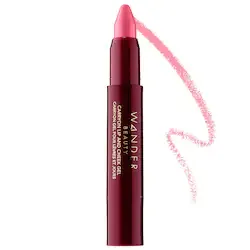
Wander Beauty Carryon Lip and Cheek Gel
Works for
1 of 1 advertised claim delivered
Moisturizing8 ingredients credited for this claimGood support
“This hydrating and portable, multitasking, twist up gel crayon can easily be worn on both lips and cheeks.”
This product can help soften the skin and reduce its moisture loss with emollients and occlusives: cera microcristallina, butyrospermum parkii oil.
Keep in mind that this product does not contain effective ingredients to attract water to the upper layer of the skin. This is why an additional product with humectants like glycerin or hyaluronic acid can be helpful (apply it before this product for the best results).
Can it cause trouble?
Irritancy7 flagged ingredientsLow risk
Comedogenic2 ingredients rated 2 or more on the 0–5 pore-clogging scale2 flagged
User reviews
Be the first — your take helps the next person decide.
Ingredients
Filter by role to see what each ingredient is doing.
Polybutene~22–33%
Isopropyl palmitate~4.7–7%
- Irritation risk
- Medium
- Comedogenicity
- 3/5
Helps soften the upper layer of the skin and create a thicker product consistency
More about Isopropyl palmitateTriisotridecyl trimellitate~4.9–7.3%
- Irritation risk
- Low
Synthetic wax~3.8–5.8%
- Irritation risk
- Low
Used to stabilize product formulations and thicken product consistency
More about Synthetic waxC12-15 alkyl benzoate~3.1–4.6%
- Irritation risk
- Low
Enhances the product texture and makes it more spreadable. Helps reduce water loss from the outer layer of skin. Extands the shelf life by preventing bacteria growth
More about C12-15 alkyl benzoateMicrocrystalline wax~2.3–3.4%
Cera microcristallina~1.9–2.9%
- Irritation risk
- Low
Helps to soften the upper layer of the skin, reduce water loss from its surface and create a thicker product consistency
More about Cera microcristallinaCeresin~1.4–2.1%
Hydrogenated dimer dilinoleyl/dimethylcarbonate copolymer~1–1.5%
- Irritation risk
- Low
Butyrospermum parkii oil~0.9–1.4%
- Irritation risk
- Low
- Comedogenicity
- 3/5
Persea gratissima oil~0.55–1.3%
- Irritation risk
- Medium
An emollient that helps soften the skin and could be helpful in repairing its barrier function
More about Persea gratissima oilMacadamia integrifolia seed oil~0.5–1.2%
- Irritation risk
- Low
A plant oil that helps soften the upper layer of the skin
More about Macadamia integrifolia seed oilSimmondsia chinensis seed oil~0.5–1.15%
- Irritation risk
- Medium
Softens the upper layer of skin and helps restore the healthy skin barrier. Has shown to help calm down inflammation in skin. It is a stable oil, meaning that it retains its properties even when exposed to air.
More about Simmondsia chinensis seed oilPhenoxyethanol~0.35–0.8%
- Irritation risk
- Low
A preservative. It helps prevent bacterial growth in cosmetic products
More about PhenoxyethanolTocopheryl acetate~0.35–0.75%
- Irritation risk
- Medium
A more stable but less bio-available form of vitamin E compared to Tocopherol. Might help moisturize and protect the skin from free radicals, but mostly used in low concentrations to stabilize other ingredients.
More about Tocopheryl acetateTetrahexyldecyl ascorbate~0.2–0.75%
- Irritation risk
- Medium
Being a lipid soluble form of vitamin C, it is more stable than ascorbic acid, but still degrades quickly and needs to be stabilized in a formulation with another ingredient. It is claimed to penetrate skin better than pure vitamin C and have the the similar benefits, but solid studies of its effectiveness are lacking. Is likely to require a higher concentration in a product than pure vitamin C to be effective. It might be able to help reduce pore clogging.
More about Tetrahexyldecyl ascorbateTitanium dioxide~0.35–0.8%
- Irritation risk
- Low
Works as a UV filter when used in high concentrations. It is photostable and is effective mostly against the UVB light, with some protection in the UVA range. In small concentrations, used for its ability to improve the color of cosmetic products. Is usually well tolerated by the skin
More about Titanium dioxideCi 77492~0.15–0.55%
Ci 77491~0.1–0.4%
- Irritation risk
- Low
A red colorant made of iron oxide. Typically is not irritating
More about Ci 77491Ci 15850~0.1–0.35%
Ci 77499~0.1–0.35%
Ci 15850~0.05–0.2%
Ci 19140~0.05–0.1%
Ingredient list view
Polybutene, Isopropyl palmitate, Triisotridecyl trimellitate, Synthetic wax, C12-15 alkyl benzoate, Microcrystalline wax, Cera microcristallina, Ceresin, Hydrogenated dimer dilinoleyl/dimethylcarbonate copolymer, Butyrospermum parkii oil, Persea gratissima oil, Macadamia integrifolia seed oil, Simmondsia chinensis seed oil, Phenoxyethanol, Tocopheryl acetate, Tetrahexyldecyl ascorbate, Titanium dioxide, Ci 77492, Ci 77491, Ci 15850, Ci 77499, Ci 15850, Unknown, Ci 19140
Compare prices
Retailers ranked by price — lowest first.
Affiliate links · prices updated regularly · As an Amazon Associate, WIMJ earns from qualifying purchases.
Sources cited in this review
Every concentration estimate and effectiveness label is anchored to one of these 6 studies and safety reviews.
- 1
- 2Final Report on the Safety Assessment of Isopropyl Isostearatejournals.sagepub.com
- 3
- 4
- 5
- 6

Affiliate links · As an Amazon Associate, WIMJ earns from qualifying purchases.