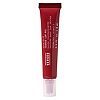
Versed Skin Silk Slip tinted lip oil fig
Works for
1 of 1 advertised claim delivered
Moisturizing11 ingredients credited for this claimGood support
“It’s a moisturizing blend of jojoba, camellia, sesame and sunflower seed oils, and antioxidant-rich vitamin E that conditions and smooths chapped lips.”
This product can help improve hydration of the skin with the two types of ingredients.
The first type is called “humectants”:
these ingredients help attract water.
When humectants are on the surface of the skin, they “pull in” the moisture from the outside environment, or from
within deeper layers of the skin. The following ingredients in this product do the job:
glycerin.
This product also contains ingredients called “occlusives”. They help reduce the speed with which our skin loses moisture to the outside environment. These ingredients also help soften the upper layer of the skin, so it feels less tight and nicer to the touch. The following ingredients in this product do the job: simmondsia chinensis seed oil, glycine soja oil.
Anti-oxidationNot advertised by the brand · 4 ingredients credited for this claimModerate support
This product contains antioxidants (camellia sinensis leaf extract) that might be able to help neutralize free radicals in skin to lessen the damage it gets from the UV light (sun). There is not enough evidence to confirm their effectiveness in skin though.
Can it cause trouble?
Irritancy7 flagged ingredientsLow risk
Comedogenic2 ingredients rated 2 or more on the 0–5 pore-clogging scale2 flagged
User reviews
Be the first — your take helps the next person decide.
Ingredients
Filter by role to see what each ingredient is doing.
Hydrogenated polyisobutene~22–33%
- Irritation risk
- Low
Used to improve the product consistency and soften the upper layer of the skin
More about Hydrogenated polyisobutenePolybutene~4.8–7.2%
Hydrogenated styrene/isoprene copolymer~4.6–6.9%
- Irritation risk
- Medium
Helps to create a thicker product consistency
More about Hydrogenated styrene/isoprene copolymerTocopheryl acetate~3.6–5.5%
- Irritation risk
- Medium
A more stable but less bio-available form of vitamin E compared to Tocopherol. Might help moisturize and protect the skin from free radicals, but mostly used in low concentrations to stabilize other ingredients.
More about Tocopheryl acetateOlea europaea fruit oil~2.9–4.3%
- Irritation risk
- Medium
An emollient that helps soften the skin but is not effective for restoring its barrier function. Might be helpful to calm down inflammation
More about Olea europaea fruit oilSesamum indicum seed oil~2.3–3.4%
- Irritation risk
- Low
A good moisturizing plant oil. Due to the high linoleic acid content, it helps soften the upper layer of the skin, reduce water loss and support skin barrier function
More about Sesamum indicum seed oilSimmondsia chinensis seed oil~1.9–2.8%
- Irritation risk
- Medium
Softens the upper layer of skin and helps restore the healthy skin barrier. Has shown to help calm down inflammation in skin. It is a stable oil, meaning that it retains its properties even when exposed to air.
More about Simmondsia chinensis seed oilMacadamia integrifolia seed oil~1.4–2.1%
- Irritation risk
- Low
A plant oil that helps soften the upper layer of the skin
More about Macadamia integrifolia seed oilGlycine soja oil~1.1–1.7%
- Irritation risk
- Medium
- Comedogenicity
- 2/5
A good emollient that helps soften the skin and helps repair its barrier function. It can clog pores if used in high concentrations.
More about Glycine soja oilCamellia sinensis leaf extract~0.95–1.4%
- Irritation risk
- Low
Can contain potent anti-oxidant compounds (abbreviated ECG, GCG, EGC, and EGCG) that might help protect the skin from free radicals. Can help calm down inflammation and has some anti-bacterial properties. Unfortunately, these antioxidants are unstable and lose their effectiveness very quickly in products. The concentration of the antioxidant compounds in the extract also tends to be low to be effective in topical formulation
More about Camellia sinensis leaf extractButyrospermum parkii butter~0.85–1.25%
- Irritation risk
- Low
- Comedogenicity
- 3/5
A great moisturising ingredient that softens the skin and reduces water loss from its upper layer. It also can be helpful in protecting skin from free radicals
More about Butyrospermum parkii butterGlycerin~0.5–1.2%
- Irritation risk
- Low
One of the best moisturizing ingredients. Naturally present in skin. It attracts water to the upper layer of the skin working as a humectant
More about GlycerinTocopherol~0.45–1.05%
- Irritation risk
- Low
Pure form of vitamin E. Can help moisturise and protect the skin from free radicals. Often used to help stabilise other ingredients or the formula itself
More about TocopherolSynthetic wax~0.45–1.05%
- Irritation risk
- Low
Used to stabilize product formulations and thicken product consistency
More about Synthetic waxIsocetyl stearoyl stearate~0.4–0.95%
- Irritation risk
- Low
Helps soften the upper layer of the skin
More about Isocetyl stearoyl stearatePentaerythrityl tetra-di-t-butyl hydroxyhydrocinnamate~0.2–0.8%
- Irritation risk
- Low
Used to increase stability of product formulations
More about Pentaerythrityl tetra-di-t-butyl hydroxyhydrocinnamateIsopropyl titanium triisostearate~0.35–0.8%
- Irritation risk
- Medium
Helps water and oil mix together
More about Isopropyl titanium triisostearateIron oxides~0.15–0.65%
- Irritation risk
- Low
An umbrella term for the following three colorants: CI 77491, CI 77492, CI 77499. They might be able to offer some protection against visible light, but the degree of the protection is not clear
More about Iron oxidesCi 77492~0.1–0.45%
Ci 77499~0.1–0.4%
Titanium dioxide~0.15–0.5%
- Irritation risk
- Low
Works as a UV filter when used in high concentrations. It is photostable and is effective mostly against the UVB light, with some protection in the UVA range. In small concentrations, used for its ability to improve the color of cosmetic products. Is usually well tolerated by the skin
More about Titanium dioxideCi 77891~0.05–0.25%
- Irritation risk
- Low
Ci 15850~0.05–0.25%
Ingredient list view
Hydrogenated polyisobutene, Polybutene, Hydrogenated styrene/isoprene copolymer, Tocopheryl acetate, Olea europaea fruit oil, Sesamum indicum seed oil, Simmondsia chinensis seed oil, Macadamia integrifolia seed oil, Glycine soja oil, Camellia sinensis leaf extract, Butyrospermum parkii butter, Glycerin, Tocopherol, Synthetic wax, Isocetyl stearoyl stearate, Pentaerythrityl tetra-di-t-butyl hydroxyhydrocinnamate, Isopropyl titanium triisostearate, Iron oxides, Ci 77492, Ci 77499, Titanium dioxide, Ci 77891, Ci 15850
Compare prices
Retailers ranked by price — lowest first.
Affiliate links · prices updated regularly · As an Amazon Associate, WIMJ earns from qualifying purchases.
Sources cited in this review
Every concentration estimate and effectiveness label is anchored to one of these 11 studies and safety reviews.
- 1
- 2
- 3Use of “natural” oils for moisturization: Review of olive, coconut, and sunflower seed oilonlinelibrary.wiley.com
- 4
- 5Triglyceride composition of Sesamum indicum seed oilonlinelibrary.wiley.com
- 6

Affiliate links · As an Amazon Associate, WIMJ earns from qualifying purchases.