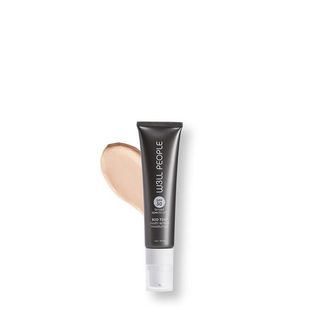
W3LL PEOPLE Bio Tint Multi-Action Moisturizer SPF 30
Works for
4 of 4 advertised claims delivered
Sun protectionSPF 30 · 2 UV filtersBroad spectrum
This product offers a good level of protection against both UVB and UVA rays.
It is a mineral sunscreen. In other words, it contains non-organic UV filters. It will probably not sting your eyes but might leave a white cast.
This product can be considered "reef safe" because it does not contain the UV filters (oxybenzone and octinoxate) that can be harmful to coral reefs when present in the water in high concentrations.
Evens skin tone3 ingredients credited for this claimStrong support
“Organic coconut boosts skin hydration while organic pomegranate helps rejuvenate and provide antioxidant support, broccoli seed oil smooths and brightens the complexion, algae extracts combat hyper-pigmentation / discoloration, and organic Ginseng anti-oxidizes and revitalizes skin.”
This product offers broad spectrum sun protection. It means that it can prevent hyperpigmentation and help keep the skin tone even (sun damage is the main factor causing age spots, darkening of post-acne marks and other discolorations).
Moisturizing24 ingredients credited for this claimStrong support
“Bio Tint Multi-Action Moisturizer SPF 30”
This product can help improve hydration of the skin with the two types of ingredients.
The first type is called “humectants”:
these ingredients help attract water.
When humectants are on the surface of the skin, they “pull in” the moisture from the outside environment, or from
within deeper layers of the skin. The following ingredients in this product do the job:
algae extract, glycerin.
This product also contains ingredients called “occlusives”. They help reduce the speed with which our skin loses moisture to the outside environment. These ingredients also help soften the upper layer of the skin, so it feels less tight and nicer to the touch. The following ingredients in this product do the job: caprylic/capric triglyceride, cocos nucifera oil.
The following ingredients in this product are especially good for supporting the skin barrier and helping with the hydration level: ceramide ng, palmitoyl hexapeptide-12, palmitoyl tripeptide-38
Anti-aging7 ingredients credited for this claimStrong support
“• Advanced bio-peptide complex boosts collagen”
This product can help reduce and prevent fine lines and wrinkles, improve skin elasticity and firmness because it contains palmitoyl hexapeptide-12.
These ingredients in the product can also be helpful, even though there is less evidence for their effectiveness: palmitoyl tripeptide-38.
Keep in mind that it typically takes at least 6 weeks to notice any results because the changes that are needed to improve fine lines and elasticity happen in the deeper layers of the skin. No topical anti-aging product can “erase” wrinkles or fully reverse signs of aging.
This product can also help prevent early signs of skin aging because it offers a good level of broad spectrum sun protection. Sun damage is the main cause of premature skin aging, and protecting your skin from the sun is the best anti-aging strategy.
Anti-oxidationNot advertised by the brand · 7 ingredients credited for this claimModerate support
This product contains antioxidants (camellia sinensis leaf extract) that might be able to help neutralize free radicals in skin to lessen the damage it gets from the UV light (sun). There is not enough evidence to confirm their effectiveness in skin though.
Can it cause trouble?
Irritancy1 strong irritant: Calendula officinalis flower extractMedium risk
Comedogenic3 ingredients rated 2 or more on the 0–5 pore-clogging scale3 flagged
User reviews
Be the first — your take helps the next person decide.
Ingredients
Filter by role to see what each ingredient is doing.
Zinc oxide20%
- Irritation risk
- Low
A broad spectrum sunblock (protects from both UVA and UVB rays). Is suitable for most sensitive skins. In small concentrations, can be used as a colorant
More about Zinc oxideWater~45–55%
Coco-caprylate/caprate~5.8–7.1%
- Irritation risk
- Low
Helps to soften the upper layer of the skin without creating a greasy texture
More about Coco-caprylate/caprateCaprylic/capric triglyceride~5.3–6.4%
- Irritation risk
- Medium
A good mix of fatty acids that forms a protective layer on the skin. Improves the shelf life of products. Derived from coconut and glycerin
More about Caprylic/capric triglyceridePolyglyceryl-3 polyricinoleate~2.8–3.4%
- Irritation risk
- Medium
Helps oil and water mix together
More about Polyglyceryl-3 polyricinoleateSilica~2.4–3%
Ricinus communis seed oil~2–2.4%
- Irritation risk
- Medium
A plant oil that can help soften the skin. It might be helpful in calming down inflammation, but solid research is lacking. Is often used in lip products to create the needed product consistency
More about Ricinus communis seed oilGlycerin~1.8–2.2%
- Irritation risk
- Low
One of the best moisturizing ingredients. Naturally present in skin. It attracts water to the upper layer of the skin working as a humectant
More about GlycerinShea butter ethyl esters~1.6–1.9%
- Irritation risk
- Low
Helps soften the upper layer of the skin
More about Shea butter ethyl estersDisteardimonium hectorite~1.3–1.6%
- Irritation risk
- Low
A type of clay that is used to thicken the product consistency
More about Disteardimonium hectoriteBrassica oleracea italica seed oil~1.2–1.4%
- Irritation risk
- Medium
A plant seed oil that consists mainly of erucic acid and used to help soften the upper layer of the skin. This fatty acid can enhance penetration of other ingredients into the skin but it is not a good moisturizer on its own
More about Brassica oleracea italica seed oilPolyglyceryl-3 diisostearate~0.95–1.15%
- Irritation risk
- Medium
- Comedogenicity
- 3/5
Helps oil and water mix together
More about Polyglyceryl-3 diisostearateMagnesium sulfate~0.75–1.15%
Isostearic acid~0.75–1.1%
- Irritation risk
- Low
Used to create a nice product texture
More about Isostearic acidLecithin~0.65–1%
- Irritation risk
- Low
Used mostly for creating emulsions - helping oil and water mix together. Helps soften the upper layer of the skin
More about LecithinPolyhydroxystearic acid~0.6–0.9%
- Irritation risk
- Medium
Used to create a thicker product consistency and stabilize the formulation
More about Polyhydroxystearic acidGluconolactone~0.55–0.85%
- Irritation risk
- Medium
A polyhydroxy acid (PHA) that helps shed the dead cells from the skin surface revealing smoother skin. Is believed to be genter than AHAs. It helps attract water to the upper layer of the skin and can stimulate production of skin's own hyaluronic acid resulting in improved hydration levels. It has been shown to be helpful against acne and clogged pores if used consistently (e.g over a period of 12 weeks) in high enough concentration. It can help reduce fine lines and wrinkles and improve skin tone with long-term application. Can help neutralize free radicals
More about GluconolactoneArgania spinosa kernel oil~0.6–0.9%
- Irritation risk
- Medium
An emollient that helps soften the upper layer of the skin. Might have some weak anti-oxidant properties
More about Argania spinosa kernel oilTocopheryl acetate~0.55–0.8%
- Irritation risk
- Medium
A more stable but less bio-available form of vitamin E compared to Tocopherol. Might help moisturize and protect the skin from free radicals, but mostly used in low concentrations to stabilize other ingredients.
More about Tocopheryl acetateIsoamyl laurate~0.55–0.8%
- Irritation risk
- Medium
Helps stabilize emulsions and create a nice product texture
More about Isoamyl laurateC12-15 alkyl benzoate~0.5–0.75%
- Irritation risk
- Low
Enhances the product texture and makes it more spreadable. Helps reduce water loss from the outer layer of skin. Extands the shelf life by preventing bacteria growth
More about C12-15 alkyl benzoateCocos nucifera oil~0.45–0.65%
- Irritation risk
- Low
- Comedogenicity
- 3/5
An emollient. Found to be as effective as a moisturizer for dry skin as mineral oil. Could be comedogenic
More about Cocos nucifera oilCucurbita pepo seed oil~0.45–0.7%
- Irritation risk
- Low
Helps soften the upper layer of the skin
More about Cucurbita pepo seed oilTetrahexyldecyl ascorbate~0.45–0.65%
- Irritation risk
- Medium
Being a lipid soluble form of vitamin C, it is more stable than ascorbic acid, but still degrades quickly and needs to be stabilized in a formulation with another ingredient. It is claimed to penetrate skin better than pure vitamin C and have the the similar benefits, but solid studies of its effectiveness are lacking. Is likely to require a higher concentration in a product than pure vitamin C to be effective. It might be able to help reduce pore clogging.
More about Tetrahexyldecyl ascorbateGlyceryl caprylate~0.5–0.75%
- Irritation risk
- Low
An emollient that can also help water and oil mix together, as well as prevent bacteria growth in products
More about Glyceryl caprylateSodium benzoate~0.25–0.5%
Ricinus communis seed oil~0.45–0.7%
- Irritation risk
- Medium
A plant oil that can help soften the skin. It might be helpful in calming down inflammation, but solid research is lacking. Is often used in lip products to create the needed product consistency
More about Ricinus communis seed oilTribehenin~0.45–0.7%
- Irritation risk
- Low
Used to create a thicker product consistency and soften the upper layer of the skin
More about TribeheninPunica granatum seed oil~0.45–0.7%
- Irritation risk
- Low
Helps soften the upper layer of the skin
More about Punica granatum seed oilBisabolol~0.4–0.6%
- Irritation risk
- Low
An active component of chamomile plant that historically has been used to calm down irritated skin. A recent study shows that bisabolol indeed can have some anti-inflammatory effect on skin, even though conclusive data is lacking. Bisabolol has a sweet floral scent and can be added to products for its aromatic properties
More about BisabololIsoamyl cocoate~0.45–0.65%
- Irritation risk
- Medium
Helps oil and water mix together and works as a cleansing agent
More about Isoamyl cocoateGlyceryl undecylenate~0.45–0.65%
- Irritation risk
- Medium
Helps oil and water mix together and helps preserve the product formulation
More about Glyceryl undecylenatePhytic acid~0.35–0.65%
- Irritation risk
- Medium
An alpha-hydroxy acid (AHA), but is mostly used to stabilize product formulations in cosmetics
More about Phytic acidAloe barbadensis leaf juice~0.35–0.6%
- Irritation risk
- Medium
Traditionally used to treat sunburns, dermatitis and inflammation, but evidence for its effectiveness is lacking. The extract can contain humectants that help attract water into the skin
More about Aloe barbadensis leaf juiceCeramide ng~0.35–0.65%
- Irritation risk
- Low
A type of lipid similar to ceramides naturally present in skin. Helps to soften the upper layer of the skin and supports the skin barrier function to keep it hydrated. Can help to prevent inflammation in skin
More about Ceramide ngCalendula officinalis flower extract~0.25–0.5%
- Irritation risk
- High
A plant extract that has some anti-oxidant and anti-bacterial properties. Can be irritating
More about Calendula officinalis flower extractChamomilla recutita flower extract~0.3–0.55%
- Irritation risk
- High
Plant extract that can have healing and anti-inflammatory properties. It is a potential allergen and can be irritating
More about Chamomilla recutita flower extractPanax quinquefolius root extract~0.3–0.55%
- Irritation risk
- Low
Calcium gluconate~0.3–0.6%
- Irritation risk
- Low
Helps attract water to the upper layer of the skin and helps to improve appearance of the product
More about Calcium gluconateCamellia sinensis leaf extract~0.3–0.6%
- Irritation risk
- Low
Can contain potent anti-oxidant compounds (abbreviated ECG, GCG, EGC, and EGCG) that might help protect the skin from free radicals. Can help calm down inflammation and has some anti-bacterial properties. Unfortunately, these antioxidants are unstable and lose their effectiveness very quickly in products. The concentration of the antioxidant compounds in the extract also tends to be low to be effective in topical formulation
More about Camellia sinensis leaf extractHydroxypropyl cyclodextrin~0.3–0.6%
- Irritation risk
- Medium
Used to stabilize product formulations and help soften the upper layer of the skin
More about Hydroxypropyl cyclodextrinAlgae extract~0.35–0.6%
- Irritation risk
- Low
- Comedogenicity
- 3/5
Plant extract that helps the skin to attract water and make it more smooth for touch. Also shows promise of anti-aging properties, but research is not extensive yet
More about Algae extractPalmitoyl tripeptide-38~0.25–0.45%
- Irritation risk
- Low
A type of peptide. Peptides are excellent moisturizers and might be able support collagen production reducing fine lines and wrinkles
More about Palmitoyl tripeptide-38Palmitoyl hexapeptide-12~0.2–0.4%
- Irritation risk
- Low
A type of peptide. Peptides are excellent moisturizers and might be able support collagen production reducing fine lines and wrinkles
More about Palmitoyl hexapeptide-12Titanium dioxide~0.25–0.5%
- Irritation risk
- Low
Works as a UV filter when used in high concentrations. It is photostable and is effective mostly against the UVB light, with some protection in the UVA range. In small concentrations, used for its ability to improve the color of cosmetic products. Is usually well tolerated by the skin
More about Titanium dioxideCi 77492~0.15–0.25%
Iron oxides~0.1–0.2%
- Irritation risk
- Low
An umbrella term for the following three colorants: CI 77491, CI 77492, CI 77499. They might be able to offer some protection against visible light, but the degree of the protection is not clear
More about Iron oxidesCi 77499~0.1–0.15%
Ingredient list view
Zinc oxide, Water, Coco-caprylate/caprate, Caprylic/capric triglyceride, Polyglyceryl-3 polyricinoleate, Silica, Ricinus communis seed oil, Glycerin, Shea butter ethyl esters, Disteardimonium hectorite, Brassica oleracea italica seed oil, Polyglyceryl-3 diisostearate, Magnesium sulfate, Isostearic acid, Lecithin, Polyhydroxystearic acid, Gluconolactone, Argania spinosa kernel oil, Tocopheryl acetate, Isoamyl laurate, C12-15 alkyl benzoate, Cocos nucifera oil, Cucurbita pepo seed oil, Tetrahexyldecyl ascorbate, Glyceryl caprylate, Sodium benzoate, Ricinus communis seed oil, Tribehenin, Punica granatum seed oil, Bisabolol, Isoamyl cocoate, Glyceryl undecylenate, Phytic acid, Aloe barbadensis leaf juice, Ceramide ng, Calendula officinalis flower extract, Chamomilla recutita flower extract, Panax quinquefolius root extract, Calcium gluconate, Camellia sinensis leaf extract, Hydroxypropyl cyclodextrin, Algae extract, Palmitoyl tripeptide-38, Palmitoyl hexapeptide-12, Titanium dioxide, Ci 77492, Iron oxides, Ci 77499
Compare prices
Retailers ranked by price — lowest first.
Affiliate links · prices updated regularly · As an Amazon Associate, WIMJ earns from qualifying purchases.
Product summary
The ingredient list suggests that "W3LL PEOPLE - Bio Tint Multi-Action Moisturizer SPF 30" can provide reliable sun protection. We love that it can protect from both UVA and UVB rays (not all sunscreens with SPF ratings give UVA protection. UVA rays do not cause sunburn, but still damage our skin and lead to early aging).
Its formula is also hydrating, so you might not need an additional moistruizer during the day. This product prevents early signs of aging by protecting against sun damage (all broad spectrum sunscreens do that).
Sunscreen filters
This sunscreen uses a mixture of both mineral and organic (so-called "chemical") UV filters. The organic filters in the product are: oxybenzone, avobenzone and butyloctyl salicylate. As for the mineral filters, this sunscreen uses zinc oxide.
Irritation risk
This moisturizer contains some common irritants, including those without a benefit for the skin. We assess the overall irritancy of this moisturizer to be high. For a detailed overview of all potential irritants: click here
You can see the detailed formula review with the breakdown of all actives in the product and the full ingredient list with estimated concentrations in the tables below.
About the brand
According to Cruelty-Free Kitty "W3LL PEOPLE" is cruelty free and so is its parent company.
Price
The product retails from 21.00$ up to 29.99$ in the United States.
For a detailed price comparison: click here.
Sources cited in this review
Every concentration estimate and effectiveness label is anchored to one of these 35 studies and safety reviews.
- 1A review of inorganic UV filters zinc oxide and titanium dioxideonlinelibrary.wiley.com
- 2
- 3
- 4
- 5
- 6Safety Assessment of Alkyl Esters as Used in Cosmeticscir-safety.org

Affiliate links · As an Amazon Associate, WIMJ earns from qualifying purchases.