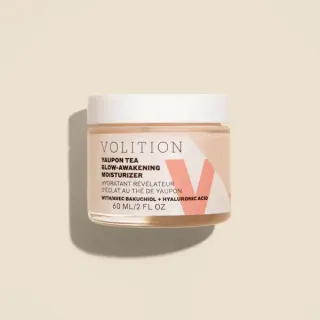
Volition Yaupon Tea Glow-Awakening Moisturizer

Volition Yaupon Tea Glow-Awakening Moisturizer

Efficacy87/100IrritancyHigh
Edit

Works for

2 of 2 advertised claims delivered

Anti-aging
3 ingredients credited for this claim
Strong support
What the product description says
“Bakuchiol also appears in this youth-boosting concoction, and is a naturally-derived retinol alternative that minimises the look of fine lines – keeping skin healthy and plump, but not puffy.”
Source: Cultbeauty

This product can help reduce and prevent fine lines and wrinkles, improve skin elasticity and firmness because it contains bakuchiol.

Keep in mind that it typically takes at least 6 weeks to notice any results because the changes that are needed to improve fine lines and elasticity happen in the deeper layers of the skin. No topical anti-aging product can “erase” wrinkles or fully reverse signs of aging.

BakuchiolKey activeEffect: HighA plant extract that is, though different in chemical structure, acts similar to retinoids. First studies show that it can help reduce fine lines and wrinkles, improve skin tone, reduce clogged pores and blemishes, and reduce inflammation. There is no conclusive evidence that bakuchiol is as effective as retinol however. The study that directly compared retinol with bakuchiol used bakuchiol applied twice daily compared to once per day for the retinol. According to this study, bakuchiol is less irritating than retinol. Bakuchiol is extracted from seeds of Babchi plant. Other parts of the plant contain coumarins that could cause allergic and irritant reactions. These compounds should be removed in the extraction process when bakuchiol is produced, but it is a good idea to be cautious and stay away from products that include the Babchi plant extracts other than purified bakuchiol to avoid irritation~1.7–2.1%
Camellia sinensis leaf extractEffect: LowCan contain potent anti-oxidant compounds (abbreviated ECG, GCG, EGC, and EGCG) that might help protect the skin from free radicals. Can help calm down inflammation and has some anti-bacterial properties. Unfortunately, these antioxidants are unstable and lose their effectiveness very quickly in products. The concentration of the antioxidant compounds in the extract also tends to be low to be effective in topical formulation~0.5–0.8%
TocopherolEffect: Low, below effective dosePure form of vitamin E. Can help moisturise and protect the skin from free radicals. Often used to help stabilise other ingredients or the formula itself~0.1–0.2%
Moisturizing
17 ingredients credited for this claim
Good support
What the product description says
“Yaupon Tea Glow-Awakening Moisturizer”
From product name

This product can help improve hydration of the skin with the two types of ingredients.

The first type is called “humectants”:
these ingredients help attract water. When humectants are on the surface of the skin, they “pull in” the moisture from the outside environment, or from within deeper layers of the skin. The following ingredients in this product do the job: betaine, glycerin.

This product also contains ingredients called “occlusives”. They help reduce the speed with which our skin loses moisture to the outside environment. These ingredients also help soften the upper layer of the skin, so it feels less tight and nicer to the touch. The following ingredients in this product do the job: glycine soja oil, isododecane.

Sodium hyaluronateKey active· HumectantEffect: HighOne of the best moisturizing ingredients. Attracts water into the upper layer of the skin~1.9–2.4%
BetaineKey active· HumectantEffect: HighHelps attract water to the upper layer of the skin and improves the product texture~0.3–0.55%
Corallina officinalis extractKey activeEffect: HighRed algae extract that helps attract water to the upper layer of the skin and might contain antioxidants~0.9–1.1%
SucroseKey active· HumectantEffect: HighCan help attract water to the upper layer of the skin. In crystal form, it can work as a gentle exfoliant, gentler than the salt scrub. Helps stabilize the emulsion~0.3–0.5%
GlycerinKey active· HumectantEffect: HighOne of the best moisturizing ingredients. Naturally present in skin. It attracts water to the upper layer of the skin working as a humectant~4.4–5.3%
Glycine soja oilKey active· EmollientEffect: HighA good emollient that helps soften the skin and helps repair its barrier function. It can clog pores if used in high concentrations.~0.3–0.6%
IsododecaneKey active· Emollient, OcclusiveEffect: MediumAn emollient that helps soften the skin and can decrease moisture loss. Helps create a nice product texture~0.3–0.6%
Capryloyl glycerin/sebacic acid copolymerKey activeEffect: MediumHelps soften the upper layer of the skin~0.3–0.6%
Diheptyl succinateKey active· EmollientEffect: MediumHelps to soften the upper layer of the skin and creates a nice product finish on the skin~0.35–0.6%
Cucumis melo cantalupensis fruit extractEffect: LowA fruit extract that might help attract water to the upper layer of the skin and might have some antioxidant properties but evidence of effectiveness in skin is missing~0.3–0.55%
Polysilicone-11Effect: LowA silicone that forms a light film on the skin surface helping to bind water and temporarily absorb oils creating a matt and powdery feel~0.3–0.6%
Glyceryl caprylate· EmollientEffect: LowAn emollient that can also help water and oil mix together, as well as prevent bacteria growth in products~0.4–0.6%
Camellia sinensis leaf extractEffect: LowCan contain potent anti-oxidant compounds (abbreviated ECG, GCG, EGC, and EGCG) that might help protect the skin from free radicals. Can help calm down inflammation and has some anti-bacterial properties. Unfortunately, these antioxidants are unstable and lose their effectiveness very quickly in products. The concentration of the antioxidant compounds in the extract also tends to be low to be effective in topical formulation~0.5–0.8%
Caprylic/capric triglycerideUnder-dosedEffect: HighA good mix of fatty acids that forms a protective layer on the skin. Improves the shelf life of products. Derived from coconut and glycerin~0.4–0.6%
Pyrus malus fruit extractUnder-dosedEffect: MediumCan have some moisturizing properties due to its sugar content~0.45–0.7%
Cucumis sativus fruit extractEffect: Low, below effective doseMight be somewhat helpful in reducing hyperpigmentation and neutralizing free radicals but its typical concentration in a product is too low for having an effect~0.3–0.55%
TocopherolEffect: Low, below effective dosePure form of vitamin E. Can help moisturise and protect the skin from free radicals. Often used to help stabilise other ingredients or the formula itself~0.1–0.2%
Anti-oxidation
Not advertised by the brand · 15 ingredients credited for this claim
Strong support

This product contains antioxidants (bakuchiol) that can help neutralize free radicals in skin. By doing so, they can lessen the damage the skin gets from the UV light (sun).

The following ingredients - camellia sinensis leaf extract also can have an antioxidant effect, but there is less evidence to confirm their effectiveness in skin.

BakuchiolKey activeEffect: HighA plant extract that is, though different in chemical structure, acts similar to retinoids. First studies show that it can help reduce fine lines and wrinkles, improve skin tone, reduce clogged pores and blemishes, and reduce inflammation. There is no conclusive evidence that bakuchiol is as effective as retinol however. The study that directly compared retinol with bakuchiol used bakuchiol applied twice daily compared to once per day for the retinol. According to this study, bakuchiol is less irritating than retinol. Bakuchiol is extracted from seeds of Babchi plant. Other parts of the plant contain coumarins that could cause allergic and irritant reactions. These compounds should be removed in the extraction process when bakuchiol is produced, but it is a good idea to be cautious and stay away from products that include the Babchi plant extracts other than purified bakuchiol to avoid irritation~1.7–2.1%
Camellia sinensis leaf extractKey activeEffect: MediumCan contain potent anti-oxidant compounds (abbreviated ECG, GCG, EGC, and EGCG) that might help protect the skin from free radicals. Can help calm down inflammation and has some anti-bacterial properties. Unfortunately, these antioxidants are unstable and lose their effectiveness very quickly in products. The concentration of the antioxidant compounds in the extract also tends to be low to be effective in topical formulation~0.5–0.8%
Eclipta prostrata extractEffect: LowA plant extract that might help neutralize free radicals in skin. It can be irritating~0.55–0.85%
Melia azadirachta flower extractEffect: LowA plant extract that might be helpful to neutralize free radicals in skin~1.5–1.8%
Cucumis melo cantalupensis fruit extractEffect: LowA fruit extract that might help attract water to the upper layer of the skin and might have some antioxidant properties but evidence of effectiveness in skin is missing~0.3–0.55%
Cucumis melo fruit extractEffect: LowA fruit extract that might have some anti-oxidant properties~0.3–0.6%
Coccinia indica fruit extractEffect: LowA plant extract that might have some anti-oxidant effect helping neutralize free radicals in skin~0.7–1%
Coffea arabica seed extractEffect: LowMight be helpful in neutralizing free radicals in skin~0.5–0.8%
Corallina officinalis extractEffect: LowRed algae extract that helps attract water to the upper layer of the skin and might contain antioxidants~0.9–1.1%
Vaccinium macrocarpon fruit extractEffect: LowA berry extract. Might have some anti-oxidant properties~0.3–0.6%
Rubus idaeus fruit extractEffect: LowA fruit extract that might have some anti-oxidant properties but evidence of effectiveness in skin is lacking~0.45–0.65%
TocopherolUnder-dosedEffect: HighPure form of vitamin E. Can help moisturise and protect the skin from free radicals. Often used to help stabilise other ingredients or the formula itself~0.1–0.2%
Pyrus malus fruit extractEffect: Low, below effective doseCan have some moisturizing properties due to its sugar content~0.45–0.7%
Cucumis sativus fruit extractEffect: Low, below effective doseMight be somewhat helpful in reducing hyperpigmentation and neutralizing free radicals but its typical concentration in a product is too low for having an effect~0.3–0.55%
Rosmarinus officinalis leaf extractEffect: Low, below effective doseCan be helpful in reducing inflammation in skin, including inflamed acne. It can be irritating~0.3–0.55%
Evens skin tone
Not advertised by the brand · 2 ingredients credited for this claim
Strong support

This product can help reduce hypepigmentation and even out the skin tone because it contains the following effective ingredients: bakuchiol

Keep in mind that you would need to apply any topical skincare targetted at hypigmentation consistently for a couple of months to get a result. No topical skincare product can help get rid of hyperpigmentation (including post-acne marks and age spots) instantly.

BakuchiolKey activeEffect: HighA plant extract that is, though different in chemical structure, acts similar to retinoids. First studies show that it can help reduce fine lines and wrinkles, improve skin tone, reduce clogged pores and blemishes, and reduce inflammation. There is no conclusive evidence that bakuchiol is as effective as retinol however. The study that directly compared retinol with bakuchiol used bakuchiol applied twice daily compared to once per day for the retinol. According to this study, bakuchiol is less irritating than retinol. Bakuchiol is extracted from seeds of Babchi plant. Other parts of the plant contain coumarins that could cause allergic and irritant reactions. These compounds should be removed in the extraction process when bakuchiol is produced, but it is a good idea to be cautious and stay away from products that include the Babchi plant extracts other than purified bakuchiol to avoid irritation~1.7–2.1%
Camellia sinensis leaf extractEffect: LowCan contain potent anti-oxidant compounds (abbreviated ECG, GCG, EGC, and EGCG) that might help protect the skin from free radicals. Can help calm down inflammation and has some anti-bacterial properties. Unfortunately, these antioxidants are unstable and lose their effectiveness very quickly in products. The concentration of the antioxidant compounds in the extract also tends to be low to be effective in topical formulation~0.5–0.8%
Anti-blemish
Not advertised by the brand · 4 ingredients credited for this claim
Good support

This product might be able to help reduce blemishes and clogged pores because it contains bakuchiol.

BakuchiolKey activeEffect: HighA plant extract that is, though different in chemical structure, acts similar to retinoids. First studies show that it can help reduce fine lines and wrinkles, improve skin tone, reduce clogged pores and blemishes, and reduce inflammation. There is no conclusive evidence that bakuchiol is as effective as retinol however. The study that directly compared retinol with bakuchiol used bakuchiol applied twice daily compared to once per day for the retinol. According to this study, bakuchiol is less irritating than retinol. Bakuchiol is extracted from seeds of Babchi plant. Other parts of the plant contain coumarins that could cause allergic and irritant reactions. These compounds should be removed in the extraction process when bakuchiol is produced, but it is a good idea to be cautious and stay away from products that include the Babchi plant extracts other than purified bakuchiol to avoid irritation~1.7–2.1%
Melia azadirachta leaf extractEffect: LowA plant extract that has anti-bacterial properties. Can be used to preserve the product. Can be irritating~1.2–1.5%
Camellia sinensis leaf extractEffect: LowCan contain potent anti-oxidant compounds (abbreviated ECG, GCG, EGC, and EGCG) that might help protect the skin from free radicals. Can help calm down inflammation and has some anti-bacterial properties. Unfortunately, these antioxidants are unstable and lose their effectiveness very quickly in products. The concentration of the antioxidant compounds in the extract also tends to be low to be effective in topical formulation~0.5–0.8%
Rosmarinus officinalis leaf extractUnder-dosedEffect: MediumCan be helpful in reducing inflammation in skin, including inflamed acne. It can be irritating~0.3–0.55%

Can it cause trouble?

Irritancy
9 strong irritants: Hamamelis virginiana water, Lavandula angustifolia flower/leaf/stem extract + 7 more — patch-test recommended
High risk
We flagged 31 ingredients with irritancy potential. Severity depends on your sensitivity threshold; the table lists the worst offenders first.
IngredientFunctionIrritationEst. amount
Hamamelis virginiana waterA plant extract that can help calm down inflammation in skin. Can, however, itself be irritatingHigh~3.4–4.1%est.
Melia azadirachta leaf extractA plant extract that has anti-bacterial properties. Can be used to preserve the product. Can be irritatingHigh~1.2–1.5%est.
Eclipta prostrata extractA plant extract that might help neutralize free radicals in skin. It can be irritatingHigh~0.55–0.85%est.
Lavandula angustifolia flower/leaf/stem extractUsed as a fragranceHigh~0.5–0.75%est.
Salvia officinalis leaf extractSage leaf extract. It can be irritatingHigh~0.45–0.7%est.
Citrus limon peel extractA very irritating fragrant ingredientHigh~0.35–0.6%est.
Rosmarinus officinalis leaf extractCan be helpful in reducing inflammation in skin, including inflamed acne. It can be irritatingHigh~0.3–0.55%est.
Vaccinium macrocarpon fruit extractA berry extract. Might have some anti-oxidant propertiesHigh~0.3–0.6%est.
Rose extractUsed as a fragrance. Can be irritatingHigh~0.3–0.55%est.
LinaloolA fragrance. Can be irritatingHigh~0.3–0.55%est.
MenthoxypropanediolUsed as a fragrance. Can be irritatingHigh~0.3–0.55%est.
AlcoholCan be drying and contribute to skin irritation. Used in formulars to dissolve other ingredients, create a thinner product consistency or for its antibacterial propertiesHigh~0.3–0.55%est.
Decyl glucosideHelps oil and water mix together. Can be irritatingHigh~0.4–0.6%est.
Amyl cinnamal—High~0.15–0.3%est.
BakuchiolA plant extract that is, though different in chemical structure, acts similar to retinoids. First studies show that it can help reduce fine lines and wrinkles, improve skin tone, reduce clogged pores and blemishes, and reduce inflammation. There is no conclusive evidence that bakuchiol is as effective as retinol however. The study that directly compared retinol with bakuchiol used bakuchiol applied twice daily compared to once per day for the retinol. According to this study, bakuchiol is less irritating than retinol. Bakuchiol is extracted from seeds of Babchi plant. Other parts of the plant contain coumarins that could cause allergic and irritant reactions. These compounds should be removed in the extraction process when bakuchiol is produced, but it is a good idea to be cautious and stay away from products that include the Babchi plant extracts other than purified bakuchiol to avoid irritationMedium~1.7–2.1%est.
Melia azadirachta flower extractA plant extract that might be helpful to neutralize free radicals in skinMedium~1.5–1.8%est.
Coccinia indica fruit extractA plant extract that might have some anti-oxidant effect helping neutralize free radicals in skinMedium~0.7–1%est.
Pyrus malus fruit extractCan have some moisturizing properties due to its sugar contentMedium~0.45–0.7%est.
Rubus idaeus fruit extractA fruit extract that might have some anti-oxidant properties but evidence of effectiveness in skin is lackingMedium~0.45–0.65%est.
Cucumis melo fruit extractA fruit extract that might have some anti-oxidant propertiesMedium~0.3–0.6%est.
Cucumis melo cantalupensis fruit extractA fruit extract that might help attract water to the upper layer of the skin and might have some antioxidant properties but evidence of effectiveness in skin is missingMedium~0.3–0.55%est.
Cucumis sativus fruit extractMight be somewhat helpful in reducing hyperpigmentation and neutralizing free radicals but its typical concentration in a product is too low for having an effectMedium~0.3–0.55%est.
Glycine soja oilA good emollient that helps soften the skin and helps repair its barrier function. It can clog pores if used in high concentrations.Medium~0.3–0.6%est.
Potassium sorbateA preservativeMedium~0.3–0.6%est.
Caprylic/capric triglycerideA good mix of fatty acids that forms a protective layer on the skin. Improves the shelf life of products. Derived from coconut and glycerinMedium~0.4–0.6%est.
Triethyl citrateUsed as a fragrance. Rarely causes irritationMedium~0.3–0.55%est.
Acrylates/c10-30 alkyl acrylate crosspolymerMaintains the texture of skincare products. Allows the product to spread evenly. Helps oil and water mix togetherMedium~0.35–0.6%est.
Caprylhydroxamic acidA preservativeMedium~0.3–0.6%est.
Lauryl glucosideHelps oil and water mix togetherMedium~0.35–0.65%est.
Citric acidCan work as an exfoliant but is typically used to adjust the product pHMedium~0.25–0.5%est.
Acacia senegal gumHelps mask the small of other ingredients and improve the product textureMedium~0.25–0.45%est.
Comedogenic
2 ingredients rated 2 or more on the 0–5 pore-clogging scale
2 flagged
These ingredients have a comedogenic rating of 2 or more on a 0–5 scale; the table shows each one's rating. In leave-on products they can clog pores in acne-prone skin.
IngredientFunctionRatingEst. amount
Corallina officinalis extractRed algae extract that helps attract water to the upper layer of the skin and might contain antioxidants3/5~0.9–1.1%est.
Glycine soja oilA good emollient that helps soften the skin and helps repair its barrier function. It can clog pores if used in high concentrations.2/5~0.3–0.6%est.
Edit

User reviews

Would you recommend?
No community reviews yet.

Be the first — your take helps the next person decide.

Write a review · ~30s

Ingredients

Filter by role to see what each ingredient is doing.

Water~45–55%
Formula
Irritation risk
Low

Plain old water

More about Water
Propanediol~5.2–6.4%
Formula
Irritation risk
Low

Acts as a solvent for other ingredients. Speeds up the absorption of other ingredients into the skin

More about Propanediol
Glycerin~4.4–5.3%
Key active
Irritation risk
Low
Works for
Moisturizing

One of the best moisturizing ingredients. Naturally present in skin. It attracts water to the upper layer of the skin working as a humectant

More about Glycerin
Hamamelis virginiana water~3.4–4.1%
Irritant · high
Irritation risk
High
Works for
Anti-inflammatory

A plant extract that can help calm down inflammation in skin. Can, however, itself be irritating

More about Hamamelis virginiana water
Ilex vomitoria leaf powder~2.8–3.5%
Formula
Ilex aquifolium leaf extract~2.2–2.7%
Formula
Sodium hyaluronate~1.9–2.4%
Key active
Irritation risk
Low
Works for
Moisturizing

One of the best moisturizing ingredients. Attracts water into the upper layer of the skin

More about Sodium hyaluronate
Bakuchiol~1.7–2.1%
Key activeIrritant · medium
Irritation risk
Medium
Works for
Anti-agingAnti-inflammatoryAnti-blemishEvens skin toneAnti-oxidation

A plant extract that is, though different in chemical structure, acts similar to retinoids. First studies show that it can help reduce fine lines and wrinkles, improve skin tone, reduce clogged pores and blemishes, and reduce inflammation. There is no conclusive evidence that bakuchiol is as effective as retinol however. The study that directly compared retinol with bakuchiol used bakuchiol applied twice daily compared to once per day for the retinol. According to this study, bakuchiol is less irritating than retinol. Bakuchiol is extracted from seeds of Babchi plant. Other parts of the plant contain coumarins that could cause allergic and irritant reactions. These compounds should be removed in the extraction process when bakuchiol is produced, but it is a good idea to be cautious and stay away from products that include the Babchi plant extracts other than purified bakuchiol to avoid irritation

More about Bakuchiol
Melia azadirachta flower extract~1.5–1.8%
Irritant · medium
Irritation risk
Medium
Works for
Anti-oxidation

A plant extract that might be helpful to neutralize free radicals in skin

More about Melia azadirachta flower extract
Melia azadirachta leaf extract~1.2–1.5%
Irritant · high
Irritation risk
High
Works for
AntibacterialAnti-blemish

A plant extract that has anti-bacterial properties. Can be used to preserve the product. Can be irritating

More about Melia azadirachta leaf extract
Corallina officinalis extract~0.9–1.1%
Key activeComedogenic 3/5
Irritation risk
Low
Comedogenicity
3/5
Works for
MoisturizingAnti-oxidation

Red algae extract that helps attract water to the upper layer of the skin and might contain antioxidants

More about Corallina officinalis extract
Coccinia indica fruit extract~0.7–1%
Irritant · medium
Irritation risk
Medium
Works for
Anti-oxidation

A plant extract that might have some anti-oxidant effect helping neutralize free radicals in skin

More about Coccinia indica fruit extract
Eclipta prostrata extract~0.55–0.85%
Irritant · high
Irritation risk
High
Works for
Anti-inflammatoryAnti-oxidation

A plant extract that might help neutralize free radicals in skin. It can be irritating

More about Eclipta prostrata extract
Coffea arabica seed extract~0.5–0.8%
Formula
Irritation risk
Low
Works for
Anti-oxidation

Might be helpful in neutralizing free radicals in skin

More about Coffea arabica seed extract
Camellia sinensis leaf extract~0.5–0.8%
Key active
Irritation risk
Low
Works for
Anti-oxidationAntibacterialAnti-agingAnti-blemishEvens skin toneMoisturizing

Can contain potent anti-oxidant compounds (abbreviated ECG, GCG, EGC, and EGCG) that might help protect the skin from free radicals. Can help calm down inflammation and has some anti-bacterial properties. Unfortunately, these antioxidants are unstable and lose their effectiveness very quickly in products. The concentration of the antioxidant compounds in the extract also tends to be low to be effective in topical formulation

More about Camellia sinensis leaf extract
Lavandula angustifolia flower/leaf/stem extract~0.5–0.75%
Irritant · high
Pyrus malus fruit extract~0.45–0.7%
Under-dosedIrritant · medium
Irritation risk
Medium
Works for
MoisturizingAnti-oxidation

Can have some moisturizing properties due to its sugar content

More about Pyrus malus fruit extract
Rubus idaeus fruit extract~0.45–0.65%
Irritant · medium
Irritation risk
Medium
Works for
Anti-oxidation

A fruit extract that might have some anti-oxidant properties but evidence of effectiveness in skin is lacking

More about Rubus idaeus fruit extract
Salvia officinalis leaf extract~0.45–0.7%
Irritant · high
Irritation risk
High

Sage leaf extract. It can be irritating

More about Salvia officinalis leaf extract
Citrus limon peel extract~0.35–0.6%
Irritant · high
Irritation risk
High

A very irritating fragrant ingredient

More about Citrus limon peel extract
Cucumis melo fruit extract~0.3–0.6%
Irritant · medium
Irritation risk
Medium
Works for
Anti-oxidation

A fruit extract that might have some anti-oxidant properties

More about Cucumis melo fruit extract
Rosmarinus officinalis leaf extract~0.3–0.55%
Under-dosedIrritant · high
Irritation risk
High
Works for
Anti-blemishAntibacterialAnti-oxidation

Can be helpful in reducing inflammation in skin, including inflamed acne. It can be irritating

More about Rosmarinus officinalis leaf extract
Vaccinium macrocarpon fruit extract~0.3–0.6%
Irritant · high
Irritation risk
High
Works for
Anti-oxidation

A berry extract. Might have some anti-oxidant properties

More about Vaccinium macrocarpon fruit extract
Cucumis melo cantalupensis fruit extract~0.3–0.55%
Irritant · medium
Irritation risk
Medium
Works for
Anti-oxidationMoisturizing

A fruit extract that might help attract water to the upper layer of the skin and might have some antioxidant properties but evidence of effectiveness in skin is missing

More about Cucumis melo cantalupensis fruit extract
Cucumis sativus fruit extract~0.3–0.55%
Irritant · medium
Irritation risk
Medium
Works for
MoisturizingAnti-oxidation

Might be somewhat helpful in reducing hyperpigmentation and neutralizing free radicals but its typical concentration in a product is too low for having an effect

More about Cucumis sativus fruit extract
Rose extract~0.3–0.55%
Irritant · high
Irritation risk
High

Used as a fragrance. Can be irritating

More about Rose extract
Glycine soja oil~0.3–0.6%
Key activeComedogenic 2/5Irritant · medium
Irritation risk
Medium
Comedogenicity
2/5
Works for
Moisturizing

A good emollient that helps soften the skin and helps repair its barrier function. It can clog pores if used in high concentrations.

More about Glycine soja oil
Betaine~0.3–0.55%
Key active
Irritation risk
Low
Works for
Moisturizing

Helps attract water to the upper layer of the skin and improves the product texture

More about Betaine
Potassium sorbate~0.3–0.6%
Irritant · medium
Irritation risk
Medium

A preservative

More about Potassium sorbate
Sodium benzoate~0.25–0.5%
Formula
Irritation risk
Low

A preservative

More about Sodium benzoate
Caprylic/capric triglyceride~0.4–0.6%
Under-dosedIrritant · medium
Irritation risk
Medium
Works for
Moisturizing

A good mix of fatty acids that forms a protective layer on the skin. Improves the shelf life of products. Derived from coconut and glycerin

More about Caprylic/capric triglyceride
Sucrose~0.3–0.5%
Key active
Irritation risk
Low
Works for
Moisturizing

Can help attract water to the upper layer of the skin. In crystal form, it can work as a gentle exfoliant, gentler than the salt scrub. Helps stabilize the emulsion

More about Sucrose
Triethyl citrate~0.3–0.55%
Irritant · medium
Irritation risk
Medium

Used as a fragrance. Rarely causes irritation

More about Triethyl citrate
Linalool~0.3–0.55%
Irritant · high
Irritation risk
High

A fragrance. Can be irritating

More about Linalool
Capryloyl glycerin/sebacic acid copolymer~0.3–0.6%
Key active
Irritation risk
Low
Works for
Moisturizing

Helps soften the upper layer of the skin

More about Capryloyl glycerin/sebacic acid copolymer
Glyceryl caprylate~0.4–0.6%
Formula
Irritation risk
Low
Works for
CleansingMoisturizing

An emollient that can also help water and oil mix together, as well as prevent bacteria growth in products

More about Glyceryl caprylate
Isododecane~0.3–0.6%
Key active
Irritation risk
Low
Works for
Moisturizing

An emollient that helps soften the skin and can decrease moisture loss. Helps create a nice product texture

More about Isododecane
Acrylates/c10-30 alkyl acrylate crosspolymer~0.35–0.6%
Irritant · medium
Irritation risk
Medium

Maintains the texture of skincare products. Allows the product to spread evenly. Helps oil and water mix together

More about Acrylates/c10-30 alkyl acrylate crosspolymer
Diheptyl succinate~0.35–0.6%
Key active
Irritation risk
Low
Works for
Moisturizing

Helps to soften the upper layer of the skin and creates a nice product finish on the skin

More about Diheptyl succinate
Sodium hydroxide~0.3–0.55%
Formula
Irritation risk
Low

Used to adjust the product's pH

More about Sodium hydroxide
Menthoxypropanediol~0.3–0.55%
Irritant · high
Irritation risk
High

Used as a fragrance. Can be irritating

More about Menthoxypropanediol
Alcohol~0.3–0.55%
Irritant · high
Irritation risk
High
Works for
Antibacterial

Can be drying and contribute to skin irritation. Used in formulars to dissolve other ingredients, create a thinner product consistency or for its antibacterial properties

More about Alcohol
Caprylhydroxamic acid~0.3–0.6%
Irritant · medium
Irritation risk
Medium

A preservative

More about Caprylhydroxamic acid
Polysilicone-11~0.3–0.6%
Formula
Irritation risk
Low
Works for
MattifyingMoisturizing

A silicone that forms a light film on the skin surface helping to bind water and temporarily absorb oils creating a matt and powdery feel

More about Polysilicone-11
Decyl glucoside~0.4–0.6%
Irritant · high
Irritation risk
High
Works for
Cleansing

Helps oil and water mix together. Can be irritating

More about Decyl glucoside
Sodium phytate~0.3–0.55%
Formula
Irritation risk
Low

Used to stabilize product formulations

More about Sodium phytate
Lauryl glucoside~0.35–0.65%
Irritant · medium
Irritation risk
Medium
Works for
Cleansing

Helps oil and water mix together

More about Lauryl glucoside
Citric acid~0.25–0.5%
Irritant · medium
Irritation risk
Medium

Can work as an exfoliant but is typically used to adjust the product pH

More about Citric acid
Acacia senegal gum~0.25–0.45%
Irritant · medium
Irritation risk
Medium

Helps mask the small of other ingredients and improve the product texture

More about Acacia senegal gum
Maltodextrin~0.2–0.4%
Formula
Irritation risk
Low
Works for
Mattifying

Used to stabilize the product formulation and can help absorb oil

More about Maltodextrin
Amyl cinnamal~0.15–0.3%
Irritant · high
Irritation risk
High
More about Amyl cinnamal
Sodium ascorbate~0.15–0.3%
Formula
Beta-carotene~0.15–0.3%
Formula
Irritation risk
Low

A colorant adding orange or bright yellow color

More about Beta-carotene
Ci 75130~0.15–0.25%
Formula
Irritation risk
Low
More about Ci 75130
Tocopherol~0.1–0.2%
Under-dosed
Irritation risk
Low
Works for
Anti-oxidationMoisturizingAnti-inflammatoryAnti-aging

Pure form of vitamin E. Can help moisturise and protect the skin from free radicals. Often used to help stabilise other ingredients or the formula itself

More about Tocopherol
Silica~0.2–0.35%
Formula
Irritation risk
Low

Used to absorb oil and can temporarily mattify skin

More about Silica
Ingredient list view

Water, Propanediol, Glycerin, Hamamelis virginiana water, Ilex vomitoria leaf powder, Ilex aquifolium leaf extract, Sodium hyaluronate, Bakuchiol, Melia azadirachta flower extract, Melia azadirachta leaf extract, Corallina officinalis extract, Coccinia indica fruit extract, Eclipta prostrata extract, Coffea arabica seed extract, Camellia sinensis leaf extract, Lavandula angustifolia flower/leaf/stem extract, Pyrus malus fruit extract, Rubus idaeus fruit extract, Salvia officinalis leaf extract, Citrus limon peel extract, Cucumis melo fruit extract, Rosmarinus officinalis leaf extract, Vaccinium macrocarpon fruit extract, Cucumis melo cantalupensis fruit extract, Cucumis sativus fruit extract, Rose extract, Glycine soja oil, Betaine, Potassium sorbate, Sodium benzoate, Caprylic/capric triglyceride, Sucrose, Triethyl citrate, Linalool, Capryloyl glycerin/sebacic acid copolymer, Glyceryl caprylate, Isododecane, Acrylates/c10-30 alkyl acrylate crosspolymer, Diheptyl succinate, Sodium hydroxide, Menthoxypropanediol, Alcohol, Caprylhydroxamic acid, Polysilicone-11, Decyl glucoside, Sodium phytate, Lauryl glucoside, Citric acid, Acacia senegal gum, Maltodextrin, Amyl cinnamal, Sodium ascorbate, Beta-carotene, Ci 75130, Tocopherol, Silica

Compare prices

Retailers ranked by price — lowest first.

Amazon USPrice as of 10/16/2026 00:09 GMT
$44.00
Buy

Affiliate links · prices updated regularly · As an Amazon Associate, WIMJ earns from qualifying purchases.

Worth comparing, line by line.

Match % combines shared ingredients, the first five ingredients, shared actives and hero ingredients, irritancy (lower counts in the alternative's favour), texture and body area. Only products in the same routine step are compared.

Side-by-side comparison of this product against its closest alternatives
VolitionYaupon Tea Glow-Awakening MoisturizerYOUR PRODUCTThe outsetRestorative Niacinamide Night CreamEczema HoneyConcentrated Cocktail Renewal CreamEsmi Skin MineralsAnti-Ageing Moisturiser
Match—89%87%86%
Price$34.37$44.00+$9.63$19.95−$14.42$104.44+$70.07
Shared key ingredients—5 of 125 of 124 of 12
Key difference—NiacinamideColloidal OatmealAcetyl Octapeptide-3
Irritancy High Medium Medium Medium
Drying alcohol Contains drying alcohol ———
View product Shop Shop Shop
Cheaper alternatives? See how this stacks up against similar formulas.
We compare ingredient profiles across our catalog — pick the closest match for your budget.
Open dupe finder

Sources cited in this review

Every concentration estimate and effectiveness label is anchored to one of these 20 studies and safety reviews.

  1. 1
  2. 2
  3. 3
  4. 4
  5. 5
  6. 6
Volition Yaupon Tea Glow-Awakening Moisturizer
VolitionYaupon Tea Glow-Awakening Moisturizer

Affiliate links · As an Amazon Associate, WIMJ earns from qualifying purchases.

As an Amazon Associate, WIMJ earns from qualifying purchases.