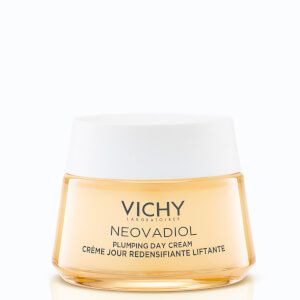
Vichy Neovadiol Perimenopause Plumping Day Cream for Dry Skin
Works for
3 of 3 advertised claims delivered
Anti-aging3 ingredients credited for this claimStrong support
“The hydrating day cream targets loss of firmness and sagging, working to replenish skin moisture.”
This product can help reduce and prevent fine lines and wrinkles, improve skin elasticity and firmness because it contains adenosine.
Keep in mind that it typically takes at least 6 weeks to notice any results because the changes that are needed to improve fine lines and elasticity happen in the deeper layers of the skin. No topical anti-aging product can “erase” wrinkles or fully reverse signs of aging.
Evens skin tone2 ingredients credited for this claimModerate support
“Skin appears smoother, supple and more even-toned.”
The following ingredient (ingredients) in this product might be helpful, but there is no evidence to confirm that it actually works: capryloyl salicylic acid.
Moisturizing18 ingredients credited for this claimGood support
“The hydrating day cream targets loss of firmness and sagging, working to replenish skin moisture.”
This product can help improve hydration of the skin with the two types of ingredients.
The first type is called “humectants”:
these ingredients help attract water.
When humectants are on the surface of the skin, they “pull in” the moisture from the outside environment, or from
within deeper layers of the skin. The following ingredients in this product do the job:
glycerin, sodium hyaluronate.
This product also contains ingredients called “occlusives”. They help reduce the speed with which our skin loses moisture to the outside environment. These ingredients also help soften the upper layer of the skin, so it feels less tight and nicer to the touch. The following ingredients in this product do the job: butyrospermum parkii butter, cera alba.
ExfoliationNot advertised by the brand · 2 ingredients credited for this claimStrong support
This product can help exfoliate the skin. In other words, it helps break down the bonds between dead cells on the surface of the skin and speed up the skin turnover. Skin often appears softer and brighter after exfoliation, but overdoing it can result in disrupted skin barrier. The following ingredient is doing the exfoliating job in this product: capryloyl salicylic acid.
Can it cause trouble?
Irritancy2 strong irritants: Alcohol denat., ParfumMedium risk
Comedogenic4 ingredients rated 2 or more on the 0–5 pore-clogging scale4 flagged


User reviews
Be the first — your take helps the next person decide.
Ingredients
Filter by role to see what each ingredient is doing.
Water~45–55%
Prunus armeniaca kernel oil~4.6–5.7%
- Irritation risk
- Medium
An emollient that helps soften the skin
More about Prunus armeniaca kernel oilDimethicone~4.1–5.1%
- Irritation risk
- Low
A silicone that helps to reduce water loss from the surface of the skin. Can temporarily "fill in" lines and wrinkles, absorb oil, and create a nice product finish
More about DimethiconeGlycerin~3–3.7%
- Irritation risk
- Low
One of the best moisturizing ingredients. Naturally present in skin. It attracts water to the upper layer of the skin working as a humectant
More about GlycerinHydroxypropyl tetrahydropyrantriol~2.3–2.8%
- Irritation risk
- High
A sugar-derived compound that helps to attract water to the upper layer of the skin and might be able to stimulate synthesis of skin's own moisturizing factors, but solid research is lacking. It could be irritating
More about Hydroxypropyl tetrahydropyrantriolZea mays starch~1.9–2.4%
- Irritation risk
- Medium
- Comedogenicity
- 3/5
Used to thicken the product's consistency
More about Zea mays starchAlcohol denat.~1.7–2%
- Irritation risk
- High
Produces temporary toning effect. Can help dissolve other ingredients or preserve products
More about Alcohol denat.Propanediol~1.5–1.8%
- Irritation risk
- Low
Acts as a solvent for other ingredients. Speeds up the absorption of other ingredients into the skin
More about PropanediolPropylene glycol~1.2–1.4%
- Irritation risk
- High
Helps oil and water mix together and can enhance the penetration of other ingredients into the skin. It can be irritating
More about Propylene glycolStearic acid~1.1–1.3%
- Irritation risk
- Low
Helps oil and water mix together and works as an emollient
More about Stearic acidOryza sativa bran oil~0.75–1.1%
- Irritation risk
- Low
Helps soften the upper layer of the skin and might have some anti-oxidant properties
More about Oryza sativa bran oilButyrospermum parkii butter~0.65–1%
- Irritation risk
- Low
- Comedogenicity
- 3/5
A great moisturising ingredient that softens the skin and reduces water loss from its upper layer. It also can be helpful in protecting skin from free radicals
More about Butyrospermum parkii butterIsohexadecane~0.65–1%
- Irritation risk
- Low
Improves the texture of the product and helps soften the skin. Helps oil and water mix together and can be used as a cleansing agent
More about IsohexadecanePalmitic acid~0.6–0.85%
- Irritation risk
- Low
An emollient that is naturally present in skin and helps soften it
More about Palmitic acidPeg-100 stearate~0.6–0.9%
- Irritation risk
- Low
Helps oil and water mix togehter and creates a nice product texture
More about Peg-100 stearatePeg-20 stearate~0.5–0.75%
Stearyl alcohol~0.55–0.8%
- Irritation risk
- Low
An emollient that helps soften the skin
More about Stearyl alcoholGlyceryl stearate~0.5–0.75%
- Irritation risk
- Low
An emollient that softens the skin and forms a protective layer on its surface. Helps water and oil mix together
More about Glyceryl stearateCera alba~0.5–0.8%
- Irritation risk
- Medium
Forms a protective barrier that holds water and keeps dry skin hydrated. Keeps an emulsion from separating into its oil and liquid components, and increases the thickness of a product. Can be an allergen
More about Cera albaHydroxyethylpiperazine ethane sulfonic acid~0.35–0.65%
- Irritation risk
- Medium
Used to regulate product's pH, but can be also used as an exfoliator when included in higher concentrations. There is a controversy about whether it can generate free radicals and induce skin cell damage when used in topical products
More about Hydroxyethylpiperazine ethane sulfonic acidCi 15985~0.35–0.6%
Ci 77891~0.3–0.55%
- Irritation risk
- Low
Sorbitan oleate~0.3–0.6%
- Irritation risk
- Medium
- Comedogenicity
- 2/5
Helps oil and water mix together
More about Sorbitan oleateNiacinamide~0.3–0.55%
- Irritation risk
- Low
Is proven to be effective in reducing blemishes, evening out skin tone and helping to improve lines and wrinkles. It helps the skin to repair sun damage, calm down inflammation and keep maintain good levels of moisture. The concentration of about 2% is effective for supporting the skin barrier and evening out the skin tone. Concentration of 4-6% is better for helping with acne and balancing the sebum production
More about NiacinamideDimethiconol~0.35–0.6%
- Irritation risk
- Low
A silicone that makes products more spreadable and keeps skin smooth. Helps to add gloss to skin and may visually fill in fine lines/wrinkles for short time
More about DimethiconolMyristic acid~0.3–0.6%
- Irritation risk
- Medium
- Comedogenicity
- 3/5
Helps oil and water mix together. Could be comedogenic
More about Myristic acidSodium hyaluronate~0.25–0.5%
- Irritation risk
- Low
One of the best moisturizing ingredients. Attracts water into the upper layer of the skin
More about Sodium hyaluronateAdenosine~0.25–0.5%
- Irritation risk
- Low
Might help improve cell turnover and reduce inflammation in skin. One study shows that the ingredients might be able to help reduce dynamic wrinkles (for example, in the corners of the eyes or on the forehead)
More about AdenosineCaprylyl glycol~0.3–0.5%
- Irritation risk
- Medium
Helps preserve products and creates a nice product texture
More about Caprylyl glycolCapryloyl salicylic acid~0.25–0.45%
- Irritation risk
- High
Citric acid~0.2–0.4%
- Irritation risk
- Medium
Can work as an exfoliant but is typically used to adjust the product pH
More about Citric acidCassia angustifolia seed polysaccharide~0.2–0.35%
- Irritation risk
- Medium
Helps attract water to the upper layer of the skin. Is sometimes referred to as "natural" hyaluronic acid (even though hyaluronic acid is not unnatural and is present in human skin)
More about Cassia angustifolia seed polysaccharideTrisodium ethylenediamine disuccinate~0.15–0.3%
- Irritation risk
- Medium
Used to improve stability of the formulation
More about Trisodium ethylenediamine disuccinateSynthetic fluorphlogopite~0.15–0.3%
- Irritation risk
- Low
A mineral that is used as an optical filter (makes the skin looks nicer through light reflection) and to improve the texture of cosmetic products
More about Synthetic fluorphlogopitePentaerythrityl tetra-di-t-butyl hydroxyhydrocinnamate~0.15–0.25%
- Irritation risk
- Low
Used to increase stability of product formulations
More about Pentaerythrityl tetra-di-t-butyl hydroxyhydrocinnamateAcrylamide/sodium acryloyldimethyltaurate copolymer~0.1–0.2%
- Irritation risk
- Low
Helps water and oil mix together and create gel-like textures
More about Acrylamide/sodium acryloyldimethyltaurate copolymerPolysorbate 80~0.1–0.2%
Parfum~0.05–0.1%
- Irritation risk
- High
An aromatic blend of unspecified and possibly irritating ingredients
More about ParfumIngredient list view
Water, Prunus armeniaca kernel oil, Dimethicone, Glycerin, Hydroxypropyl tetrahydropyrantriol, Zea mays starch, Alcohol denat., Propanediol, Propylene glycol, Stearic acid, Oryza sativa bran oil, Butyrospermum parkii butter, Isohexadecane, Palmitic acid, Peg-100 stearate, Peg-20 stearate, Stearyl alcohol, Glyceryl stearate, Cera alba, Hydroxyethylpiperazine ethane sulfonic acid, Ci 15985, Ci 77891, Sorbitan oleate, Niacinamide, Dimethiconol, Myristic acid, Sodium hyaluronate, Adenosine, Caprylyl glycol, Capryloyl salicylic acid, Citric acid, Cassia angustifolia seed polysaccharide, Trisodium ethylenediamine disuccinate, Synthetic fluorphlogopite, Pentaerythrityl tetra-di-t-butyl hydroxyhydrocinnamate, Acrylamide/sodium acryloyldimethyltaurate copolymer, Polysorbate 80, Parfum
Compare prices
Retailers ranked by price — lowest first.


Worth comparing, line by line.
Match % combines shared ingredients, the first five ingredients, shared actives and hero ingredients, irritancy (lower counts in the alternative's favour), texture and body area. Only products in the same routine step are compared.
| VichyNeovadiol Perimenopause Plumping Day Cream for Dry SkinYOUR PRODUCT | Dr. Reju-AllAdvanced PDRN Rejuvenating Cream Max 60ml | It CosmeticsConfidence in a Cream Barrier Boost Skin Barrier Repair Moisturizer | OrjenaResponse synergy barrier cream | |
|---|---|---|---|---|
| Match | — | 82% | 80% | 80% |
| Price | $30.92 | $64.77+$33.85 | $49.00+$18.08 | $25.00−$5.92 |
| Shared key ingredients | — | 5 of 14 | 5 of 14 | 5 of 14 |
| Key difference | — | Panthenol | Acetyl Dipeptide-1 Cetyl Ester | Sh-Polypeptide-9 |
| Irritancy | Medium | Low | Low | Low |
| Drying alcohol | Contains drying alcohol | — | — | — |
| View product | Shop | Shop | Shop |


Sources cited in this review
Every concentration estimate and effectiveness label is anchored to one of these 22 studies and safety reviews.
- 1
- 2Final Report on the Safety Assessment of Dimethicone Copolyoljournals.sagepub.com
- 3
- 4
- 5
- 6

Affiliate links · As an Amazon Associate, WIMJ earns from qualifying purchases.