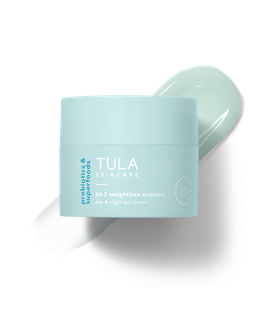
Works for
1 of 1 advertised claim delivered
Moisturizing27 ingredients credited for this claimStrong support
“Hydration that feels like floating on a cloud. 24-7 moisture you love, in a weightless gel texture”
This product contains good ingredients to attract water to the upper layer of the skin. These ingredients are called "humectants": glycerin, lactobacillus ferment.
When humectants are on the surface of the skin, they “pull in” the moisture from the outside environment, or from within deeper layers of the skin. If the air is dry, humectants can speed up the moisture loss from the skin. This is why it is a good idea to use another product on top of this one to help "seal in" the moisture (look for ingredients like dimethicone, squalane, oils and butters).
The following ingredients in this product are especially good for supporting the skin barrier and helping with the hydration level: urea
Can it cause trouble?
Irritancy25 flagged ingredientsMedium risk
ComedogenicClean of flagged comedogenic ingredientsNone flagged
![Nordic Hydra [LÄHDE] Fresh Moisture 24H Water Gel](/_ipx/q_80&f_webp&fit_inside&s_160x160/https://image-delivery.nyc3.cdn.digitaloceanspaces.com/full/6a7fe8a4c6897d8c4da5c7ab26d9a2af.jpeg)
User reviews
Be the first — your take helps the next person decide.
Ingredients
Filter by role to see what each ingredient is doing.
Water~45–55%
Glycerin~4.5–5.5%
- Irritation risk
- Low
One of the best moisturizing ingredients. Naturally present in skin. It attracts water to the upper layer of the skin working as a humectant
More about GlycerinC13-15 alkane~4–4.9%
Propanediol~2.8–3.5%
- Irritation risk
- Low
Acts as a solvent for other ingredients. Speeds up the absorption of other ingredients into the skin
More about PropanediolSodium acrylates copolymer~1.9–2.4%
- Irritation risk
- Medium
Used to create a thicker product consistency
More about Sodium acrylates copolymerWater~1.7–2%
Collagen amino acids~1.4–1.7%
- Irritation risk
- Low
Help attract water to the upper layer of the skin, soften it and support the skin barrier function
More about Collagen amino acidsCitrullus lanatus fruit extract~1.3–1.6%
- Irritation risk
- Medium
A plant extract that can contain an antioxidant compound
More about Citrullus lanatus fruit extractPyrus malus fruit extract~1.1–1.3%
- Irritation risk
- Medium
Can have some moisturizing properties due to its sugar content
More about Pyrus malus fruit extractHydrolyzed rice protein~0.75–1.15%
- Irritation risk
- Low
Helps attract water to the upper layer of the skin. Might have some anti-oxidant properties
More about Hydrolyzed rice proteinPunica granatum pericarp extract~0.6–0.9%
- Irritation risk
- Low
Niacinamide~0.5–0.75%
- Irritation risk
- Low
Is proven to be effective in reducing blemishes, evening out skin tone and helping to improve lines and wrinkles. It helps the skin to repair sun damage, calm down inflammation and keep maintain good levels of moisture. The concentration of about 2% is effective for supporting the skin barrier and evening out the skin tone. Concentration of 4-6% is better for helping with acne and balancing the sebum production
More about NiacinamideLactococcus ferment lysate~0.45–0.65%
- Irritation risk
- Low
Consists of remains of dead bacteria cells. Is likely helpful in attracting water to the upper layer of the skin. Might be helpful in reducing inflammation and neutralizing free radicals in skin
More about Lactococcus ferment lysateLactobacillus~0.35–0.65%
- Irritation risk
- Low
A non-living ingredient made by fermentation with the bacteria Lactobacillus. It can help attract water to the upper layer of the skin and might help reduce inflammation
More about LactobacillusLactobacillus ferment~0.3–0.6%
- Irritation risk
- Low
A fermentation product created by bacteria Lactobacillus. The fermented product has anti-bacterial properties and might be helpful in calming down inflammation, but studies are lacking. Helps attract water to the upper layer of the skin. Can be used as a preservative
More about Lactobacillus fermentCurcuma longa root extract~0.3–0.55%
- Irritation risk
- High
A plant extract that can contain an active compound curcumin, that may have some anti-inflammatory properties when applied to the skin, but solid research is lacking and the typical concentration used in skincare products is too low. Can be an irritant
More about Curcuma longa root extractLactic acid~0.3–0.6%
- Irritation risk
- Medium
An exfoliating and moisturizing alpha-hydroxy acid (AHA). Typically causes less irritation than other AHAs, for example, glycolic acid. At high concentrations (about 15%), lactic acid can help reduce lines and wrinkles. Recent studies show that lactic acid can support the "good" bacteria living on skin's surface (healthy skin microbiome)
More about Lactic acidAlpha-glucan oligosaccharide~0.35–0.65%
- Irritation risk
- Low
Helps attract water to the upper layer of the skin
More about Alpha-glucan oligosaccharideBeta vulgaris root extract~0.25–0.5%
- Irritation risk
- Medium
A plant extract that might have some antioxidant properties, but mostly used in cosmetics for its color
More about Beta vulgaris root extractSodium hyaluronate~0.25–0.45%
- Irritation risk
- Low
One of the best moisturizing ingredients. Attracts water into the upper layer of the skin
More about Sodium hyaluronateLens esculenta fruit extract~0.25–0.45%
- Irritation risk
- Medium
A plant extract containing sugars that might help attract water to the upper layer of the skin. Is claimed by the manufacturer to help reduce pore size but evidence is lacking
More about Lens esculenta fruit extractPolymnia sonchifolia root juice~0.25–0.45%
- Irritation risk
- High
A plant extract that helps attract water to the upper layer of the skin and might have some anti-oxidant properties
More about Polymnia sonchifolia root juiceSodium acetylated hyaluronate~0.2–0.4%
- Irritation risk
- Low
A type of hyaluronic acid that works as an excellent moisturizer by attracting water into the upper layer of the skin. Is typically feels less sticky on the skin compared to the usual hyaluronic acid
More about Sodium acetylated hyaluronateHydrolyzed sodium hyaluronate~0.2–0.4%
- Irritation risk
- Low
Attracts water into the upper layer of the skin
More about Hydrolyzed sodium hyaluronateSodium hyaluronate crosspolymer~0.2–0.4%
- Irritation risk
- Medium
Attracts water into the upper layer of the skin
More about Sodium hyaluronate crosspolymerTetrahexyldecyl ascorbate~0.2–0.4%
- Irritation risk
- Medium
Being a lipid soluble form of vitamin C, it is more stable than ascorbic acid, but still degrades quickly and needs to be stabilized in a formulation with another ingredient. It is claimed to penetrate skin better than pure vitamin C and have the the similar benefits, but solid studies of its effectiveness are lacking. Is likely to require a higher concentration in a product than pure vitamin C to be effective. It might be able to help reduce pore clogging.
More about Tetrahexyldecyl ascorbateInulin~0.2–0.4%
- Irritation risk
- Low
Helps attract water to the upper layer of the skin. Is claimed to support the growth of "good" bacteria in skin (as a "prebiotic"), but the research is lacking
More about InulinLeuconostoc/radish root ferment filtrate~0.2–0.4%
- Irritation risk
- Medium
A preservative that comes from radishes fermented by a bacteria. New research suggests that the preservation properties in the ingredient come from an ammonium salt that is not present naturally in radish root but used in its cultivation. Is problematic because the exact amount of the preservative agents is difficult to determine
More about Leuconostoc/radish root ferment filtrateVaccinium myrtillus leaf extract~0.2–0.4%
- Irritation risk
- Low
Pterocarpus marsupium bark/wood extract~0.2–0.4%
- Irritation risk
- Low
Sodium pca~0.2–0.4%
- Irritation risk
- Low
Naturally present in skin and helps to attract water to its upper layer
More about Sodium pcaCoco-caprylate/caprate~0.25–0.45%
- Irritation risk
- Low
Helps to soften the upper layer of the skin without creating a greasy texture
More about Coco-caprylate/caprateLecithin~0.25–0.45%
- Irritation risk
- Low
Used mostly for creating emulsions - helping oil and water mix together. Helps soften the upper layer of the skin
More about Lecithin1,2-hexanediol~0.2–0.4%
Urea~0.2–0.4%
- Irritation risk
- Low
Naturally present in skin (urea makes up about 7% of natural moisturizing factors in skin). Attracts water to the upper layer of the skin. Also has a positive effect on the skin barrier beyond the humectant action. Can enhance penetration of other ingredients. Is an exfoliating ingredient when used in high concentrations
More about UreaLysolecithin~0.25–0.45%
- Irritation risk
- Low
Lecithin derivative. It helps oil and water mix together and can enhance penetration of other ingredients. It helps soften the upper layer of the skin
More about LysolecithinPentylene glycol~0.25–0.5%
- Irritation risk
- Medium
Used to preserve products, dissolve other ingredients and create a nice product texture
More about Pentylene glycolHydroxyacetophenone~0.2–0.4%
Caprylhydroxamic acid~0.2–0.4%
Trisodium ethylenediamine disuccinate~0.2–0.4%
- Irritation risk
- Medium
Used to improve stability of the formulation
More about Trisodium ethylenediamine disuccinateSodium lactate~0.2–0.4%
- Irritation risk
- Medium
Helps attract water to the upper layer of the skin. Is often used to adjust the pH level of the product
More about Sodium lactateCitric acid~0.2–0.4%
- Irritation risk
- Medium
Can work as an exfoliant but is typically used to adjust the product pH
More about Citric acidPhenethyl alcohol~0.2–0.4%
Tocopheryl acetate~0.2–0.4%
- Irritation risk
- Medium
A more stable but less bio-available form of vitamin E compared to Tocopherol. Might help moisturize and protect the skin from free radicals, but mostly used in low concentrations to stabilize other ingredients.
More about Tocopheryl acetateCaprylyl glycol~0.2–0.4%
- Irritation risk
- Medium
Helps preserve products and creates a nice product texture
More about Caprylyl glycolMaltodextrin~0.2–0.35%
- Irritation risk
- Low
Used to stabilize the product formulation and can help absorb oil
More about MaltodextrinSodium benzoate~0.15–0.3%
Potassium sorbate~0.15–0.3%
Phytic acid~0.2–0.35%
- Irritation risk
- Medium
An alpha-hydroxy acid (AHA), but is mostly used to stabilize product formulations in cosmetics
More about Phytic acidSodium hydroxide~0.15–0.25%
Butylene glycol~0.1–0.2%
- Irritation risk
- Low
Used to create a nice product texture and help delivery of other ingredients. Might be somewhat helpful in attracting water to the upper layer of the skin
More about Butylene glycolTocopherol~0.15–0.25%
- Irritation risk
- Low
Pure form of vitamin E. Can help moisturise and protect the skin from free radicals. Often used to help stabilise other ingredients or the formula itself
More about TocopherolSodium chloride~0.15–0.25%
- Irritation risk
- Low
Used to stabilize mixtures of oil and water, and create thicker, gel-like product textures
More about Sodium chlorideEthylhexylglycerin~0.05–0.15%
Ci 42090~0.05–0.1%
Ingredient list view
Water, Glycerin, C13-15 alkane, Propanediol, Sodium acrylates copolymer, Water, Collagen amino acids, Citrullus lanatus fruit extract, Pyrus malus fruit extract, Hydrolyzed rice protein, Punica granatum pericarp extract, Niacinamide, Lactococcus ferment lysate, Lactobacillus, Lactobacillus ferment, Curcuma longa root extract, Lactic acid, Alpha-glucan oligosaccharide, Beta vulgaris root extract, Sodium hyaluronate, Lens esculenta fruit extract, Polymnia sonchifolia root juice, Sodium acetylated hyaluronate, Hydrolyzed sodium hyaluronate, Sodium hyaluronate crosspolymer, Tetrahexyldecyl ascorbate, Inulin, Leuconostoc/radish root ferment filtrate, Vaccinium myrtillus leaf extract, Pterocarpus marsupium bark/wood extract, Sodium pca, Coco-caprylate/caprate, Lecithin, 1,2-hexanediol, Urea, Lysolecithin, Pentylene glycol, Hydroxyacetophenone, Caprylhydroxamic acid, Trisodium ethylenediamine disuccinate, Sodium lactate, Citric acid, Phenethyl alcohol, Tocopheryl acetate, Caprylyl glycol, Maltodextrin, Sodium benzoate, Potassium sorbate, Phytic acid, Sodium hydroxide, Butylene glycol, Tocopherol, Sodium chloride, Ethylhexylglycerin, Ci 42090
Compare prices
Retailers ranked by price — lowest first.

Affiliate links · prices updated regularly
Worth comparing, line by line.
Match % combines shared ingredients, the first five ingredients, shared actives and hero ingredients, irritancy (lower counts in the alternative's favour), texture and body area. Only products in the same routine step are compared.
| US24-7 Weightless MoistureYOUR PRODUCT | CetaphilOptimal Hydration Skin Replenishing Water Gel | MarudermHyaluronic Acid Moisturizer Face & Body Cream | CosmetocriticoUltra Lipid Repair | |
|---|---|---|---|---|
| Match | — | 80% | 75% | 74% |
| Price | $58.00 | — | $21.99−$36.01 | — |
| Shared key ingredients | — | 4 of 16 | 6 of 16 | 9 of 16 |
| Key difference | — | Anhydroxylitol | Panthenol | Gluconolactone |
| Irritancy | Medium | Low | Low | Medium |
| Drying alcohol | — | — | — | — |
| View product | Shop | Shop | Shop |

Sources cited in this review
Every concentration estimate and effectiveness label is anchored to one of these 27 studies and safety reviews.
- 1
- 2
- 3Analyzing Lycopene Content in Fruitssciencedirect.com
- 4
- 5
- 6

Affiliate links · As an Amazon Associate, WIMJ earns from qualifying purchases.