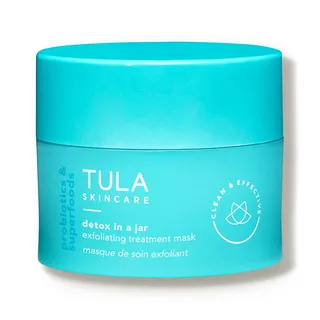
Works for
Evens skin toneLactic acid ~1.2–1.4%, below the ~2% it needsUnder-dosed
“Lifts off dead skin, draws out impurities and promotes cell turnover to reveal a more even skin tone Vitamin E and camelina sativa seed oil have antioxidant actions that protect the skin and provide ageless effects Patented probiotic technology protects against harmful bacteria and restores skin's natural balance and texture TULA Skincare offers a line of products formulated with nutritive elements to nourish skin from the inside out.”
Effective ingredients missing or their concentration is too low
ExfoliationLactic acid ~1.2–1.4%, below the ~2% it needsUnder-dosed
“Detox In A Jar Exfoliating Treatment Mask”
This product does not contain effective exfoliating ingredients. It might be able to deliver physical exfoliation, that is scrub off some of the dead cells on the surface of the skin. We do not recommend physical exfoliation, because it is not uniform (some bits of skin can get exfoliated too much while others not at all). It can also traumatize the skin and aggrevate acne and other skin conditions.
MoisturizingSide benefit the brand mentions · Glycerin, Octyldodecyl neopentanoate + 15 moreWorks
“Plant-based, biodegradable beads also help exfoliation by releasing hydrating nutrients including jojoba and vitamin E to heal and calm skin.”
This product can help improve hydration of the skin with the two types of ingredients.
The first type is called “humectants”:
these ingredients help attract water.
When humectants are on the surface of the skin, they “pull in” the moisture from the outside environment, or from
within deeper layers of the skin. The following ingredients in this product do the job:
glycerin, hydrolyzed rice protein.
This product also contains ingredients called “occlusives”. They help reduce the speed with which our skin loses moisture to the outside environment. These ingredients also help soften the upper layer of the skin, so it feels less tight and nicer to the touch. The following ingredients in this product do the job: butyrospermum parkii butter, carthamus tinctorius seed oil.
Anti-oxidationSide benefit · Camellia sinensis leaf extract, Butyrospermum parkii butter + 6 moreMay help
This product contains antioxidants (camellia sinensis leaf extract) that might be able to help neutralize free radicals in skin to lessen the damage it gets from the UV light (sun). There is not enough evidence to confirm their effectiveness in skin though.
Can it cause trouble?
Irritancy4 strong irritants: Cananga odorata flower oil, Citrus aurantium dulcis oil + 2 more — patch-test recommendedHigh risk
Comedogenic2 ingredients rated 2 or more on the 0–5 pore-clogging scale2 flagged

User reviews
Be the first — your take helps the next person decide.
Ingredients
Filter by role to see what each ingredient is doing.
Water~45–55%
Glycerin~4.8–5.9%
- Irritation risk
- Low
One of the best moisturizing ingredients. Naturally present in skin. It attracts water to the upper layer of the skin working as a humectant
More about GlycerinTitanium dioxide~4.7–5.8%
- Irritation risk
- Low
Works as a UV filter when used in high concentrations. It is photostable and is effective mostly against the UVB light, with some protection in the UVA range. In small concentrations, used for its ability to improve the color of cosmetic products. Is usually well tolerated by the skin
More about Titanium dioxideBentonite~3.4–4.1%
Hydrogenated soybean oil~2.7–3.3%
- Irritation risk
- Low
- Comedogenicity
- 2/5
Kaolin~2.3–2.8%
- Irritation risk
- Low
A type of clay that consists mainly of aluminum silicate. Helps absorb oil and creates a thicker product consistency. Can be used to add a white color
More about KaolinOctyldodecyl neopentanoate~1.9–2.3%
- Irritation risk
- Low
An emollient that helps soften the skin. Often used to stabilize other ingredients, for example, sunscreen
More about Octyldodecyl neopentanoateSorbitan stearate~1.6–2%
Bifida ferment lysate~1.4–1.7%
- Irritation risk
- Low
Consists of remains of dead yeast bacteria cells. Helps to hydrate the skin and reduce irritation. Might has some anti-oxidant effect
More about Bifida ferment lysateLactic acid~1.2–1.4%
- Irritation risk
- Medium
An exfoliating and moisturizing alpha-hydroxy acid (AHA). Typically causes less irritation than other AHAs, for example, glycolic acid. At high concentrations (about 15%), lactic acid can help reduce lines and wrinkles. Recent studies show that lactic acid can support the "good" bacteria living on skin's surface (healthy skin microbiome)
More about Lactic acidCurcuma longa root extract~1–1.2%
- Irritation risk
- High
A plant extract that can contain an active compound curcumin, that may have some anti-inflammatory properties when applied to the skin, but solid research is lacking and the typical concentration used in skincare products is too low. Can be an irritant
More about Curcuma longa root extractCitric acid~0.8–1.2%
- Irritation risk
- Medium
Can work as an exfoliant but is typically used to adjust the product pH
More about Citric acidButyrospermum parkii butter~0.9–1.1%
- Irritation risk
- Low
- Comedogenicity
- 3/5
A great moisturising ingredient that softens the skin and reduces water loss from its upper layer. It also can be helpful in protecting skin from free radicals
More about Butyrospermum parkii butterOlea europaea fruit oil~0.75–1.1%
- Irritation risk
- Medium
An emollient that helps soften the skin but is not effective for restoring its barrier function. Might be helpful to calm down inflammation
More about Olea europaea fruit oilHydrolyzed rice protein~0.65–1%
- Irritation risk
- Low
Helps attract water to the upper layer of the skin. Might have some anti-oxidant properties
More about Hydrolyzed rice proteinCichorium intybus root extract~0.65–1%
- Irritation risk
- Low
Vaccinium angustifolium fruit extract~0.6–0.9%
- Irritation risk
- Medium
A plant extract tha can have anti-oxidant properties, but evidence of effectiveness in skin is lacking
More about Vaccinium angustifolium fruit extractCarthamus tinctorius seed oil~0.65–0.95%
- Irritation risk
- Low
An emollient that helps soften the skin and might help calm down inflammation
More about Carthamus tinctorius seed oilCamellia sinensis leaf extract~0.55–0.85%
- Irritation risk
- Low
Can contain potent anti-oxidant compounds (abbreviated ECG, GCG, EGC, and EGCG) that might help protect the skin from free radicals. Can help calm down inflammation and has some anti-bacterial properties. Unfortunately, these antioxidants are unstable and lose their effectiveness very quickly in products. The concentration of the antioxidant compounds in the extract also tends to be low to be effective in topical formulation
More about Camellia sinensis leaf extractCamelina sativa seed oil~0.5–0.8%
- Irritation risk
- Low
Helps soften the upper layer of the skin
More about Camelina sativa seed oilVolcanic sand~0.5–0.75%
- Irritation risk
- Low
Lactis proteinum~0.5–0.75%
- Irritation risk
- Low
Yogurt powder~0.5–0.75%
- Irritation risk
- Low
Ascorbyl palmitate~0.5–0.7%
- Irritation risk
- Medium
Being a lipid soluble form of vitamin C, it is more stable and can penetrate the skin better than L-Ascorbic acid. It is effective in protecting the skin from free radicals, as well as evening the skin tone, but is less effective in stimulating collagen production compared to L-Ascorbic acid.
More about Ascorbyl palmitateMicrocrystalline cellulose~0.5–0.75%
Olus oil~0.55–0.8%
- Irritation risk
- Low
An oil from a mixture of different vegetables. Helps soften the upper layer of the skin
More about Olus oilInulin~0.45–0.7%
- Irritation risk
- Low
Helps attract water to the upper layer of the skin. Is claimed to support the growth of "good" bacteria in skin (as a "prebiotic"), but the research is lacking
More about InulinLactose~0.45–0.7%
- Irritation risk
- Low
Helps attract water to the upper layer of the skin
More about LactoseTocopheryl acetate~0.5–0.75%
- Irritation risk
- Medium
A more stable but less bio-available form of vitamin E compared to Tocopherol. Might help moisturize and protect the skin from free radicals, but mostly used in low concentrations to stabilize other ingredients.
More about Tocopheryl acetateButylene glycol~0.5–0.7%
- Irritation risk
- Low
Used to create a nice product texture and help delivery of other ingredients. Might be somewhat helpful in attracting water to the upper layer of the skin
More about Butylene glycolXanthan gum~0.5–0.7%
- Irritation risk
- Low
Used to create a thicker product consistency
More about Xanthan gumDecylene glycol~0.45–0.7%
- Irritation risk
- Low
Used to creat a nice product texture and support penetration of other ingredients
More about Decylene glycolCaprylyl glycol~0.5–0.75%
- Irritation risk
- Medium
Helps preserve products and creates a nice product texture
More about Caprylyl glycolPentylene glycol~0.5–0.8%
- Irritation risk
- Medium
Used to preserve products, dissolve other ingredients and create a nice product texture
More about Pentylene glycolEthylhexylglycerin~0.45–0.65%
Octyldodecanol~0.35–0.6%
- Irritation risk
- Low
An emollient that helps to soften the skin and create a pleasant product texture and stabilize the formulation
More about OctyldodecanolBulnesia sarmientoi wood oil~0.3–0.55%
- Irritation risk
- Low
Cananga odorata flower oil~0.3–0.55%
Citrus aurantium dulcis oil~0.3–0.55%
- Irritation risk
- High
Used as a fragrance. It can be irritating and cause photosensitivity
More about Citrus aurantium dulcis oilCitrus limon fruit oil~0.3–0.5%
- Irritation risk
- High
Juniperus mexicana oil~0.3–0.5%
- Irritation risk
- Low
Trisodium dicarboxymethyl alaninate~0.25–0.45%
- Irritation risk
- Low
Sodium chloride~0.25–0.45%
- Irritation risk
- Low
Used to stabilize mixtures of oil and water, and create thicker, gel-like product textures
More about Sodium chlorideSorbic acid~0.2–0.4%
Sodium glycolate~0.2–0.4%
- Irritation risk
- Low
1,2-hexanediol~0.15–0.25%
Phenethyl alcohol~0.15–0.3%
Parfum~0.15–0.25%
- Irritation risk
- High
An aromatic blend of unspecified and possibly irritating ingredients
More about ParfumPhenoxyethanol~0.15–0.3%
- Irritation risk
- Low
A preservative. It helps prevent bacterial growth in cosmetic products
More about PhenoxyethanolChromium hydroxide green~0.1–0.15%
Ultramarines~0.1–0.15%
- Irritation risk
- Low
Ingredient list view
Water, Glycerin, Titanium dioxide, Bentonite, Hydrogenated soybean oil, Kaolin, Octyldodecyl neopentanoate, Sorbitan stearate, Bifida ferment lysate, Lactic acid, Curcuma longa root extract, Citric acid, Butyrospermum parkii butter, Olea europaea fruit oil, Hydrolyzed rice protein, Cichorium intybus root extract, Vaccinium angustifolium fruit extract, Carthamus tinctorius seed oil, Camellia sinensis leaf extract, Camelina sativa seed oil, Volcanic sand, Lactis proteinum, Yogurt powder, Ascorbyl palmitate, Microcrystalline cellulose, Olus oil, Inulin, Lactose, Tocopheryl acetate, Butylene glycol, Xanthan gum, Decylene glycol, Caprylyl glycol, Pentylene glycol, Ethylhexylglycerin, Octyldodecanol, Bulnesia sarmientoi wood oil, Cananga odorata flower oil, Citrus aurantium dulcis oil, Citrus limon fruit oil, Juniperus mexicana oil, Trisodium dicarboxymethyl alaninate, Sodium chloride, Sorbic acid, Sodium glycolate, 1,2-hexanediol, Phenethyl alcohol, Parfum, Phenoxyethanol, Chromium hydroxide green, Ultramarines
Compare prices
Retailers ranked by price — lowest first.


Worth comparing, line by line.
Match % combines shared ingredients, the first five ingredients, shared actives and hero ingredients, irritancy (lower counts in the alternative's favour), texture and body area. Only products in the same routine step are compared.
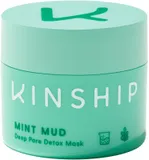
| TulaDetox In A Jar Exfoliating Treatment MaskYOUR PRODUCT | Baxter of CaliforniaClay Mask AHA | KinshipMint Mud Deep Pore Detox Mask | Jan MariniLuminate Face Mask | |
|---|---|---|---|---|
| Match | — | 56% | 56% | 55% |
| Price | $48.00 | $24.16−$23.84 | — | $154.36+$106.36 |
| Shared key ingredients | — | 3 of 11 | 3 of 11 | 4 of 11 |
| Key difference | — | Allantoin | Allantoin | A Type Of Green Tea Extract |
| Irritancy | High | Medium | Medium | Low |
| Drying alcohol | — | — | — | — |
| View product | Shop | Shop | Shop |


More alternatives: Typology Coffret Masque Pores Dilatés et Points Noirs — AHA 10 % + PHA 10 %Naturium AHA Exfoliating Mask 10%
Sources cited in this review
Every concentration estimate and effectiveness label is anchored to one of these 18 studies and safety reviews.
- 1
- 2
- 3Bifidobacterium longumlysate, a new ingredient forreactive skinonlinelibrary.wiley.com
- 4Use of Probiotics for Dermal Applicationsresearchgate.net
- 5Epidermal and dermal effects of topical lactic acidncbi.nlm.nih.gov
- 6Dual Effects of Alpha-Hydroxy Acids on the Skinpdfs.semanticscholar.org

Affiliate links · As an Amazon Associate, WIMJ earns from qualifying purchases.