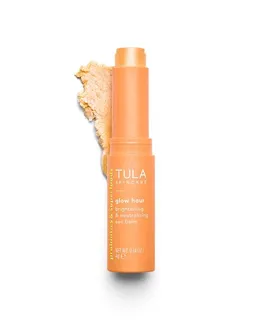
Works for
MoisturizingLactococcus ferment lysate, Trehalose + 15 moreWorks
“Each swipe cools, hydrates, luminates with a golden peachy glow & transports you to the magical time of day that is glow hour.”
This product contains good ingredients to attract water to the upper layer of the skin. These ingredients are called "humectants": glycerin, hyaluronic acid.
When humectants are on the surface of the skin, they “pull in” the moisture from the outside environment, or from within deeper layers of the skin. If the air is dry, humectants can speed up the moisture loss from the skin. This is why it is a good idea to use another product on top of this one to help "seal in" the moisture (look for ingredients like dimethicone, squalane, oils and butters).
Can it cause trouble?
Irritancy2 strong irritants: Citrus grandis seed extract, Menthyl lactateMedium risk
Comedogenic2 ingredients rated 2 or more on the 0–5 pore-clogging scale2 flagged
User reviews
Be the first — your take helps the next person decide.
Ingredients
Filter by role to see what each ingredient is doing.
Propanediol~25–31%
- Irritation risk
- Low
Acts as a solvent for other ingredients. Speeds up the absorption of other ingredients into the skin
More about PropanediolWater~13–16%
Aloe barbadensis leaf juice~5.9–7.2%
- Irritation risk
- Medium
Traditionally used to treat sunburns, dermatitis and inflammation, but evidence for its effectiveness is lacking. The extract can contain humectants that help attract water into the skin
More about Aloe barbadensis leaf juiceMica~4–4.8%
- Irritation risk
- Low
Creates an illusion of smoother and more radiant skin tone. Adds shimmer to the skin by reflecting light
More about MicaSodium stearate~3.3–4.1%
Xylitol~2.1–2.6%
- Irritation risk
- Low
Helps attract water to the upper layer of the skin and repair the skin barrier function
More about XylitolLactococcus ferment lysate~1.8–2.2%
- Irritation risk
- Low
Consists of remains of dead bacteria cells. Is likely helpful in attracting water to the upper layer of the skin. Might be helpful in reducing inflammation and neutralizing free radicals in skin
More about Lactococcus ferment lysateTrehalose~1.6–1.9%
- Irritation risk
- Low
A sugar that attracts water to the upper layer of the skin
More about TrehaloseOleth-20~1.6–2%
Glycerin~1.3–1.6%
- Irritation risk
- Low
One of the best moisturizing ingredients. Naturally present in skin. It attracts water to the upper layer of the skin working as a humectant
More about GlycerinCitrullus lanatus fruit extract~1–1.2%
- Irritation risk
- Medium
A plant extract that can contain an antioxidant compound
More about Citrullus lanatus fruit extractLens esculenta fruit extract~0.8–1.15%
- Irritation risk
- Medium
A plant extract containing sugars that might help attract water to the upper layer of the skin. Is claimed by the manufacturer to help reduce pore size but evidence is lacking
More about Lens esculenta fruit extractCaffeine~0.7–1.05%
- Irritation risk
- Medium
Might be helpful in neutralizing free radicals. Can have a dehydration effect that might somewhat decrease the look of puffy eyes
More about CaffeinePyrus malus fruit extract~0.7–1.05%
- Irritation risk
- Medium
Can have some moisturizing properties due to its sugar content
More about Pyrus malus fruit extractVaccinium vitis-idaea fruit extract~0.65–1%
- Irritation risk
- Low
Cocos nucifera water~0.65–1%
- Irritation risk
- Low
Might help to attract water to the upper layer of the skin
More about Cocos nucifera waterFucus vesiculosus extract~0.65–0.95%
- Irritation risk
- Low
- Comedogenicity
- 3/5
Lactic acid~0.6–0.9%
- Irritation risk
- Medium
An exfoliating and moisturizing alpha-hydroxy acid (AHA). Typically causes less irritation than other AHAs, for example, glycolic acid. At high concentrations (about 15%), lactic acid can help reduce lines and wrinkles. Recent studies show that lactic acid can support the "good" bacteria living on skin's surface (healthy skin microbiome)
More about Lactic acidHyaluronic acid~0.6–0.9%
- Irritation risk
- Low
One of the best moisturizing ingredients. Attracts water into the upper layer of the skin. Naturally present in skin. Typically has large molecule size unless advertised otherwise on the product label. Helps support skin's barrier function and may help to reduce inflammation
More about Hyaluronic acidGluconolactone~0.55–0.85%
- Irritation risk
- Medium
A polyhydroxy acid (PHA) that helps shed the dead cells from the skin surface revealing smoother skin. Is believed to be genter than AHAs. It helps attract water to the upper layer of the skin and can stimulate production of skin's own hyaluronic acid resulting in improved hydration levels. It has been shown to be helpful against acne and clogged pores if used consistently (e.g over a period of 12 weeks) in high enough concentration. It can help reduce fine lines and wrinkles and improve skin tone with long-term application. Can help neutralize free radicals
More about GluconolactoneCitrus grandis seed extract~0.5–0.75%
- Irritation risk
- High
Psidium guajava leaf extract~0.55–0.8%
- Irritation risk
- Low
Vaccinium angustifolium fruit extract~0.5–0.7%
- Irritation risk
- Medium
A plant extract tha can have anti-oxidant properties, but evidence of effectiveness in skin is lacking
More about Vaccinium angustifolium fruit extractCapryloyl glycerin/sebacic acid copolymer~0.65–1%
- Irritation risk
- Low
Helps soften the upper layer of the skin
More about Capryloyl glycerin/sebacic acid copolymerTocopherol~0.5–0.8%
- Irritation risk
- Low
Pure form of vitamin E. Can help moisturise and protect the skin from free radicals. Often used to help stabilise other ingredients or the formula itself
More about TocopherolCalcium gluconate~0.55–0.85%
- Irritation risk
- Low
Helps attract water to the upper layer of the skin and helps to improve appearance of the product
More about Calcium gluconateSclerotium gum~0.5–0.75%
- Irritation risk
- Low
Used to create gel-like formulas and stabilize emulsions
More about Sclerotium gumMenthone glycerin acetal~0.5–0.75%
- Irritation risk
- Low
Menthyl lactate~0.5–0.75%
Ethylhexylglycerin~0.45–0.7%
Sodium pca~0.45–0.7%
- Irritation risk
- Low
Naturally present in skin and helps to attract water to its upper layer
More about Sodium pcaXanthan gum~0.45–0.7%
- Irritation risk
- Low
Used to create a thicker product consistency
More about Xanthan gumHexylene glycol~0.45–0.65%
- Irritation risk
- Medium
Helps create a more spreadable product texture
More about Hexylene glycolCitric acid~0.45–0.65%
- Irritation risk
- Medium
Can work as an exfoliant but is typically used to adjust the product pH
More about Citric acidCaprylyl glycol~0.45–0.7%
- Irritation risk
- Medium
Helps preserve products and creates a nice product texture
More about Caprylyl glycolSodium lactate~0.4–0.6%
- Irritation risk
- Medium
Helps attract water to the upper layer of the skin. Is often used to adjust the pH level of the product
More about Sodium lactateSodium benzoate~0.25–0.5%
Sodium chloride~0.3–0.6%
- Irritation risk
- Low
Used to stabilize mixtures of oil and water, and create thicker, gel-like product textures
More about Sodium chloridePhenoxyethanol~0.25–0.45%
- Irritation risk
- Low
A preservative. It helps prevent bacterial growth in cosmetic products
More about PhenoxyethanolDiheptyl succinate~0.25–0.45%
- Irritation risk
- Low
Helps to soften the upper layer of the skin and creates a nice product finish on the skin
More about Diheptyl succinatePotassium sorbate~0.15–0.25%
Ci 19140~0.15–0.3%
Ci 16035~0.15–0.3%
Titanium dioxide~0.15–0.3%
- Irritation risk
- Low
Works as a UV filter when used in high concentrations. It is photostable and is effective mostly against the UVB light, with some protection in the UVA range. In small concentrations, used for its ability to improve the color of cosmetic products. Is usually well tolerated by the skin
More about Titanium dioxideTin oxide~0.2–0.4%
- Irritation risk
- Low
A colorant that can add a pearl-like appearance to the formulation
More about Tin oxideIngredient list view
Propanediol, Water, Aloe barbadensis leaf juice, Mica, Sodium stearate, Xylitol, Lactococcus ferment lysate, Trehalose, Oleth-20, Glycerin, Citrullus lanatus fruit extract, Lens esculenta fruit extract, Caffeine, Pyrus malus fruit extract, Vaccinium vitis-idaea fruit extract, Cocos nucifera water, Fucus vesiculosus extract, Lactic acid, Hyaluronic acid, Gluconolactone, Citrus grandis seed extract, Psidium guajava leaf extract, Vaccinium angustifolium fruit extract, Capryloyl glycerin/sebacic acid copolymer, Tocopherol, Calcium gluconate, Sclerotium gum, Menthone glycerin acetal, Menthyl lactate, Ethylhexylglycerin, Sodium pca, Xanthan gum, Hexylene glycol, Citric acid, Caprylyl glycol, Sodium lactate, Sodium benzoate, Sodium chloride, Phenoxyethanol, Diheptyl succinate, Potassium sorbate, Ci 19140, Ci 16035, Titanium dioxide, Tin oxide
Compare prices
Retailers ranked by price — lowest first.
Worth comparing, line by line.
Match % combines shared ingredients, the first five ingredients, shared actives and hero ingredients, irritancy (lower counts in the alternative's favour), texture and body area. Only products in the same routine step are compared.
| Tulabrightening & neutralizing eye balmYOUR PRODUCT | AntipodesExclusive Triple Pack - Kiwi Seed Oil Eye Cream | NEOSTRATAEye Cream | LumeneNordic Ageless [AJATON] Radiant Youth Eye Cream | |
|---|---|---|---|---|
| Match | — | 38% | 37% | 36% |
| Price | — | $52.91 | $54.00 | $43.28 |
| Shared key ingredients | — | 1 of 11 | 3 of 11 | 3 of 11 |
| Key difference | — | Borago Officinalis Seed Oil | Panthenol | N-Prolyl Palmitoyl Tripeptide-56 Acetate |
| Irritancy | Medium | Low | Low | Medium |
| Drying alcohol | — | — | — | — |
| View product | Shop | Shop | Shop |



More alternatives: bareMinerals Ageless Phyto-Retinol Eye CreamSkinfix Barrier+ Triple Lipid-Boost 360° Eye
Sources cited in this review
Every concentration estimate and effectiveness label is anchored to one of these 22 studies and safety reviews.
- 1
- 2Analyzing Lycopene Content in Fruitssciencedirect.com
- 3Epidermal and dermal effects of topical lactic acidncbi.nlm.nih.gov
- 4Dual Effects of Alpha-Hydroxy Acids on the Skinpdfs.semanticscholar.org
- 5Efficacy of a New Topical Nano-hyaluronic Acid in Humansncbi.nlm.nih.gov
- 6Physiochemical properties and application of hyaluronic acid: a systematic reviewonlinelibrary.wiley.com

Affiliate links · As an Amazon Associate, WIMJ earns from qualifying purchases.