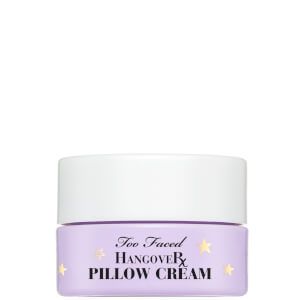
Too Faced Hangover Mini Pillow Cream
Works for
1 of 1 advertised claim delivered
MoisturizingPalmitoyl hexapeptide-12, Petrolatum + 37 moreStrong evidence
“This nourishing night cream acts as a plush pillow for your skin, releasing a host of fortifying ingredients that strive to keep your visage happy, hydrated and healthy-looking.”
This product can help improve hydration of the skin with the two types of ingredients.
The first type is called “humectants”:
these ingredients help attract water.
When humectants are on the surface of the skin, they “pull in” the moisture from the outside environment, or from
within deeper layers of the skin. The following ingredients in this product do the job:
glycerin, hydroxyethyl urea.
This product also contains ingredients called “occlusives”. They help reduce the speed with which our skin loses moisture to the outside environment. These ingredients also help soften the upper layer of the skin, so it feels less tight and nicer to the touch. The following ingredients in this product do the job: cocos nucifera oil, dimethicone.
The following ingredients in this product are especially good for supporting the skin barrier and helping with the hydration level: acetyl hexapeptide-8, palmitoyl hexapeptide-12, petrolatum
Anti-agingNot advertised by the brand · Palmitoyl hexapeptide-12, Acetyl hexapeptide-8 + 4 moreStrong evidence
This product can help reduce and prevent fine lines and wrinkles, improve skin elasticity and firmness because it contains palmitoyl hexapeptide-12.
These ingredients in the product can also be helpful, even though there is less evidence for their effectiveness: acetyl hexapeptide-8.
Keep in mind that it typically takes at least 6 weeks to notice any results because the changes that are needed to improve fine lines and elasticity happen in the deeper layers of the skin. No topical anti-aging product can “erase” wrinkles or fully reverse signs of aging.
ExfoliationNot advertised by the brand · Hydroxyethyl ureaStrong evidence
This product can help exfoliate the skin. In other words, it helps break down the bonds between dead cells on the surface of the skin and speed up the skin turnover. Skin often appears softer and brighter after exfoliation, but overdoing it can result in disrupted skin barrier. The following ingredient is doing the exfoliating job in this product: hydroxyethyl urea.
Can it cause trouble?
Irritancy1 strong irritant: ParfumMedium risk
Comedogenic8 ingredients rated 2 or more on the 0–5 pore-clogging scale8 flagged

User reviews
Be the first — your take helps the next person decide.
Ingredients
Filter by role to see what each ingredient is doing.
Water~45–55%
Dimethicone~5.6–6.8%
- Irritation risk
- Low
A silicone that helps to reduce water loss from the surface of the skin. Can temporarily "fill in" lines and wrinkles, absorb oil, and create a nice product finish
More about DimethiconePetrolatum~4.2–5.2%
- Irritation risk
- Low
One of the most effective and the most studied occlusive ingredients that creates a protective layer on top of the skin preventing moisture loss
More about PetrolatumGlycerin~3–3.7%
- Irritation risk
- Low
One of the best moisturizing ingredients. Naturally present in skin. It attracts water to the upper layer of the skin working as a humectant
More about GlycerinCaprylic/capric/myristic/stearic triglyceride~2.3–2.8%
- Irritation risk
- Low
Helps to soften the upper layer of the skin
More about Caprylic/capric/myristic/stearic triglycerideIsopropyl isostearate~1.9–2.3%
- Irritation risk
- Low
- Comedogenicity
- 3/5
An emollient that helps soften the skin
More about Isopropyl isostearateGlycereth-26~1.6–2%
Butylene glycol~1.4–1.7%
- Irritation risk
- Low
Used to create a nice product texture and help delivery of other ingredients. Might be somewhat helpful in attracting water to the upper layer of the skin
More about Butylene glycolPeg-100 stearate~1.2–1.5%
- Irritation risk
- Low
Helps oil and water mix togehter and creates a nice product texture
More about Peg-100 stearateNiacinamide~0.8–1.2%
- Irritation risk
- Low
Is proven to be effective in reducing blemishes, evening out skin tone and helping to improve lines and wrinkles. It helps the skin to repair sun damage, calm down inflammation and keep maintain good levels of moisture. The concentration of about 2% is effective for supporting the skin barrier and evening out the skin tone. Concentration of 4-6% is better for helping with acne and balancing the sebum production
More about NiacinamideSqualane~0.7–1.05%
- Irritation risk
- Low
An oil naturally present in skin. Works as an emollient to soften the skin and form a protective layer on its surface without a greasy feeling.
More about SqualaneHydroxyethyl urea~0.5–0.75%
- Irritation risk
- Low
A derivative of urea, a compound that is naturally present in skin. Attracts water to the upper layer of the skin. Can enhance penetration of other ingredients
More about Hydroxyethyl ureaOryza sativa bran oil~0.5–0.7%
- Irritation risk
- Low
Helps soften the upper layer of the skin and might have some anti-oxidant properties
More about Oryza sativa bran oilPolysilicone-11~0.45–0.65%
- Irritation risk
- Low
A silicone that forms a light film on the skin surface helping to bind water and temporarily absorb oils creating a matt and powdery feel
More about Polysilicone-11Cetearyl alcohol~0.45–0.65%
- Irritation risk
- Low
- Comedogenicity
- 2/5
A non-drying alcohol. Works as an emollient. Helps water and oil mix together and creates a nice product texture
More about Cetearyl alcoholSodium polyaspartate~0.3–0.6%
- Irritation risk
- Medium
Helps attract water to the upper layer of the skin and can help stabilize the product formulation
More about Sodium polyaspartateMeteorite powder~0.3–0.55%
- Irritation risk
- Low
Lactobacillus ferment~0.25–0.5%
- Irritation risk
- Low
A fermentation product created by bacteria Lactobacillus. The fermented product has anti-bacterial properties and might be helpful in calming down inflammation, but studies are lacking. Helps attract water to the upper layer of the skin. Can be used as a preservative
More about Lactobacillus fermentYogurt powder~0.25–0.5%
- Irritation risk
- Low
Tocopheryl acetate~0.25–0.5%
- Irritation risk
- Medium
A more stable but less bio-available form of vitamin E compared to Tocopherol. Might help moisturize and protect the skin from free radicals, but mostly used in low concentrations to stabilize other ingredients.
More about Tocopheryl acetateSodium hyaluronate~0.25–0.45%
- Irritation risk
- Low
One of the best moisturizing ingredients. Attracts water into the upper layer of the skin
More about Sodium hyaluronateCaffeine~0.25–0.4%
- Irritation risk
- Medium
Might be helpful in neutralizing free radicals. Can have a dehydration effect that might somewhat decrease the look of puffy eyes
More about CaffeineCocos nucifera oil~0.2–0.35%
- Irritation risk
- Low
- Comedogenicity
- 3/5
An emollient. Found to be as effective as a moisturizer for dry skin as mineral oil. Could be comedogenic
More about Cocos nucifera oilCocos nucifera (coconut) liquid endosperm~0.15–0.3%
- Irritation risk
- Low
Cocos nucifera fruit juice~0.2–0.4%
- Irritation risk
- Low
Butyrospermum parkii butter~0.25–0.45%
- Irritation risk
- Low
- Comedogenicity
- 3/5
A great moisturising ingredient that softens the skin and reduces water loss from its upper layer. It also can be helpful in protecting skin from free radicals
More about Butyrospermum parkii butterLaminaria digitata extract~0.2–0.4%
- Irritation risk
- Low
- Comedogenicity
- 3/5
Seaweed extract that helps the skin to attract water and make it more smooth for touch. Also shows promise of anti-aging properties, but good research is lacking at the moment
More about Laminaria digitata extractOlea europaea fruit oil~0.25–0.4%
- Irritation risk
- Medium
An emollient that helps soften the skin but is not effective for restoring its barrier function. Might be helpful to calm down inflammation
More about Olea europaea fruit oilMangifera indica seed butter~0.2–0.4%
- Irritation risk
- Low
Helps to soften the upper layer of the skin and might have some anti-oxidant effect
More about Mangifera indica seed butterPersea gratissima oil~0.25–0.5%
- Irritation risk
- Medium
An emollient that helps soften the skin and could be helpful in repairing its barrier function
More about Persea gratissima oilPunica granatum sterols~0.2–0.4%
- Irritation risk
- Low
Sigesbeckia orientalis extract~0.2–0.35%
- Irritation risk
- Medium
A plant extract that can contain an anti-inflammatory compound
More about Sigesbeckia orientalis extractPorphyridium cruentum extract~0.2–0.4%
- Irritation risk
- Low
- Comedogenicity
- 3/5
A red algae extract. Can help attract water to the upper layer of the skin and might have an antioxidant effect
More about Porphyridium cruentum extractPalmitoyl hexapeptide-12~0.2–0.4%
- Irritation risk
- Low
A type of peptide. Peptides are excellent moisturizers and might be able support collagen production reducing fine lines and wrinkles
More about Palmitoyl hexapeptide-12Acetyl hexapeptide-8~0.2–0.4%
- Irritation risk
- Low
A type of peptide. Peptides are excellent moisturizers and might be able support collagen production reducing fine lines and wrinkles
More about Acetyl hexapeptide-8Linoleic acid~0.3–0.6%
- Irritation risk
- Low
An excellent emollient. Helps soften the skin, restore its barrier function, and can help to calm down inflammation. It can be helpful to prevent blemishes and clogged pores
More about Linoleic acidCaprylic/capric triglyceride~0.25–0.5%
- Irritation risk
- Medium
A good mix of fatty acids that forms a protective layer on the skin. Improves the shelf life of products. Derived from coconut and glycerin
More about Caprylic/capric triglycerideTrehalose~0.2–0.4%
- Irritation risk
- Low
A sugar that attracts water to the upper layer of the skin
More about TrehaloseCetearyl glucoside~0.25–0.45%
- Irritation risk
- Medium
Helps water and oil in the product mix well together and improves product texture
More about Cetearyl glucosideSorbitol~0.2–0.4%
- Irritation risk
- Low
Helps attract water to the upper layer of the skin and improves the product texture
More about SorbitolMyristyl myristate~0.25–0.45%
- Irritation risk
- Medium
- Comedogenicity
- 3/5
An emollient. Is not recommended for acne-prone skin as it can be comedogenic
More about Myristyl myristateIsohexadecane~0.3–0.55%
- Irritation risk
- Low
Improves the texture of the product and helps soften the skin. Helps oil and water mix together and can be used as a cleansing agent
More about IsohexadecaneAluminum hydroxide~0.25–0.45%
- Irritation risk
- Low
Is used to add opaque (non-transparent) appearance to formulations. Can be used to coat other ingredients for even dispersion. This is a different ingredient compared to the ones used in antipersperants (aluminium chloride and aluminium chlorohydrate)
More about Aluminum hydroxideTin oxide~0.3–0.6%
- Irritation risk
- Low
A colorant that can add a pearl-like appearance to the formulation
More about Tin oxideTromethamine~0.2–0.4%
Peg-8~0.2–0.4%
- Irritation risk
- Medium
Used to create a nice product consistency
More about Peg-8Acrylates/c10-30 alkyl acrylate crosspolymer~0.25–0.45%
- Irritation risk
- Medium
Maintains the texture of skincare products. Allows the product to spread evenly. Helps oil and water mix together
More about Acrylates/c10-30 alkyl acrylate crosspolymerPolysorbate 80~0.25–0.45%
Sucrose~0.2–0.35%
- Irritation risk
- Low
Can help attract water to the upper layer of the skin. In crystal form, it can work as a gentle exfoliant, gentler than the salt scrub. Helps stabilize the emulsion
More about SucroseSilica~0.3–0.55%
Glyceryl polymethacrylate~0.25–0.45%
- Irritation risk
- Low
Used to create a nice product texture
More about Glyceryl polymethacrylateAcrylamide/sodium acryloyldimethyltaurate copolymer~0.2–0.4%
- Irritation risk
- Low
Helps water and oil mix together and create gel-like textures
More about Acrylamide/sodium acryloyldimethyltaurate copolymerSynthetic fluorphlogopite~0.25–0.4%
- Irritation risk
- Low
A mineral that is used as an optical filter (makes the skin looks nicer through light reflection) and to improve the texture of cosmetic products
More about Synthetic fluorphlogopiteCaprylyl glycol~0.25–0.45%
- Irritation risk
- Medium
Helps preserve products and creates a nice product texture
More about Caprylyl glycolCitric acid~0.2–0.4%
- Irritation risk
- Medium
Can work as an exfoliant but is typically used to adjust the product pH
More about Citric acidStearic acid~0.3–0.6%
- Irritation risk
- Low
Helps oil and water mix together and works as an emollient
More about Stearic acidGlyceryl stearate~0.25–0.5%
- Irritation risk
- Low
An emollient that softens the skin and forms a protective layer on its surface. Helps water and oil mix together
More about Glyceryl stearateMyristyl alcohol~0.25–0.45%
- Irritation risk
- High
Helps to stabilize the product formulation while softening the upper layer of the skin. Can be irritating
More about Myristyl alcoholHydrogenated vegetable oil~0.25–0.45%
- Irritation risk
- Low
- Comedogenicity
- 2/5
An oil from a mixture of different vegetables. Helps soften the upper layer of the skin
More about Hydrogenated vegetable oilParfum~0.2–0.35%
- Irritation risk
- High
An aromatic blend of unspecified and possibly irritating ingredients
More about ParfumTocopherol~0.2–0.4%
- Irritation risk
- Low
Pure form of vitamin E. Can help moisturise and protect the skin from free radicals. Often used to help stabilise other ingredients or the formula itself
More about TocopherolDisodium edta~0.2–0.35%
Pentaerythrityl tetra-di-t-butyl hydroxyhydrocinnamate~0.2–0.4%
- Irritation risk
- Low
Used to increase stability of product formulations
More about Pentaerythrityl tetra-di-t-butyl hydroxyhydrocinnamateBht~0.15–0.3%
Potassium sorbate~0.15–0.3%
Phenoxyethanol~0.15–0.25%
- Irritation risk
- Low
A preservative. It helps prevent bacterial growth in cosmetic products
More about PhenoxyethanolMica~0.2–0.35%
- Irritation risk
- Low
Creates an illusion of smoother and more radiant skin tone. Adds shimmer to the skin by reflecting light
More about MicaTitanium dioxide~0.15–0.3%
- Irritation risk
- Low
Works as a UV filter when used in high concentrations. It is photostable and is effective mostly against the UVB light, with some protection in the UVA range. In small concentrations, used for its ability to improve the color of cosmetic products. Is usually well tolerated by the skin
More about Titanium dioxideCi 77891~0.1–0.2%
- Irritation risk
- Low
Ci 14700~0.1–0.2%
Ingredient list view
Water, Dimethicone, Petrolatum, Glycerin, Caprylic/capric/myristic/stearic triglyceride, Isopropyl isostearate, Glycereth-26, Butylene glycol, Peg-100 stearate, Niacinamide, Squalane, Hydroxyethyl urea, Oryza sativa bran oil, Polysilicone-11, Cetearyl alcohol, Sodium polyaspartate, Meteorite powder, Lactobacillus ferment, Yogurt powder, Tocopheryl acetate, Sodium hyaluronate, Caffeine, Cocos nucifera oil, Cocos nucifera (coconut) liquid endosperm, Cocos nucifera fruit juice, Butyrospermum parkii butter, Laminaria digitata extract, Olea europaea fruit oil, Mangifera indica seed butter, Persea gratissima oil, Punica granatum sterols, Sigesbeckia orientalis extract, Porphyridium cruentum extract, Palmitoyl hexapeptide-12, Acetyl hexapeptide-8, Linoleic acid, Caprylic/capric triglyceride, Trehalose, Cetearyl glucoside, Sorbitol, Myristyl myristate, Isohexadecane, Aluminum hydroxide, Tin oxide, Tromethamine, Peg-8, Acrylates/c10-30 alkyl acrylate crosspolymer, Polysorbate 80, Sucrose, Silica, Glyceryl polymethacrylate, Acrylamide/sodium acryloyldimethyltaurate copolymer, Synthetic fluorphlogopite, Caprylyl glycol, Citric acid, Stearic acid, Glyceryl stearate, Myristyl alcohol, Hydrogenated vegetable oil, Parfum, Tocopherol, Disodium edta, Pentaerythrityl tetra-di-t-butyl hydroxyhydrocinnamate, Bht, Potassium sorbate, Phenoxyethanol, Mica, Titanium dioxide, Ci 77891, Ci 14700
Compare prices
Retailers ranked by price — lowest first.

Affiliate links · prices updated regularly
Worth comparing, line by line.
Match % combines shared ingredients, the first five ingredients, shared actives and hero ingredients, irritancy (lower counts in the alternative's favour), texture and body area. Only products in the same routine step are compared.
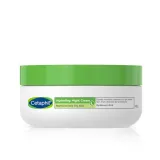
| Too FacedHangover Mini Pillow CreamYOUR PRODUCT | CetaphilHydrating Night Cream | QVDermcare Eczema Daily Cream With Ceramides | EyenlipSalmon Oil Revitalizing Cream | |
|---|---|---|---|---|
| Match | — | 76% | 75% | 73% |
| Price | $20.05 | $1.32−$18.73 | — | $16.52−$3.53 |
| Shared key ingredients | — | 5 of 24 | 4 of 24 | 7 of 24 |
| Key difference | — | Panthenol | Lactic Acid | Hexapeptide-9 |
| Irritancy | Medium | Low | Low | Medium |
| Drying alcohol | — | — | — | — |
| View product | Shop | Shop | Shop |


Product summary
Based on the ingredients included, "Too Faced - Hangover Mini Pillow Cream" works well for moisturizing the skin. To work well, any moisturizer needs to include a combination of water-binding and emollient ingredients. Too Faced - Hangover Mini Pillow Cream ticks this box. Acetyl hexapeptide-8, glycerin, hydroxyethyl urea, lactobacillus ferment and sodium hyaluronate in this product (humectants) attract water molecules to the upper layer of the skin (the water comes from the outside air or from the deeper layers of the skin if the air is dry). Emollients in this formulation (petrolatum, oryza sativa bran oil, cocos nucifera oil, dimethicone and squalane) help to reduce the moisture loss from the skin. They also soften the skin surface and relieve the feeling of dryness and tightness.
Ingredient callouts
- This moistruizer also contains peptides (palmitoyl hexapeptide-12 0.20% - 0.40% and acetyl hexapeptide-8 0.20% - 0.40%). Peptides is a very big group of ingredients. They all consist of a different combination of amino-acids. Our skin produces peptides naturally. Some of them work as natural anti-biotics, promote wound-healing and production of collagen. The scientists are still studying how effective the topical application of peptides is, but it is very likely that peptides in skincare are helpful. They might be able to support skin barrier restoration and even have an anti-aging benefit. At the very least, they certainly help attract water to the skin and support the hydration in this way.
Irritation risk
There are some common irritants in this product, including ingredients that do not have benefits for the skin. We assess the overall irritancy of this moisturizer to be medium. For a detailed overview of all potential irritants: click here
You can see the detailed formula review with the breakdown of all actives in the product and the full ingredient list with estimated concentrations in the tables below.
About the brand
According to Cruelty-Free Kitty "Too Faced" is cruelty free, but its parent company is not.
Price
The product retails for 15.00£ in the United Kingdom.
For a detailed price comparison: click here.
Sources cited in this review
Every concentration estimate and effectiveness label is anchored to one of these 31 studies and safety reviews.
- 1
- 2Final Report on the Safety Assessment of Dimethicone Copolyoljournals.sagepub.com
- 3
- 4
- 5
- 6

Affiliate links · As an Amazon Associate, WIMJ earns from qualifying purchases.